
AI model analysis
Claude Opus 5 High vs Gemini 1.5 Pro: Which Model Should Developers Choose?
A developer-focused comparison of Claude Opus 5 High and Gemini 1.5 Pro, covering coding performance, operational availability, pricing, latency, and migration risk.
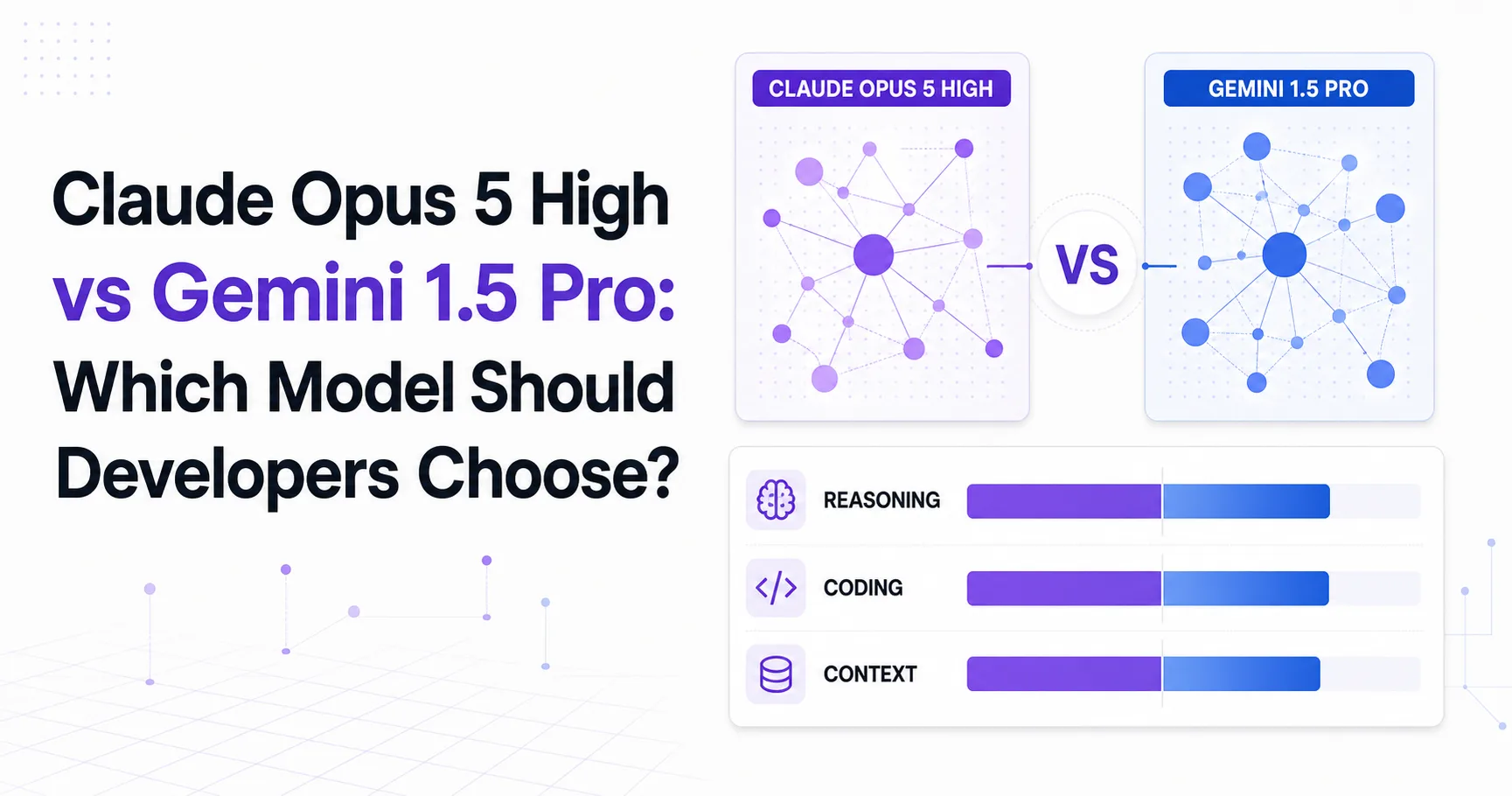
- **Winner overall:** Claude Opus 5 (Adaptive Reasoning, High Effort), with a 76.5 coding index and 58.9 intelligence index - **Cheaper:** Claude Opus 5 (Adaptive Reasoning, High Effort) at $10 vs $15 per 1M blended tokens - **Faster:** Claude Opus 5 (Adaptive Reasoning, High Effort) at 54.599 median output tokens per second, while Gemini 1.5 Pro has no comparable value - **Pick Claude Opus 5 when:** You need a currently available model for complex coding, agent workflows, or enterprise automation - **Watch out:** Gemini 1.5 Pro's current endpoint, pricing, and version status are not clearly maintained in Google's active documentation
Claude Opus 5 High vs Gemini 1.5 Pro
Claude Opus 5 (Adaptive Reasoning, High Effort) is the safer choice for a new developer project because it combines stronger measured capability with an active, documented product position. The data snapshot gives Claude Opus 5 a coding index of 76.5 and an intelligence index of 58.9, while Gemini 1.5 Pro records 23.6 and 10 respectively. Claude Opus 5 is also listed as available in Anthropic’s current model overview, while Google’s current model documentation does not show an active entry for Gemini 1.5 Pro. Anthropic’s announcement describes Claude Opus 5 as a model for complex agentic coding and enterprise work. Google’s model documentation does not provide an active endpoint or current parameter page for the specific Gemini 1.5 Pro Sep '24 version.
Executive summary for developers
Claude Opus 5 (Adaptive Reasoning, High Effort) wins this comparison on capability, availability, and listed blended-token cost. The Artificial Analysis snapshot reports a coding index of 76.5 for Claude Opus 5 versus 23.6 for Gemini 1.5 Pro, and an intelligence index of 58.9 versus 10. The Claude model overview presents Claude Opus 5 as an available model with text and image input, text output, multilingual support, and visual understanding. Google’s Gemini API model page currently does not preserve an active model card for Gemini 1.5 Pro Sep '24.
That difference changes the engineering decision. Claude Opus 5 can be evaluated as a live API dependency with documented identifiers, platform availability, and current operating guidance. Gemini 1.5 Pro may still appear in older code, examples, or internal systems, but the supplied evidence does not establish that a new project can call it reliably today. Google has not provided a clear retirement date for this exact version in the cited materials, so the correct conclusion is uncertainty rather than a confirmed shutdown.
The comparison is less complete on user experience. Claude Opus 5 has a median output speed of 54.599 tokens per second in the data snapshot, while Gemini 1.5 Pro has no comparable value. Both models show latency of 0.3 seconds in that snapshot. That makes Claude the measurable performance choice, but it does not prove that every production workload will feel faster. The available Gemini evidence lacks enough version-specific testing to support a stronger claim.
Performance: what the measured gap means in practice
Claude Opus 5 (Adaptive Reasoning, High Effort) offers the stronger evidence for coding and complex reasoning workloads, but its reasoning behavior can increase operational overhead. The data snapshot reports a coding index of 76.5 for Claude Opus 5 and 23.6 for Gemini 1.5 Pro. The intelligence index shows the same direction, at 58.9 for Claude Opus 5 and 10 for Gemini 1.5 Pro. Those results suggest a meaningful difference for repository-level coding, multi-step debugging, planning, and tasks where the model must maintain a coherent strategy across several tool calls.
The practical implication is not that Claude will solve every coding task correctly. It is that Claude has substantially stronger evidence for the work developers usually find expensive to supervise. A higher coding result can reduce review effort when the task requires architectural judgment, broad file changes, or sustained debugging. It can also produce more value in agent workflows where a failed intermediate decision causes later steps to compound the error.
Claude’s documented adaptive thinking changes how teams should interpret speed. The thinking documentation explains that thinking contributes to the output limit and can affect request behavior. The Opus 5 update notes warn that default thinking can increase latency and cost for long tasks. The community has also reported verbosity, over-analysis, and large autonomous edits, although the r/ClaudeAI discussion has no standardized test method. Treat those reports as workflow risks, not measured failure rates.
Claude has a measured median output speed of 54.599 tokens per second. Gemini 1.5 Pro has no comparable speed value in the supplied snapshot, so a speed ranking is not possible. Both models have latency of 0.3 seconds in the dataset, but equal latency does not imply equal time to a useful answer. Claude may spend more work inside reasoning, while Gemini’s current version-specific behavior is not documented well enough to model.
Cost: why the cheaper model is not automatically the lower-cost system
Claude Opus 5 (Adaptive Reasoning, High Effort) is cheaper on every listed token price, but its reasoning-heavy behavior can still make workload cost depend on request design. The snapshot lists a blended price of $10 per 1M tokens for Claude Opus 5 and $15 for Gemini 1.5 Pro. It lists input prices of $5 and $10, and output prices of $25 and $30. The chart below this section should be used for the exact price comparison.
The important question is how many calls are required to reach an accepted result. If Claude’s higher measured coding capability reduces retries, manual correction, or tool-loop failures, the lower blended price understates its economic advantage. If a workload sends many simple prompts with unnecessarily high reasoning effort, the same model can consume more output and take longer than the task requires. Anthropic’s effort guidance describes effort as a behavior signal rather than a strict token budget. Teams that need a hard ceiling should use an explicit output limit and monitor actual usage.
Caching can also change the calculation. Anthropic’s pricing page documents separate cache-write and cache-hit prices, so applications with long repeated instructions should model cache behavior instead of relying only on blended pricing. The supplied Google pricing evidence does not list a current price for Gemini 1.5 Pro. Google’s pricing page therefore cannot support a current production cost estimate for that exact version.
That missing Gemini price is more than a billing inconvenience. A model without a confirmed endpoint and price cannot be included confidently in a new system’s cost forecast. It may be attractive in an existing environment with historical access, but the evidence is insufficient to claim that it is cheaper, available, or economically stable for new deployments.
Recommendation by developer scenario
Claude Opus 5 (Adaptive Reasoning, High Effort) should be the default selection for new developer-facing systems that need a dependable current model. Its measured coding index of 76.5, intelligence index of 58.9, documented model identity, and current availability form a stronger decision package than Gemini 1.5 Pro’s historical feature profile.
Choose Claude Opus 5 for repository-scale coding, autonomous implementation, multi-step debugging, enterprise automation, and workflows that need image-aware reasoning alongside text. Anthropic’s official announcement specifically positions the model around complex agentic coding and enterprise work. Its documented support across the Claude API, Amazon Bedrock, Google Cloud, and Microsoft Foundry also gives teams more deployment options, according to the model overview.
Use Claude with explicit operating controls. Set effort according to task difficulty, constrain output where cost matters, require approval before broad file changes, and keep tool handling in the supported thinking configuration. Anthropic’s thinking guidance says forced tool use requires adaptive thinking and warns about incompatible sampling settings. Anthropic also documents mid-conversation tool changes and server-side fallbacks in the Opus 5 update notes.
Consider Gemini 1.5 Pro only when an existing system already depends on it and can verify access in its own account. Do not select it for a new build based solely on its historical long-context reputation. Google’s current documentation does not confirm the specific version’s active endpoint, current parameters, or price. The evidence is insufficient to establish whether migration can be avoided, so teams should run an authenticated availability check and a representative regression suite before committing to continued use.
Claude Opus 5 still needs a resilience plan. The Claude status incident records an elevated-errors event affecting Claude Opus 5 services. That event does not negate the model’s current availability, but it supports normal production precautions such as retries, timeouts, observability, and a fallback model.
Before you choose
Claude Opus 5 (Adaptive Reasoning, High Effort) has enough current evidence for a primary recommendation, while Gemini 1.5 Pro requires version-specific verification before adoption. The strongest evidence is asymmetric: Claude has current product documentation, pricing, operating guidance, and a measured performance snapshot. Gemini has historical positioning but no current active model card or price for the exact Sep '24 version in the supplied sources.
The comparison therefore answers two different questions. For a new project, Claude is the practical choice. For an existing Gemini integration, the key question is not whether Gemini was once capable, but whether the exact endpoint still works, what it costs, and whether its behavior remains stable enough for the application’s tests. The supplied research does not answer those questions. A developer should verify them directly before planning a migration, rollback, or long-term support commitment.
Frequently asked questions
Which model should developers choose for a new coding product?
Developers should choose Claude Opus 5 for a new coding product because it has current availability, documented API behavior, a 76.5 coding index, and a lower listed blended-token price than Gemini 1.5 Pro.
Is Gemini 1.5 Pro cheaper than Claude Opus 5?
No, the supplied data lists Gemini 1.5 Pro at $15 per 1M blended tokens and Claude Opus 5 at $10, while Google’s current pricing page does not confirm a live price for this exact version.
Does Claude Opus 5 respond faster than Gemini 1.5 Pro?
Claude Opus 5 has a measured median output speed of 54.599 tokens per second, but Gemini 1.5 Pro has no comparable value, so the evidence cannot prove a complete speed ranking.
Should an existing Gemini 1.5 Pro integration be migrated immediately?
Teams should first verify the authenticated endpoint, billing behavior, and regression results because the supplied evidence does not provide a retirement date, active endpoint, or current price for Gemini 1.5 Pro.
What is the main production risk with Claude Opus 5?
The main risk is reasoning overhead and autonomous behavior: thinking can increase latency and cost, while community reports describe verbosity and broad edits, although no standardized public failure rate is available.
Sources
- Introducing Claude Opus 5Claude Opus 5 positioning, agentic coding focus, enterprise use, and official capability claims.
- Models overviewCurrent availability, supported modalities, deployment platforms, model identity, and operating characteristics.
- What's new in Claude Opus 5Adaptive thinking behavior, tool changes, fallbacks, migration constraints, and operational risks.
- ThinkingThinking behavior, tool calling requirements, output limits, and configuration constraints.
- EffortEffort semantics and the distinction between behavioral control and strict token budgeting.
- Anthropic PricingClaude Opus 5 token pricing and prompt caching considerations.
- Model IDs and versioningStable model identifiers and versioning context.
- Is Opus 5 actually that bad, or is it just Reddit hype?Unstandardized developer reports about verbosity, speed, over-analysis, and autonomous edits.
- Gemini API model documentationCurrent Gemini model directory status and missing active documentation for Gemini 1.5 Pro Sep '24.
- Gemini API pricingAbsence of a current listed price for Gemini 1.5 Pro Sep '24.
- Elevated errors on Claude Opus 5Evidence of a recorded Claude Opus 5 service incident and the need for production resilience.
Published: