
AI model analysis
Claude Opus 5 (High) vs GPT-5.6 Sol (max): Which Model Should Developers Choose?
A developer-focused comparison of coding quality, throughput, cost, reasoning controls, integrations, and production risks.
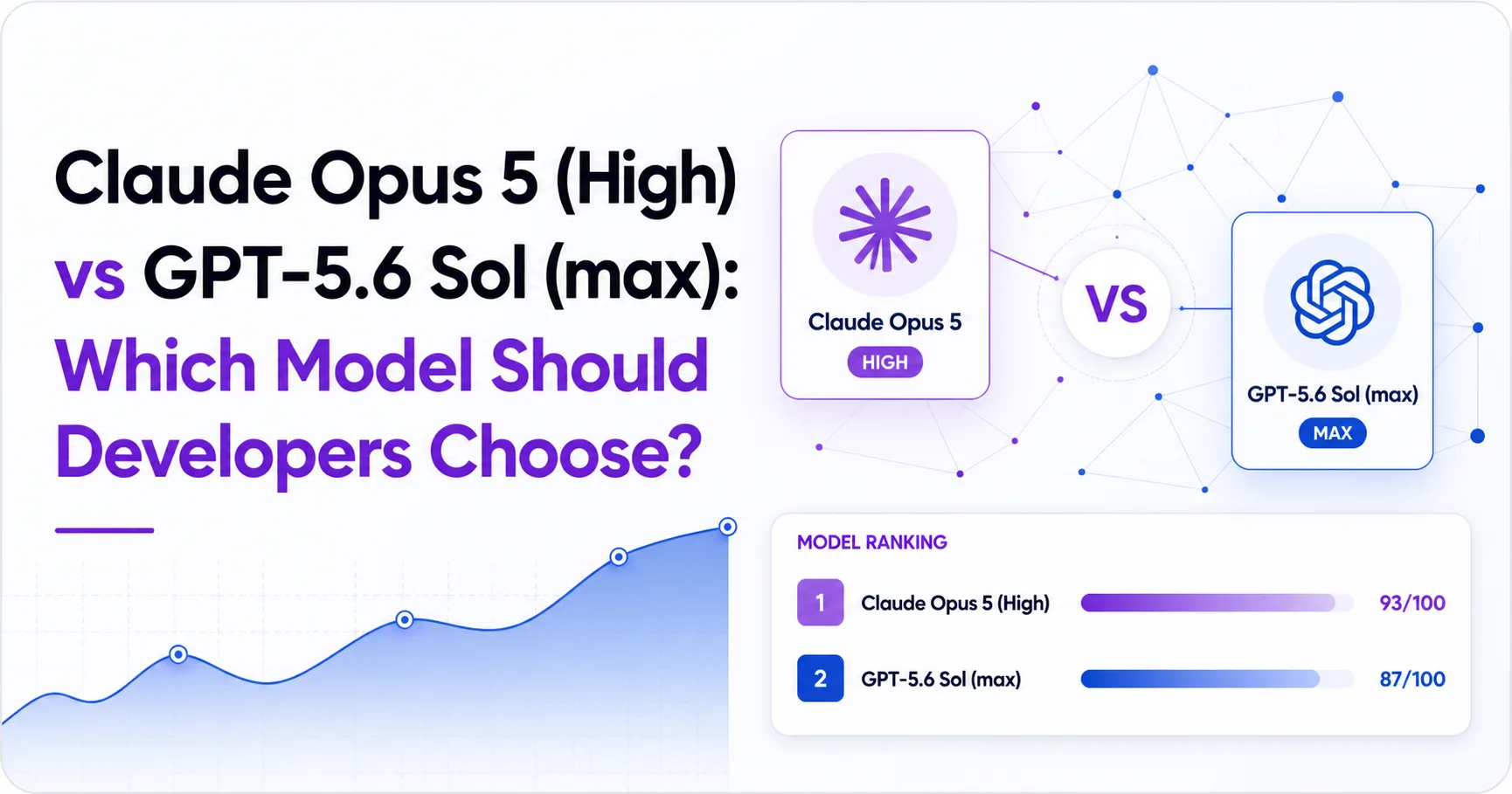
- **Winner overall:** GPT-5.6 Sol (max), 77.4 coding index vs 76.5 and 77.617 median output tokens per second vs 54.599 - **Cheaper:** Claude Opus 5 at $10 vs $11.25 per 1M blended tokens - **Faster:** GPT-5.6 Sol (max) at 77.617 median output tokens per second - **Pick Claude Opus 5 when:** your workload is output-heavy, because output is $25 vs $30 per 1M tokens - **Watch out:** intelligence is tied at 58.9, while coding is 76.5 vs 77.4, so no universal winner is proven
Claude Opus 5 vs GPT-5.6 Sol: The Short Answer
GPT-5.6 Sol (max) is the stronger default for developers who value coding results and interactive throughput, while Claude Opus 5 is the lower-cost choice for output-heavy work.
The supplied Artificial Analysis snapshot gives GPT-5.6 Sol (max) a coding index of 77.4 versus Claude Opus 5 at 76.5, ties them at 58.9 on the intelligence index, and reports 77.617 versus 54.599 median output tokens per second. Data provided by https://artificialanalysis.ai/ (Artificial Analysis).
That combination supports GPT as the default for coding agents that stream substantial results to a developer. Claude remains the rational choice when generated output dominates the bill, because its blended price is $10 versus $11.25 per 1M tokens and its output price is $25 versus $30.
The verdict is narrow rather than universal. The data snapshot shows an intelligence tie and a small coding separation, while neither vendor supplies a controlled, same-task comparison in the supplied releases.
Anthropic describes Opus 5 as a leading model across a broad frontier of tasks, and OpenAI presents Sol as a flagship for reasoning, programming, and professional work. Those claims establish positioning, not a shared acceptance test. Read Anthropic’s release alongside OpenAI’s release before treating either vendor’s benchmark language as a direct comparison.
Summary: A Close Quality Split With Different Operating Profiles
GPT-5.6 Sol (max) wins the narrow overall comparison, while Claude Opus 5 wins blended price and ties intelligence.
| Decision signal | Claude Opus 5 | GPT-5.6 Sol | Practical reading |
|---|---|---|---|
| Coding index | 76.5 | 77.4 | GPT has the measured edge |
| Intelligence index | 58.9 | 58.9 | Tie |
| Median output speed | 54.599 | 77.617 | GPT streams faster |
| Reported latency | 0.3 | 0.3 | Tie in the supplied snapshot |
| Blended price per 1M tokens | $10 | $11.25 | Claude costs less |
| Input price per 1M tokens | $5 | $5 | Tie |
| Output price per 1M tokens | $25 | $30 | Claude costs less |
The table shows a practical split: GPT leads the measured coding and output-speed rows, Claude leads blended and output cost, and intelligence and reported latency are tied. A developer should treat the split as a workload decision, not a universal ranking. The underlying comparison comes from Artificial Analysis.
Official documentation reinforces that the two products target similar high-end work but expose different control surfaces. Claude’s model overview lists text and image input, text output, multilingual capability, vision, and multiple cloud routes. OpenAI’s model directory and GPT-5.6 Sol model page describe text and image input, Responses API, Chat Completions, structured outputs, function calling, and a broad tool surface.
Modality boundaries can decide the choice before benchmark scores matter. GPT’s official model page excludes audio and video input. Claude’s official overview emphasizes text and image input, multilingual work, and visual understanding. Neither model’s supplied material establishes a universal advantage for every multimodal application.
Lifecycle evidence is also close. The supplied documentation lists both models as available without a deprecation signal. Claude uses claude-opus-5 as its API ID and stable alias, while the page slug claude-opus-5-high represents a comparison configuration, not the official API ID. GPT uses gpt-5.6-sol for the model and gpt-5.6 as its stable alias. See Claude’s versioning guide and the GPT-5.6 Sol documentation.
Finally, high and max are not calibrated across vendors. Claude’s high effort setting and adaptive thinking, and GPT’s max reasoning effort, describe different internal policies. No supplied source proves that the selected settings spend equivalent reasoning work. The relevant controls are documented in Claude’s effort guide and OpenAI’s reasoning guide.
Performance: Throughput Helps, But Completion Time Remains Unproven
GPT-5.6 Sol (max) has the practical throughput edge, but the available data does not prove a consistent end-to-end completion-time advantage.
GPT’s reported median output speed of 77.617 tokens per second versus Claude’s 54.599 gives a meaningful advantage in interactive streaming. The advantage matters when a developer watches patches, uses iterative tool calls, or waits for long generated artifacts. It matters less when an application needs only a final structured result after background work. These figures come from the Artificial Analysis snapshot.
Equal reported latency of 0.3 does not settle time to a useful answer. A latency chart cannot tell whether a model spent more time reasoning before emitting, whether it made extra tool calls, or whether its first answer required more repair. A faster visible stream can still produce a slower workflow if the output needs more review or correction.
Claude’s adaptive thinking is enabled by default, and Anthropic says effort controls behavior rather than acting as a strict token budget. The Claude effort documentation and thinking documentation describe why lower effort does not guarantee a fixed amount of reasoning. OpenAI likewise warns in its reasoning guide that higher effort increases reasoning tokens, delay, and cost, and recommends validating the benefit with evaluations.
That makes the configured pair especially important. Claude Opus 5 (High) is not a transparent equivalent of GPT-5.6 Sol (max). A high setting may still think extensively on a difficult task, while max explicitly asks GPT to spend more effort. The chart compares observed runs, not a universal speed law.
Community reports point in the same broad direction on risk but diverge on severity. Claude users describe long answers, overthinking simple requests, and unapproved broad changes, while other users prefer giving it a clear target and leaving it to work in the Claude Reddit discussion. The Claude Hacker News discussion adds a visually ambitious reconstruction case, but that case originated from the official announcement. GPT users describe over-designed code and searches that drift from the task in Reddit feedback and Hacker News feedback.
Those reports are useful for designing guardrails, not for predicting success rates. The supplied material contains no reliable independent test with a shared task set, measured completion time, or reproducible coding success rate.
Cost: Claude Leads the Chart, Yet Reasoning Can Change the Bill
Claude Opus 5 is the cheaper default for output-heavy traffic, but workload shape and reasoning behavior can reverse the operational bill.
For the supplied blended-token measure, Claude is priced at $10 per 1M tokens versus GPT at $11.25. The causal point is output: Claude charges $25 per 1M output tokens while GPT charges $30. Output-heavy agent loops, verbose explanations, and long tool transcripts therefore favor Claude before quality adjustments. The comparison comes from Artificial Analysis.
Input price is tied at $5, so Claude’s advantage does not come from reading context. A pipeline that reads large repositories but emits little text may see much smaller savings than the blended chart suggests. A pipeline that repeatedly emits plans, patches, or tool arguments can see larger savings, provided it does not need retries.
Hidden reasoning makes nominal output prices less intuitive. Anthropic says thinking and final text share the max_tokens limit in its thinking documentation. OpenAI says hidden reasoning tokens occupy the context window and are billed as output in its reasoning documentation. Higher effort can therefore make a cheaper per-token model expensive in practice if it thinks longer or needs more calls.
Pricing modes create further conditions. Claude documents prompt caching and a Fast mode research preview in its Opus 5 update notes, while its pricing page describes the standard API and caching options. OpenAI documents Standard, Batch, Flex, and Fast mode in its API pricing guide. A production bill therefore depends on cache reuse, service tier, batch eligibility, and latency requirements, not only the displayed blended price.
GPT’s model page also warns that very large inputs can move a request into higher pricing treatment. Claude’s documentation warns that long thinking can require streaming or batch handling. A long-context workload can therefore reverse the apparent winner through retries, timeouts, or operational complexity before model quality is considered.
No supplied data quantifies those effects for a common workload. Developers should measure billable input, visible output, hidden reasoning, cache behavior, retries, and tool calls on representative tasks before declaring a production cost winner.
Recommendation: Match the Model to the Workflow
GPT-5.6 Sol (max) fits tool-rich coding products, while Claude Opus 5 fits cost-sensitive autonomous work with strong scope controls.
Choose GPT when the product’s main risk is slow feedback during coding or investigation. Its measured coding index is 77.4 versus Claude’s 76.5, and its median output speed is 77.617 versus 54.599. Those are the clearest observed advantages in the data snapshot. They matter most for interactive coding agents, repository exploration, and workflows where developers review streamed changes continuously.
GPT is also the better fit when the application wants OpenAI’s Responses API tool ecosystem. The GPT-5.6 Sol model page documents structured outputs, function calling, web search, file search, code execution, computer use, MCP, and tool search. The reasoning guide explains how reasoning effort can be tuned rather than locked to max for every request.
Choose Claude when output volume is the dominant cost driver, or when deployment must reach Anthropic’s API, Amazon Bedrock, Google Cloud, or Microsoft Foundry. Claude’s official model overview documents those routes. Its adaptive thinking model can suit clearly scoped autonomous jobs, but community reports make explicit scope, approval gates, and diff review important. The community evidence comes from the Claude Reddit thread.
For strict tool protocols, keep Claude thinking enabled unless tests prove otherwise. Anthropic documents a failure mode where disabled thinking can put tool calls in normal text or expose internal XML tags in the Opus 5 update notes. For GPT, treat max as an expensive operating mode and test lower effort settings on representative tasks before making it the default. A Hacker News report describes better subjective behavior after lowering reasoning effort, but that report is not a controlled evaluation.
Do not treat the site comparison slug as a deployable API name. Use Claude’s official claude-opus-5 ID, and use GPT’s gpt-5.6-sol or its documented stable alias gpt-5.6, after confirming the target platform. Claude’s identifier rules are covered in the model ID guide.
Both models remain listed as available in the supplied current documentation, so lifecycle status does not decide the choice. Anthropic’s status page records an Opus 5 elevated-errors incident, which is a reason to measure provider reliability and fallback behavior, not proof of a lasting availability gap.
FAQ: What the Available Evidence Does Not Answer
Claude Opus 5 and GPT-5.6 Sol answer different parts of the selection question, and the supplied evidence leaves several production variables unresolved.
Artificial Analysis provides a compact head-to-head view, but the snapshot does not expose task-level examples, confidence intervals, reasoning-token distributions, cache hit rates, or retry costs. The tie at 58.9 means the general intelligence index cannot choose between them.
Vendor benchmark pages are also asymmetric. Anthropic claims leadership across a broad set of evaluations without showing every raw score in its official announcement, while OpenAI publishes scores from its own benchmark portfolio in its GPT-5.6 announcement. The announcements are useful for understanding intended strengths, but they cannot substitute for a shared evaluation.
Community posts add failure patterns, not population estimates. Both models attract reports of overthinking, scope drift, and excess code, yet the methods are informal and the conclusions conflict. Treat those posts as hypotheses for your pilot.
For a final decision, run the same repository tasks, tool permissions, acceptance tests, and output limits through both configurations. Record useful-result time, repair count, output volume, and billable tokens, then choose the model that wins your actual workflow. Those measurements are not present in the supplied evidence, so this comparison cannot name a universal winner.
Frequently asked questions
Which model is the better default for coding agents?
GPT-5.6 Sol (max) is the better default for coding agents when measured coding performance and interactive output speed matter more than output cost. The supplied snapshot reports 77.4 coding versus 76.5 and 77.617 median output tokens per second versus 54.599. See Artificial Analysis for the comparison data.
Which model is cheaper for production?
Claude Opus 5 is cheaper for output-heavy production because its blended price is $10 versus GPT-5.6 Sol at $11.25 per 1M tokens, with output priced at $25 versus $30. Actual bills can change with reasoning, caching, retries, and service tier choices. See Artificial Analysis and the Anthropic pricing documentation.
Are Claude High and GPT max equivalent reasoning budgets?
Claude Opus 5 High and GPT-5.6 Sol max are not equivalent reasoning budgets because Anthropic’s effort control and OpenAI’s reasoning effort expose vendor-specific behavior. No supplied source calibrates the settings or proves equivalent hidden reasoning work. Compare them with your own task set using Claude’s effort guide and OpenAI’s reasoning guide.
Should developers trust community reports about overthinking?
Developers should use community reports as guardrail ideas rather than stable performance evidence, because the cited Reddit and Hacker News posts lack shared tasks, reproducible measurements, and consistent conclusions. The reports are still useful for testing scope limits, approval gates, output constraints, and reasoning settings in a controlled pilot. Relevant discussions include Claude users and GPT users.
Does the comparison prove which model is faster end to end?
The comparison proves a median output-speed advantage for GPT-5.6 Sol (max), not a universal end-to-end advantage, because both report 0.3 latency and the evidence lacks standardized completion-time testing. Tool calls, reasoning duration, repair work, and developer review can change the practical result. See the Artificial Analysis snapshot and OpenAI’s reasoning guidance.
Which API names should developers use?
Use claude-opus-5 for Claude and gpt-5.6-sol for GPT, because the Claude comparison slug is not its official API ID and OpenAI documents gpt-5.6 as a stable alias. Confirm platform-specific identifiers before deployment. See Claude’s model ID guide and the GPT-5.6 Sol model page.
Sources
- Artificial AnalysisHead-to-head coding, intelligence, speed, latency, and pricing snapshot.
- Introducing Claude Opus 5Anthropic positioning and official benchmark claims.
- Models overviewClaude capabilities, platforms, availability, and model positioning.
- What’s new in Claude Opus 5Adaptive thinking, tool behavior, beta features, and operational limitations.
- Anthropic PricingClaude pricing modes, prompt caching, and service options.
- Model IDs and versioningClaude API ID, stable alias, and version semantics.
- EffortClaude effort behavior and token-budget caveats.
- ThinkingClaude thinking limits, tool behavior, streaming, and output accounting.
- Is Opus 5 actually that bad, or is it just Reddit hype?Anecdotal Claude coding feedback and conflicting user experiences.
- Claude Opus 5Community discussion of a visually complex Claude task and evidence limitations.
- Elevated errors on Claude Opus 5Historical Claude service incident and reliability context.
- OpenAI ModelsGPT model directory, positioning, and availability.
- GPT-5.6 SolGPT capabilities, APIs, model ID, stable alias, modality limits, and pricing behavior.
- Reasoning modelsGPT reasoning effort, hidden reasoning tokens, latency, and cost behavior.
- OpenAI API PricingOpenAI Standard, Batch, Flex, and Fast mode pricing options.
- GPT-5.6: Frontier intelligence that scales with your ambitionOpenAI positioning and official benchmark claims.
- I spent two weeks testing GPT-5.6. Here’s what I found.Anecdotal GPT coding, token consumption, and over-design feedback.
- Ask HN: How are you productive with GPT 5.6 Sol?Anecdotal GPT investigation feedback and reasoning-effort observations.
Published: