
AI model analysis
Claude Opus 5 vs GPT-5 nano: Which Model Should Developers Choose?
A developer-focused comparison of Claude Opus 5 and GPT-5 nano across intelligence, coding evidence, speed, cost, reliability, and model availability.
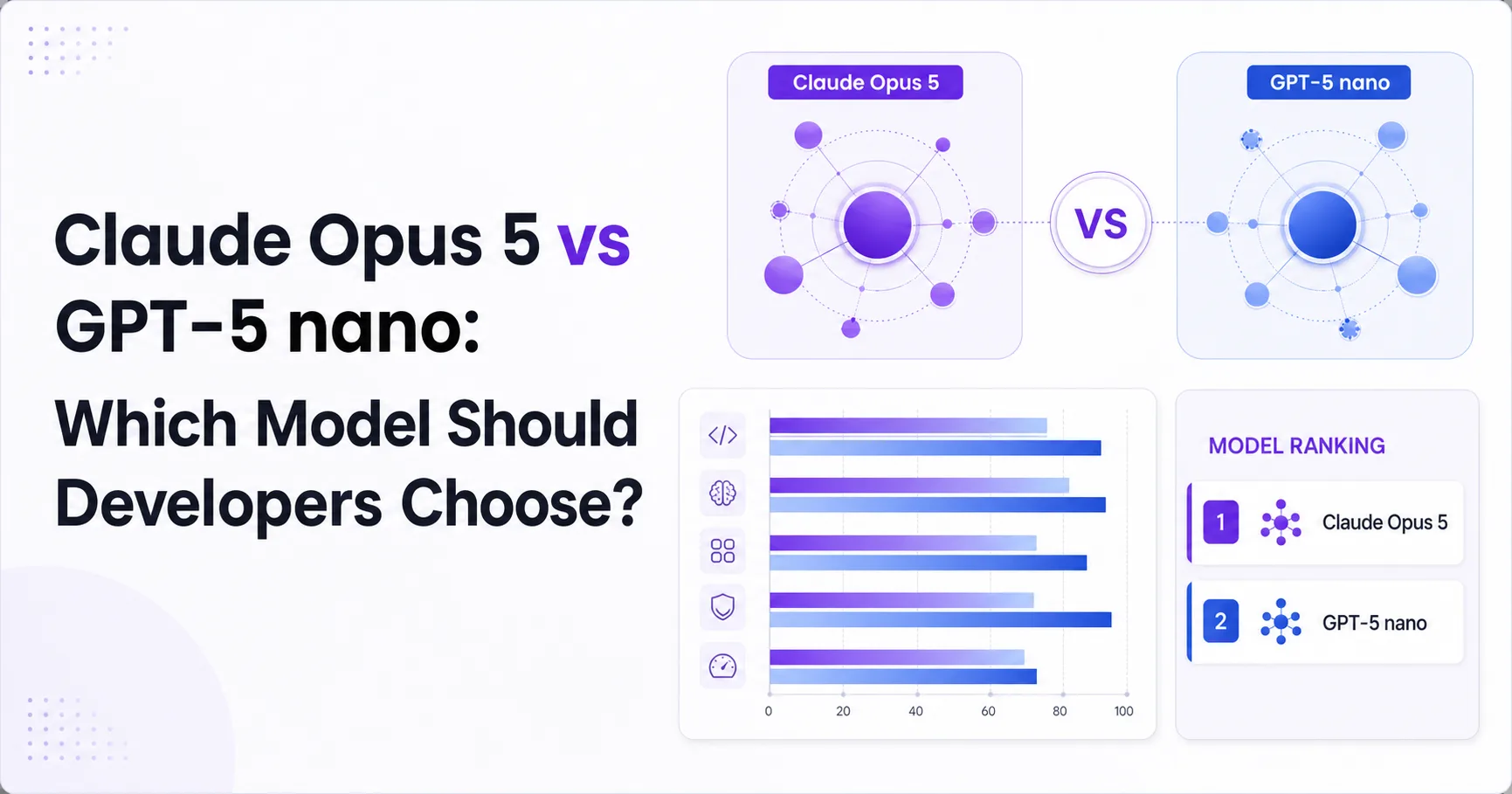
- **Winner overall:** Claude Opus 5, with an Artificial Analysis Intelligence Index of 58.9 vs 19.9 - **Cheaper:** GPT-5 nano at $0.1375 vs $10 per 1M blended tokens - **Faster:** Claude Opus 5 at 54.599 median output tokens per second - **Pick Claude Opus 5 when:** the task requires complex agentic coding, long-horizon execution, or broad reasoning quality - **Watch out:** GPT-5 nano has a stronger Math Index at 83.7, but its current official model status, limits, and coding evidence are unavailable
Claude Opus 5 vs GPT-5 nano
Claude Opus 5 is the safer choice for demanding development work, while GPT-5 nano is the lower-cost option with major evidence gaps. The available Artificial Analysis snapshot gives Claude Opus 5 an Intelligence Index of 58.9, compared with 19.9 for GPT-5 nano, a difference of 39 points. GPT-5 nano is dramatically cheaper at $0.1375 per 1M blended tokens, compared with $10 for Claude Opus 5. The price gap makes the models serve different buying decisions rather than compete as direct substitutes.\n\nClaude Opus 5 is an available Anthropic model released on 2026-07-24, according to the Anthropic release announcement and model overview. The current OpenAI model directory does not list GPT-5 nano, so its present API status, limits, and stable identifier cannot be confirmed from the OpenAI Models documentation.\n\nData provided by https://artificialanalysis.ai/.
Executive summary for developers
Claude Opus 5 offers the stronger documented general-purpose profile, while GPT-5 nano offers the stronger documented price proposition. Claude Opus 5 leads the available Intelligence Index comparison, and its official positioning targets complex agentic coding and enterprise work. Anthropic documents text and image input, text output, multilingual capability, visual understanding, and availability across several infrastructure providers in its model overview.\n\nGPT-5 nano cannot be evaluated with the same confidence because the current OpenAI directory does not list the model. OpenAI’s current documentation describes capabilities for the latest models, but does not explicitly establish that those statements apply to GPT-5 nano. The OpenAI Models page also does not confirm its context window, maximum output, supported parameters, or current availability.\n\nThe data does reveal one important split. Claude Opus 5 records a Coding Index of 76.5, but GPT-5 nano has no corresponding Coding Index in the supplied snapshot. GPT-5 nano records a Math Index of 83.7, but Claude Opus 5 has no corresponding Math Index. Neither missing comparison should be treated as a win. Developers should therefore interpret this as a documented general-intelligence advantage for Claude, a documented mathematical signal for GPT-5 nano, and an incomplete head-to-head benchmark record.\n\nCommunity evidence does not close the gap. A Reddit discussion reports verbosity, slow-feeling responses, overthinking, and overly broad autonomous changes, but the thread has no standardized reproducible test. A Hacker News discussion includes a technical reconstruction example, yet the case originated from Anthropic’s own announcement and is not an independent replication.
Performance: capability matters more than raw speed
Claude Opus 5 is the better-supported performance choice for complex software tasks, but the evidence does not establish a complete speed or coding-success comparison. Its Artificial Analysis Coding Index is 76.5, and its Intelligence Index is 58.9. Those values suggest a model intended for multi-step reasoning, code generation, and autonomous task completion, but they do not prove success on a specific repository or workflow. The Anthropic announcement claims leading results across several evaluations, while also leaving some original benchmark values outside the announcement’s prose.\n\nClaude Opus 5 has a median output speed of 54.599 tokens per second and a latency value of 0.3 seconds in the supplied data. GPT-5 nano has no reported median output speed, so developers cannot conclude that its lower price also brings lower or higher perceived latency. Both models show 0.3 seconds for the supplied latency metric, but equal initial latency does not mean equal time to a useful answer. Thinking depth, output length, tool use, retries, and validation work can dominate an interactive coding workflow.\n\nClaude’s default adaptive thinking is a meaningful operational difference. Anthropic explains that thinking consumes the output limit and can increase latency and cost in long tasks in its Opus 5 update notes and thinking documentation. The same documentation warns that disabling thinking can cause malformed tool behavior or internal XML labels. GPT-5 nano has no equivalent documented behavior in the supplied sources. That is evidence of missing documentation, not evidence of cleaner execution.
Cost: GPT-5 nano wins the price test, if it is actually available
GPT-5 nano is the clear cost winner in the supplied snapshot, but its undocumented current status makes the apparent savings impossible to treat as a production guarantee. Its blended price is $0.1375 per 1M tokens, compared with $10 for Claude Opus 5. Its input price is $0.05 and its output price is $0.4, while Claude Opus 5 costs $5 for input and $25 for output. The supplied comparison therefore gives GPT-5 nano the lower price in every listed pricing category.\n\nThe practical question is whether a cheaper request remains cheaper after quality controls. A low-cost model can require more retries, stricter validation, additional routing, or human review if it fails a task that Claude would complete in one pass. The data does not provide retry rates, task success rates, token usage distributions, or total workflow cost, so no reliable break-even point can be calculated.\n\nClaude Opus 5 also has documented prompt-caching prices and multiple deployment channels in the Anthropic pricing documentation. Those features may matter for workloads with repeated context, but the supplied data does not quantify their effect. OpenAI’s current pricing page lists GPT-5.4 nano rather than GPT-5 nano. Developers must not substitute that model’s price for GPT-5 nano’s price. The snapshot’s GPT-5 nano price is usable for comparison, but its current official availability remains unverified.
Recommendation by workload
Claude Opus 5 should be the default choice for high-consequence agentic coding, while GPT-5 nano should be tested as a low-cost specialist only after availability is verified. Choose Claude Opus 5 when the model must understand a large codebase, plan several dependent changes, operate tools, or continue autonomously toward a complex goal. Anthropic positions the model for complex agentic coding and enterprise work in the official announcement, and its documented Coding Index is 76.5.\n\nChoose GPT-5 nano when the workload is inexpensive to retry, mathematically focused, and already protected by deterministic checks. The supplied Math Index is 83.7, which is a useful signal for arithmetic or mathematical evaluation. It is not a general coding score, and it cannot establish superiority for repository modification, tool orchestration, or long-horizon planning.\n\nFor a production decision, verify the exact GPT-5 nano endpoint, identifier, context limit, output limit, parameter behavior, and retirement status before integrating it. The current OpenAI directory does not answer those questions. For Claude Opus 5, pin the documented model identifier and test adaptive-thinking behavior with your tool protocol. The model IDs and versioning guide explains why a fixed snapshot identifier should not be assumed to follow future releases.\n\nThe most defensible rollout is staged: use Claude Opus 5 for quality-critical paths, measure GPT-5 nano on a representative low-risk sample, and promote it only if its real task success offsets the missing documentation.
FAQ before choosing
Claude Opus 5 is the stronger default for developers who need documented capability and deployment guidance. Anthropic publishes its model identity, positioning, parameters, pricing, and operational behavior, while the supplied OpenAI sources do not currently identify GPT-5 nano.\n\nGPT-5 nano is the cheaper option by a wide margin in the supplied data. Its blended price is $0.1375 per 1M tokens, versus $10 for Claude Opus 5. That advantage matters most for high-volume, low-risk requests that can be validated automatically.\n\nThe evidence does not prove which model is faster overall. Claude Opus 5 has a reported median output speed of 54.599 tokens per second, but GPT-5 nano has no reported value in the snapshot. Both have 0.3 seconds for the supplied latency metric, which does not capture completion time or time to a correct result.\n\nThe evidence does not prove that GPT-5 nano is better at mathematics across all tasks. Its Math Index is 83.7, but Claude Opus 5 has no Math Index in the snapshot, so the comparison is incomplete rather than decisive.\n\nClaude Opus 5 has clearer documented failure risks. Anthropic warns about thinking-related output limits, tool-call formatting when thinking is disabled, and configuration constraints around effort in its thinking documentation. GPT-5 nano’s equivalent risks are not documented in the supplied sources.
Frequently asked questions
Which model should I choose for production coding?
Choose Claude Opus 5 for production coding when correctness, complex planning, tool use, and autonomous execution matter more than minimum token cost. Its documented Coding Index is 76.5, while GPT-5 nano has no comparable coding result in the supplied data.
Is GPT-5 nano worth testing despite the documentation gap?
GPT-5 nano is worth testing for low-risk, highly repeatable workloads because its blended price is $0.1375 per 1M tokens and its Math Index is 83.7. Verify availability and endpoint behavior before production adoption.
Which model is faster?
Claude Opus 5 is the only model with a reported median output speed, at 54.599 tokens per second. The supplied snapshot gives both models 0.3 seconds of latency, but it provides no GPT-5 nano output-speed value.
Does Claude Opus 5 justify its higher price?
Claude Opus 5 can justify its higher price when one successful complex task avoids retries, review, or orchestration overhead. The supplied data does not include failure rates or total workflow cost, so the break-even claim requires your own evaluation.
Sources
- Artificial AnalysisData attribution for evaluation, pricing, latency, and output-speed comparisons.
- Introducing Claude Opus 5Anthropic's release date, positioning, capability claims, and benchmark claims.
- Models overviewClaude Opus 5 availability, supported modalities, deployment channels, and model documentation.
- What's new in Claude Opus 5Adaptive thinking, effort behavior, tool changes, migration constraints, and operational warnings.
- ThinkingThinking behavior, output limits, tool-call behavior, and configuration constraints.
- Anthropic PricingClaude Opus 5 standard pricing, caching pricing, and deployment-related cost context.
- Model IDs and versioningClaude model identifier and fixed snapshot versioning guidance.
- OpenAI ModelsVerification that GPT-5 nano is absent from the current model directory and that its limits and availability are unconfirmed.
- OpenAI API PricingVerification that the current pricing page lists GPT-5.4 nano rather than GPT-5 nano.
- Is Opus 5 actually that bad, or is it just Reddit hype?Caveated developer reports about verbosity, speed, overthinking, and autonomous code changes.
- Claude Opus 5Community discussion and the disclosed technical reconstruction case, which is not an independent replication.
Published: