
AI model analysis
Claude Opus 5 vs Kimi K3 for Developers: Quality, Speed, Cost, and Production Fit
A developer-focused comparison of Claude Opus 5 and Kimi K3 across measured quality, speed, price, tooling, and production fit.
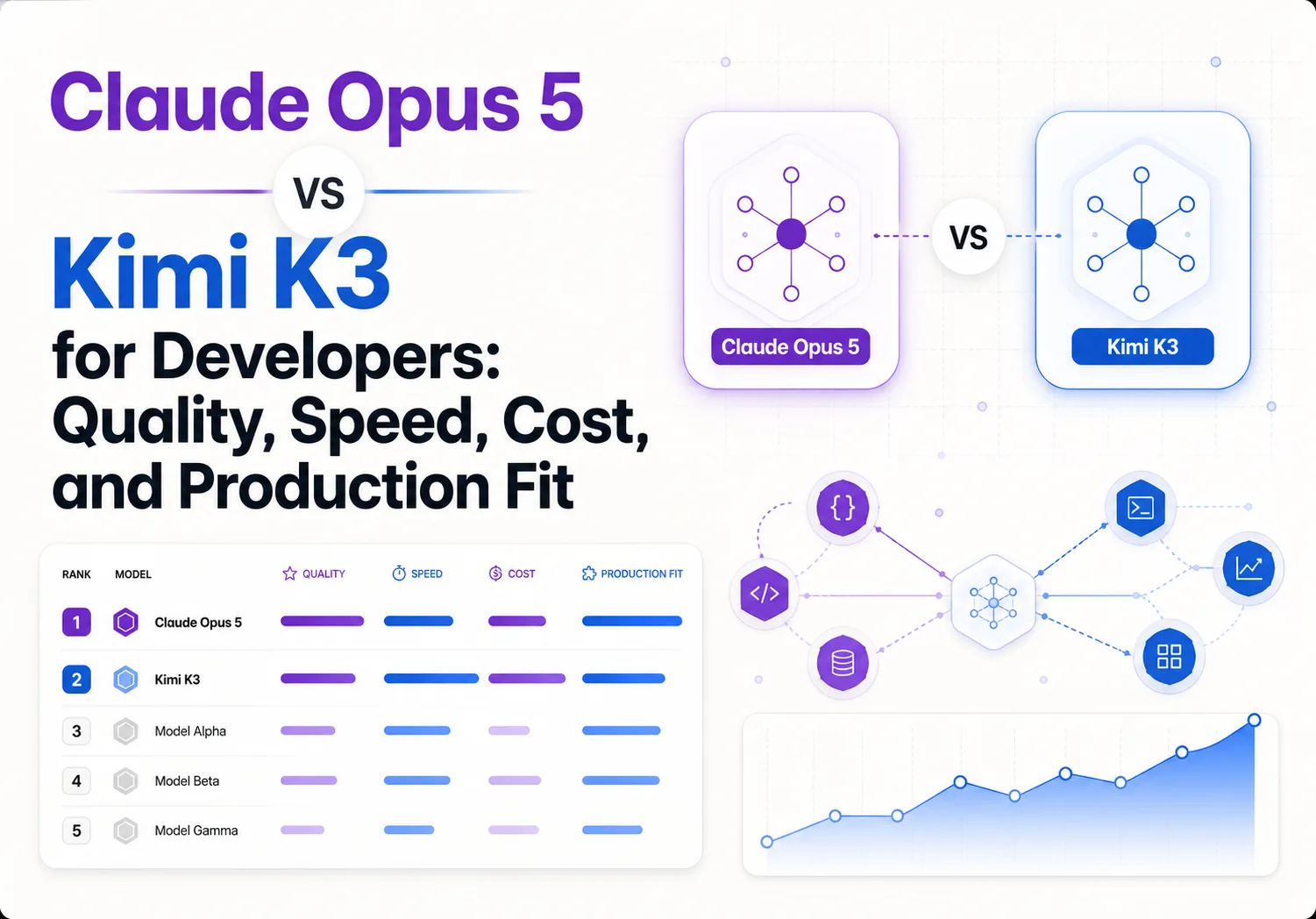
- **Winner overall:** Claude Opus 5, higher intelligence at 58.9 versus 57.1 and coding at 76.5 versus 76.2 - **Cheaper:** Kimi K3 (max) at $6 vs $10 per 1M blended tokens - **Faster:** Claude Opus 5 at 54.599 median output tokens per second versus 34.453 - **Pick Kimi K3 (max) when:** a $6 blended-token price matters more than Claude Opus 5's 54.599 output speed - **Watch out:** Coding scores are 76.5 versus 76.2, so the evidence does not prove a decisive coding winner
Claude Opus 5 vs Kimi K3: the short answer
Claude Opus 5 is the stronger overall choice, while Kimi K3 is cheaper for developers willing to accept slower generation and more harness discipline.
The supplied Artificial Analysis snapshot gives Claude Opus 5 the higher intelligence score, the higher coding score, and the higher median output speed. Kimi K3 leads on blended, input, and output token pricing. Measured latency is tied, so the decision depends more on sustained generation, reasoning behavior, and operational controls than on first-response arrival.
Naming also matters during implementation. Anthropic documents claude-opus-5 as the API model identifier and stable alias in its model overview, while Kimi documents kimi-k3 as the API model name in its Kimi K3 Quickstart. The page label claude-opus-5-high describes the comparison entry, not a separate Anthropic API model. Likewise, Kimi’s max label describes the reasoning setting rather than a standalone model.
The practical verdict is conditional. Choose Claude Opus 5 for production agents where throughput, tool discipline, and broad provider access matter. Choose Kimi K3 when token economics matter more and the team can validate the agent harness, history handling, and continuation behavior.
Summary of the meaningful differences
Claude Opus 5 leads the measured intelligence and speed results, while Kimi K3 leads the listed price results.
| Decision factor | Claude Opus 5 | Kimi K3 | Selection meaning |
|---|---|---|---|
| Intelligence index | 58.9 | 57.1 | Claude has the higher broad capability signal |
| Coding index | 76.5 | 76.2 | The coding result is effectively close, not a decisive separation |
| Median output speed | 54.599 | 34.453 | Claude is better suited to long interactive runs |
| Measured latency | 0.3 | 0.3 | Neither model wins the measured first-response metric |
| Blended price per 1M tokens | $10 | $6 | Kimi has the lower headline cost |
| Release date | 2026-07-24 | 2026-07-16 | Kimi entered the supplied comparison earlier |
The quality comparison needs careful reading. Claude’s intelligence lead is clearer than its coding lead, while the coding scores are close enough that repository conventions, tool reliability, and retry behavior may dominate the result. Artificial Analysis provides the comparable measurements used here.
The official evidence is not symmetrical. Anthropic’s announcement presents Claude Opus 5 as a leader across several evaluations, but does not provide every chart’s complete raw score in the announcement text. Kimi’s technical blog publishes specific benchmark results and explains that different evaluations use different agent harnesses. Those claims cannot be treated as a shared, independently controlled benchmark.
The supplied material therefore supports a practical ranking, not a universal capability claim. Claude Opus 5 has the stronger measured profile. Kimi K3 has the stronger price profile. The evidence is insufficient to predict which model will complete a particular private repository more reliably without a workload-specific test.
Performance: speed helps, but reasoning behavior decides the workflow
Claude Opus 5 is the faster measured model, while Kimi K3 keeps the coding comparison nearly even.
The output-speed gap is large enough to affect interactive development. Claude Opus 5 records 54.599 median output tokens per second, compared with 34.453 for Kimi K3. That difference matters most in agent loops that inspect files, call tools, revise plans, and stream long answers. Faster generation can reduce the time a developer waits between actions, but it does not prove higher task completion quality.
Measured latency is 0.3 seconds for each model. That tie suggests the choice is unlikely to be settled by the first visible response. The more important question is how much reasoning follows the initial response and how reliably the model converts that reasoning into tool calls.
Anthropic documents adaptive thinking as the default behavior for Claude Opus 5 and describes effort as a behavioral signal rather than a strict token budget in its effort documentation. Its thinking documentation also explains how thinking interacts with output limits and tool use. Kimi’s Quickstart states that thinking is always enabled and that max is the default reasoning setting. Raw output speed is therefore an incomplete proxy for completed task time on either model.
The official benchmark evidence also has a comparability problem. Anthropic emphasizes broad agentic coding, research, and computer-use results in its release announcement. Kimi reports benchmark outcomes in its technical blog, while noting that evaluation harnesses differ. The supplied research does not establish a common test protocol, so neither official announcement can settle cross-model coding reliability by itself.
Community reports reinforce that uncertainty. Some Claude developers describe excessive analysis, slow responses, and unrequested broad changes. Other commenters say Claude Opus 5 performs well after receiving a clear goal and uninterrupted execution time. These reports are anecdotal, and the original post did not include a systematic test. Kimi has a similar limitation: a Hermes user reported substantial progress on a personal project but still needed manual review and continuation after the run reached its token limit. No reliable public evidence gives either model a stable real-world completion rate.
Cost: Kimi wins the invoice, but not every workload
Kimi K3 is cheaper on every listed token price, but total task cost depends on reasoning length, retries, and completion rate.
The blended price is $6 for Kimi K3 versus $10 for Claude Opus 5. Kimi also lists $3 input tokens and $15 output tokens, while Claude lists $5 input tokens and $25 output tokens. Those prices make Kimi the obvious candidate for high-volume workloads with predictable prompts and limited operational overhead.
The headline advantage can shrink in agentic work. Anthropic explains in its Opus 5 update that thinking and final output share the synchronous output limit. The thinking guide warns that long reasoning can increase latency and cost. Lowering effort may reduce usage, but Anthropic does not describe effort as a hard budget. Teams that need a strict ceiling must enforce an explicit output limit and measure the resulting completion rate.
Kimi’s reasoning setting creates a different cost risk. Its Quickstart documents always-on thinking and a default max reasoning level. A cheap request that produces a long plan, reaches a limit, or requires a second run may cost more than a shorter Claude run that finishes the task in one pass. The available Kimi pricing and Claude pricing pages describe caching and token rates, but they do not provide a universal total-cost estimate for private agent workloads.
Caching can also change the ranking. Repeated system instructions, repository context, or tool definitions may create different cache behavior from one application to another. The supplied material does not provide a directly comparable cache-hit workload, so developers should measure effective cost with their own prompt structure.
A useful cost test should track completed tasks, retries, tool calls, and human cleanup alongside token spend. That is especially important because the Kimi community report describes an unfinished long-running task, while the Claude community discussion describes overthinking and unnecessary changes. Neither report supplies enough data to quantify the cost impact, but both show why sticker price is not the whole budget.
Recommendation by developer scenario
Claude Opus 5 is the default production pick, while Kimi K3 is the better trial choice for cost-sensitive autonomous workloads with a tested harness.
| Developer need | Recommended model | Reason |
|---|---|---|
| Production coding agent | Claude Opus 5 | Higher measured intelligence, higher coding score, faster output, and more documented controls |
| High-volume token-sensitive work | Kimi K3 | Lower blended, input, and output prices |
| Interactive long-running sessions | Claude Opus 5 | The higher median output speed should reduce waiting during repeated tool loops |
| Coding benchmark tie-breaker | Neither by default | The coding scores are 76.5 and 76.2, so the supplied result is too close for a universal decision |
| Kimi-native experimentation | Kimi K3 | The official API, Kimi Code, Kimi Work, and Kimi.com paths support a focused ecosystem |
| Multi-provider deployment | Claude Opus 5 | Anthropic documents access through its API, Bedrock, Google Cloud, and Microsoft Foundry |
Version and naming checks should happen before any migration. Anthropic’s model ID documentation describes claude-opus-5 as a fixed snapshot identifier rather than a label that silently moves to a future model. Kimi’s model list lists kimi-k3 as the current model name and does not list kimi-k3-max as a separate model. A routing layer should therefore store the API identifier and reasoning setting separately.
Availability is also broadly positive in the supplied material. Anthropic’s model overview lists Claude Opus 5 as available, without a deprecated or retired marker. Kimi’s current model list lists kimi-k3 as available while marking some older models as discontinued. Neither source establishes a future support guarantee, so teams should still monitor model pages and pin identifiers in deployment configuration.
The strongest reason to choose Claude is operational confidence, not a dramatic coding-score lead. Anthropic documents adaptive reasoning, tool behavior, provider availability, and migration constraints in greater detail. The strongest reason to choose Kimi is economic flexibility, especially for workloads where lower prices outweigh slower generation. The research does not establish a reliable independent winner for real repository completion, so a final choice should include a private acceptance test with the team’s own tools and history format.
Checks to complete before switching models
Claude Opus 5 and Kimi K3 need different pre-production checks, so developers should test protocol behavior before comparing invoice totals.
- Verify model identity. Use
claude-opus-5for Claude andkimi-k3for Kimi. Do not infer an API model from a page slug or from themaxreasoning label. The relevant guidance appears in Anthropic’s model overview, model ID guide, and Kimi’s Quickstart. - Test reasoning and output limits. Claude’s thinking tokens share the output ceiling, and effort is not a strict budget. Kimi keeps thinking enabled and exposes reasoning effort separately. Validate actual completion behavior with representative tasks using the Claude thinking guide and Kimi documentation.
- Validate tool protocol handling. Claude’s update notes describe a failure mode where disabled thinking can cause tool calls to appear as ordinary text or expose internal tags. Kimi supports structured tool features, but its official blog warns that an incompatible harness or missing historical thinking can make generation unstable.
- Test multimodal inputs separately. Kimi’s Quickstart requires object-array content for visual input and does not accept public image URLs directly. Do not assume an image pipeline built for Claude will transfer unchanged.
- Treat web search as a separate risk. Kimi’s documentation says its web search feature is being updated and is not recommended for production workflows. The supplied evidence does not establish equivalent production behavior across the two models.
Frequently asked questions
Which model is better for coding agents?
Claude Opus 5 is the safer default for coding agents because it leads the measured coding index and output speed, although the coding gap is small in the supplied comparison. Artificial Analysis supports the measured ranking, while Anthropic’s thinking documentation explains important tool-use constraints.
Which model is cheaper to run?
Kimi K3 is cheaper on listed token prices, with $6 blended tokens versus Claude Opus 5 at $10, but thinking, retries, caching, and incomplete runs can change total application spend. Compare completed tasks and human cleanup, not token rates alone.
Which model is faster?
Claude Opus 5 is faster in median output speed at 54.599 tokens per second versus Kimi K3 at 34.453, while measured latency is tied at 0.3 seconds. The speed advantage matters most during long interactive agent sessions.
Does Kimi K3 replace Claude Opus 5 for production?
Kimi K3 does not automatically replace Claude Opus 5 because coding scores are close, official benchmark methods differ, and community evidence remains anecdotal. Kimi can still be the better production choice when lower token prices and a validated harness dominate the decision.
Should developers treat Kimi K3 max as a separate model?
Developers should treat Kimi K3 max as a reasoning configuration, not a separate API model. Kimi’s Quickstart documents kimi-k3 as the model name and max as the reasoning effort setting.
What is the biggest evidence gap in this comparison?
The biggest evidence gap is the absence of a shared, reproducible real-repository evaluation covering completion rate, retries, tool errors, and human cleanup. The supplied benchmarks establish useful directional signals, but they do not predict every developer workflow.
Sources
- Artificial AnalysisComparable intelligence, coding, speed, latency, pricing, and release-date data.
- Introducing Claude Opus 5Anthropic's positioning, capability claims, and official benchmark framing.
- Models overviewClaude API model identity, availability, supported platforms, and model capabilities.
- What's new in Claude Opus 5Thinking defaults, tool behavior, migration constraints, and operational limitations.
- Anthropic PricingClaude token pricing and caching considerations.
- Model IDs and versioningClaude fixed snapshot identifiers and versioning behavior.
- EffortClaude effort levels and their relationship to reasoning token usage.
- ThinkingClaude thinking, output limits, tool calls, and configuration constraints.
- Is Opus 5 actually that bad, or is it just Reddit hype?Anecdotal Claude developer feedback about verbosity, speed, overthinking, and autonomous changes.
- Kimi K3 official technical blogKimi positioning, official benchmark framing, harness requirements, and model behavior.
- Kimi K3 QuickstartKimi model naming, reasoning settings, tool features, visual inputs, and web-search limitations.
- Flagship Model Kimi K3 PricingKimi token pricing and cache-related cost considerations.
- Model ListKimi current model availability and deprecated model status.
- Just tested Kimi K3 with HermesAnecdotal Kimi coding experience involving long-running work, token limits, and manual continuation.
Published: