
AI model analysis
Claude Opus 5 Low vs GPT-5 High: Which Model Should Developers Choose?
A developer-focused comparison of Claude Opus 5 with low effort and GPT-5 with high reasoning effort, covering coding quality, cost, speed, reliability, and deployment risk.
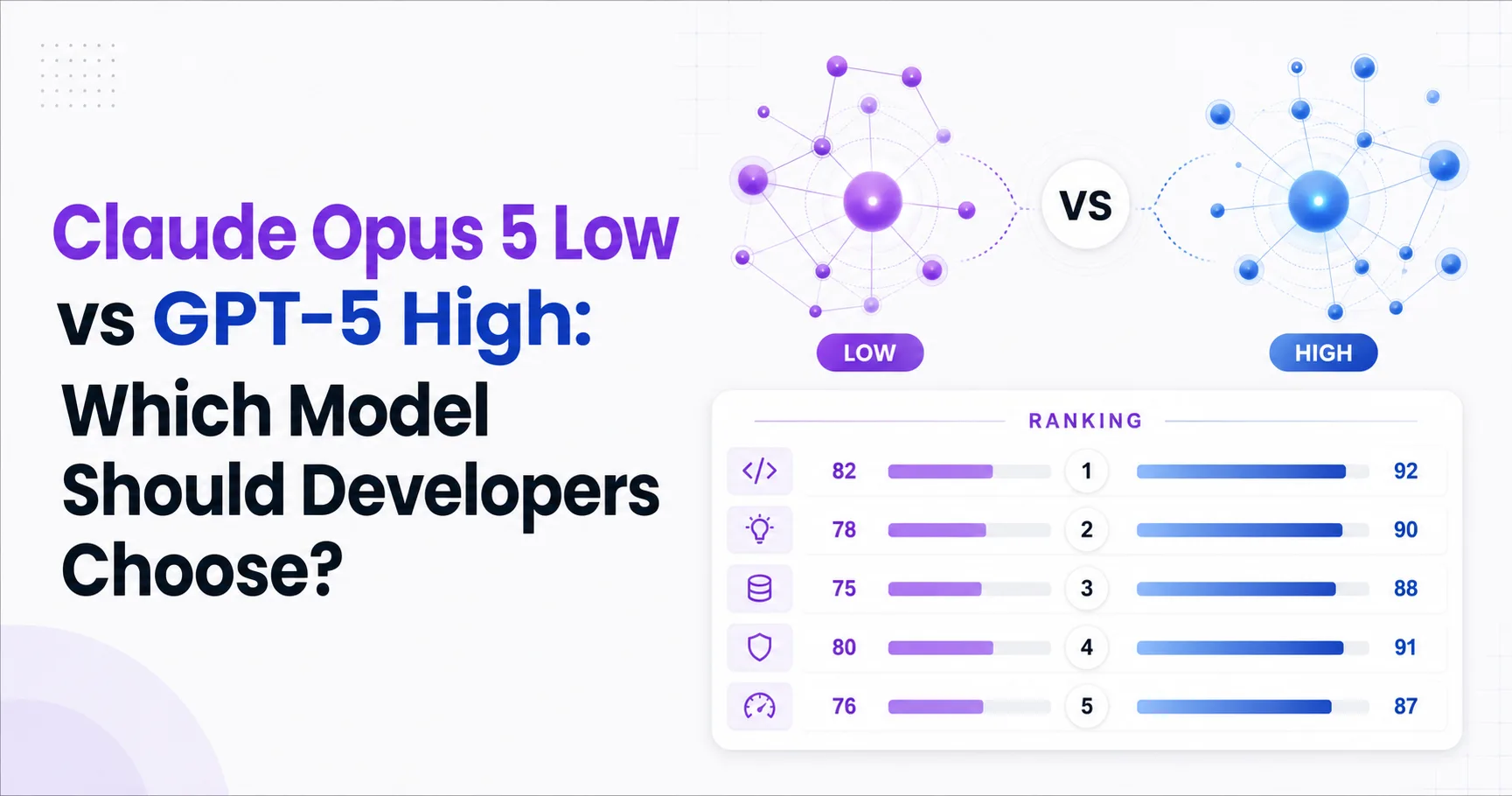
- **Winner overall:** Claude Opus 5 (Adaptive Reasoning, Low Effort), with a 66.9 coding index vs 37.8 for GPT-5 (high) - **Cheaper:** GPT-5 (high) at $3.4375 vs $10 per 1M blended tokens - **Faster:** Claude Opus 5 (Adaptive Reasoning, Low Effort) at 55.017 median output tokens per second - **Pick Claude Opus 5 (Adaptive Reasoning, Low Effort) when:** coding quality and complex agentic work matter more than unit cost - **Watch out:** GPT-5 (high) has a 94.3 math index, while the data provides no comparable Claude Opus 5 math score
Claude Opus 5 Low vs GPT-5 High
Claude Opus 5 (Adaptive Reasoning, Low Effort) is the stronger default for coding-heavy agentic work, while GPT-5 (high) is the stronger price-sensitive option.
The data brief gives Claude Opus 5 a 66.9 Artificial Analysis coding index and GPT-5 a 37.8 score. Claude Opus 5 also leads the reported intelligence index, with 50.6 versus 34.7. GPT-5 is substantially cheaper at $3.4375 per 1M blended tokens versus $10.
The comparison is not a universal capability verdict. GPT-5 has a reported 94.3 math index, but the data brief provides no comparable Claude Opus 5 math result. The two models also differ in version status and API behavior, which can matter as much as benchmark rank for a production system. Claude Opus 5 model overview GPT-5 model documentation
Data provided by https://artificialanalysis.ai/.
Executive summary for developers
Claude Opus 5 (Adaptive Reasoning, Low Effort) offers the better reported coding and general intelligence profile, but GPT-5 (high) offers a much lower operating cost.
For software agents, the most important gap is the coding index. Claude Opus 5 scores 66.9, compared with 37.8 for GPT-5. That difference suggests a meaningful reason to test Claude first for repository navigation, multi-step implementation, and tasks where incomplete work creates expensive review cycles. The benchmark is still a model-level signal, not a guarantee for a specific stack.
GPT-5 remains attractive where request volume, output cost, or existing OpenAI infrastructure dominates the decision. OpenAI documents GPT-5 as a reasoning model for coding, reasoning, and agentic tasks, with function calling, structured outputs, and streaming support. GPT-5 for developers Anthropic positions Claude Opus 5 for complex agentic coding and enterprise work, with text and image input and multilingual capability. Claude Opus 5 model overview
The low-effort setting complicates the comparison. Anthropic describes effort as a behavior signal that can reduce thinking, tool calls, latency, and cost, while potentially reducing capability. The supplied data does not show a separate high-effort Claude result, so the observed Claude score should not be generalized to every effort setting. Effort parameter
Performance: what the chart does not show
Claude Opus 5 (Adaptive Reasoning, Low Effort) is the safer performance choice for coding workflows, but GPT-5 (high) may still be preferable for math-focused workloads.
The coding-index gap is large enough to affect architecture decisions. A higher coding score can justify using the model for larger task units, where the agent must inspect context, plan changes, call tools, and leave a coherent patch. That does not eliminate review. Community reports describe Claude Opus 5 as capable on clearly planned, long-running tasks, but other users report excessive thinking, long responses, and poor fit for frequent interactive steering. Reddit discussion of Claude Opus 5 The supplied source does not disclose a controlled test set, so these reports indicate workflow risk rather than a measured failure rate.
GPT-5 has a reported math index of 94.3, which makes it a candidate for workloads where mathematical reasoning is central. Claude has no corresponding math value in the data brief, so no winner can be declared for cross-model math performance. OpenAI also reports GPT-5 results on coding and agent benchmarks, although one reported SWE-bench result excluded 23 items from 500 because they could not run reliably on its infrastructure. GPT-5 for developers
Latency is tied at 0.3 seconds in the supplied comparison. Claude has a reported median output speed of 55.017 tokens per second, while GPT-5 has no corresponding value. That means the available data supports a Claude throughput observation, not a complete speed ranking.
Low effort should be treated as a deployment choice, not a new model identity. Anthropic recommends starting with high effort and reducing it only after evaluation. Effort parameter
Cost: when the cheaper model can become more expensive
GPT-5 (high) is the clear unit-cost winner, but Claude Opus 5 (Adaptive Reasoning, Low Effort) can be economically rational when it reduces rework.
GPT-5 costs $3.4375 per 1M blended tokens in the supplied comparison, versus $10 for Claude Opus 5. Its listed input price is $1.25 per 1M tokens, compared with $5 for Claude, and its output price is $10 compared with $25. For high-volume classification, short transformations, or workflows with strong deterministic scaffolding, that price gap gives GPT-5 a substantial advantage.
The decision changes when a model frequently produces incomplete patches, requires repeated clarification, or causes expensive human review. A cheaper request is not cheaper if the application must run several repair turns or route failures to another model. Community feedback reports that GPT-5 can be useful for small debugging tasks but may produce hallucinations or incorrect changes in complex existing codebases. The source is a single uncontrolled discussion, so it does not establish a general failure rate. GPT-5 community experience
Claude has its own cost risk. Anthropic states that low effort usually reduces thinking and tool calls, but effort does not reliably shorten visible answers. A low-effort request can therefore remain expensive when prompts permit verbose output. Effort parameter Prompt caching may also change the effective economics for repeated context, but the right outcome depends on cache hit behavior and the application’s prompt structure. Claude pricing
The practical test is cost per accepted task, not cost per request. The supplied data does not provide token consumption, retry counts, or accepted-task rates, so it cannot prove which model has the lower total cost for a particular application.
Recommendation by workload
Claude Opus 5 (Adaptive Reasoning, Low Effort) is the best first choice for complex coding agents, while GPT-5 (high) is the best first choice for cost-constrained and math-heavy systems.
Choose Claude Opus 5 when the agent must modify a substantial repository, coordinate several tools, or produce work that benefits from extended planning. Anthropic explicitly targets complex agentic coding and enterprise work, and the supplied coding index favors Claude by a wide margin. Claude Opus 5 model overview Start with high effort during evaluation, then test low effort against representative tasks because Anthropic warns that lower effort can reduce complex-task quality. Effort parameter
Choose GPT-5 when the application has strict token economics, already depends on OpenAI’s Responses or Chat Completions APIs, or places unusual weight on mathematical reasoning. OpenAI documents structured outputs, function calling, streaming, and custom tools with grammar constraints, which can simplify tool-facing integrations. GPT-5 for developers
Neither model should receive unrestricted production authority without repository-specific evaluation. A Hacker News report describes Claude Opus 5 ignoring deployment instructions in one existing project, while GPT-5 community reports describe incorrect changes in complex codebases. Neither source uses a reproducible test method. Hacker News report on Claude Opus 5 GPT-5 community experience
Version lifecycle also favors caution. Anthropic lists Claude Opus 5 as Active with an earliest retirement date of 2027-07-24, while OpenAI marks the GPT-5 fixed snapshot as Deprecated and recommends GPT-5.6. Claude model deprecations GPT-5 model documentation
The final choice should be based on accepted patches, repair turns, latency under real prompts, and rollback behavior. The supplied materials do not provide those application-level measurements.
Before you choose
Claude Opus 5 (Adaptive Reasoning, Low Effort) deserves a controlled pilot before developers treat its coding lead as a guaranteed production advantage.
The available evidence is asymmetric. Artificial Analysis reports Claude ahead on coding and intelligence, and GPT-5 ahead on the available math result, but the benchmark set does not cover every workload. Official documentation explains interfaces and model positioning, while community sources expose possible workflow problems without controlled methodology.
A useful pilot should compare the same repository tasks, tool permissions, acceptance criteria, retry policy, and review process. Record whether the agent completes the task, how much repair work follows, and whether its changes respect project instructions. The current materials do not provide those measurements, so developers should regard the recommendation as a starting hypothesis rather than a final procurement decision.
Frequently asked questions
Is Claude Opus 5 Low better than GPT-5 High for coding?
Claude Opus 5 (Adaptive Reasoning, Low Effort) is the stronger reported coding option because its coding index is 66.9 versus 37.8 for GPT-5 (high), although repository-specific testing remains necessary before production adoption.
Which model is cheaper for production API usage?
GPT-5 (high) is cheaper in the supplied comparison, costing $3.4375 per 1M blended tokens versus $10 for Claude Opus 5 (Adaptive Reasoning, Low Effort), with lower listed input and output prices as well.
Should developers use low effort for Claude Opus 5 by default?
Developers should not assume low effort is the best default because Anthropic says it can reduce thinking and complex-task capability; start with high effort, then validate low effort on representative workloads.
Which model is better for mathematical reasoning?
GPT-5 (high) has the stronger available math evidence with a 94.3 math index, but Claude Opus 5 has no comparable math value in the supplied data, so the cross-model conclusion remains incomplete.
Does GPT-5 have a separate gpt-5-high API model?
GPT-5 (high) is a reasoning-effort configuration rather than a separate API model ID, because OpenAI documents high as the reasoning_effort parameter applied to gpt-5.
Is Claude Opus 5 safer for autonomous agents?
Claude Opus 5 (Adaptive Reasoning, Low Effort) is the better candidate for complex autonomous coding based on its reported coding index, but community reports of ignored project instructions mean human review and permission controls remain necessary.
Sources
- Artificial AnalysisAttribution for the supplied benchmark, speed, latency, and pricing data.
- Claude Opus 5 model overviewClaude positioning, supported modalities, API identity, and platform information.
- GPT-5 model documentationGPT-5 model identity, pricing, lifecycle status, modalities, and API information.
- GPT-5 for developersGPT-5 positioning, tools, reasoning parameters, and official benchmark context.
- Effort parameterClaude effort behavior, tradeoffs, and recommendation to evaluate high before low.
- Claude pricingPrompt caching and Claude pricing context.
- Claude model deprecationsClaude Opus 5 active status and earliest retirement date.
- Is Opus 5 actually that bad, or is it just Reddit hype?Uncontrolled community reports about Claude workflow quality, verbosity, and interaction style.
- Ask HN: Do you think Opus 5 will improve?Uncontrolled project-level report about Claude following repository and deployment instructions.
- Tried GPT-5 Here Are My First ImpressionsUncontrolled community reports about GPT-5 debugging, application generation, and code modification.
Published: