
AI model analysis
Claude Opus 5 Low vs GPT-5 nano High: Which Model Should Developers Choose?
A developer-focused comparison of Claude Opus 5 with low adaptive reasoning and GPT-5 nano with high reasoning, covering capability evidence, speed, cost, availability, and selection risk.
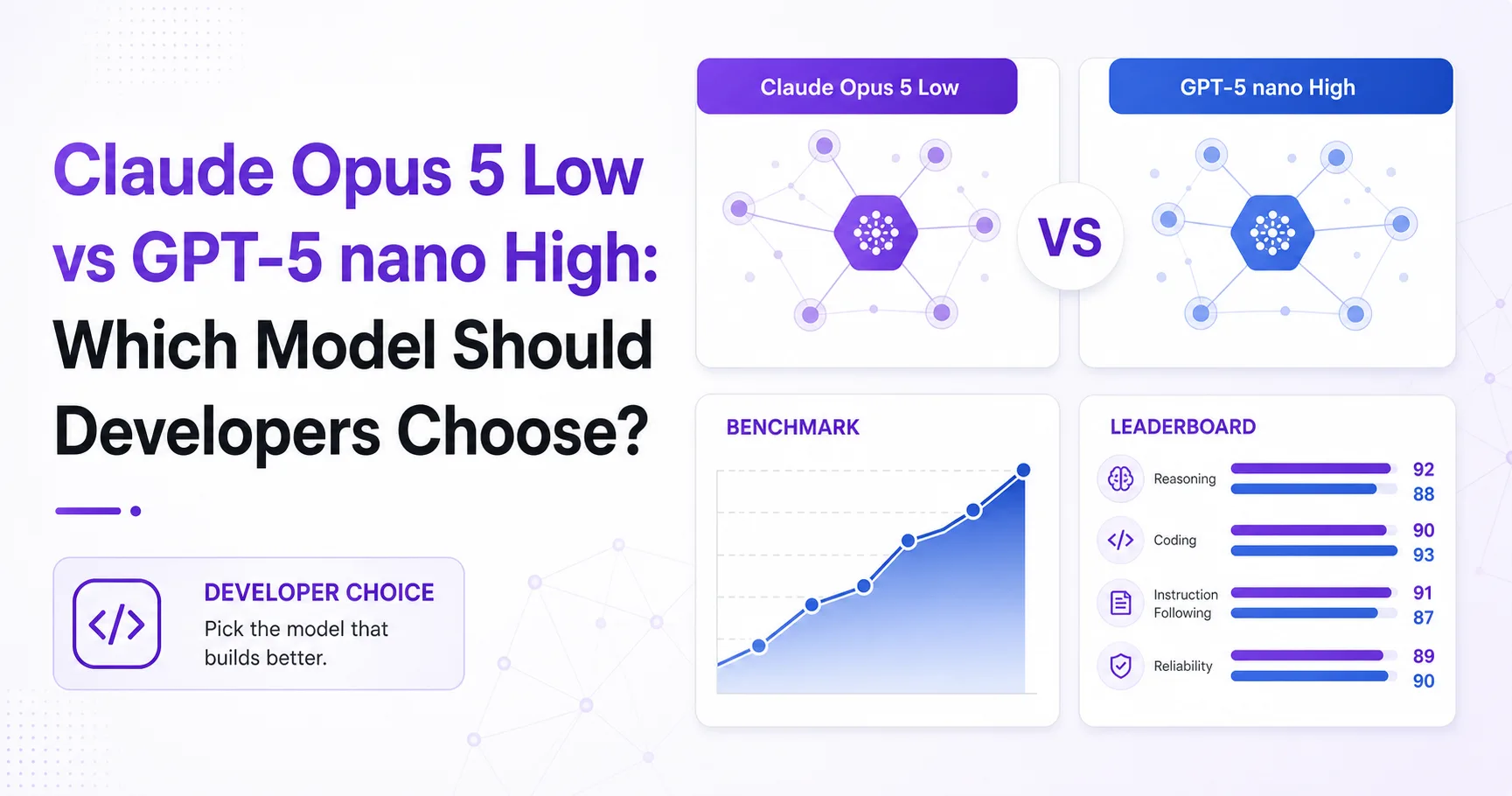
- **Winner overall:** Claude Opus 5 (Adaptive Reasoning, Low Effort), with an Artificial Analysis Intelligence Index of 50.6 vs 19.9 - **Cheaper:** GPT-5 nano (high) at $0.1375 vs $10 per 1M blended tokens - **Faster:** Claude Opus 5 (Adaptive Reasoning, Low Effort) at 55.017 median output tokens per second; GPT-5 nano speed is unavailable - **Pick Claude Opus 5 (Adaptive Reasoning, Low Effort) when:** coding quality, agentic execution, and broad task performance matter more than the $10 blended-token price - **Watch out:** GPT-5 nano has a math index of 83.7, but comparable coding, context, availability, and speed evidence is unavailable
Claude Opus 5 Low vs GPT-5 nano High
Claude Opus 5 (Adaptive Reasoning, Low Effort) is the safer capability choice, while GPT-5 nano (high) is the far cheaper option with a serious evidence gap. The Artificial Analysis snapshot gives Claude Opus 5 an Intelligence Index of 50.6 and GPT-5 nano an Intelligence Index of 19.9. It also reports a Math Index of 83.7 for GPT-5 nano, but no comparable math result for Claude Opus 5. The snapshot reports Claude Opus 5 output speed at 55.017 median output tokens per second, while GPT-5 nano has no reported value. Both models show 0.3 seconds of latency in the supplied data. Data provided by https://artificialanalysis.ai/
The comparison therefore has an uneven shape. Claude has stronger evidence for broad intelligence and coding, while GPT-5 nano has a strong math result and a much lower listed price. Developers should not read the missing GPT-5 nano fields as poor performance. They indicate that the supplied evidence does not establish the model’s coding score, output speed, context window, or current API status.
The central selection question is not simply whether one model scores higher. It is whether the task can tolerate uncertainty around GPT-5 nano’s current identity and operational limits. Claude Opus 5 is documented as an active model with a stable API name and a stated retirement expectation. GPT-5 nano is absent from the current official model directory and pricing page, so production users need a verification step before adoption.
The Evidence Favors Claude, but the Price Favors GPT-5 nano
Claude Opus 5 (Adaptive Reasoning, Low Effort) wins the documented general-purpose comparison, while GPT-5 nano (high) wins the cost comparison by a wide margin. Anthropic describes Claude Opus 5 as a model for complex agentic coding and enterprise work, with text and image input, text output, multilingual capability, and visual understanding. These claims appear in the Claude model overview and Anthropic launch announcement.
The supplied benchmark data supports that positioning. Claude Opus 5 reaches 66.9 on the Artificial Analysis Coding Index and 50.6 on the Artificial Analysis Intelligence Index. GPT-5 nano reaches 83.7 on the Artificial Analysis Math Index, but the snapshot does not provide its Coding Index. That missing comparison prevents a clean conclusion about software engineering, despite Claude’s stronger documented coding result.
| Decision factor | Better-supported choice | Why |
|---|---|---|
| Broad capability | Claude Opus 5 | Intelligence Index of 50.6 vs 19.9 |
| Coding evidence | Claude Opus 5 | Coding Index of 66.9; GPT-5 nano value unavailable |
| Math evidence | GPT-5 nano | Math Index of 83.7; Claude value unavailable |
| Blended cost | GPT-5 nano | $0.1375 vs $10 per 1M blended tokens |
| Reported output speed | Claude Opus 5 | 55.017 median output tokens per second; GPT value unavailable |
| Measured latency | Tie | Both are listed at 0.3 seconds |
The important qualification is operational confidence. Anthropic documents Claude’s API identifier, platform availability, context window, output limits, effort controls, and deprecation status. OpenAI’s current model directory does not list GPT-5 nano, and its current pricing page lists a different nano model instead. GPT-5 nano may still work in a particular environment, but the supplied research does not prove that it remains a supported production target.
Performance: Claude Has Broader Evidence, GPT-5 nano Has a Narrower Proven Result
Claude Opus 5 (Adaptive Reasoning, Low Effort) is the better-supported performance choice because its evidence covers coding and general intelligence, while GPT-5 nano’s strongest supplied result is limited to math. The Artificial Analysis snapshot reports Claude Opus 5 at 66.9 on coding and 50.6 on intelligence. GPT-5 nano is reported at 83.7 on math and 19.9 on intelligence. The figures suggest different strengths, not a complete task-by-task ranking.
For developers building repository agents, code review systems, or multi-step automation, Claude’s coding evidence is directly relevant. Anthropic also positions the model for complex agentic coding and enterprise work in its official announcement. That positioning is consistent with the supplied coding score, but it does not guarantee reliable behavior in every codebase.
Claude’s low-effort setting changes the tradeoff. Anthropic says adaptive thinking is enabled by default, and effort controls can reduce thinking effort, tool calls, latency, and cost while potentially reducing performance on complex reasoning, coding, and agentic tasks. Low effort is therefore a deployment configuration, not an independent model identity. Developers should evaluate the exact setting used in production.
The reported speed result also needs careful interpretation. Claude Opus 5 has a median output speed of 55.017, but the supplied data does not report GPT-5 nano’s output speed. Both models have a listed latency of 0.3 seconds, so the data does not establish that either model feels faster for a complete interaction. Output speed matters after generation starts, while agent loops, tool execution, retries, and response length can dominate user-visible time.
Community reports add risk signals but not reliable failure rates. Reddit users disagree about whether Opus 5 is effective for planned autonomous work or frustratingly slow and verbose, as described in this Reddit discussion. A Hacker News report describes ignored project instructions and deployment problems in one project, but provides no controlled test in the discussion. An X post reports dislike of the work experience while ranking Opus 5 highly in a blind test, without publishing complete methods in the post. No comparable community evidence was found for GPT-5 nano.
Cost: GPT-5 nano Is Dramatically Cheaper, but Availability Can Change the Calculation
GPT-5 nano (high) is the clear listed-cost winner at $0.1375 per 1M blended tokens versus $10 for Claude Opus 5 (Adaptive Reasoning, Low Effort). That gap makes GPT-5 nano attractive for high-volume classification, extraction, routing, lightweight transformation, and math-heavy workloads where the required API target is confirmed.
The price difference does not automatically make GPT-5 nano cheaper in a production system. The supplied research cannot confirm that GPT-5 nano is currently callable, has a stable alias, or has documented context and output limits. OpenAI’s current official model documentation does not list the model. The current OpenAI pricing documentation lists gpt-5.4-nano at different prices, but that model must not be treated as evidence about GPT-5 nano.
Claude’s higher price can still be rational when a failed task requires human review, retries, repair prompts, or a second model call. The supplied data does not quantify those operational costs, so no break-even claim can be made. The correct conclusion is conditional: GPT-5 nano is cheaper per listed token, while Claude may be cheaper per successfully completed complex task if its broader capability reduces recovery work. That hypothesis requires a task-specific evaluation.
Claude also has documented caching options. The Claude pricing page lists separate rates for base input, cache writes, cache hits, and output. The Opus 5 update notes state that prompt caching supports a minimum cached prompt length of 512 tokens. These details can matter for repeated system instructions or long agent contexts, but the supplied GPT-5 nano research does not provide comparable caching information.
The price comparison should therefore be treated as a procurement signal, not a complete cost model. Confirm model availability, measure successful task completion, count retries and tool calls, and include human review before selecting GPT-5 nano solely because its token price is lower.
Recommendation: Use Claude for Complex Development Work and GPT-5 nano Only After Verification
Claude Opus 5 (Adaptive Reasoning, Low Effort) is the recommended default for complex development workflows, while GPT-5 nano (high) should be considered for validated low-cost workloads. Claude’s supplied Coding Index is 66.9, its Intelligence Index is 50.6, and Anthropic explicitly targets complex agentic coding and enterprise work. Those facts make it the more defensible choice for codebase changes, architecture-sensitive tasks, and workflows where failure recovery is expensive.
Choose Claude Opus 5 when the system must interpret a large repository, follow project instructions, use tools across several steps, or produce code that needs limited repair. Start with the documented high-effort behavior for difficult tasks, then test low effort against representative work. Anthropic warns in the effort documentation that lower effort can reduce complex-task performance and does not reliably shorten visible answers.
Choose GPT-5 nano when the task is narrow, the math result matters, request volume makes token cost central, and the exact API endpoint has been verified. Its Math Index is 83.7, and its blended price is $0.1375 per 1M tokens. The research does not establish its coding quality, output speed, context capacity, or current availability, so it should not be selected for a critical agent solely from the price and math score.
A sensible rollout is a two-model policy. Route complex coding and agentic work to Claude. Route narrow, repeatable tasks to GPT-5 nano only after an availability check and a small acceptance set. Keep a fallback path because Claude has had a recorded service incident, documented by the Claude status page, although that event was an availability issue rather than a fixed capability failure.
The largest unresolved question is GPT-5 nano’s production status. The supplied research contains no reliable community experience and no current official listing. That evidence gap is more important than the raw price advantage for teams that need predictable maintenance, documented limits, and a stable integration contract. Anthropic lists Claude Opus 5 as active with an expected earliest retirement date in its model deprecation documentation.
Questions Developers Should Answer Before Choosing
GPT-5 nano (high) requires the most verification before production adoption because the supplied research cannot confirm its current official availability or operating limits. The following questions focus on decisions that the benchmark snapshot does not answer directly.
Is GPT-5 nano the better choice for every cost-sensitive application?
GPT-5 nano (high) is the better token-price choice, but the evidence does not show that it is the better total-cost choice for every application. Its listed blended price is $0.1375, yet current official documentation does not list the model. Teams should verify access and measure retries, failures, review work, and task completion before treating the listed price as the final operating cost.
Should developers use Claude Opus 5 low effort for difficult coding tasks?
Claude Opus 5 (Adaptive Reasoning, Low Effort) can reduce thinking effort and cost, but Anthropic advises evaluating lower effort against the default high setting for complex coding and agentic work. The supplied Coding Index is 66.9 for Claude, but the research does not show how much low effort changes that result on a team’s own repository.
Does GPT-5 nano’s math result prove that it is better for reasoning?
GPT-5 nano (high) has the stronger supplied math result at 83.7, but that result does not establish superiority across coding, general intelligence, tool use, or autonomous workflows. The supplied Intelligence Index is 19.9 for GPT-5 nano and 50.6 for Claude Opus 5, so developers should treat the math result as a workload-specific signal.
Are the two models equally fast?
Claude Opus 5 (Adaptive Reasoning, Low Effort) and GPT-5 nano (high) both have listed latency of 0.3 seconds, but the models cannot be declared equally fast overall. Claude’s median output speed is 55.017, while GPT-5 nano’s output speed is unavailable. Full workflow time also depends on output length, tools, retries, and external services.
Is Claude Opus 5 a stable production dependency?
Claude Opus 5 (Adaptive Reasoning, Low Effort) has stronger documented production status because Anthropic lists an active model, a stable API name, supported platforms, and deprecation information. That does not eliminate outage risk. A recorded Claude Opus 5 incident shows why production systems should still maintain monitoring, fallback behavior, and human review for consequential changes.
Frequently asked questions
Which model should developers choose for complex coding agents?
Claude Opus 5 (Adaptive Reasoning, Low Effort) is the stronger default because it has a supplied Coding Index of 66.9, broader documented agentic coding positioning, and more complete production documentation than GPT-5 nano.
Which model is cheaper for token usage?
GPT-5 nano (high) is cheaper at $0.1375 per 1M blended tokens compared with Claude Opus 5 at $10, although current official availability and operational limits remain unconfirmed.
Is GPT-5 nano better for mathematics?
GPT-5 nano (high) has the stronger supplied math evidence with a Math Index of 83.7, but that result does not establish better coding, general intelligence, tool use, or agentic reliability.
Can low effort make Claude Opus 5 suitable for all tasks?
Claude Opus 5 low effort is not suitable for every task automatically because Anthropic says lower effort can reduce complex reasoning, coding, and agentic performance, requiring validation on representative workloads.
Sources
- Artificial AnalysisAttribution for the supplied benchmark, pricing, latency, and output-speed snapshot.
- Claude model overviewClaude Opus 5 positioning, API identity, capabilities, platform support, context, and output documentation.
- Introducing Claude Opus 5Anthropic's positioning of Claude Opus 5 and official performance claims.
- EffortAdaptive reasoning, effort settings, and the tradeoff between effort and complex-task performance.
- OpenAI ModelsVerification that GPT-5 nano is absent from the current official model directory and that its limits and availability are unconfirmed.
- OpenAI API PricingVerification that the current pricing page lists a different nano model rather than GPT-5 nano.
- Is Opus 5 actually that bad, or is it just Reddit hype?Community disagreement about Claude Opus 5 speed, verbosity, planning, and autonomous work.
- Ask HN: Do you think Opus 5 will improve?An individual project report about ignored project instructions and deployment problems.
- BIG NEWS: Opus 5 is here...and I hate working with itA community blind-test report showing disagreement between work experience and benchmark ranking.
- Claude pricingClaude standard pricing and prompt-caching pricing details.
- What's new in Claude Opus 5Claude Opus 5 adaptive thinking behavior, API constraints, and prompt-caching details.
- Elevated errors on Claude Opus 5Documented Claude Opus 5 service availability incident.
- Model deprecationsClaude Opus 5 active status, stable model identity, and deprecation information.
Published: