
AI model analysis
Claude Opus 5 Medium vs GPT-4o mini: Which Model Should Developers Choose?
A developer-focused comparison of Claude Opus 5 with medium adaptive reasoning and GPT-4o mini across coding quality, latency, cost, model availability, and production risk.
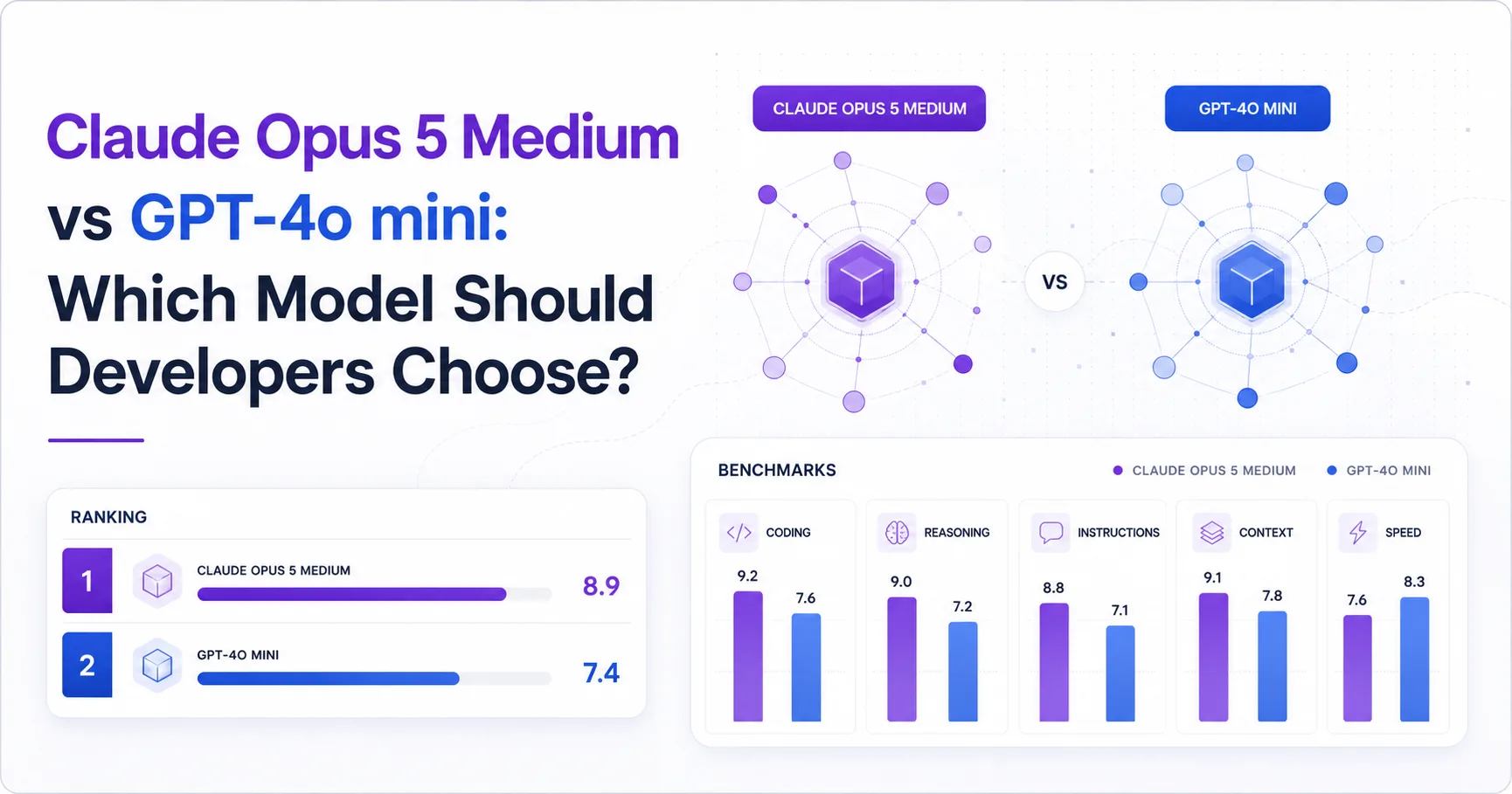
- **Winner overall:** Claude Opus 5 (Adaptive Reasoning, Medium Effort), with a 74.3 coding index versus 11.4 - **Cheaper:** GPT-4o mini at $0.2625 vs $10 per 1M blended tokens - **Faster:** Claude Opus 5 at 54.838 median output tokens per second - **Pick Claude Opus 5 when:** the workflow involves complex agentic coding, multi-file changes, or code review - **Watch out:** GPT-4o mini's current availability and price are not confirmed on OpenAI's current pages
Claude Opus 5 Medium vs GPT-4o mini
Claude Opus 5 is the stronger choice for demanding developer workflows, while GPT-4o mini remains the practical option for cost-sensitive, bounded tasks. The Artificial Analysis snapshot gives Claude Opus 5 a coding index of 74.3 and GPT-4o mini a coding index of 11.4, a gap that matters when a model must reason across files, tests, and implementation constraints. Artificial Analysis provides the comparison data used in this article.
The models serve different operating assumptions. Claude Opus 5 is positioned for complex agentic coding and enterprise work, with adaptive reasoning controlled through an effort setting. Anthropic’s model overview identifies claude-opus-5 as the API model and stable alias. GPT-4o mini was introduced as a small model for frequent, cost-efficient tasks. OpenAI’s launch announcement describes it as a text and image input model with text output.
The central selection question is therefore not which model is universally better. It is whether higher task reliability justifies a materially higher token bill for your workflow. Claude Opus 5 has the evidence advantage for complex coding. GPT-4o mini has the cost advantage by a wide margin, but its current product status requires verification before a new production commitment.
Executive summary
Claude Opus 5 offers the clearer quality margin for developers who need autonomous reasoning, while GPT-4o mini offers the clearer economic margin for high-volume simple work.
| Decision factor | Claude Opus 5 | GPT-4o mini |
|---|---|---|
| Artificial Analysis coding index | 74.3 | 11.4 |
| Artificial Analysis intelligence index | 56.3 | 6.9 |
| Blended price per 1M tokens | $10 | $0.2625 |
| Input price per 1M tokens | $5 | $0.15 |
| Output price per 1M tokens | $25 | $0.6 |
| Median output speed | 54.838 tokens per second | Not reported |
| Latency | 0.3 seconds | 0.3 seconds |
These figures point to a split decision. Claude Opus 5 is the better candidate for coding agents, repository-level changes, difficult reviews, and workflows where rework is expensive. GPT-4o mini is better suited to classification, extraction, lightweight transformations, short responses, and other tasks where a small error does not trigger expensive downstream work.
Claude Opus 5’s official documentation also gives it a substantially larger context window and output ceiling than GPT-4o mini. The model overview lists a 1M-token context window and a 128k-token maximum output for Claude Opus 5, with a larger output limit available for a specific Message Batches beta configuration. Anthropic’s model overview documents those limits. OpenAI’s GPT-4o mini documentation lists a 128,000-token context window and a 16,384-token maximum output.
The comparison does not establish that Claude Opus 5 is more reliable for every task. The benchmark snapshot does not include a directly comparable math score for Claude Opus 5, and the research brief found no reproducible community benchmark for either model’s coding experience. That evidence gap should shape the rollout plan.
Performance: the gap is about task complexity, not just benchmark rank
Claude Opus 5 is the better fit when a single request must sustain reasoning across implementation, verification, and revision.
The coding-index gap is large enough to change architecture decisions. A developer assistant using Claude Opus 5 can reasonably be evaluated for repository-level work, multi-file implementation, code review, and longer agent loops. Anthropic explicitly positions the model around deep reasoning, long-running agentic coding, multi-file development, code review, visual understanding, and multi-agent collaboration. The Opus 5 update notes describe adaptive thinking and the low, medium, high, xhigh, and max effort levels.
The medium setting needs careful interpretation. claude-opus-5-medium is not identified as a separate official API model. The request should use claude-opus-5 with effort: "medium", while the API and Claude Code defaults use a higher effort level. Anthropic’s update notes explain this distinction. A benchmark result associated with the medium slug should therefore be reproduced with the effort parameter set explicitly.
GPT-4o mini is not automatically a poor engineering choice. Its official launch material reports HumanEval at 87.2%, alongside other release benchmarks, but those results do not guarantee strong performance on autonomous repository work. OpenAI’s launch announcement presents those scores as release-time benchmark results, not as a promise for every coding workflow.
The practical difference appears when failure creates work. If GPT-4o mini produces a plausible but incomplete patch, a human or second system must detect and repair it. That may still be cheaper for isolated edits. If the task requires repeated tool calls, architectural consistency, or careful regression reasoning, the lower-cost model can become expensive through rework.
Speed evidence is asymmetric. Claude Opus 5 has a reported median output rate of 54.838 tokens per second, while the snapshot reports no corresponding GPT-4o mini value. Both models show 0.3 seconds of latency in the supplied data. The result is not a complete speed ranking. Developers should measure time to accepted change, not only first-token latency or generation rate.
Community reports reinforce the need for task-level testing, but they do not settle the question. Some users describe Claude Opus 5 completing complex tasks for hours through repeated editing, testing, and rework. One long-task report gives that experience without reproducible code or a quantitative score. Other users report over-planning, excessive testing, missed work, and unrequested changes. Community reports and another report describe those failure modes without controlled measurements.
The evidence is insufficient to claim that Claude Opus 5 is consistently faster, more autonomous, or more reliable in production. The strongest supported conclusion is narrower: Claude Opus 5 has the stronger supplied coding and intelligence scores, while the actual benefit depends on whether your workload rewards sustained reasoning.
Cost: GPT-4o mini wins the invoice, but not every workflow
GPT-4o mini is the economic winner by a wide margin, but its low token price only matters if the model can complete the task within the surrounding system budget.
The supplied blended price is $0.2625 per 1M tokens for GPT-4o mini and $10 for Claude Opus 5. Claude Opus 5 also charges $5 per 1M input tokens and $25 per 1M output tokens, while GPT-4o mini’s supplied prices are $0.15 and $0.6. Artificial Analysis supplies the comparison values. These prices make GPT-4o mini the natural default for large volumes of predictable, low-risk requests.
The cost conclusion can reverse when output quality affects execution. A cheap model that requires additional review, retries, patch repair, or escalation consumes more than its token invoice. This is especially relevant for coding agents, where an incomplete change can trigger another model call, a human review cycle, or a failed deployment check. The supplied data does not quantify those secondary costs, so no exact break-even point can be claimed.
Claude Opus 5’s pricing has another operational dimension. Anthropic lists prompt caching at $6.25 for a five-minute write, $10 for a one-hour write, and $0.50 for a cache hit. Anthropic’s pricing page documents these prices. Repeated repository context or stable enterprise instructions may make caching relevant, but the correct choice depends on cache hit behavior that the brief does not provide.
GPT-4o mini’s historical launch price was $0.15 per 1M input tokens and $0.6 per 1M output tokens. OpenAI’s launch announcement reports those prices at launch. The current OpenAI pricing page does not list gpt-4o-mini, so the historical figures should not be treated as a confirmed current contract price. OpenAI’s current pricing page is the required check before deployment.
The most defensible cost policy is workload routing. Use GPT-4o mini for tasks with short outputs, clear validation, and low failure impact. Use Claude Opus 5 where the model must reduce ambiguity, maintain context across changes, or produce work that would be costly to repair. The missing evidence is production-level cost per accepted task. Teams should collect that metric during a controlled pilot.
Recommendation for developers
Claude Opus 5 should be the primary candidate for complex coding agents, while GPT-4o mini should be the default candidate for inexpensive, bounded automation.
Choose Claude Opus 5 when the workflow includes several of these conditions: the request spans multiple files, the agent must inspect and modify an existing repository, tests need to be interpreted rather than merely run, or the cost of an incorrect architectural decision is high. Its supplied coding index of 74.3 versus 11.4 for GPT-4o mini supports that choice. Anthropic’s official positioning also targets long-running agentic coding and code review. The official Opus 5 announcement describes those capabilities, while also acknowledging important limitations in long-cycle autonomous biological research.
Choose GPT-4o mini when the task is narrow and easy to validate. Good candidates include routing, structured extraction, short content transformation, simple metadata generation, and first-pass assistance around a deterministic tool. The price difference makes it attractive for workloads where a small probability of correction is acceptable.
Do not select Claude Opus 5 solely because it has a larger context window. Large context does not guarantee consistent use of every detail. Community evidence includes a reported case involving contradictory advice within approximately 69.6k tokens of context, although the report lacks a complete prompt and executable test set. The long-context report is useful as a risk signal, not as a measured failure rate.
Do not select GPT-4o mini solely because its historical price is low. OpenAI’s current model directory emphasizes the GPT-5 family and does not present the same current positioning for GPT-4o mini. OpenAI’s model directory does not provide enough evidence to confirm the model’s present strategic status. The current pricing page also does not list it. Confirm endpoint acceptance, account availability, and effective pricing before committing to the design.
A sensible evaluation should compare accepted outcomes. Use the same repository tasks, the same tool permissions, the same validation commands, and an explicit medium effort setting for Claude Opus 5. Track successful completion, human correction time, unnecessary file changes, test regressions, total tokens, and time to accepted change. The supplied brief does not include those production measures, so a pilot remains necessary.
The final recommendation is conditional. Claude Opus 5 is the better quality-first choice for difficult developer work. GPT-4o mini is the better cost-first choice for constrained automation. Teams with mixed traffic should route between them instead of forcing one model to serve every request.
What developers should verify before choosing
Claude Opus 5 requires explicit effort configuration and output-budget planning before developers can interpret its benchmark or production behavior.
Anthropic states that thinking tokens and ordinary response tokens share the max_tokens total limit. The Opus 5 update notes also warn that disabling thinking can cause tool calls to appear as ordinary text or expose internal XML tags. These behaviors make integration testing important when a workflow depends on structured tool calls.
Community feedback also points to operational controls. Users report slow complex tasks, over-testing, unexplained follow-up questions, unclear terminology, and communication that is less clear than the technical execution. A slow-task report, a communication report, and a report about extra questions provide anecdotal evidence only. Teams should therefore cap tool budgets, require tests, and inspect diffs before accepting autonomous changes.
GPT-4o mini requires a different verification path. Its documented capability boundary covers text and image input with text output, and the official documentation does not list native audio or video capability. The GPT-4o mini model documentation supports that narrower interpretation. Its context window also should not be treated as proof of stable performance on arbitrarily long inputs.
The unresolved questions are material. The research brief does not establish current GPT-4o mini availability, current price, reproducible coding quality, or community coding behavior. It also does not provide a comparable Claude Opus 5 math index. Those omissions prevent a universal winner claim beyond the supplied coding and intelligence comparison.
Frequently asked questions
Which model is better for coding agents?
Claude Opus 5 is the stronger candidate for coding agents because its supplied coding index is 74.3 versus 11.4 for GPT-4o mini, although teams should validate accepted changes on their own repositories.
Which model is cheaper for production API traffic?
GPT-4o mini is cheaper in the supplied data at $0.2625 per 1M blended tokens versus $10 for Claude Opus 5, but its current OpenAI price is not confirmed on the current pricing page.
Is Claude Opus 5 Medium a separate API model?
Claude Opus 5 Medium is not identified as a separate official API model; developers should call claude-opus-5 and set effort: "medium" explicitly according to Anthropic’s documentation.
Which model has lower latency?
Neither model wins the supplied latency comparison because both are reported at 0.3 seconds, while only Claude Opus 5 has a reported output-speed value of 54.838 tokens per second.
Should developers replace GPT-4o mini with Claude Opus 5?
Developers should replace GPT-4o mini only for workflows where higher reasoning quality reduces costly correction, because the supplied evidence supports Claude’s coding advantage but does not quantify production rework.
What is the main risk with Claude Opus 5?
Claude Opus 5’s main documented integration risks are longer responses, more frequent progress narration, shared thinking and output token limits, and occasional tool-call formatting problems when thinking is disabled.
Sources
- Artificial AnalysisComparison data for coding and intelligence indices, pricing, latency, and output speed.
- Claude models overviewClaude Opus 5 model identifier, platforms, capabilities, context window, and output limits.
- What's new in Claude Opus 5Adaptive reasoning, effort configuration, thinking behavior, output limits, and integration constraints.
- Claude pricingClaude Opus 5 input, output, and prompt caching prices.
- Introducing Claude Opus 5Claude Opus 5 positioning, coding use cases, release claims, and stated limitations.
- GPT-4o mini: Advancing cost-efficient intelligenceGPT-4o mini positioning, release benchmarks, capabilities, and launch pricing.
- GPT-4o mini model documentationGPT-4o mini model alias, fixed version, context window, output limit, and documented capability boundary.
- OpenAI modelsCurrent OpenAI model directory and the absence of clear current GPT-4o mini positioning.
- OpenAI API pricingCurrent pricing verification and the absence of a listed GPT-4o mini price.
- Claude Opus 5 long-task feedbackAnecdotal report of extended complex coding tasks with repeated editing and testing.
- Claude Opus 5 over-planning feedbackAnecdotal report of over-planning and excessive testing.
- Claude Opus 5 unrequested changes feedbackAnecdotal report of changes beyond the requested scope.
- Claude Opus 5 long-context feedbackAnecdotal report of contradictory reasoning in a long-context task.
- Claude Opus 5 speed feedbackAnecdotal report about slow complex tasks and testing practices.
- Claude Opus 5 communication feedbackAnecdotal report about unclear communication and terminology.
- Claude Opus 5 extra-question feedbackAnecdotal report about additional questions after task completion.
Published: