
AI model analysis
Claude Opus 5 Medium vs GPT-5.5 xhigh: A Developer's Model Selection Guide
A developer-focused comparison of Claude Opus 5 and GPT-5.5 across coding quality, general intelligence, speed evidence, cost, reliability, and agent workflows.
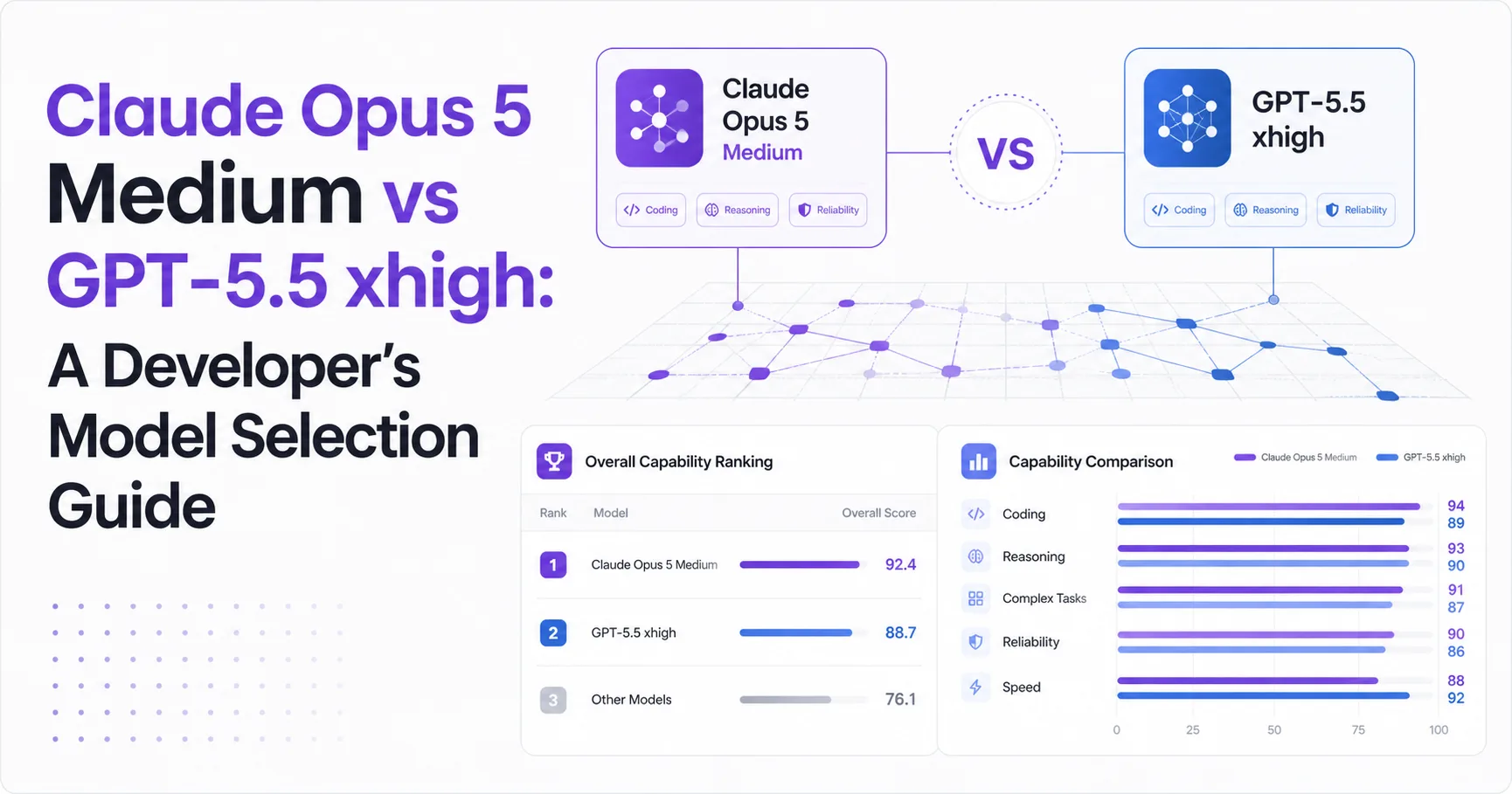
- **Winner overall:** GPT-5.5 (xhigh), 74.9 coding index edges Claude Opus 5 at 74.3, while Claude leads the intelligence index at 56.3. - **Cheaper:** Claude Opus 5 at $10 vs $11.25 per 1M blended tokens - **Faster:** Claude Opus 5 at 54.838 (median output tokens per second; GPT-5.5 has no supplied value) - **Pick GPT-5.5 (xhigh) when:** you prioritize tool-rich coding workflows and the 74.9 coding index over the lower blended price. - **Watch out:** latency is tied at 0.3 seconds, but the supplied data does not provide a GPT-5.5 output-speed value.
Claude Opus 5 Medium vs GPT-5.5 xhigh
GPT-5.5 (xhigh) is the stronger coding pick, while Claude Opus 5 offers the better measured general-intelligence and blended-cost profile.
The supplied Artificial Analysis snapshot gives GPT-5.5 a coding index of 74.9 versus 74.3 for Claude Opus 5. Claude leads the intelligence index at 56.3 versus 54.8. Claude also leads the supplied 3:1 blended price at $10 versus $11.25 per 1M blended tokens. Both list latency at 0.3 seconds, but only Claude has a median output speed value, 54.838 tokens per second.
Data provided by https://artificialanalysis.ai/
The comparison uses configuration labels rather than separate model identities. Anthropic documents claude-opus-5 with effort=medium in its model overview and Opus update. OpenAI documents gpt-5.5 with reasoning.effort=xhigh in its model page and latest-model guide.
That makes the choice workload-dependent. GPT-5.5 has the clearer coding signal. Claude has the clearer cost and general-intelligence signal. Speed remains unresolved.
Decision summary
Claude Opus 5 and GPT-5.5 split the decision: Claude leads the intelligence index and cost, while GPT leads the coding index.
| Decision axis | Claude Opus 5 | GPT-5.5 | Selection meaning |
|---|---|---|---|
| Coding index | 74.3 | 74.9 | GPT has the stronger coding result in the supplied snapshot |
| Intelligence index | 56.3 | 54.8 | Claude has the stronger general-intelligence result |
| 3:1 blended price per 1M tokens | $10 | $11.25 | Claude has the lower supplied blended cost |
| Input price per 1M tokens | $5 | $5 | Input-heavy workloads begin from the same rate |
| Output price per 1M tokens | $25 | $30 | Output-heavy workloads favor Claude’s listed rate |
| Latency | 0.3 seconds | 0.3 seconds | The supplied latency measure is tied |
| Median output speed | 54.838 tokens per second | Not reported | No controlled speed winner can be declared |
The table uses the Artificial Analysis data snapshot, not a universal production forecast. The coding and intelligence indexes describe different selection priorities. A coding agent may reasonably prefer GPT-5.5, while a broader reasoning workload may reasonably prefer Claude Opus 5.
Lifecycle posture is also asymmetrical. Anthropic’s model overview lists Claude Opus 5 as directly available without a deprecated or retired label. OpenAI’s GPT-5.5 model page still documents direct API use, while the current OpenAI model directory presents a broader newer-model lineup. Neither source establishes a shutdown date.
Official positioning differs as well. Anthropic’s release announcement emphasizes complex agentic coding and long-running autonomous work. OpenAI’s release announcement and latest-model guide emphasize complex professional work, coding, and tool-rich agents. These are positioning claims, not proof that either model wins every developer workflow.
Performance: what the indexes mean in practice
GPT-5.5 (xhigh) is the stronger coding benchmark pick, but the supplied data does not establish a faster model.
The coding index gives GPT-5.5 74.9 and Claude Opus 5 74.3. That supports GPT-5.5 as the default candidate for coding-centered agents. It does not show whether the edge comes from patch accuracy, planning, tool use, test repair, or task selection. The supplied snapshot does not provide enough detail to map the result directly to a repository.
Speed evidence is weaker. Claude reports 54.838 median output tokens per second. GPT-5.5 has no corresponding supplied value. Both models report 0.3-second latency. The fair conclusion is that Claude has the only measured output-speed signal in this comparison, not that Claude is definitively faster. A production bakeoff should measure time to accepted change, not only time to first token or token generation.
The official failure boundaries also differ. Anthropic warns that thinking tokens share the max_tokens ceiling and that responses may become longer, with more progress narration, verification, and delegation. These details appear in the Claude Opus 5 update. OpenAI warns that xhigh can cause overthinking, extra search, added delay, or quality regression when tools are too open or stopping rules are weak. The GPT-5.5 guide recommends explicit tests, acceptance criteria, delegation rules, and stop conditions.
Community evidence is mixed. A Claude Code user reports hours of editing, testing, and rework with good results. Other Opus feedback describes overplanning and missed work, while a separate speed report describes slow complex tasks. GPT-5.5 receives positive architecture and debugging feedback in this coding discussion, but other users report terse abstractions and fragile structures without strong constraints. None of these reports provides a controlled independent benchmark.
Cost: unit price versus task cost
Claude Opus 5 is cheaper on the supplied blended measure, yet workload shape and output length can change the operational winner.
The supplied 3:1 blended measure favors Claude at $10 versus $11.25 per 1M blended tokens. Input pricing is tied at $5, while output pricing is listed at $25 for Claude and $30 for GPT-5.5. Those rates make Claude the clear default for output-heavy workloads, assuming comparable token use and retry behavior. The underlying values come from the Artificial Analysis snapshot, with provider terms documented by Anthropic in its pricing page and by OpenAI in its API pricing.
The price chart cannot show the cost of behavior. Anthropic says Opus may produce longer responses, narrate progress more often, verify work, and delegate subtasks. Longer outputs can consume more budget even when the unit rate is lower. OpenAI says higher reasoning effort can add delay and cost, especially with open-ended tools or weak stopping rules. These constraints are described in the Claude update and GPT-5.5 guide.
Claude can therefore be cheaper per token but more expensive per accepted change if it overplans, retries, or makes unrequested edits. GPT-5.5 can justify its higher output rate if stronger orchestration reduces failed attempts or review work. The available evidence does not include task-level token counts, retry rates, review time, or accepted-change cost. That gap prevents a reliable production-cost winner beyond the supplied blended measure.
Recommendation by developer workflow
GPT-5.5 (xhigh) is the default for tool-rich coding agents, while Claude Opus 5 suits cost-sensitive, long-running implementation work.
Pick GPT-5.5 (xhigh) when coding execution is the primary objective. The supplied coding index is 74.9, and OpenAI documents support for function calling, structured outputs, file search, web search, Code Interpreter, hosted shell, computer use, and MCP in the GPT-5.5 model page. This makes GPT-5.5 a strong candidate for agents that need explicit tool orchestration and acceptance checks. The latest-model guide also makes the required safeguards clear: define reuse rules, delegation, tests, acceptance criteria, and stopping conditions.
Pick Claude Opus 5 when cost and sustained implementation matter more. Claude leads the supplied intelligence index at 56.3 and the blended price at $10. Anthropic positions Opus around complex agentic coding, multi-file development, review, and long-running work in the Opus update and official announcement. Community reports also describe strong results on extended coding tasks, although other users report overplanning, slow complex work, and unrequested changes.
Run a private bakeoff before committing either model to an important repository. Test the same issue set, repository rules, tool permissions, acceptance checks, and review process. Measure accepted changes, rework, total tokens, tool errors, and human correction time. The public evidence does not establish these production measures.
Configure the names correctly. Use claude-opus-5 with effort=medium, not claude-opus-5-medium, according to Anthropic’s model overview. Use gpt-5.5 with reasoning.effort=xhigh, according to OpenAI’s model documentation. Treat the labels as settings, not separate API model IDs.
Questions to answer before adoption
Claude Opus 5 and GPT-5.5 need different safeguards, so the best choice depends on control, workload, and evidence tolerance.
The supplied evidence supports a clear coding signal for GPT-5.5 at 74.9 and a clear intelligence signal for Claude Opus 5 at 56.3. It also supports a blended-cost advantage for Claude at $10 versus $11.25. It does not support a complete speed ranking because GPT-5.5 has no supplied median output-speed value, even though both models show 0.3-second latency.
The official guidance points to a shared lesson. GPT-5.5 needs explicit stopping rules and acceptance criteria, while Claude requires attention to output length, thinking-token limits, and autonomous tool behavior. Community reports reinforce the need for repository-specific testing. The GPT-5.5 guide, Claude update, and mixed GPT community discussion all support that caution.
Frequently asked questions
Which model should developers choose for coding agents?
Choose GPT-5.5 (xhigh) for a tool-rich coding agent when coding quality and explicit orchestration matter more than blended price and unmeasured speed. Its coding index is 74.9 versus Claude Opus 5 at 74.3, while OpenAI documents extensive tool support and recommends strict acceptance criteria.
Which model is cheaper in production?
Choose Claude Opus 5 as the cheaper default on the supplied blended measure, although real task cost depends on token volume, retries, output length, and tool behavior. Claude is listed at $10 versus GPT-5.5 at $11.25 per 1M blended tokens.
Is GPT-5.5 faster than Claude Opus 5?
GPT-5.5 is not proven faster here because the snapshot reports equal 0.3-second latency and no GPT-5.5 median output-speed value. Claude Opus 5 has the only supplied output-speed measurement, at 54.838 tokens per second, so a production test remains necessary.
Are Claude Opus 5 Medium and GPT-5.5 xhigh separate API models?
Neither label is a separate API model configuration. Anthropic documents claude-opus-5 with effort=medium, while OpenAI documents gpt-5.5 with reasoning.effort=xhigh; the provider documentation is available in the Anthropic model overview and OpenAI model page.
What is the main reliability risk with either model?
The shared reliability risk is weak orchestration around an otherwise capable model. Claude may overplan, narrate excessively, or make unrequested changes, while GPT-5.5 may overthink or produce fragile structures without clear constraints, tests, and stopping rules.
Sources
- Artificial AnalysisCoding index, intelligence index, pricing, latency, and output-speed values used in the comparison.
- Claude models overviewClaude Opus 5 model identity, API availability, configuration, and lifecycle status.
- What's new in Claude Opus 5Adaptive reasoning, effort settings, output behavior, tool limitations, and official positioning.
- Anthropic pricingClaude API pricing context.
- Introducing Claude Opus 5Anthropic's official positioning and stated capability boundaries.
- GPT-5.5 model documentationGPT-5.5 model identity, configuration, API availability, and supported tools.
- Using GPT-5.5Reasoning effort behavior, orchestration guidance, stopping rules, and known failure modes.
- OpenAI modelsCurrent model-directory positioning and lifecycle context.
- OpenAI API pricingGPT-5.5 pricing context and operational cost considerations.
- Introducing GPT-5.5OpenAI's official positioning and release context.
- Claude Opus 5 long-task feedbackCommunity report describing extended coding tasks with repeated edits, tests, and rework.
- Claude Opus 5 overplanning feedbackCommunity report describing overplanning and missed work.
- Claude Opus 5 speed feedbackCommunity report describing slow complex tasks and its lack of controlled comparison.
- GPT-5.5 architecture and coding workflow feedbackPositive community feedback on architecture, debugging, planning, and long project sessions.
- GPT-5.5 mixed coding feedbackCommunity reports about concise abstractions, fragile structures, domain modeling, and the need for stronger constraints.
Published: