
AI model analysis
Claude Opus 5 Medium vs GPT-5.6 Sol Max: Which Model Should Developers Choose?
A developer-focused comparison of Claude Opus 5 Medium and GPT-5.6 Sol Max across measured performance, throughput, cost, deployment, and workflow risk.
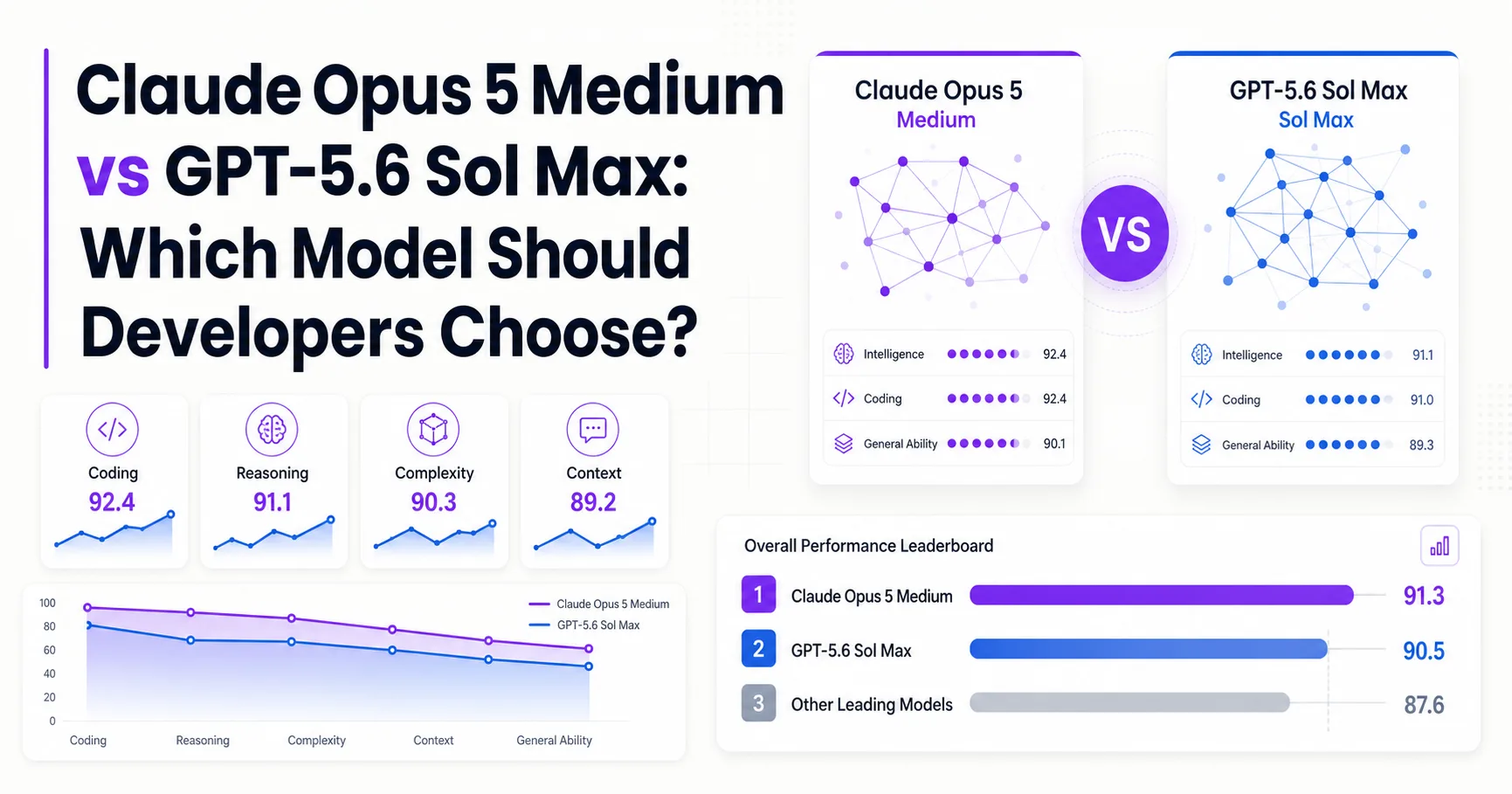
- **Winner overall:** GPT-5.6 Sol (max), with higher Artificial Analysis coding and intelligence scores at 77.4 and 58.9 - **Cheaper:** Claude Opus 5 (Adaptive Reasoning, Medium Effort) at $10 vs $11.25 per 1M blended tokens - **Faster:** GPT-5.6 Sol (max) at 77.617 median output tokens per second - **Pick Claude Opus 5 (Adaptive Reasoning, Medium Effort) when:** output economics matter more than the measured coding index, with $25 output tokens vs $30 - **Watch out:** measured latency is tied at 0.3 seconds, while real-world speed and effort-related token use remain unsettled by the supplied evidence
Claude Opus 5 Medium vs GPT-5.6 Sol Max: Executive Verdict
GPT-5.6 Sol (max) is the better default for performance-sensitive developer workloads, while Claude Opus 5 (Adaptive Reasoning, Medium Effort) is the better price-sensitive choice, according to Artificial Analysis.
The labels are easy to misread. Anthropic’s model overview identifies claude-opus-5 as the API model, while the Claude Opus 5 update describes effort=medium as a reasoning control. OpenAI’s model detail identifies gpt-5.6-sol, and the reasoning guide documents reasoning.effort=max. The supplied comparison therefore evaluates named configurations, not a setting-free model essence.
The official pages list current API availability for both models, so lifecycle status does not create a clear winner in the supplied evidence. See Anthropic’s model overview and OpenAI’s model catalog. Data provided by https://artificialanalysis.ai/.
The Decision in One View
GPT-5.6 Sol (max) wins the supplied aggregate comparison, while Claude Opus 5 (Adaptive Reasoning, Medium Effort) wins the blended price comparison, according to Artificial Analysis.
| Decision axis | Better fit | Evidence and implication |
|---|---|---|
| Measured coding and intelligence | GPT-5.6 Sol (max) | Coding index 77.4 versus 74.3, and intelligence index 58.9 versus 56.3. |
| Blended economics | Claude Opus 5 (Adaptive Reasoning, Medium Effort) | $10 versus $11.25 per 1M blended tokens. |
| Output-heavy economics | Claude Opus 5 (Adaptive Reasoning, Medium Effort) | $25 versus $30 per 1M output tokens. |
| Output throughput | GPT-5.6 Sol (max) | 77.617 versus 54.838 median output tokens per second. |
| Request startup | Tie | Latency is 0.3 seconds for each model. |
| Deployment shape | Depends on infrastructure | Claude supports the Claude API, Amazon Bedrock, Google Cloud, and Microsoft Foundry through Anthropic’s overview. GPT supports Responses API and Chat Completions, with an extensive tool surface documented in OpenAI’s model detail. |
That split creates a practical decision rule. GPT has the evidence edge for teams that value coding scores, reasoning scores, and sustained output throughput. Claude is more attractive when output cost, provider routing, or generated artifact volume dominates the workload.
Community signals do not overturn the measured result, but they do add operational caution. A Claude user describes long iterative coding tasks with repeated testing and rework in this report. Other users report overplanning and unnecessary testing in this comment. GPT users similarly report overdesign and uneven usage patterns in a Reddit test report. These reports are useful hypotheses, not production guarantees.
The central evidence gap is completion quality. The supplied materials do not measure successful task completion, repair count, tool-call correctness, reviewer effort, or cost per shipped change. Those outcomes should decide a final procurement choice.
Performance: Throughput Favors GPT, but Settings Matter
GPT-5.6 Sol (max) is the measured performance leader, but the evidence supports a workflow advantage rather than a universal quality verdict, according to Artificial Analysis.
The coding index is 77.4 for GPT-5.6 Sol and 74.3 for Claude Opus 5. That spread supports starting GPT on repository-wide changes, debugging, and code-agent tasks. The intelligence index points the same way, at 58.9 for GPT and 56.3 for Claude. These indices still summarize benchmark behavior, not completed pull requests, defect escape, or reviewer effort.
The clearest operational difference is output throughput: GPT records 77.617 median output tokens per second versus Claude at 54.838. Latency is tied at 0.3 seconds. GPT therefore has the stronger case for long streamed responses, while equal latency removes a reason to prefer either model for short requests. The supplied brief does not show end-to-end agent duration, so throughput should not be treated as task completion speed.
Official narratives are not directly aligned. Anthropic’s release highlights Frontier-Bench, CursorBench, ARC-AGI, Zapier AutomationBench, and OSWorld, while OpenAI’s release reports Agents’ Last Exam, BrowseComp, OSWorld, and security evaluations. The materials do not provide a shared, fully reproducible head-to-head setup, so vendor benchmark claims cannot replace the comparable Artificial Analysis indices.
Settings also limit the conclusion. Anthropic’s update says medium is an effort choice on Opus 5, and OpenAI’s reasoning guide says max increases reasoning work, latency, and cost. A GPT max result cannot be generalized to lower effort, and a Claude medium result cannot be generalized to higher effort.
Community reports are split. Users describe slow Claude experiences here and fast experiences here. GPT users report investigation sprawl in Hacker News, while lower effort reportedly improved one user’s experience. None of these reports supplies controlled task evidence.
Cost: Claude Wins Token Economics, but Invoice Shape Can Change
Claude Opus 5 is the safer cost default for output-heavy agents, while GPT-5.6 Sol becomes rational when higher throughput improves completed-task economics, according to Artificial Analysis.
Under the supplied blended metric, Claude costs $10 per 1M blended tokens versus $11.25 for GPT. Input pricing is $5 for each model, but output pricing is $25 for Claude and $30 for GPT. The practical implication is straightforward: workflows that generate long plans, patches, test output, or explanations will favor Claude’s invoice before retries and hidden reasoning are counted.
The chart cannot show invoice shape. Anthropic’s pricing includes prompt-caching options, while OpenAI’s pricing distinguishes standard, cached, batch, flex, fast, and long-context paths. OpenAI’s reasoning guide also says hidden reasoning tokens consume context and are billed as output. Anthropic’s update says thinking tokens share the max_tokens ceiling with the visible response. These mechanics can change the effective cost of a real agent, even when the listed blended price is stable.
A cheaper token is not always a cheaper shipped change. Extra retries, review time, tool mistakes, or over-scoped edits can dominate the invoice. Claude users report overplanning in one comment and unrequested changes in another. GPT users report overdesign and investigation sprawl in Reddit and Hacker News. The supplied briefs do not include cache hit rates, reasoning-token counts, retry counts, or cost per completed task. That is a material evidence gap, so finance comparisons should instrument completed work rather than extrapolate from token price alone.
Recommendation by Developer Workload
GPT-5.6 Sol (max) is the best default for performance-first coding agents, while Claude Opus 5 is the better fit for cost-sensitive, output-heavy workflows.
| Workload | Recommended choice | Why |
|---|---|---|
| Repository-wide coding, debugging, and tool-rich agents | GPT-5.6 Sol (max) | Higher supplied coding and throughput results, plus the Responses API tool surface. |
| Output-heavy generation, budget-constrained automation, and multi-provider enterprise routing | Claude Opus 5 (Adaptive Reasoning, Medium Effort) | Lower blended and output prices, plus documented access through Claude API, Amazon Bedrock, Google Cloud, and Microsoft Foundry in Anthropic’s overview. |
| Long-running autonomous coding | Pilot both | Anthropic emphasizes long-cycle agentic coding in its release, but community evidence reports sustained progress in one Claude account and overplanning in another. GPT community reports overdesign in a Reddit evaluation. |
| High-consequence changes | Choose by task evaluation | Neither brief measures tool-call correctness, completed-task rate, or human review cost. |
If a team must standardize on one model, GPT is the stronger starting point for the supplied performance data. Claude becomes the rational default when output cost, provider choice, or long generated artifacts dominate the workload. The choice should follow actual effort settings: effort=medium and reasoning.effort=max are not interchangeable controls, as Anthropic’s update and OpenAI’s reasoning guide explain.
Guardrails matter for both. Bound file scope, require tests before accepting changes, record tool calls, and reject unrequested diffs. Claude feedback includes reports of ignored instructions in this comment and extra changes in this comment, while GPT feedback includes reports of defensive or over-scoped implementation in Hacker News. Those reports are unverified community signals, so they justify controls and testing, not a blanket rejection.
The final recommendation is conditional: start with GPT for measured coding advantage and speed, keep Claude in the bake-off for lower output cost and deployment flexibility, and decide on completed-task data that the supplied briefs do not contain.
What to Validate Before Purchase
GPT-5.6 Sol (max) and Claude Opus 5 need a task-level evaluation before procurement because the supplied evidence stops short of completed-work metrics.
A useful bake-off should keep the repository, tools, prompts, acceptance tests, and effort settings fixed, then record success, retries, review burden, tool-call correctness, latency, and total cost. The official controls differ: Claude documents adaptive effort and OpenAI documents reasoning effort. The FAQ below answers the buying questions the supplied briefs leave open.
Frequently asked questions
Which model wins overall?
GPT-5.6 Sol (max) wins the supplied aggregate comparison because its Artificial Analysis coding index is 77.4 and intelligence index is 58.9, versus Claude Opus 5 at 74.3 and 56.3. Artificial Analysis supplies the comparable values, but the result does not predict every repository or agent workflow.
Which model is cheaper?
Claude Opus 5 is cheaper under the supplied blended metric at $10 per 1M blended tokens versus GPT-5.6 Sol at $11.25. Claude also lists $25 output tokens per 1M, while GPT lists $30. Anthropic’s pricing and OpenAI’s pricing show different billing controls, so caching, reasoning usage, retries, and completion length still need measurement.
Which model is faster?
GPT-5.6 Sol is faster on measured output throughput at 77.617 median output tokens per second versus Claude Opus 5 at 54.838, while latency is tied at 0.3 seconds. Artificial Analysis does not establish real-world agent completion time, because retries and tool work are not included.
Is Claude Medium comparable to GPT Max?
Claude Opus 5 Medium and GPT-5.6 Sol Max are configuration labels, not fully separate API model IDs: Anthropic documents claude-opus-5 with an effort control, while OpenAI documents gpt-5.6-sol with reasoning effort. The comparison is valid for those settings, not every deployment.
What should developers test before choosing?
Developers should test completed-task success, tool-call correctness, retry frequency, review burden, and total cost on their own repositories before choosing either model. The supplied briefs lack standardized measurements for those outcomes, while OpenAI’s model detail and Anthropic’s overview document different interfaces and deployment surfaces.
Sources
- Artificial AnalysisComparable coding, intelligence, throughput, latency, and pricing data.
- Claude Models OverviewClaude API model identity, availability, deployment platforms, and capabilities.
- What's New in Claude Opus 5Effort settings, adaptive reasoning, thinking behavior, output limits, and model configuration.
- Anthropic API PricingClaude token pricing and prompt-caching billing behavior.
- Introducing Claude Opus 5Anthropic's official positioning, benchmark claims, and agentic coding emphasis.
- OpenAI ModelsOpenAI model catalog, availability, and model positioning.
- GPT-5.6 Sol Model DetailsGPT model identity, API surfaces, tools, and deployment capabilities.
- Reasoning ModelsReasoning effort settings, max behavior, hidden reasoning tokens, latency, and cost implications.
- OpenAI API PricingOpenAI standard, cached, batch, flex, fast, and long-context billing paths.
- GPT-5.6: Frontier Intelligence That Scales With Your AmbitionOpenAI's official positioning and benchmark claims.
- Claude Opus 5 Long-Task FeedbackCommunity report describing sustained iterative coding work.
- Claude Opus 5 Overplanning FeedbackCommunity report describing overplanning and excessive testing.
- Claude Opus 5 Slow-Speed FeedbackCommunity report describing slow perceived performance.
- Claude Opus 5 Fast-Speed FeedbackCommunity report describing fast perceived performance.
- Claude Opus 5 Instruction-Following FeedbackCommunity report describing possible instruction drift.
- Claude Opus 5 Unrequested-Change FeedbackCommunity report describing unrequested modifications.
- I Spent Two Weeks Testing GPT-5.6Community report describing GPT overdesign and variable token usage.
- Ask HN: How Are You Productive With GPT-5.6 Sol?Community reports describing investigation sprawl, defensive coding, and effort-setting effects.
Published: