
AI model analysis
Claude Opus 5 vs GPT-5.6 Sol: Which Model Should Developers Choose?
A developer-focused comparison of Claude Opus 5 and GPT-5.6 Sol across capability, output speed, cost, APIs, reliability, and production fit.
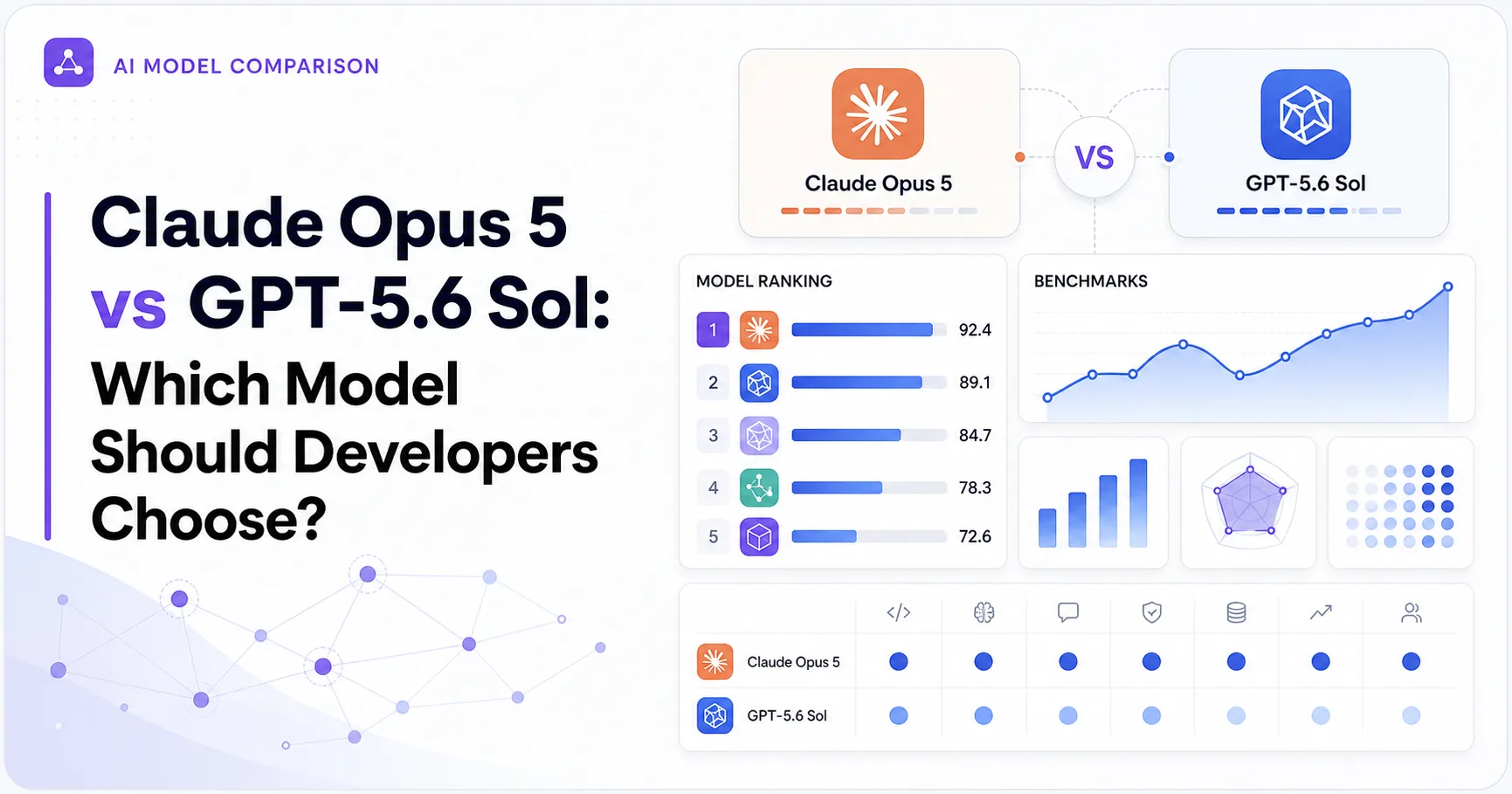
- **Winner overall:** Claude Opus 5 (Adaptive Reasoning, Max Effort), with 60.7 on the Intelligence Index and 78 on the Coding Index - **Cheaper:** Claude Opus 5 (Adaptive Reasoning, Max Effort) at $10 vs $11.25 per 1M blended tokens - **Faster:** GPT-5.6 Sol (max) at 77.617 (median output tokens per second) - **Pick Claude Opus 5 when:** quality-sensitive agentic coding matters more than speed, with a 78 coding index and $10 blended price - **Watch out:** Reported latency is tied at 0.3 seconds, but no controlled task-level study proves which model completes real work faster
Claude Opus 5 vs GPT-5.6 Sol
Claude Opus 5 (Adaptive Reasoning, Max Effort) is the stronger default for developers who value measured capability and lower blended cost over streaming speed. Artificial Analysis reports Claude Opus 5 at 60.7 on its Intelligence Index and 78 on its Coding Index. GPT-5.6 Sol (max) scores 58.9 and 77.4 on those same measures. GPT-5.6 Sol (max) produces output at 77.617 median tokens per second, compared with 60.088 for Claude Opus 5. Reported latency is tied at 0.3 seconds. The practical choice is therefore quality and cost versus completion throughput, not a universal victory.
Anthropic presents Claude Opus 5 as a model for complex agentic coding and enterprise work, with adaptive thinking and multimodal input in its launch announcement and model overview. OpenAI presents GPT-5.6 Sol as a flagship model for complex reasoning, programming, and professional work in its launch announcement and model page. Those descriptions establish intended use, not a matched test result. The briefs contain no controlled head-to-head suite covering the same prompts, tools, context sizes, or successful task costs. Treat the snapshot as a screening signal, then validate it with your workload.
Data provided by Artificial Analysis.
The comparison in one view
Claude Opus 5 (Adaptive Reasoning, Max Effort) wins measured quality and blended cost, while GPT-5.6 Sol (max) wins output speed and offers a different tool ecosystem.
| Signal | Claude Opus 5 | GPT-5.6 Sol | What it means |
|---|---|---|---|
| Artificial Analysis Intelligence Index | 60.7 | 58.9 | Claude has the higher supplied intelligence score |
| Artificial Analysis Coding Index | 78 | 77.4 | Claude has the higher supplied coding score |
| Median output tokens per second | 60.088 | 77.617 | GPT produces visible output faster |
| Reported latency | 0.3 seconds | 0.3 seconds | The supplied latency result is tied |
| Blended price per 1M tokens | $10 | $11.25 | Claude is cheaper on the supplied workload ratio |
These signals identify the default tradeoff, not a universal winner. Artificial Analysis supplies model-level measurements, but the brief does not include matched prompts, task success rates, intervention counts, or cost per successful completion.
Operational status is broadly favorable for both models. Anthropic lists Claude Opus 5 as Active in its model deprecations documentation. OpenAI’s current model catalog and GPT-5.6 Sol model page list GPT-5.6 Sol as callable without a Deprecated label. The briefs do not show a confirmed successor replacing either model.
The integration paths differ. Claude Opus 5 is available through the Claude API, Amazon Bedrock, Google Cloud, and Microsoft Foundry, according to the Anthropic model overview. GPT-5.6 Sol supports Responses API and Chat Completions, with a broad tool surface documented on the OpenAI model page. Vendor benchmark narratives also differ. Anthropic claims leading results across several agentic and coding evaluations, while OpenAI reports strong results across reasoning, browsing, coding, and security evaluations in its official announcement. Different benchmark families and protocols prevent those claims from settling this comparison.
Community evidence is split. Claude users report strong performance on complex work, alongside verbosity, overthinking, and task drift in the ClaudeCode discussion and ClaudeAI discussion. GPT users report similar overengineering and investigation drift in the Reddit testing report and Hacker News discussion. None of these reports provides a standardized test method.
Performance: speed is clear, task superiority is not
GPT-5.6 Sol (max) is the faster streaming choice, while Claude Opus 5 (Adaptive Reasoning, Max Effort) holds the measured capability lead. Artificial Analysis reports GPT-5.6 Sol at 77.617 median output tokens per second and Claude Opus 5 at 60.088. With reported latency tied at 0.3 seconds, the clear measured advantage is sustained output rate.
That distinction matters for developer experience. Faster output can make a long streamed answer, code patch, or investigation feel more responsive after generation begins. It does not prove faster first-token delivery, faster tool execution, faster error recovery, or faster completion of a successful task. The supplied brief names output speed and latency, but it does not define a workflow-level completion metric. Developers should therefore treat the speed result as a throughput signal rather than a complete productivity result.
Claude Opus 5 leads the supplied coding index at 78, while GPT-5.6 Sol records 77.4. Claude also leads the supplied intelligence index at 60.7 versus 58.9. Those results favor Claude directionally, but the brief does not explain how the score gaps map to repository size, tool reliability, test coverage, or human review time. A small model-level lead may disappear if a workflow values response speed, structured tool calls, or predictable brevity more heavily.
Reasoning configuration can change the experience substantially. Claude Opus 5 enables adaptive thinking by default and exposes effort levels through the Anthropic model documentation. GPT-5.6 Sol exposes reasoning effort options and a pro mode for harder tasks through the OpenAI reasoning guide. Higher effort can improve difficult work, but the guide also warns that it increases reasoning token use, latency, and cost.
Community reports reinforce the need for workload testing. Claude users describe excessive thinking, long responses, and occasional instruction drift in the ClaudeCode discussion. GPT users describe broad investigations, defensive code, and over-designed implementations in the GPT-5.6 Reddit report and Sol Hacker News thread. These observations are useful risk signals, but they do not establish stable failure rates.
The evidence gap is specific: neither brief provides comparable pass rates, tail latency, token usage per successful task, or human intervention requirements. Those missing measurements matter more than a small index difference for production agent design.
Cost: Claude wins the sticker price, but workload shape decides the bill
Claude Opus 5 (Adaptive Reasoning, Max Effort) is the lower-cost choice on the supplied blended workload assumption, but GPT-5.6 Sol (max) can justify its premium when faster completion reduces waiting or review friction. Artificial Analysis places Claude Opus 5 at $10 and GPT-5.6 Sol at $11.25 per 1M blended tokens.
The input price is tied at $5 per 1M tokens. The output price favors Claude Opus 5 at $25 versus $30 for GPT-5.6 Sol. That difference matters most when responses, reasoning, generated code, or tool summaries consume a large share of usage. Input-heavy workloads narrow the direct price advantage because the supplied input rates are equal.
The blended figure is useful for screening, but it hides traffic shape. A service with short prompts and brief outputs will behave differently from an agent that repeatedly sends repository context, requests long patches, and performs several verification loops. The brief does not provide cache-hit rates, retry rates, average output size, or cost per successful task. Without those measurements, no reader can prove that the cheaper model produces the cheaper shipped result.
Reasoning tokens create another source of uncertainty. Anthropic documents that thinking tokens and visible response text share the max_tokens ceiling in its Opus 5 update notes. OpenAI states that reasoning tokens occupy the context window and are billed as output tokens in its reasoning guide. A model that spends more hidden work can therefore consume more budget even when the visible answer looks similar.
The vendors also expose different pricing controls. Anthropic documents prompt caching and a Fast mode in its pricing documentation. OpenAI documents Standard, Batch, Flex, and Fast modes in its API pricing documentation. These options can materially change the preferred model for batch workloads, cached prompts, or latency-sensitive traffic. The supplied comparison does not model those policies, so production teams should compare complete runs under the same routing and caching rules.
Recommendation by developer workload
Claude Opus 5 (Adaptive Reasoning, Max Effort) is the better starting point for quality-sensitive agentic coding, while GPT-5.6 Sol (max) fits latency-sensitive workflows with a mature OpenAI tool path. The recommendation follows the supplied quality, speed, and price signals, plus the vendors’ documented positioning.
Choose Claude Opus 5 when the workflow has difficult repository changes, multi-step reasoning, or a high cost of incorrect implementation. Anthropic explicitly positions the model for complex agentic coding and enterprise work in its official announcement. Claude’s higher supplied intelligence and coding scores support that starting point. Its lower blended price also helps when generated output is a large part of total usage. Claude’s documented availability across the Claude API, Amazon Bedrock, Google Cloud, and Microsoft Foundry may also matter for teams that need provider choice, as described in the model overview.
Choose GPT-5.6 Sol when visible response speed is central to the product experience. Its 77.617 median output tokens per second is higher than Claude Opus 5’s 60.088 in the supplied data. GPT-5.6 Sol also offers Responses API integrations for function calling, structured output, hosted tools, computer use, MCP, and related workflows, according to the GPT-5.6 Sol model page. An existing OpenAI stack may therefore reduce integration work even if the model-level blended price is higher.
Use explicit controls for either model. Anthropic recommends keeping thinking enabled because disabled thinking can cause tool calls to appear as ordinary text or expose internal XML markers, according to the Opus 5 update notes. OpenAI recommends selecting higher reasoning effort only when measured gains justify additional cost and latency, according to the reasoning guide. Community reports suggest that concise instructions and lower effort can improve practical usability, but those reports remain anecdotal in the ClaudeAI thread and Sol discussion.
Keep the capability boundaries in scope. Anthropic states that Opus cyber safeguards block binary vulnerability scanning, penetration testing, and exploit generation outside its verification program in the launch announcement. OpenAI documents that GPT-5.6 Sol does not support audio input, video input, or fine-tuning on its model page. Those constraints can outweigh benchmark leadership for specialized products.
The final decision should come from a representative evaluation. Run the same tasks, tools, acceptance checks, and context policies through both models. Record successful completion, human intervention, visible latency, total tokens, retries, and shipped defects. The briefs do not provide those workflow-level results, so a universal production winner would be overstated.
What the supplied evidence still cannot answer
Claude Opus 5 (Adaptive Reasoning, Max Effort) and GPT-5.6 Sol (max) require task-specific validation because the supplied evidence does not include a controlled head-to-head production test.
The official materials support different narratives. Anthropic emphasizes complex agentic coding, enterprise work, and broad benchmark leadership in its Claude Opus 5 announcement. OpenAI emphasizes complex reasoning, programming, professional work, and results across its own evaluation set in the GPT-5.6 announcement. Those claims are credible descriptions of vendor intent, but they do not share a common task set or protocol.
The community evidence is similarly mixed. Some Claude users describe strong complex-task performance, while others report verbosity and overthinking in the ClaudeCode discussion. Sol users report overengineering and broad investigations in the Reddit test report and Hacker News thread. These reports identify failure modes worth testing, not probabilities worth assuming.
The missing answer is workflow economics. The briefs do not show which model completes a real task with fewer retries, fewer human corrections, or less total token use. That is the evidence a developer should collect before committing to a default.
Frequently asked questions
Which model is the overall winner for most developers?
Claude Opus 5 is the better default in this snapshot because it leads both supplied Artificial Analysis indices and costs less on the blended measure. GPT-5.6 Sol remains the better fit when faster streamed output matters more than that quality and price advantage. Artificial Analysis
Which model should I choose for interactive coding?
GPT-5.6 Sol is the stronger candidate for interactive coding when visible response speed dominates, because its median output speed is 77.617 tokens per second versus 60.088 for Claude Opus 5. Claude Opus 5 remains attractive when task quality and adaptive reasoning matter more. Artificial Analysis OpenAI reasoning guide
Is Claude Opus 5 always cheaper in production?
Claude Opus 5 is cheaper on the supplied blended price and output rate, but production cost is not guaranteed to stay lower. Reasoning tokens, cache behavior, long-context pricing, retries, and task success can change total spend, while the brief provides no cost-per-success measure. Anthropic pricing OpenAI pricing
Should I trust the community complaints?
Community complaints are useful risk signals, not settled benchmarks. Users of both models report verbosity, overengineering, task drift, or excessive reasoning, but the linked discussions lack controlled tasks and consistent measurements. Test representative workflows with your own prompts, tools, and acceptance checks. ClaudeCode discussion Sol discussion
What evidence is still missing before a final decision?
A final decision still needs matched task success rates, complete-run cost, intervention counts, and tail latency under your tool stack. The supplied snapshot gives model-level indices, median output speed, reported latency, and prices, but not those workflow-level measures. Artificial Analysis
Sources
- Artificial AnalysisComparison metrics, pricing snapshot, output speed, latency, and required data attribution
- Introducing Claude Opus 5Anthropic positioning, official benchmark claims, cyber limitations, and agentic coding scope
- Models overviewClaude capabilities, adaptive reasoning, model availability, and provider access
- What’s new in Claude Opus 5Thinking behavior, effort settings, tool-call behavior, and token limits
- Anthropic pricingClaude standard pricing, prompt caching, and Fast mode
- Model deprecationsClaude Opus 5 active lifecycle status
- The Opus 5 ExperienceCommunity reports about Claude coding quality, verbosity, overthinking, and task drift
- Is Opus 5 actually that bad, or is it just Reddit hype?Community disagreement and anecdotal reports about Claude behavior
- Claude Opus 5Community feedback about visual workflows and excessive task exploration
- OpenAI ModelsOpenAI model catalog and current model availability
- GPT-5.6 SolGPT capabilities, APIs, tools, modality limits, model status, and pricing behavior
- Reasoning modelsReasoning effort, pro mode, reasoning token cost, latency, and context behavior
- OpenAI API PricingOpenAI Standard, Batch, Flex, and Fast pricing modes
- GPT-5.6: Frontier intelligence that scales with your ambitionOpenAI positioning, release context, and official benchmark claims
- I spent two weeks testing GPT-5.6. Here’s what I found.Community reports about GPT overengineering, token use, and coding behavior
- Ask HN: How are you productive with GPT 5.6 Sol?Community feedback about investigation drift, reasoning effort, and practical coding experience
Published: