
AI model analysis
Claude Opus 5 vs GPT-5.6 Sol (high): Which Model Should Developers Choose?
A developer-focused comparison of Claude Opus 5 and GPT-5.6 Sol (high), covering coding quality, speed, cost, operational risks, and practical model selection.
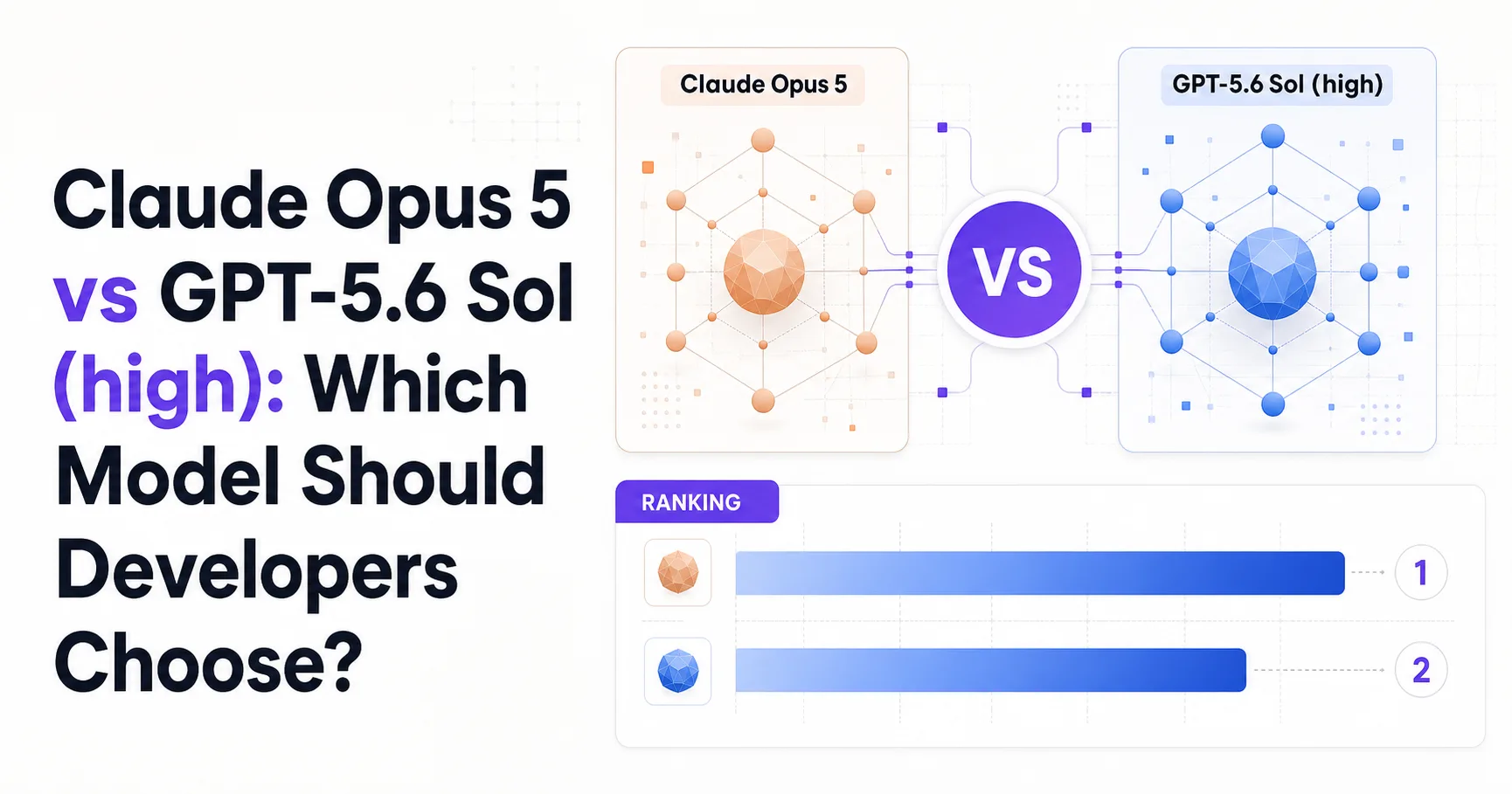
- **Winner overall:** Claude Opus 5, with a 60.7 Intelligence Index and 78 Coding Index - **Cheaper:** Claude Opus 5 at $10 vs $11.25 per 1M blended tokens - **Faster:** GPT-5.6 Sol (high) at 73.648 median output tokens per second - **Pick Claude Opus 5 when:** coding quality, broad reasoning performance, and lower output cost matter most - **Watch out:** Community reports on speed, verbosity, and over-engineering remain anecdotal rather than standardized evidence
Claude Opus 5 vs GPT-5.6 Sol (high)
Claude Opus 5 is the stronger default for developers who value broad reasoning quality and lower blended cost, while GPT-5.6 Sol (high) is the better fit when generated output speed is the main constraint. The Artificial Analysis snapshot gives Claude Opus 5 a 60.7 Intelligence Index and a 78 Coding Index, compared with 55.9 and 77.2 for GPT-5.6 Sol (high). GPT-5.6 Sol (high) produces output at 73.648 median tokens per second, compared with 60.088 for Claude Opus 5. The measured latency is 0.3 seconds for each model. Data provided by https://artificialanalysis.ai/\n\nThe comparison is more nuanced than a simple benchmark ranking. Anthropic positions Claude Opus 5 around complex agentic coding and enterprise work, while OpenAI positions GPT-5.6 Sol around complex professional work, reasoning, and coding. Anthropic’s launch announcement and OpenAI’s launch announcement describe different evaluation programs, so their headline results do not establish a direct head-to-head winner.
Executive summary for model selection
Claude Opus 5 is the better overall choice when developers need the strongest combined reasoning and coding profile at the lower blended price. The measured advantage is clearest on the Intelligence Index, where Claude Opus 5 scores 60.7 versus 55.9 for GPT-5.6 Sol (high). Its Coding Index lead is smaller, at 78 versus 77.2, so the coding decision should depend on workflow details rather than the score alone.\n\n| Selection factor | Better fit | Why it matters |\n|—|—|—|\n| Broad reasoning | Claude Opus 5 | Higher Intelligence Index in the supplied snapshot |\n| Coding benchmark position | Claude Opus 5 | Narrowly higher Coding Index |\n| Output speed | GPT-5.6 Sol (high) | Higher median output rate |\n| Blended cost | Claude Opus 5 | Lower price in the supplied three-to-one blended measure |\n| First-response latency | Tie | The supplied latency is 0.3 seconds for each model |\n\nClaude Opus 5 also offers adaptive thinking and configurable effort levels through the Claude API and Claude Code. Anthropic’s model overview describes the model’s text and image input, multilingual, and vision support. GPT-5.6 Sol supports reasoning controls, structured outputs, function calling, hosted tools, and several API surfaces. OpenAI’s model page and reasoning guide document those controls.\n\nThe evidence does not answer which model is more reliable on a developer’s specific repository, framework, or agent harness. Neither supplied research brief provides a standardized, independently reproduced comparison of the two models on the same task set. Treat the snapshot as a decision signal, then validate with representative tasks from your own codebase.
Performance: what the speed and score gap means
GPT-5.6 Sol (high) is the faster generator, but Claude Opus 5 has the stronger measured quality profile for developers who can tolerate slower token emission. The supplied snapshot reports 73.648 median output tokens per second for GPT-5.6 Sol (high) and 60.088 for Claude Opus 5, while latency is 0.3 seconds for each model. That combination suggests GPT-5.6 Sol (high) may complete visible responses sooner once generation begins, but it does not prove faster end-to-end task completion.\n\nFor interactive coding, output speed matters most when the task requires long explanations, large patches, or repeated tool results. It matters less when the model spends time reasoning, waiting for tools, or receiving repository context. OpenAI states that reasoning tokens consume the output budget and can cause an incomplete response when the limit is too low. The OpenAI reasoning guide therefore makes configuration part of the performance decision. A fast stream can still produce a poor developer experience if the response ends before the required patch or explanation is complete.\n\nClaude Opus 5’s Coding Index is 78 versus 77.2 for GPT-5.6 Sol (high), a narrow difference that should not be treated as proof that Claude wins every coding task. Anthropic claims leadership across several agentic, coding, browsing, and computer-use evaluations, with methodology details supplied for some tests. Anthropic’s announcement provides that official context. OpenAI reports strong results across coding, browsing, operating-system, and security evaluations, but its announcement does not provide a separate score for the high reasoning configuration. OpenAI’s announcement supplies the published results and their scope.\n\nThe qualitative evidence is mixed for both models. Some Claude users report strong performance on complex, long-running tasks, while others describe verbosity, slow behavior, and excessive reasoning. ClaudeCode discussion and Claude community discussion provide those reports, but neither uses a reproducible test method. GPT-5.6 Sol users report over-engineering, slow small changes, and investigations that drift off course. The Codex discussion and Hacker News discussion describe those risks without establishing their frequency. A separate limited Hacker News rewrite test covers only one task, so it cannot settle general coding performance.
Cost: the cheaper model can still cost more in practice
Claude Opus 5 is cheaper on the supplied blended measure, but GPT-5.6 Sol (high) can be economically reasonable when faster output reduces developer waiting or orchestration overhead. The snapshot lists $10 for Claude Opus 5 and $11.25 for GPT-5.6 Sol (high) per 1M blended tokens. Input pricing is equal at $5, while output pricing is $25 for Claude Opus 5 and $30 for GPT-5.6 Sol (high).\n\nThe visible price gap understates the operational question. A coding agent may spend money on repeated attempts, unnecessary defensive code, verbose explanations, or tool calls that do not improve the final patch. Community reports associate both models with some of these behaviors, but the reports do not measure extra token use consistently. Claude user reports mention long responses and overthinking. GPT-5.6 Sol reports mention defensive implementation and investigation drift. These are risk indicators, not verified cost multipliers.\n\nGPT-5.6 Sol also has pricing modes and long-context rules that can change the economics of a deployment. OpenAI’s pricing documentation distinguishes standard, batch, flex, and fast pricing, and states that longer inputs receive higher pricing. Claude offers prompt caching with separate write and cache-hit prices. Anthropic’s pricing documentation describes those options and the standard input and output rates.\n\nThe evidence is insufficient to declare a universal cost winner for long-running agents. The supplied data compares blended token prices, not total task cost, retry rates, tool-call counts, or human correction time. Claude Opus 5 is the safer starting point for a budget-sensitive workload. GPT-5.6 Sol (high) deserves a pilot when faster generation could reduce interaction time or improve throughput.
Recommendation by developer workflow
Claude Opus 5 is the recommended default for high-value coding agents, while GPT-5.6 Sol (high) is the better alternative for speed-sensitive workflows with strong output controls. Claude’s higher Intelligence Index, slightly higher Coding Index, and lower blended price create the strongest general selection case in the supplied data. GPT-5.6 Sol (high) remains attractive because its output rate is higher and its API exposes broad reasoning and tool controls.\n\nChoose Claude Opus 5 for repository-wide refactors, complex debugging, multi-step implementation, and workflows where reasoning quality matters more than streaming speed. Anthropic documents adaptive thinking, effort controls, tool changes during a conversation, and fallback behavior in the Opus five update notes. Developers should account for the model’s tendency toward longer responses and more visible progress narration, which Anthropic lists among behavior changes.\n\nChoose GPT-5.6 Sol (high) for interactive agents where visible generation speed is a primary product requirement, especially when structured outputs, hosted tools, or OpenAI-native integrations simplify the surrounding system. OpenAI’s model documentation lists those capabilities. Set output budgets carefully because reasoning tokens share the generation limit.\n\nNeither model should be selected solely from vendor benchmark announcements. Anthropic’s published evaluation claims and OpenAI’s published evaluation claims use different suites and reporting contexts. The official materials therefore support capability positioning, not a controlled comparison. The same limitation applies to community evidence. Hacker News feedback about Claude raises concerns about pursuing incorrect visual workflows, while GPT-5.6 Sol users report configuration-sensitive behavior. Those observations deserve targeted tests, not blanket conclusions.\n\nA practical pilot should use the same repository, prompts, tools, approval rules, and success criteria for each model. Measure completed task rate, human correction time, unnecessary change scope, tool-call failures, and total token cost. The supplied research does not provide those measurements, so the final choice remains workload-dependent.
FAQ before choosing a model
Claude Opus 5 is the safer first candidate when the team wants a balanced combination of reasoning quality, coding quality, and lower blended token cost. GPT-5.6 Sol (high) is the stronger candidate when faster output and OpenAI-native tool integration carry more weight. The supplied evidence does not establish a universal winner for every repository or agent design.
Frequently asked questions
Is Claude Opus 5 better than GPT-5.6 Sol (high) for coding?
Claude Opus 5 is the stronger measured coding choice in the supplied snapshot, but its Coding Index advantage is narrow and does not prove superiority on every framework, repository, or agent workflow.
Which model is faster for developer-facing applications?
GPT-5.6 Sol (high) is faster by the supplied median output measurement, while the reported latency is equal, so perceived application speed still depends on reasoning, tools, response length, and orchestration.
Which model is cheaper for production use?
Claude Opus 5 is cheaper on the supplied blended-token measure and has the lower output price, but retries, verbose responses, caching, long context, and human correction can change total production cost.
Should developers use the highest reasoning setting by default?
Developers should not assume the highest reasoning setting is always optimal because the supplied community evidence reports overthinking and drift, while official documentation warns that reasoning tokens consume the output budget.
Does the research prove which model is more reliable?
The research does not prove a reliability winner because community reports lack standardized testing and the official benchmark announcements use different evaluation suites, task conditions, and reporting contexts.
Sources
- Artificial AnalysisSupplied benchmark, speed, latency, and pricing snapshot attribution
- Introducing Claude Opus 5Anthropic positioning, official evaluation claims, and capability limitations
- GPT-5.6: Frontier intelligence that scales with your ambitionOpenAI positioning and official evaluation claims
- Models overviewClaude capabilities, modalities, adaptive reasoning, and deployment information
- GPT-5.6 Sol model pageGPT-5.6 Sol capabilities, tools, APIs, and model information
- Reasoning modelsReasoning controls, token budgets, and incomplete response behavior
- What’s new in Claude Opus 5Claude thinking controls, effort settings, tool changes, fallback behavior, and behavior changes
- The Opus 5 ExperienceAnecdotal Claude coding feedback about verbosity, speed, and complex tasks
- Is Opus 5 actually that bad, or is it just Reddit hype?Anecdotal Claude feedback and lack of standardized testing
- Claude Opus 5 Hacker News discussionCommunity concern about incorrect visual workflows and excessive token use
- GPT-5.6 Sol / Codex Release Discussion MegathreadAnecdotal GPT-5.6 Sol feedback about speed and over-engineering
- Ask HN: How are you productive with GPT 5.6 Sol?Anecdotal GPT-5.6 Sol feedback about investigation drift, defensive code, and reasoning settings
- Is GPT-5.6 Sol Max Worth It?A limited single-task rewrite test and its methodological limitation
- Anthropic pricingClaude standard pricing and prompt caching economics
- OpenAI API pricingGPT-5.6 Sol service tiers, pricing modes, and long-context pricing rules
Published: