
AI model analysis
Claude Opus 5 vs GPT-5 mini: Which Model Should Developers Choose?
A developer-focused comparison of Claude Opus 5 and GPT-5 mini across coding, reasoning, speed, cost, availability, and production risk.
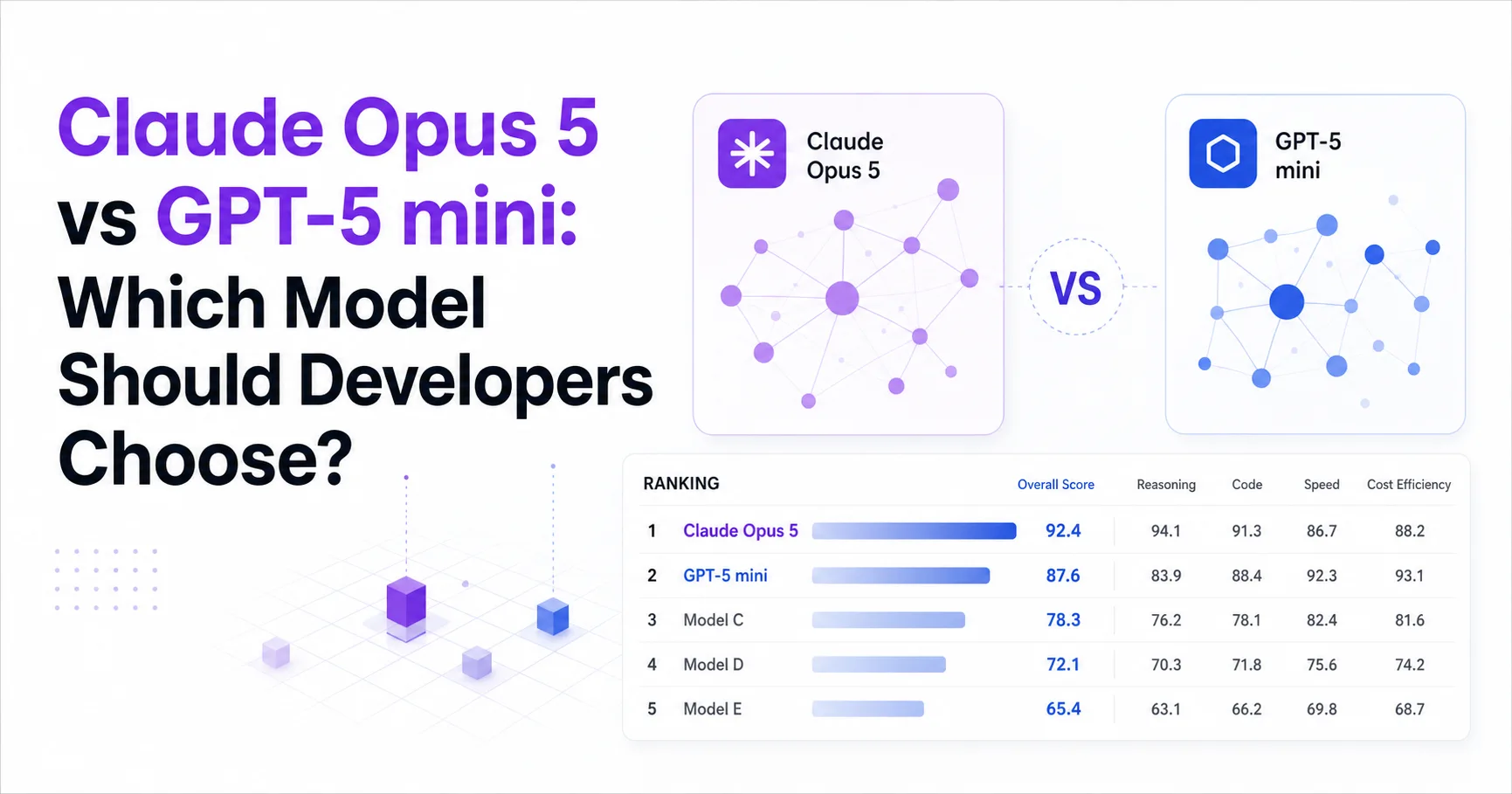
- **Winner overall:** Claude Opus 5, with an Artificial Analysis coding index of 78 vs 15.6 - **Cheaper:** GPT-5 mini at $0.6875 vs $10 per 1M blended tokens - **Faster:** Claude Opus 5 at 60.088 median output tokens per second - **Pick Claude Opus 5 when:** complex coding, agentic workflows, or long-context enterprise work matters more than price - **Watch out:** GPT-5 mini’s current API availability, capabilities, pricing, and speed are not confirmed by the cited OpenAI pages
Claude Opus 5 vs GPT-5 mini
Claude Opus 5 is the safer production choice for complex developer workflows, while GPT-5 mini is the lower-cost option with major evidence gaps. Anthropic positions Claude Opus 5 for complex agentic coding and enterprise work, with a release date of 2026-07-24 and the stable API ID claude-opus-5 (Anthropic). The current Artificial Analysis snapshot gives Claude Opus 5 a coding index of 78 and an intelligence index of 60.7. GPT-5 mini scores 15.6 on the coding index and 25.3 on the intelligence index in the supplied data. The same snapshot gives GPT-5 mini a math index of 90.7, but Claude Opus 5 has no corresponding math value, so that result cannot establish a model winner.\n\nThe comparison has an important asymmetry. Claude Opus 5 has detailed official documentation for its interface, context, reasoning controls, lifecycle, pricing, and known behavior changes. The cited OpenAI model directory does not list gpt-5-mini, and the cited pricing page does not list its pricing (OpenAI Models, OpenAI Pricing). GPT-5 mini may still be attractive for workloads where unit cost dominates, but the supplied sources do not establish how a developer should call it today.\n\nData provided by https://artificialanalysis.ai/.
Executive summary for developers
Claude Opus 5 leads this comparison on measured coding and general intelligence, while GPT-5 mini leads on listed price.\n\n| Decision factor | Claude Opus 5 | GPT-5 mini | Practical reading |\n|—|—:|—:|—|\n| Coding index | 78 | 15.6 | Claude has the stronger evidence for code-heavy work |\n| Intelligence index | 60.7 | 25.3 | Claude has the stronger broad capability signal |\n| Math index | Not provided | 90.7 | GPT has a specialized result, but there is no comparable Claude score |\n| Blended price per 1M tokens | $10 | $0.6875 | GPT is listed at a much lower unit cost |\n| Input price per 1M tokens | $5 | $0.25 | GPT is cheaper for large prompt volumes |\n| Output price per 1M tokens | $25 | $2 | GPT is cheaper for generated text |\n| Latency | 0.3 seconds | 0.3 seconds | The supplied snapshot reports a tie |\n\nThe measured gap matters most for tasks where the model must understand an unfamiliar codebase, preserve constraints across multiple files, or decide which tools to call. Anthropic documents a 1M-token context window for Claude Opus 5 and a default adaptive-thinking setup (Models overview, What’s new in Claude Opus 5). That makes Claude easier to evaluate for long repository tasks. The sources do not confirm an equivalent GPT-5 mini context window.\n\nThe price difference changes the decision for high-volume classification, extraction, routing, or simple transformation. Yet a low token price does not prove a lower application cost. More retries, human review, additional orchestration, or an unverified model endpoint can erase the apparent saving. The supplied evidence does not quantify any of those downstream costs.
Performance: what the gap means in real engineering work
Claude Opus 5 is the stronger evidence-backed choice for multi-step coding and agentic work, but the supplied data cannot prove that it is faster in every interactive workflow.\n\nThe Artificial Analysis coding index is 78 for Claude Opus 5 and 15.6 for GPT-5 mini. That difference is large enough to change the shape of an application. A coding agent with stronger task completion may need fewer repair cycles, produce fewer invalid edits, and spend less time recovering from misunderstood requirements. Those effects are plausible consequences of the benchmark gap, not directly measured outcomes in the supplied brief. Teams should validate them against their own repositories before converting the index into a staffing or latency forecast.\n\nClaude Opus 5 reports a median output speed of 60.088 tokens per second. GPT-5 mini has no speed value in the snapshot, so the evidence does not support a winner for streaming throughput. Both models show latency of 0.3 seconds in the supplied data. That tie should not be read as identical user experience because first-token timing, output length, reasoning behavior, tool calls, and retries can all affect perceived responsiveness.\n\nClaude’s default thinking behavior creates a specific performance tradeoff. Anthropic says thinking is enabled by default, and max_tokens covers both thinking tokens and visible response text (What’s new in Claude Opus 5). A previously small output limit can therefore leave too little room for the final answer. Anthropic also documents longer responses, more progress narration, more active delegation, and repeated validation as behavior changes. Community discussions report similar complaints about verbosity, slow-feeling simple tasks, and over-scoping, but those reports lack reproducible test methods (ClaudeCode Reddit discussion, ClaudeAI Reddit discussion).\n\nThe evidence gap is wider for GPT-5 mini. The cited OpenAI directory does not provide a dedicated entry, official benchmark, confirmed tool specification, or documented failure profile for gpt-5-mini (OpenAI Models). Developers should treat its performance as an open validation question, not as a known fast alternative.
Cost: the cheap model can become expensive after failure
GPT-5 mini is the clear listed-price winner, but Claude Opus 5 may be cheaper at the workflow level when failures require expensive recovery.\n\nThe supplied data lists GPT-5 mini at $0.6875 per 1M blended tokens, compared with $10 for Claude Opus 5. GPT-5 mini also has lower listed input and output prices, at $0.25 and $2 per 1M tokens, compared with $5 and $25 for Claude Opus 5. Those prices favor GPT-5 mini for predictable, high-volume tasks where each request is narrow and errors are inexpensive.\n\nThe price comparison becomes less decisive for coding agents. A failed patch can trigger another model call, a test run, a repair attempt, a review pass, and a human escalation. The supplied data contains no retry rate, task-success rate, human-review rate, or total workflow cost. Therefore, it cannot establish the cheaper model for a complete engineering process. The coding-index gap suggests that task success deserves measurement beside token price, but it does not provide a conversion from benchmark points to dollars.\n\nClaude Opus 5 also supports prompt caching. Anthropic lists a minimum cacheable prompt length of 512 tokens and documents separate write and cache-hit prices (Pricing, What’s new in Claude Opus 5). Repeated repository instructions, schemas, or stable policy text may therefore have a different cost profile from one-off prompts. The brief provides no comparable GPT-5 mini caching terms.\n\nThe most serious cost risk is procurement uncertainty. The cited OpenAI pricing page does not list GPT-5 mini, so the supplied sources cannot confirm whether $0.6875 is currently purchasable, under which API, or with which service limits (OpenAI Pricing). Treat the data snapshot as a comparison input, then verify the endpoint and invoice terms before committing architecture to the cheaper option.
Recommendation by workload
Claude Opus 5 is the default recommendation for production coding agents, while GPT-5 mini deserves a controlled pilot for cost-sensitive, low-risk workloads.\n\nChoose Claude Opus 5 for repository-scale code changes, autonomous debugging, tool-driven implementation, and enterprise workflows that depend on a documented model contract. Anthropic documents text and image input, text output, multilingual capability, vision, a 1M-token context window, adaptive thinking, and availability through the Claude API, Amazon Bedrock, Google Cloud, and Microsoft Foundry (Models overview, What’s new in Claude Opus 5). Anthropic also lists Claude Opus 5 as an Active model without a published deprecation date (Model deprecations).\n\nChoose GPT-5 mini when the workload is cheap to retry, the prompt and output are bounded, and the team can first verify the actual API identity, model availability, pricing, and tool behavior. The listed math index of 90.7 may justify a focused mathematical evaluation, but there is no matching Claude value and no official GPT-5 mini benchmark announcement in the supplied brief.\n\nAvoid making either model the sole authority for security-sensitive automation. Anthropic says Claude Opus 5 blocks binary vulnerability scanning, penetration testing, and exploit generation unless the relevant Cyber Verification Program applies (Claude Opus 5 announcement). Anthropic also says long-running autonomous biological research remains limited. Those constraints matter if the product crosses security or scientific-research boundaries.\n\nThe unresolved question is GPT-5 mini’s production contract. The cited OpenAI sources do not confirm its current status, stable alias, context window, output limit, reasoning controls, tools, failure modes, or price. That evidence gap is itself a selection risk, even if the listed token price is compelling.
Questions to answer before choosing
Claude Opus 5 is easier to approve today because its documented interface and lifecycle reduce unknowns for production planning. The questions below address decisions the supplied benchmark data cannot settle by itself.
Frequently asked questions
Is Claude Opus 5 better than GPT-5 mini for coding?
Claude Opus 5 is the stronger evidence-backed coding choice because its Artificial Analysis coding index is 78 versus 15.6 for GPT-5 mini. That result supports prioritizing Claude for complex repository changes, agentic debugging, and multi-step implementation. It does not prove identical performance on every codebase, language, or tool chain. GPT-5 mini lacks a cited official benchmark announcement and a reproducible community test in the supplied research. Teams should still run representative tasks, especially if their work is narrow, repetitive, or easy to retry.
Which model is cheaper for API usage?
GPT-5 mini is cheaper in the supplied data, at $0.6875 per 1M blended tokens versus $10 for Claude Opus 5. Its listed input price is $0.25 and its output price is $2 per 1M tokens, both below Claude’s listed prices. The cited OpenAI pricing page does not currently list GPT-5 mini, so the research cannot confirm whether those terms remain directly purchasable or describe a stable production endpoint. Validate billing and availability before committing.
Is Claude Opus 5 faster?
Claude Opus 5 has a reported median output speed of 60.088 tokens per second, while GPT-5 mini has no corresponding speed value in the supplied snapshot. Both models report latency of 0.3 seconds, so the available evidence does not establish an overall speed winner. Claude’s default thinking can make simple requests feel slower or produce longer responses, according to Anthropic’s documented behavior changes and community reports. GPT-5 mini’s speed and reasoning behavior remain unverified by the cited sources.
Should developers use GPT-5 mini for mathematical workloads?
GPT-5 mini deserves a focused math pilot because the supplied data gives it a math index of 90.7. That value cannot prove superiority over Claude Opus 5 because the snapshot provides no Claude math score. The research also lacks an official GPT-5 mini capability page, benchmark announcement, and verified failure profile. Developers should test exact problem types, answer checking, retry behavior, and required tool calls before treating the math result as a production recommendation.
What is the biggest risk in choosing GPT-5 mini?
The biggest risk is uncertainty about the production contract, not the listed token price. The cited OpenAI model directory does not list gpt-5-mini, and the cited pricing page does not provide its current standard, Batch, Flex, or Fast mode terms. The supplied research also does not confirm its context window, output limit, API identity, tools, reasoning controls, or failure modes. A pilot should verify those facts before application architecture depends on them.
Sources
- Introducing Claude Opus 5Claude Opus 5 positioning, release date, official benchmark claims, security restrictions, and scientific-research limitations
- Models overviewClaude Opus 5 model identity, context window, modalities, availability, and adaptive reasoning overview
- What’s new in Claude Opus 5Thinking behavior, effort controls, output limits, caching constraints, beta features, and documented behavior changes
- PricingClaude Opus 5 standard pricing and prompt caching pricing
- Model deprecationsClaude Opus 5 active lifecycle status and deprecation information
- OpenAI ModelsVerification of the current OpenAI model directory and the evidence gaps around GPT-5 mini capabilities, availability, and official benchmarks
- OpenAI PricingVerification that GPT-5 mini is not listed on the cited current pricing page
- The Opus 5 ExperienceUnstandardized community reports about verbosity, speed perception, overthinking, and task scope
- Is Opus 5 actually that bad, or is it just Reddit hype?Unstandardized community reports about verbosity, overthinking, deviation, and confidence errors
- Claude Opus 5 discussionCommunity concern about visual-task behavior and token expenditure without reproducible testing
- Artificial AnalysisAttribution for the supplied model comparison data, including indexes, pricing, latency, and output speed
Published: