
AI model analysis
Claude Opus 5 vs Grok-1: Which Model Should Developers Choose?
A developer-focused comparison of Claude Opus 5 and Grok-1 across capability evidence, coding fit, speed, pricing, availability, and operational risk.
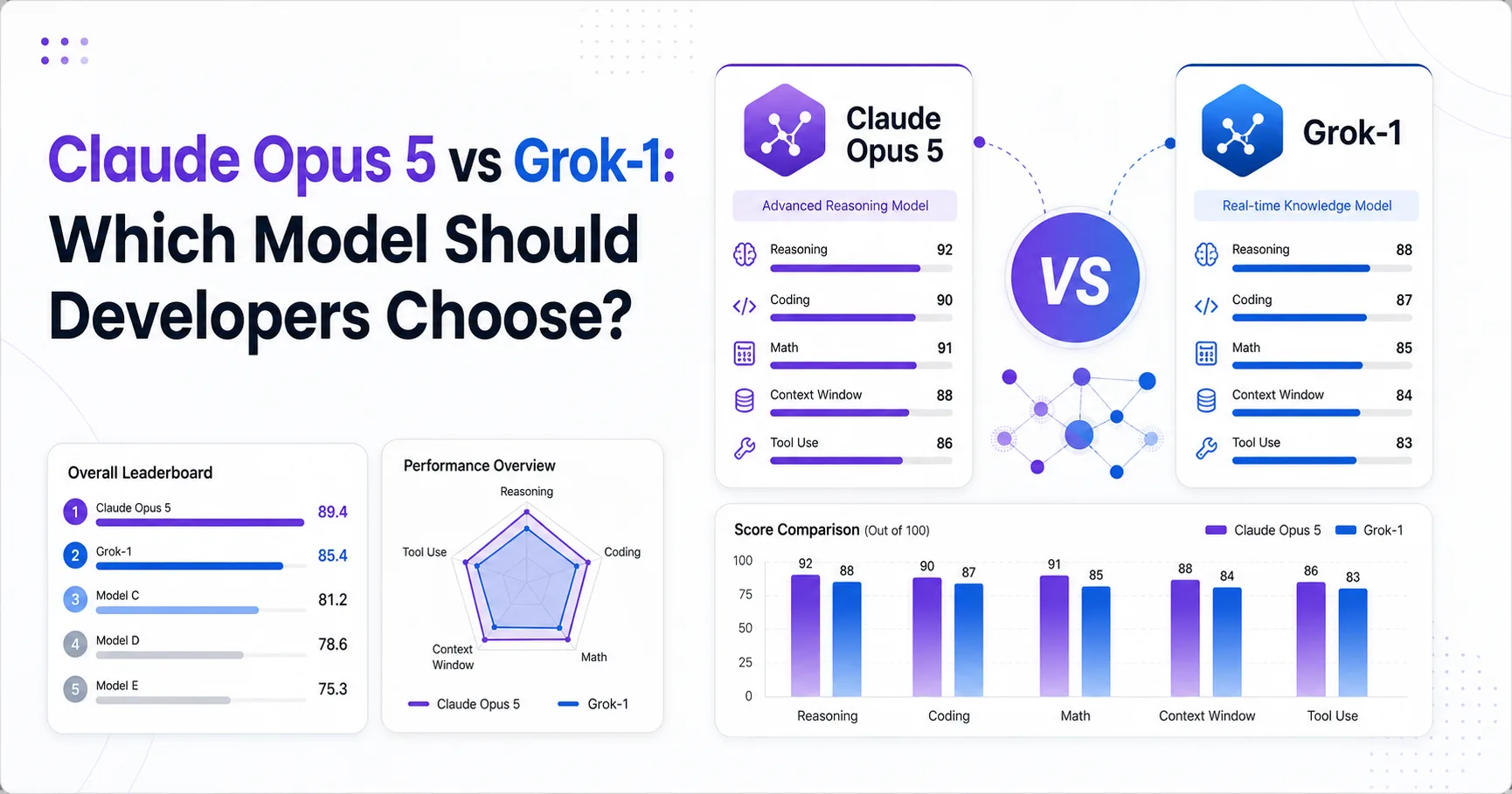
- **Winner overall:** Claude Opus 5, with an Artificial Analysis Intelligence Index score of 60.7 vs 6 for Grok-1 - **Cheaper:** Claude Opus 5 at $10 vs $15 per 1M blended tokens - **Faster:** Claude Opus 5 at 60.088 (median output tokens per second) - **Pick Claude Opus 5 when:** you need documented coding, agentic workflows, multimodal input, or enterprise deployment options - **Watch out:** Grok-1 has no verified output-speed value or coding-index value in the supplied data, so the comparison remains incomplete
Claude Opus 5 vs Grok-1 at a Glance
Claude Opus 5 is the more defensible choice for developers because it combines stronger measured capability evidence, documented API behavior, and lower supplied pricing. The Artificial Analysis Intelligence Index records Claude Opus 5 at 60.7 and Grok-1 at 6. The supplied data does not provide a Grok-1 coding index, output-speed value, context window, or verified current product status. That absence matters because model selection depends on operational evidence, not only a single score. Data provided by https://artificialanalysis.ai/.
Anthropic positions Claude Opus 5 for complex agentic coding and enterprise work, with support for text and image input, text output, multilingual use, and vision capabilities. Anthropic’s announcement and the model overview document a product that developers can evaluate through several cloud and API channels. Grok-1 has no comparable verified material in the supplied research.
The practical conclusion is clear for a new integration: Claude Opus 5 offers the stronger evidence base and the lower listed cost. Grok-1 could still be relevant if an existing platform exposes it reliably, but the supplied research cannot establish that condition.
Executive Summary for Model Selection
Claude Opus 5 gives developers a documented production path, while Grok-1 remains an evidence gap rather than a proven alternative. Anthropic lists Claude Opus 5 as an active model with a stable API identifier and availability through Claude API, Amazon Bedrock, Claude Platform on AWS, Google Cloud, and Microsoft Foundry. The model overview and model deprecation page support that conclusion.
| Decision factor | Claude Opus 5 | Grok-1 |
|---|---|---|
| Capability evidence | Intelligence Index: 60.7; Coding Index: 78 | Intelligence Index: 6; coding value unavailable |
| Blended price | $10 per 1M blended tokens | $15 per 1M blended tokens |
| Input and output pricing | $5 input, $25 output per 1M tokens | $10 input, $30 output per 1M tokens |
| Output speed evidence | 60.088 median output tokens per second | Value unavailable |
| Latency | 0.3 seconds | 0.3 seconds |
| Product documentation | Extensive official documentation | No verified official material in the supplied research |
The table does not prove that Claude Opus 5 wins every workload. It shows that Claude Opus 5 is easier to evaluate, price, deploy, and govern. Grok-1’s missing evidence prevents a fair claim about its coding quality, speed, context handling, or current availability. That uncertainty is itself a selection cost for teams building a dependable application.
Performance: What the Evidence Means in Real Work
Claude Opus 5 is the stronger performance candidate because its measured intelligence and coding evidence are substantially more actionable than Grok-1’s limited record. The Artificial Analysis Intelligence Index places Claude Opus 5 at 60.7 and Grok-1 at 6. The supplied comparison does not assign a coding-index winner because Grok-1 has no coding value. The Artificial Analysis source supplies the comparison data, while Anthropic separately claims leading results across several agentic coding, automation, and computer-use evaluations in its launch announcement.
For a developer, the important implication is task breadth. A stronger general intelligence signal can reduce the number of retries, clarifying turns, and manual corrections in multi-step work. The coding index of 78 also gives Claude Opus 5 a relevant signal for repository changes, debugging, and code-generation workflows. It does not guarantee success on a particular codebase, especially where tests, tools, permissions, or hidden requirements dominate the result.
Claude Opus 5 also supports adaptive thinking, with configurable effort levels documented in the model overview. That control can help teams trade reasoning depth against response cost and elapsed work. Anthropic warns that disabling thinking can produce malformed tool behavior or visible internal markup, so integrations should test the selected configuration rather than assume a faster setting is safer. The Opus 5 update notes describe these constraints.
The key evidence gap is Grok-1. No verified source in the supplied research establishes whether it handles long coding tasks, tools, images, or autonomous workflows well. Developers should treat any claimed parity as unverified until a controlled evaluation covers their own tasks.
Cost: Lower Price Does Not Automatically Mean Lower Spend
Claude Opus 5 is cheaper on every supplied price measure, but workload shape still determines the final bill. The blended comparison lists Claude Opus 5 at $10 and Grok-1 at $15 per 1M blended tokens. Input pricing is $5 versus $10, and output pricing is $25 versus $30. Anthropic’s pricing page confirms Claude Opus 5’s standard pricing, while the supplied Artificial Analysis data provides the direct comparison.
The charted prices matter most for applications that repeatedly send large instructions, repository context, tool results, or conversation history. Claude Opus 5’s lower input rate gives it a stronger position when prompts are large and outputs are controlled. Its lower blended rate also helps when the application mixes substantial reasoning with ordinary responses. Grok-1 would need a meaningful reduction in retries, output length, or infrastructure overhead to overcome the listed price disadvantage, but the supplied research provides no evidence that it delivers such a reduction.
Claude Opus 5 can also use prompt caching. Anthropic’s pricing documentation lists separate cache-write and cache-hit prices, and the update notes state that prompts below the documented minimum do not create cache entries. Caching may improve repeated-context economics, but it introduces eligibility and invalidation behavior that teams must measure.
The main cost risk is reasoning configuration. Claude Opus 5 enables thinking by default, and its token limit covers thinking plus the final response. A legacy output limit can therefore produce an incomplete visible answer, forcing another request. Teams should compare successful task cost, not only nominal token price. Grok-1’s missing documentation makes this same analysis impossible for that model.
Recommendation: Choose by Risk Tolerance and Task Evidence
Claude Opus 5 is the recommended default for developers who need a documented, general-purpose model for complex coding and agentic workflows. Its measured Intelligence Index is 60.7, its Coding Index is 78, its listed blended price is $10 per 1M tokens, and its median output speed is 60.088 tokens per second. Those values come from the supplied Artificial Analysis data.
Choose Claude Opus 5 for repository agents, code review, debugging, structured automation, multimodal developer tools, and enterprise deployments that need more than one access route. Anthropic documents tool-oriented behavior, adaptive thinking, fallback behavior, and supported platforms in the model overview and the Opus 5 update notes. The model is active, and Anthropic’s deprecation documentation gives developers a clearer lifecycle signal.
Consider Grok-1 only when an existing dependency already exposes it, migration cost is high, and your own evaluation demonstrates acceptable results. The supplied research cannot confirm Grok-1’s current callable status, stable identifier, pricing, context behavior, output limits, coding quality, or failure patterns. That is not proof that Grok-1 performs poorly. It means the decision would rely on evidence outside this brief.
Before production approval, test representative tasks with fixed prompts, identical tool permissions, success-based scoring, retry counts, visible-output quality, and total token usage. Pay special attention to Claude Opus 5’s tendency toward longer responses, more progress narration, broader modifications, and repeated verification. Community reports describe those behaviors, but the ClaudeCode discussion does not provide a controlled test. A separate ClaudeAI discussion reports similar concerns and also lacks a standardized method.
Claude Opus 5 is therefore the evidence-based pick. Grok-1 remains a candidate for local validation, not the safer default.
Evidence Gaps and Operational Caveats
Claude Opus 5 has documented caveats, while Grok-1 has a larger unresolved evidence gap. Anthropic states that Claude Opus 5 may produce longer responses, narrate agent progress more often, delegate more actively in multi-agent settings, and repeat verification work. The Opus 5 update notes make these behavior changes relevant to engineering teams because they can affect latency, token usage, and patch scope.
Community feedback adds a useful risk signal but not a benchmark. Users in the ClaudeCode Reddit discussion describe excessive verbosity, slow-feeling work, overthinking, instruction drift, and changes that expand beyond the request. A Hacker News discussion raises a related concern about the model pursuing an elaborate visual-processing direction without first confirming its access limitations. These reports are anecdotal and should shape test cases, not serve as measured performance claims.
Claude Opus 5 also has policy and capability boundaries for cybersecurity work and long autonomous biological research tasks. Anthropic’s announcement describes those limitations. Grok-1 has no verified failure-mode evidence in the supplied research, so developers cannot responsibly claim that it is safer, less verbose, more compliant, or more efficient.
The unresolved question is not merely which model scores higher. It is whether the selected model behaves predictably inside the developer’s tools, repository, budget, and approval process. The brief gives Claude Opus 5 a much stronger basis for answering that question, but only an application-specific test can close the remaining uncertainty.
Frequently Asked Questions
Claude Opus 5 is the better default for most documented developer workloads because it has stronger supplied capability evidence, lower listed pricing, and a clearer deployment path.
Frequently asked questions
Is Claude Opus 5 better than Grok-1 for coding?
Claude Opus 5 is the safer coding choice because the supplied data gives it a Coding Index of 78, while Grok-1 has no coding-index value. That evidence does not guarantee repository-level success, so teams should still run representative coding tasks before production adoption.
Which model is cheaper for developers?
Claude Opus 5 is cheaper on the supplied blended, input, and output prices. Its blended price is $10 per 1M tokens versus $15 for Grok-1, while its input price is $5 versus $10 and its output price is $25 versus $30.
Which model is faster?
Claude Opus 5 is the only model with a supplied median output-speed value, recorded at 60.088 tokens per second. The latency value is 0.3 seconds for each model, but Grok-1’s output speed remains unavailable, so a complete speed ranking is not possible.
Should a team use Grok-1 in production?
A team should use Grok-1 in production only after verifying its current availability, pricing, API behavior, coding quality, and failure modes through independent testing. The supplied research contains no verified official material establishing those operational facts.
What is the biggest risk with Claude Opus 5?
The biggest practical risk is unpredictable work expansion through longer responses, heavier reasoning, progress narration, repeated verification, or instruction drift. Anthropic documents related behavior changes, while community reports describe them anecdotally without controlled testing.
Does Claude Opus 5 always provide the lowest total cost?
Claude Opus 5 has the lowest supplied token prices, but total cost also depends on retries, reasoning usage, output length, caching, and human review. A team should compare successful task cost rather than nominal token price alone.
Sources
- Artificial AnalysisSupplied benchmark, pricing, latency, and output-speed comparison data
- Introducing Claude Opus 5Anthropic positioning, benchmark claims, capabilities, and safety limitations
- Models overviewClaude Opus 5 model identity, capabilities, adaptive reasoning, and deployment information
- What’s new in Claude Opus 5Thinking behavior, effort settings, tool behavior, token limits, caching constraints, and behavioral changes
- PricingClaude Opus 5 input, output, blended, and prompt-caching pricing
- Model deprecationsClaude Opus 5 active status and lifecycle evidence
- The Opus 5 ExperienceAnecdotal developer reports about verbosity, speed, overthinking, instruction drift, and scope expansion
- Is Opus 5 actually that bad, or is it just Reddit hype?Anecdotal community reports and evidence-quality caveats
- Claude Opus 5 discussionAnecdotal concern about visual-processing behavior and limitation confirmation
Published: