
AI model analysis
Claude Opus 5 vs GPT-5.6 Sol for Developers: Speed, Cost, and Agentic Coding Trade-offs
A developer-focused comparison of Claude Opus 5 and GPT-5.6 Sol across coding quality, reasoning, speed, pricing, API behavior, and production risk.
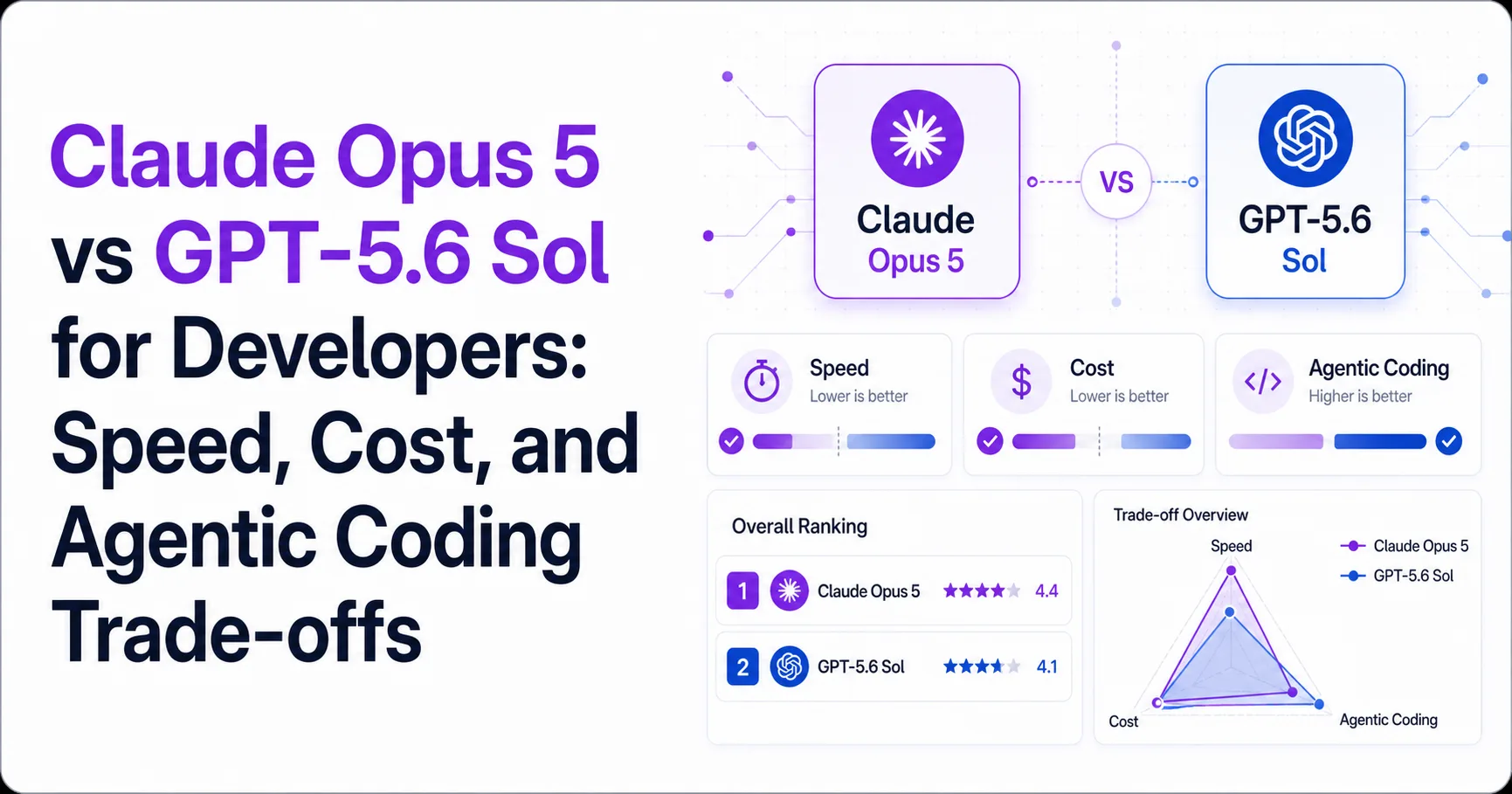
- **Winner overall:** GPT-5.6 Sol (max), 77.4 coding index and 77.617 median output tokens per second, although Claude Opus 5 reaches 60.1 on intelligence index - **Cheaper:** Claude Opus 5 (Adaptive Reasoning, Xhigh Effort) at $10 vs $11.25 per 1M blended tokens - **Faster:** GPT-5.6 Sol (max) at 77.617 (median output tokens per second) - **Pick Claude Opus 5 (Adaptive Reasoning, Xhigh Effort) when:** general reasoning matters more than the 77.4 versus 77 coding edge and you want $10 per 1M blended tokens - **Watch out:** both models show 0.3 latency seconds, but the supplied data cannot prove end-to-end task completion time
The short answer
GPT-5.6 Sol is the stronger default for interactive developer workflows, while Claude Opus 5 offers lower blended cost and a small general-intelligence lead. The supplied snapshot gives GPT-5.6 Sol 77.4 on coding and 77.617 median output tokens per second. Claude Opus 5 reaches 60.1 on intelligence and costs $10 per 1M blended tokens. GPT-5.6 Sol reaches 58.9 on intelligence and costs $11.25 per 1M blended tokens.
The practical choice depends on the unit of work. GPT-5.6 Sol is attractive when developers inspect streamed output, approve patches, and repeat short tool calls. Claude Opus 5 is attractive when a task benefits from extended planning, broader autonomy, or lower output pricing.
The comparison uses the supplied Artificial Analysis snapshot. Data provided by https://artificialanalysis.ai/. The source is also available through Artificial Analysis.
Summary: close scores, different operating profiles
Claude Opus 5 is the newer release, but GPT-5.6 Sol has the small coding and speed advantage in the supplied cross-model snapshot. Anthropic announced Claude Opus 5 on 2026-07-24, after OpenAI announced GPT-5.6 Sol on 2026-07-09. The release dates come from Introducing Claude Opus 5 and the GPT-5.6 release announcement.
The version labels need careful handling. Anthropic lists claude-opus-5 as the API model ID and alias in its Models overview. Anthropic documents xhigh as an effort setting, not as a separate API model. The Claude Opus 5 release notes describe adaptive thinking and the available effort levels. The comparison slug therefore describes a configuration.
OpenAI similarly maps GPT-5.6 Sol to gpt-5.6-sol, with gpt-5.6 as a stable alias. The OpenAI model directory and GPT-5.6 Sol model page identify the model. The max label refers to reasoning effort, not a different model family.
The official status comparison is straightforward. The supplied official pages list both models as available, and neither model appears marked as deprecated in the Claude deprecations page or the OpenAI model documentation. Claude is newer, but the evidence does not show that recency alone creates a decisive production advantage.
Vendor benchmark claims do not settle the decision. Anthropic lists many evaluations in its announcement, but does not provide a complete reproducible result table there. OpenAI reports a different benchmark portfolio in its announcement. Those claims are useful context, but they are not direct head-to-head evidence. The supplied Artificial Analysis indices are the clearest shared comparison available here.
Community evidence is divided. Some Claude users praise long autonomous execution, while others report verbosity, slow interaction, and overthinking in Reddit discussions and Hacker News. A public Claude Opus 5 review describes a cautious agent that often seeks human confirmation. GPT-5.6 Sol users report overdesign and unfocused investigation in Reddit and Hacker News. None of these reports uses a common test method.
Performance: speed favors GPT, quality remains close
GPT-5.6 Sol is the better fit for fast interactive coding loops because its 77.617 median output tokens per second exceeds Claude Opus 5 at 53.917, while both report 0.3 latency seconds. The speed gap matters after generation starts. Similar prompts, tools, and response lengths should produce faster visible progress with GPT-5.6 Sol.
The latency tie changes the interpretation. The snapshot does not show a faster first response for either model. It shows equal latency, then a clear difference in output streaming speed. Developers should therefore expect the largest benefit in long responses, patch explanations, test reports, and multi-step tool sessions. The data does not prove lower total time to a completed pull request.
Reasoning configuration can erase part of that advantage. OpenAI states in its reasoning guide that higher effort can increase reasoning token use, latency, and cost. Those reasoning tokens remain hidden from users, but they still consume the context window and count toward output billing. GPT-5.6 Sol with max is therefore a demanding configuration, not a universal speed setting.
Claude has a related trade-off. Its official release notes describe adaptive thinking as enabled by default. Thinking tokens and final response tokens share the request budget. High effort can improve difficult work, but it can also create longer responses and earlier budget pressure. Developers should test effort settings with the actual harness rather than assuming the comparison slug represents every Claude request.
The quality gap is small. GPT-5.6 Sol scores 77.4 on the coding index, compared with Claude Opus 5 at 77. Claude Opus 5 scores 60.1 on the intelligence index, compared with GPT-5.6 Sol at 58.9. These results support a narrow coding edge for GPT and a narrow general-intelligence edge for Claude. They do not identify a universal winner for repository-level work.
The missing evidence matters. Neither supplied benchmark snapshot reports completion rate, retry count, tool-call accuracy, patch acceptance, or time to a verified result. Anthropic’s public benchmark list in Introducing Claude Opus 5 and OpenAI’s published results in GPT-5.6 use different evaluation suites. A developer cannot infer production superiority from those separate vendor claims.
Community reports suggest different failure shapes, not stable rankings. Claude users describe overthinking, verbosity, and autonomous detours. GPT-5.6 Sol users describe overengineering, broad searches, and defensive code. The Claude Hacker News discussion also raises concerns about token use when inputs are missing. These observations are useful for harness design, but they lack reproducible measurements. Evidence is insufficient to say which model completes a real codebase task more reliably.
Cost: Claude wins the unit price, but output behavior can reverse the result
Claude Opus 5 is cheaper on the supplied blended measure at $10 per 1M tokens versus GPT-5.6 Sol at $11.25. The input price is tied at $5, so the difference comes from output pricing and the way each configuration spends tokens. Claude output costs $25 per 1M tokens, while GPT-5.6 Sol output costs $30.
That unit-price advantage is useful for workloads with predictable responses. It is less decisive for autonomous agents. A model that writes longer plans, performs extra validation, retries tools, or continues without asking for missing input can consume more budget per successful task. Community reports raise those concerns for both models. Claude users mention verbosity and autonomous detours in Reddit and Hacker News. GPT users describe overdesign and broad investigation in Reddit and Hacker News.
Reasoning settings also change effective cost. OpenAI’s reasoning documentation says higher effort can produce more reasoning tokens. Claude’s release notes explain that thinking shares the request’s token budget. The chart’s blended price cannot show how much hidden reasoning each successful task requires.
Official pricing pages add further variables. Anthropic’s pricing documentation describes separate cache behavior and service options. OpenAI’s API pricing page distinguishes standard, batch, flex, fast, cached, and long-context pricing. These modes can make the displayed blended comparison less representative of a production bill.
The correct economic metric is cost per accepted result. That metric should include input tokens, visible output, hidden reasoning, cache behavior, retries, tool failures, and human correction. The supplied materials do not provide those measurements. Evidence is insufficient to calculate which model is cheaper for a completed repository change, even though Claude clearly wins the supplied blended unit-price comparison.
The practical cost rule is simple. Use Claude when output volume is controlled and the lower blended rate matters. Use GPT-5.6 Sol when faster interaction reduces developer waiting or shortens agent sessions. The cheaper token is not always the cheaper engineering workflow.
Recommendation: choose by workflow shape
GPT-5.6 Sol is the best default for interactive coding agents, while Claude Opus 5 is the better controlled-cost choice for autonomy-heavy work. The supplied coding scores are nearly tied, so speed, tool integration, and operating cost should decide the first deployment.
Pick GPT-5.6 Sol when the workflow includes frequent streamed responses, repeated patch review, fast test triage, or many short approval steps. Its 77.617 median output tokens per second gives it the clearest measured advantage. The GPT-5.6 Sol documentation also describes a broad Responses API tool surface, including function calls, structured output, file search, code execution, hosted shell, computer use, MCP, and tool search. That combination suits a harness that coordinates many developer tools.
Pick Claude Opus 5 when the task rewards sustained planning, document work, visual understanding, or lower output pricing. Anthropic positions the model for complex agentic coding, multi-file changes, code review, long-context work, and multi-agent collaboration in the Models overview and release notes. Its 60.1 intelligence index and $10 blended price support that choice, but neither figure proves lower cost per successful task.
Use effort controls as part of the product design. Reserve max or xhigh for tasks where extra reasoning earns measurable value. Use lower effort for routine edits, narrow transformations, and short explanations. Require explicit checkpoints before broad autonomous work. Ask the model to stop when required input, permission, or tool output is missing.
The safest rollout uses the same repository tasks, tools, prompts, tests, and acceptance rules for both models. Measure verified completion, developer corrections, wall-clock duration, retries, and cost per accepted result. The current evidence supports GPT-5.6 Sol as the default recommendation, but it does not justify removing Claude Opus 5 from a controlled bake-off.
Questions to answer before production rollout
Claude Opus 5 and GPT-5.6 Sol cannot be ranked conclusively on end-to-end completion time or cost from the supplied snapshot. The available data measures output speed, latency, shared indices, and listed prices. It does not measure successful task completion under a common developer harness.
Before committing to a default, test whether GPT-5.6 Sol’s output-speed advantage reduces total session time after reasoning and tool calls. Test whether Claude Opus 5’s lower blended price survives longer responses, retries, and human correction. Test whether either model stops for missing information instead of inventing an alternate workflow.
The API configuration must also be fixed before comparison. Treat Claude’s xhigh and GPT’s max as reasoning settings. Record the exact model ID, effort level, tools, prompts, cache policy, and acceptance criteria. Without those controls, a model comparison can become a configuration comparison.
Frequently asked questions
Which model should I choose for interactive coding?
GPT-5.6 Sol is the better starting choice for interactive coding because it reaches 77.617 median output tokens per second and slightly leads Claude Opus 5 on the coding index at 77.4 versus 77. The Artificial Analysis snapshot does not prove lower end-to-end completion time, so validate the choice with your own repository tasks.
Which model is cheaper for API workloads?
Claude Opus 5 is cheaper on the blended measure at $10 per 1M tokens versus GPT-5.6 Sol at $11.25, but observed task cost can change with output length, retries, caching, and reasoning settings. Anthropic pricing is documented here, while OpenAI pricing is documented here.
Does Claude Opus 5 Xhigh represent a separate model?
Claude Opus 5 uses claude-opus-5 as the API model, while xhigh is an effort setting rather than a separate model ID. Anthropic confirms that distinction in its Models overview and Claude Opus 5 release notes.
Does GPT-5.6 Sol max always produce better results?
GPT-5.6 Sol with max has the higher supplied coding score and faster output, but maximum reasoning can increase latency, token use, and cost. OpenAI recommends matching reasoning effort to task difficulty in its reasoning guide, rather than treating max as a universal default.
Which vendor benchmark should developers trust?
Neither vendor benchmark list resolves the choice, because Anthropic and OpenAI report different suites and the supplied snapshot does not expose a shared task methodology for production coding. Compare the published Anthropic results with the OpenAI results as context, then run matched repository tests.
Are the community complaints reliable evidence?
Community complaints are useful risk signals, not proof of stable model behavior, because the cited discussions lack common tasks, environments, baselines, and quantitative measurements. Claude reports appear in Reddit, Hacker News, and a public review.
Sources
- Artificial AnalysisAttribution for the supplied performance, latency, coding, intelligence, and pricing snapshot.
- Models overviewClaude API model ID, alias, capabilities, positioning, and supported platforms.
- What's new in Claude Opus 5Adaptive thinking, effort settings, token limits, tool behavior, and configuration constraints.
- Introducing Claude Opus 5Claude release date, official positioning, benchmark disclosures, and safety limitations.
- Claude pricingAnthropic pricing modes, caching behavior, and service pricing variables.
- Model deprecationsClaude model lifecycle and deprecation status.
- OpenAI ModelsOpenAI model directory, model positioning, and aliases.
- GPT-5.6 SolGPT-5.6 Sol capabilities, model ID, alias, tools, modalities, and model status.
- Reasoning modelsReasoning effort, hidden reasoning tokens, latency, cost, and configuration guidance.
- OpenAI API PricingOpenAI standard, batch, flex, fast, cached, and long-context pricing variables.
- GPT-5.6: Frontier intelligence that scales with your ambitionGPT-5.6 Sol release date, official positioning, and vendor benchmark claims.
- Is Opus 5 actually that bad, or is it just Reddit hype?Community reports about Claude speed, verbosity, overthinking, autonomy, and interactive coding.
- Claude Opus 5Community reports about Claude autonomy, token consumption, and missing-input behavior.
- Elevated errors on Claude Opus 5Community reports about Claude service errors, stopping, recovery, and workflow impact.
- Claude Opus 5 reviewPublic observations about Claude coding-agent behavior, confirmation requests, and decision-making.
- I spent two weeks testing GPT-5.6. Here's what I found.Community reports about GPT-5.6 Sol overdesign, token use, duration, and coding reliability.
- Ask HN: How are you productive with GPT 5.6 Sol?Community reports about GPT-5.6 Sol investigation scope, defensive code, and effort settings.
Published: