
AI model analysis
Claude Opus 5 xhigh vs GPT-5.6 Sol high: Which Model Should Developers Choose?
A developer-focused comparison of Claude Opus 5 and GPT-5.6 Sol across reasoning, coding, speed, cost, integration risk, and workflow fit.
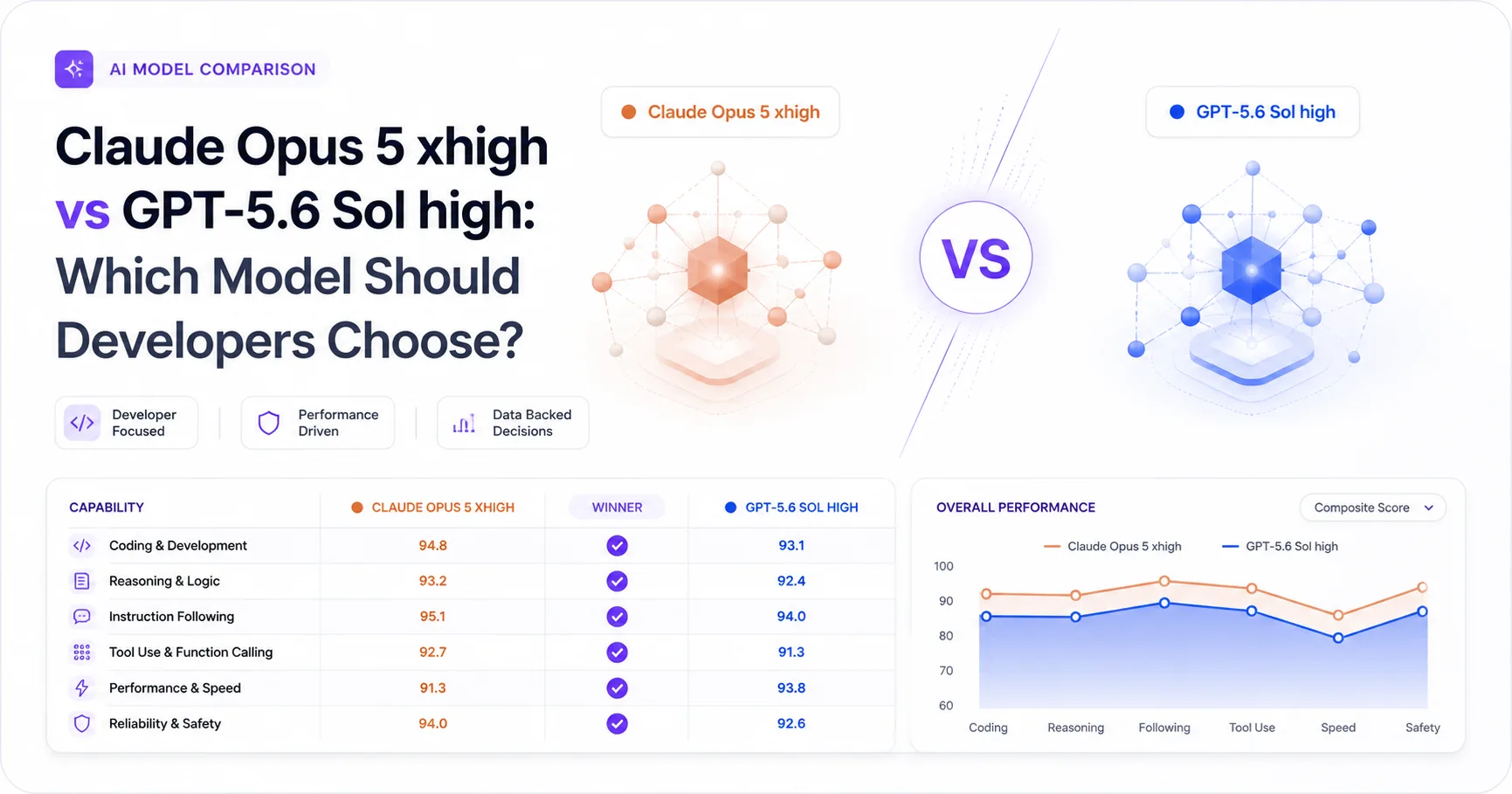
- **Winner overall:** Claude Opus 5, with a 60.1 intelligence index versus 55.9 and a lower $10 blended price per 1M tokens. - **Cheaper:** Claude Opus 5 at $10 vs $11.25 per 1M blended tokens. - **Faster:** GPT-5.6 Sol at 73.648 median output tokens per second. - **Pick Claude Opus 5 when:** broad reasoning and long-running agent work matter more than speed, given its 60.1 versus 55.9 intelligence index. - **Watch out:** coding is nearly tied at 77 versus 77.2, while exact high/xhigh success, latency, and token-use evidence remains insufficient.
Claude Opus 5 vs GPT-5.6 Sol: The Developer Decision
Claude Opus 5 is the stronger default for developers who value broad reasoning and lower blended cost over maximum generation speed, according to the Artificial Analysis data.
The supplied snapshot gives Claude Opus 5 an intelligence index of 60.1 versus 55.9 for GPT-5.6 Sol. GPT-5.6 Sol leads the coding index with 77.2 versus 77 and produces output at 73.648 median tokens per second versus 53.917. Those results describe a clear tradeoff: Claude has the broader measured intelligence result and lower normalized cost, while GPT has the stronger output-speed result.
The product labels also need careful interpretation. Anthropic documents claude-opus-5 as the stable API model and treats xhigh as an effort setting, not a separate model ID, in Models overview and What’s new in Claude Opus 5. OpenAI documents gpt-5.6-sol as the model and high as reasoning.effort in the GPT-5.6 Sol model page and the reasoning guide.
Data provided by https://artificialanalysis.ai/.
Summary: Claude Leads the Broader Tradeoff
Claude Opus 5 wins the overall tradeoff because GPT-5.6 Sol’s coding lead is narrow, while Claude leads intelligence and blended cost, based on the supplied comparison data.
| Decision lens | Edge | What it means |
|---|---|---|
| Intelligence index | Claude Opus 5 | Claude scores 60.1 versus 55.9, giving it the stronger result on the supplied general intelligence measure. |
| Coding index | GPT-5.6 Sol | GPT scores 77.2 versus 77, a lead too narrow to decide every repository or agent workflow. |
| Output speed | GPT-5.6 Sol | GPT reaches 73.648 median output tokens per second versus Claude’s 53.917. |
| Measured latency | Tie | Both models show 0.3 seconds in the supplied snapshot, so the speed difference mainly appears during generation. |
| Blended price | Claude Opus 5 | Claude costs $10 versus GPT’s $11.25 per 1M blended tokens. |
| Official model identity | Neither comparison slug | Anthropic identifies claude-opus-5 as the model, while OpenAI identifies gpt-5.6-sol; xhigh and high describe reasoning effort. |
Anthropic positions Claude Opus 5 for complex agentic coding, multi-file development, code review, visual understanding, long-context work, and multi-agent collaboration in the model overview and the launch announcement. OpenAI positions GPT-5.6 Sol for complex professional work, reasoning, coding, structured outputs, function calling, file search, web search, and hosted tools in the model page and the GPT-5.6 announcement.
Neither product appears to be the obvious lifecycle risk. Anthropic’s current model overview and deprecation page do not mark Claude Opus 5 as deprecated or retired. OpenAI’s model directory still lists GPT-5.6 Sol as a flagship model. The selection therefore turns on workflow behavior, speed, cost, and control rather than an obvious replacement concern.
Performance: GPT Is Faster, but Coding Is Almost Even
GPT-5.6 Sol is the faster generator, while Claude Opus 5 and GPT-5.6 Sol are nearly tied on coding and measured latency, according to the Artificial Analysis snapshot.
GPT-5.6 Sol produces 73.648 median output tokens per second, compared with 53.917 for Claude Opus 5. Since both models show 0.3 seconds of latency, GPT’s advantage should become most visible after the response begins. That favors interactive coding, rapid review comments, iterative edits, and agent interfaces where users watch output arrive progressively.
The coding index does not support a decisive coding winner. GPT-5.6 Sol scores 77.2, while Claude Opus 5 scores 77. A narrow benchmark difference can disappear when repository structure, tool permissions, test quality, prompt discipline, or human review changes. Developers should treat GPT’s speed lead as a clearer operational signal than its coding-index lead.
The models also emphasize different task behaviors. Anthropic describes Claude Opus 5 as suited to long-horizon agentic coding, multi-file feature work, code review, bug finding, visual tasks, and multi-agent workflows in What’s new in Claude Opus 5. OpenAI’s announcement reports broad results across coding agents, browsing, computer-use, and security evaluations, but it does not publish a separate result for the high configuration in GPT-5.6: Frontier intelligence that scales with your ambition.
Community evidence complicates the speed story. Some Claude users report slow, verbose, or overthinking behavior on simple tasks in a Reddit discussion. Hacker News users praise Claude’s autonomy while warning that it may continue building substitute workflows and consume extra tokens when inputs or permissions are missing in this discussion. A separate Hacker News report describes long-running sessions, recovery needs, and service interruptions, which are integration signals rather than proof of a model capability defect.
GPT-5.6 Sol has similar conflicting reports. Reddit users describe slow small edits and over-engineering in the Codex release discussion. A Hacker News user reports investigation drift and excessive defensive code, while claiming better subjective behavior after lowering reasoning effort in this discussion. Another Hacker News post describes a limited rewrite test, but one task cannot establish general coding performance.
The evidence gap is material: the supplied sources do not provide standardized success, latency, or token-use results for the exact high and xhigh configurations. Use the benchmark snapshot for direction, then validate on your own repository and harness.
Cost: Claude Is Cheaper on Tokens, Not Necessarily per Completed Task
Claude Opus 5 is cheaper in the supplied blended snapshot, but GPT-5.6 Sol can still win when faster completion lowers workflow overhead, based on the Artificial Analysis data.
Claude Opus 5 costs $10 versus GPT-5.6 Sol at $11.25 per 1M blended tokens. Input pricing is tied at $5, while output pricing favors Claude at $25 versus GPT at $30. The blended figure uses a 3:1 input-to-output mix, so it is useful as a baseline rather than a universal invoice forecast.
Claude should remain cheaper in output-heavy workloads under the supplied token prices. The economic conclusion becomes less direct when the unit of value is a completed engineering task. A slower interaction can increase developer waiting, retries, supervision, or abandoned sessions. A faster model can justify a higher token price if it completes the same task with fewer operational delays. Community reports describe these exact workflow tensions for both models, including Claude’s extended autonomous work in Hacker News and GPT’s slow or over-engineered sessions in Reddit.
Provider pricing also has routing details that the normalized comparison does not expose. Anthropic documents cache writes, cache hits, API access, and a fast-mode option in its pricing documentation. OpenAI separates standard, batch, flex, fast, and long-context pricing in its API pricing documentation. A deployment using caching, batch processing, or long-context requests may therefore produce a different effective price than the baseline chart.
Reasoning configuration can add another hidden cost. Anthropic states that max_tokens covers thinking and final output, while OpenAI states that max_output_tokens covers visible output and reasoning tokens in the Claude configuration notes and the OpenAI reasoning guide. A low cap can cause incomplete work, repeated calls, or unnecessary retries. The supplied materials do not establish cost per successful task, so developers should measure total tokens, tool calls, retries, and human time together.
Recommendation: Choose the Workflow, Then Test the Exact Setting
Claude Opus 5 is the safer broad-work default, while GPT-5.6 Sol is the sharper choice for speed-sensitive coding loops, according to the comparison snapshot and the providers’ documented positioning.
Pick Claude Opus 5 when
Choose Claude Opus 5 when a task combines planning, implementation, documentation, visual input, repository-wide changes, or long-running autonomous execution. Anthropic explicitly describes these capabilities in the model overview and the Opus 5 announcement. Claude’s 60.1 intelligence index also gives it the stronger measured result in the supplied comparison.
Add stronger stopping rules when the task is interactive or permission-sensitive. Anthropic says the model may produce longer responses, report progress more frequently, and delegate more actively in agentic sessions in What’s new in Claude Opus 5. Reddit and Hacker News reports add concerns about verbosity, overthinking, and continuing without enough input in the Reddit discussion and the autonomy discussion. These are risk signals, not standardized failure rates.
Pick GPT-5.6 Sol when
Choose GPT-5.6 Sol when developers need faster visible output, structured results, function calling, file search, web search, hosted shell, computer use, MCP, or other explicitly documented tools. The GPT-5.6 Sol model page lists these integration capabilities, and the 73.648 median output speed favors tight interactive loops.
Keep the prompt and harness focused. Community reports describe over-engineering, slow small edits, investigative drift, and excessive defensive code in the Codex Reddit thread and Hacker News. A limited test described in another Hacker News post offers useful testing context, but it is not enough to predict your repository’s outcome.
Validate before committing
Do not choose solely from the coding-index difference of 77 versus 77.2. The evidence does not isolate exact high and xhigh performance, and community reports disagree. Run the same repository tasks through the same tools, then compare successful completion, human edits, tool calls, wall-clock time, total tokens, retries, and incomplete responses. Treat Claude’s lower token price and GPT’s higher output speed as starting hypotheses, not final procurement conclusions.
FAQ Before Integration
Claude Opus 5 and GPT-5.6 Sol need configuration-aware integration because xhigh and high describe reasoning settings, not separate model products, according to Anthropic’s documentation and OpenAI’s reasoning guide.
Integration points
Use claude-opus-5 for the Anthropic API and gpt-5.6-sol or the documented stable alias for OpenAI, rather than treating the comparison slugs as independent API models. Anthropic warns that disabling thinking can create tool-call and visible-output issues, especially with higher effort settings. OpenAI warns that reasoning tokens consume the output budget and can produce incomplete responses when the limit is too low. These behaviors make budget handling, tool validation, timeout recovery, and retry policy part of model selection.
Current lifecycle evidence is reassuring. Anthropic’s model overview and deprecation page, together with OpenAI’s model directory, do not identify an immediate replacement concern in the supplied research.
Frequently asked questions
Is claude-opus-5-xhigh a separate Claude API model?
No, claude-opus-5-xhigh is best treated as a benchmark or configuration slug; Anthropic documents claude-opus-5 as the model and xhigh as an effort setting in Models overview.
Which model is faster for interactive coding?
GPT-5.6 Sol is faster during generation at 73.648 median output tokens per second versus Claude Opus 5 at 53.917, while both show 0.3 seconds of measured latency in the Artificial Analysis snapshot.
Which model is cheaper?
Claude Opus 5 is cheaper in the supplied blended comparison at $10 versus GPT-5.6 Sol at $11.25 per 1M blended tokens, although routing, caching, retries, and human supervision can change task-level economics.
Is GPT-5.6 Sol better for coding?
GPT-5.6 Sol has a slightly higher coding index at 77.2 versus Claude Opus 5 at 77, but the narrow gap does not establish a universal repository-level winner, especially because the exact high-setting result is not separately published.
Which model should an autonomous coding agent use?
Claude Opus 5 is the stronger starting choice for broad autonomous work because its measured intelligence index is 60.1 versus 55.9, but strict stopping rules are important because community reports describe verbosity and extended autonomous behavior.
Can higher reasoning effort be disabled safely?
Claude Opus 5 does not allow thinking to be disabled with xhigh or max, while OpenAI documents reasoning effort separately and warns that reasoning tokens consume the output budget; follow each provider’s configuration guidance.
Sources
- Artificial AnalysisNumeric comparison data, benchmark indices, pricing snapshot, latency, and output speed.
- Models overviewClaude model identity, capabilities, positioning, availability, and lifecycle context.
- What's new in Claude Opus 5Reasoning effort, thinking behavior, token limits, agent behavior, and integration constraints.
- Introducing Claude Opus 5Claude's official positioning, benchmark coverage, and safety limitations.
- Claude pricingAnthropic pricing routes, caching, and fast-mode pricing structure.
- Model deprecationsClaude lifecycle and deprecation status.
- Is Opus 5 actually that bad, or is it just Reddit hype?Community reports about Claude speed, verbosity, overthinking, and interactive coding.
- Claude Opus 5Community reports about Claude autonomy, substitute workflows, and token consumption.
- Elevated errors on Claude Opus 5Service-level reports involving long-running sessions, interruptions, and recovery.
- GPT-5.6 SolGPT model identity, capabilities, tools, model positioning, and context behavior.
- Reasoning modelsReasoning effort, token budgets, incomplete responses, and configuration behavior.
- GPT-5.6: Frontier intelligence that scales with your ambitionOpenAI's official positioning and published evaluation coverage.
- Models | OpenAI APICurrent OpenAI model directory and lifecycle context.
- Pricing | OpenAI APIOpenAI pricing routes, long-context pricing, caching, and service tiers.
- GPT-5.6 Sol / Codex Release Discussion MegathreadCommunity reports about GPT speed, over-engineering, and coding workflow behavior.
- Ask HN: How are you productive with GPT 5.6 Sol?Community reports about investigation drift, defensive code, and reasoning-effort changes.
- Is GPT-5.6 Sol Max Worth It?Limited rewrite-task testing and its methodological limitations.
Published: