
AI model analysis
Claude Opus 5 Xhigh vs GPT-5 nano: Which Model Should Developers Choose?
A developer-focused comparison of Claude Opus 5 Xhigh and GPT-5 nano across capability, speed, cost, availability, and production risk.
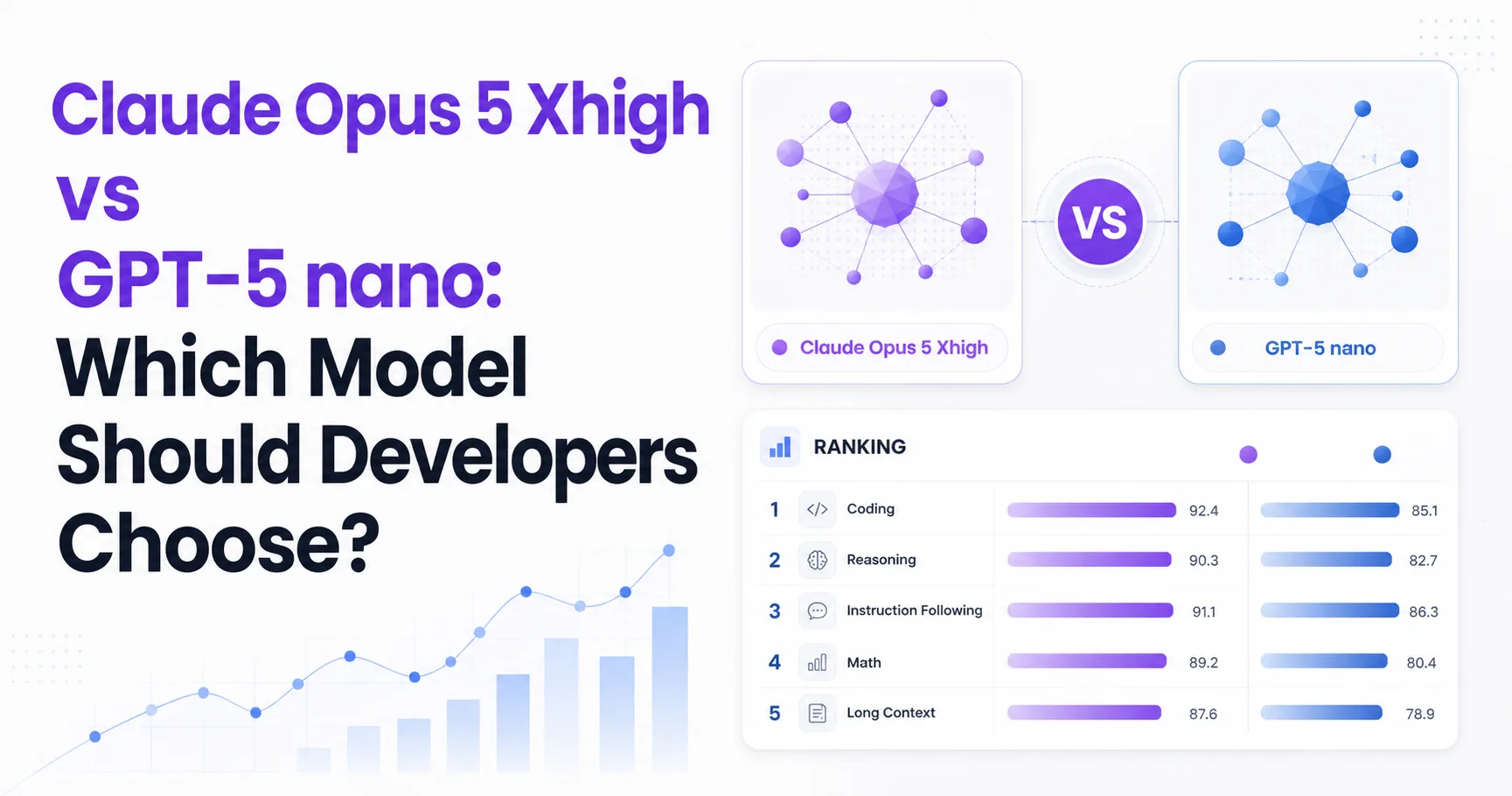
- **Winner overall:** Claude Opus 5 (Adaptive Reasoning, Xhigh Effort), with an Artificial Analysis Intelligence Index of 60.1 vs 19.9 - **Cheaper:** GPT-5 nano at $0.1375 vs $10 per 1M blended tokens - **Faster:** Claude Opus 5 (Adaptive Reasoning, Xhigh Effort) at 53.917 (median output tokens per second) - **Pick Claude Opus 5 when:** complex coding, long-running agents, and multi-file changes justify $25 per 1M output tokens - **Watch out:** both models report 0.3-second latency, but GPT-5 nano has no verified median output-speed value or current official model listing
Claude Opus 5 Xhigh vs GPT-5 nano
Claude Opus 5 (Adaptive Reasoning, Xhigh Effort) is the safer capability choice, while GPT-5 nano is the cheaper choice with materially weaker evidence for production use. The data snapshot gives Claude Opus 5 an Artificial Analysis Intelligence Index of 60.1 and GPT-5 nano 19.9, but it does not provide a directly comparable coding score for GPT-5 nano. Data provided by https://artificialanalysis.ai/ is the source of the quantitative comparison.
The naming also hides an important integration distinction. claude-opus-5-xhigh is presented as a comparison slug, while Anthropic documents claude-opus-5 as the API model ID and alias. Anthropic’s model overview identifies the stable model name and supported access paths. OpenAI’s current model directory does not list GPT-5 nano, so the comparison should be treated as a selection analysis based on the supplied snapshot, not confirmation that the OpenAI model remains directly callable. OpenAI’s model directory provides the relevant availability gap.
For a developer choosing one default model, Claude Opus 5 offers a documented operating model and a stronger general capability signal. GPT-5 nano is compelling for narrowly scoped, high-volume work only if its actual endpoint, limits, and behavior are verified first.
Executive summary for model selection
Claude Opus 5 (Adaptive Reasoning, Xhigh Effort) is the stronger general-purpose engineering model, while GPT-5 nano wins on listed unit economics and has a separate math signal. The supplied data reports Claude Opus 5 at 60.1 on the Artificial Analysis Intelligence Index, compared with 19.9 for GPT-5 nano. GPT-5 nano also records an Artificial Analysis Math Index of 83.7, but Claude Opus 5 has no corresponding math value in the snapshot. That prevents a clean conclusion about mathematical superiority.
| Decision area | Better-supported choice | Why it matters |
|---|---|---|
| General capability | Claude Opus 5 | The intelligence score is 60.1 versus 19.9. |
| Coding evidence | Claude Opus 5, with a qualification | Claude Opus 5 has a coding index of 77, while GPT-5 nano has no supplied coding score. |
| Math evidence | GPT-5 nano, provisionally | GPT-5 nano reports 83.7, but there is no matching Claude value. |
| Listed cost | GPT-5 nano | The blended price is $0.1375 versus $10 per 1M tokens. |
| Operational certainty | Claude Opus 5 | Anthropic documents the model and lifecycle status; OpenAI’s current directory does not list GPT-5 nano. |
Anthropic describes Claude Opus 5 for complex agentic coding, code review, debugging, long-context work, and multi-agent collaboration in the release announcement. Those claims align with the available coding and intelligence evidence, although Anthropic does not publish a complete reproducible table for every named evaluation. GPT-5 nano’s official capability boundary remains unclear because the current OpenAI pages do not identify that model specifically.
Performance: what the scores mean in real workflows
Claude Opus 5 (Adaptive Reasoning, Xhigh Effort) is the better-supported choice for complex engineering workflows, but the available evidence does not prove that it is better at every developer task. The supplied snapshot gives Claude Opus 5 a coding index of 77 and an intelligence index of 60.1. GPT-5 nano has no coding index in the snapshot, so the coding comparison is asymmetric rather than a measured win.
In practice, that asymmetry matters most when the task requires the model to maintain a plan across files, interpret unfamiliar code, recover from tool results, and decide what to do next. Anthropic explicitly positions Claude Opus 5 for long-running agentic coding, multi-file development, debugging, and code review in its model update. Community reports support the possibility of strong autonomy, but they also describe verbosity, overthinking, and continued work when the model should ask for missing input. Hacker News discussion and Reddit feedback are experiential reports without a reproducible test design.
Claude Opus 5 reports 53.917 median output tokens per second, while GPT-5 nano has no supplied output-speed value. Both report 0.3-second latency, but equal latency does not establish equal time to a useful answer. A fast model that needs retries, tighter decomposition, or more validation can consume more engineering time than its first-token measurement suggests.
GPT-5 nano does show a math index of 83.7, which may justify a focused trial for bounded mathematical or classification workloads. The evidence is insufficient to generalize that result to coding, tool use, or autonomous software changes. OpenAI’s current model documentation only describes the latest model family at a general level and does not explicitly attribute those capabilities to GPT-5 nano. The OpenAI models page therefore cannot close that evidence gap.
Cost: when the cheaper model may become more expensive
GPT-5 nano is the clear listed-cost winner, but its apparent savings are conditional on verified availability, adequate quality, and low rework. The snapshot lists GPT-5 nano at $0.1375 per 1M blended tokens, compared with $10 for Claude Opus 5. Claude Opus 5 also lists $5 per 1M input tokens and $25 per 1M output tokens, while GPT-5 nano lists $0.05 input and $0.4 output. Those figures make GPT-5 nano attractive for workloads dominated by short, repetitive requests.
The page-level cost chart can show the price gap, but it cannot show the cost of a failed workflow. If a low-cost model produces more invalid tool calls, weaker patches, incomplete plans, or extra review cycles, the effective cost includes retries and human intervention. That risk is especially relevant here because GPT-5 nano has no supplied coding score, no verified output-speed value, and no dedicated failure-mode documentation in the research brief.
Claude Opus 5’s pricing also interacts with its reasoning configuration. Anthropic says adaptive thinking is enabled by default, and max_tokens covers both thinking tokens and final response text in the official update. A production integration that budgets only for visible output can hit limits earlier than expected. Anthropic also documents prompt caching, including a minimum cacheable prompt length of 512 tokens and cache-hit pricing of $0.50 per MTok on the pricing page. Repeated long-context workflows may therefore have a different cost profile from isolated prompts.
OpenAI’s current pricing page lists gpt-5.4-nano, not gpt-5-nano. Its listed $0.20 input price, $0.02 cached-input price, and $1.25 output price must not be substituted for GPT-5 nano’s snapshot values. The OpenAI pricing page confirms the catalog mismatch. Until the endpoint and billing terms are verified, GPT-5 nano’s low price is a planning assumption, not a production guarantee.
Recommendation by developer workload
Claude Opus 5 (Adaptive Reasoning, Xhigh Effort) should be the default for high-consequence coding agents, while GPT-5 nano should be tested only for bounded tasks with explicit fallback rules. Claude’s documented support for text and image input, long context, adaptive reasoning, and agentic coding gives developers a clearer integration target. The Anthropic model overview also identifies Claude Opus 5 as available through the Claude API, Amazon Bedrock, Google Cloud, and Microsoft Foundry.
Choose Claude Opus 5 when the model must inspect a repository, modify several files, reason through tool results, review a patch, or continue a plan over a long session. Set effort deliberately, because xhigh is an effort configuration rather than a separate API model ID. Anthropic documents that xhigh and max cannot be combined with disabled thinking, and that such a request returns 400. The same source recommends keeping thinking enabled and controlling cost through effort settings.
Choose GPT-5 nano when the workload is narrow, repetitive, and easy to validate. Suitable candidates include small transformations, low-risk routing, structured extraction, or mathematical experiments where the 83.7 math index is relevant. Do not assume that the math result predicts coding quality. Do not deploy it as a primary autonomous coding agent until its official identifier, context limits, output limits, and billing are confirmed.
A sensible evaluation should measure successful task completion, repair rate, review time, tool-call validity, and total tokens. The supplied materials do not provide those operational measures for both models. Lenny’s public review of Claude Opus 5 covers live benchmarks, prototypes, PRDs, live coding, and agent behavior, but it is not an independently reproducible laboratory report. The review is useful for hypothesis generation, not final procurement evidence.
Claude Opus 5 is also not risk-free. Anthropic’s launch announcement says important limitations remain for long-running scientific research tasks and that biology and cybersecurity capabilities have dedicated safety controls. The announcement should be part of any risk review. The model’s publication date is 2026-07-24, while GPT-5 nano’s supplied metadata date is 2025-08-07, but the current official OpenAI catalog does not confirm GPT-5 nano’s lifecycle status. Anthropic’s model deprecations page provides a clearer lifecycle check for Claude Opus 5.
FAQ before you choose
Claude Opus 5 (Adaptive Reasoning, Xhigh Effort) is the better default when engineering correctness and agent continuity matter more than unit price. The comparison has a strong general-capability signal, but it does not establish every task-level outcome. GPT-5 nano remains a credible low-cost experiment because its listed blended price is $0.1375 and its math index is 83.7, yet official availability and coding evidence remain unresolved.
Frequently asked questions
Which model should I choose for an autonomous coding agent?
Choose Claude Opus 5 for an autonomous coding agent because it has a supplied coding index of 77, documented agentic coding support, and a verified official model identity. GPT-5 nano has no supplied coding score or current official listing, so its suitability remains unproven.
Is GPT-5 nano the obvious choice for cost-sensitive applications?
GPT-5 nano is the obvious first experiment for cost-sensitive applications because its supplied blended price is $0.1375 per 1M tokens versus $10 for Claude Opus 5. Production selection still requires endpoint, quality, retry, and billing verification.
Does GPT-5 nano beat Claude Opus 5 at mathematics?
GPT-5 nano has the stronger reported mathematics signal at 83.7, but the materials provide no corresponding Claude Opus 5 math score. The evidence supports a provisional GPT-5 nano advantage, not a complete mathematical comparison.
Are the two models equally fast because both show 0.3-second latency?
The two models have the same supplied latency value of 0.3 seconds, but they are not proven equally fast overall. Claude Opus 5 reports 53.917 median output tokens per second, while GPT-5 nano has no comparable speed value.
Is Claude Opus 5 Xhigh a separate API model?
Claude Opus 5 Xhigh is not documented as a separate API model. Anthropic documents claude-opus-5 as the model ID and describes xhigh as an effort setting, so integrations should use the official identifier and configure effort separately.
Can GPT-5 nano's current price be inferred from gpt-5.4-nano?
GPT-5 nano’s price cannot be inferred from gpt-5.4-nano. The current OpenAI pricing page lists gpt-5.4-nano at different prices, while the supplied snapshot lists GPT-5 nano at $0.05 input and $0.4 output per 1M tokens.
Sources
- Artificial AnalysisQuantitative comparison data, including evaluation scores, latency, output speed, pricing, release dates, and snapshot attribution.
- Claude models overviewClaude Opus 5 model ID, aliases, capabilities, context and output limits, supported platforms, and current availability.
- What's new in Claude Opus 5Adaptive thinking, effort settings, token limits, tool-use behavior, prompt caching, and API restrictions.
- Introducing Claude Opus 5Official positioning, evaluation names, release context, agentic coding claims, and safety limitations.
- Claude pricingClaude Opus 5 input, output, cache, and prompt caching prices.
- Model deprecationsClaude model lifecycle and deprecation status context.
- OpenAI ModelsChecking GPT-5 nano availability, official model identity, documented capabilities, and missing model-specific limits.
- OpenAI API PricingChecking the current OpenAI pricing catalog and distinguishing gpt-5.4-nano from GPT-5 nano.
- Is Opus 5 actually that bad, or is it just Reddit hype?Community reports about Claude Opus 5 speed, verbosity, overthinking, instruction following, and interactive coding.
- Claude Opus 5Community discussion about autonomy, self-directed workflows, missing inputs, and token consumption.
- Elevated errors on Claude Opus 5Community reports about long-running sessions, service errors, interruption, and recovery experience.
- Claude Opus 5 reviewPublic review covering live benchmarks, prototypes, PRDs, live coding, and agent behavior.
Published: