
AI model analysis
Claude Sonnet 4.6 Adaptive vs GPT-5 High: Which Model Should Developers Choose?
A developer-focused comparison of Claude Sonnet 4.6 Adaptive Reasoning Max Effort and GPT-5 high across coding quality, intelligence, math, latency, cost, API risk, and production fit.
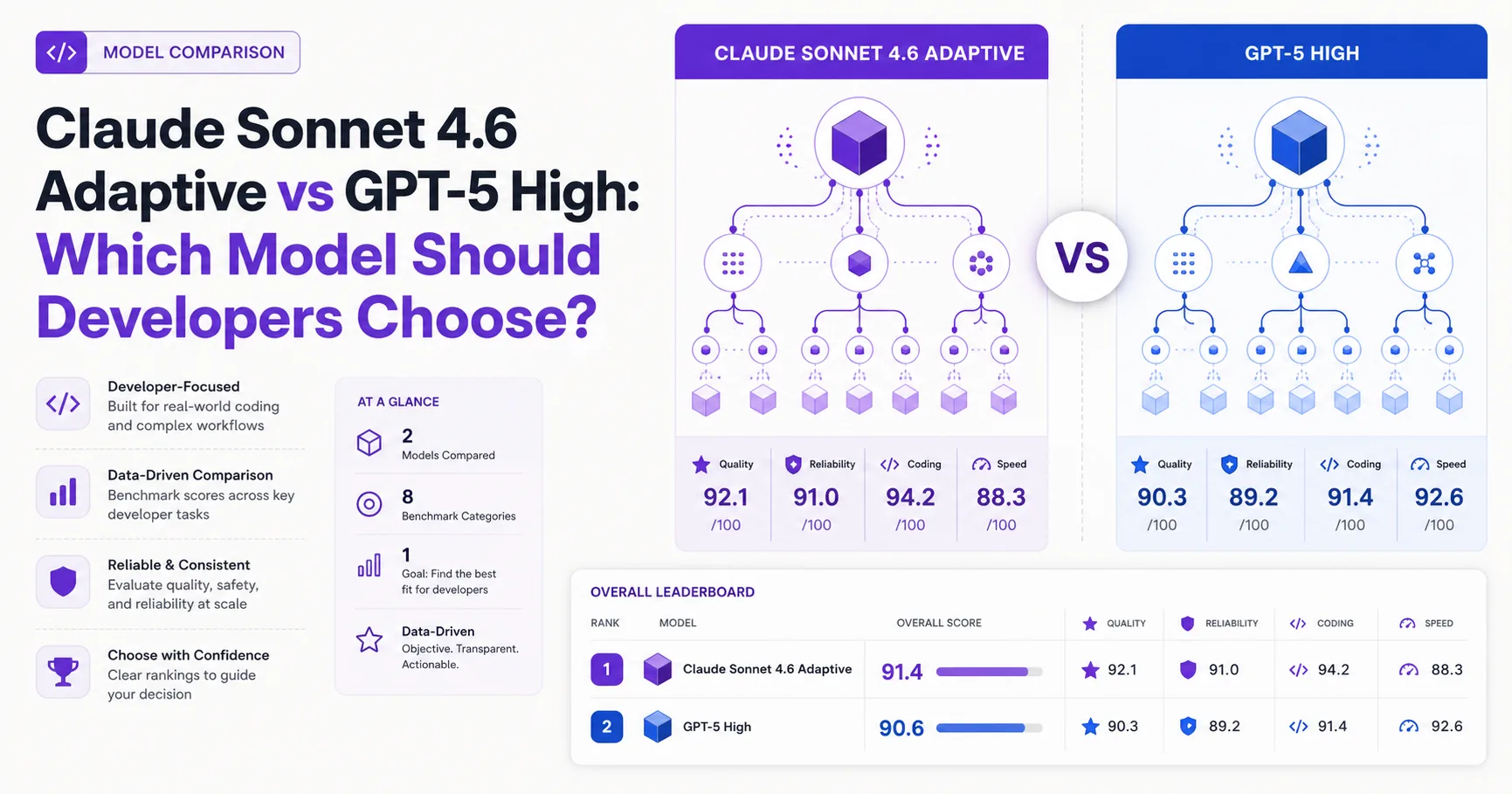
- **Winner overall:** Claude Sonnet 4.6 (Adaptive Reasoning, Max Effort), with an Artificial Analysis Intelligence Index of 47.2 vs GPT-5's 34.7 and a Coding Index of 63 vs 37.8 - **Cheaper:** GPT-5 (high) at $3.4375 vs $6 per 1M blended tokens - **Faster:** Claude Sonnet 4.6 (Adaptive Reasoning, Max Effort) and GPT-5 (high) tie at 0.3 seconds latency - **Pick GPT-5 (high) when:** lower token cost and a documented 94.3 Artificial Analysis Math Index matter more than coding leadership - **Watch out:** Claude Sonnet 4.6 lacks independently verified model-specific API limits and official benchmark results, while GPT-5's fixed snapshot carries deprecation risk
Claude Sonnet 4.6 Adaptive vs GPT-5 High
Claude Sonnet 4.6 (Adaptive Reasoning, Max Effort) is the stronger default for developers who prioritize coding and broad model quality, while GPT-5 (high) is the lower-cost choice with a documented math advantage. The Artificial Analysis snapshot reports Claude at 63 on the Coding Index and 47.2 on the Intelligence Index, compared with GPT-5 at 37.8 and 34.7 respectively (data provided by Artificial Analysis).
GPT-5 remains attractive for cost-sensitive workloads because its blended price is $3.4375 per 1M tokens, compared with Claude’s $6. Both models show 0.3 seconds latency in the supplied comparison, but neither has a reported median output speed. The practical decision therefore depends less on responsiveness and more on whether coding quality, math evidence, cost, or lifecycle certainty dominates the workload.
Executive summary for model selection
Claude Sonnet 4.6 (Adaptive Reasoning, Max Effort) offers the clearest quality lead for software engineering, but GPT-5 (high) offers the clearer cost and math case. The supplied Artificial Analysis comparison gives Claude a Coding Index of 63 versus 37.8 for GPT-5, a difference of 25.200000000000003, and an Intelligence Index of 47.2 versus 34.7, a difference of 12.5 (data provided by Artificial Analysis).
The comparison is not a complete head-to-head benchmark. GPT-5 has a reported Math Index of 94.3, while Claude’s corresponding value is unavailable in the snapshot. That means GPT-5 should not be described as weaker for mathematical work, but the evidence does not establish how the models compare on the same math test.
| Decision factor | Better-supported choice | Why it matters |
|---|---|---|
| Coding-heavy work | Claude Sonnet 4.6 | The supplied Coding Index strongly favors Claude. |
| General model quality | Claude Sonnet 4.6 | The Intelligence Index favors Claude. |
| Math-focused work | GPT-5 | GPT-5 has a reported Math Index of 94.3; Claude’s value is unavailable. |
| Token cost | GPT-5 | GPT-5 costs $3.4375 blended versus Claude at $6. |
| Measured latency | Tie | Both models are listed at 0.3 seconds. |
| API lifecycle clarity | GPT-5, with caution | GPT-5 has a documented alias, but its fixed snapshot is deprecated. |
Claude’s official documentation does not provide a standalone specification for the exact adaptive, max-effort configuration. GPT-5’s official documentation is more explicit about its API identity and controls, but the fixed snapshot’s deprecation status creates migration work. Neither model has enough evidence here to support a confident claim about real-world output speed.
Performance: what the chart means in real development
Claude Sonnet 4.6 (Adaptive Reasoning, Max Effort) is the better-supported choice for coding workflows, but the available evidence does not prove that it wins every software task. The Artificial Analysis Coding Index places Claude at 63 and GPT-5 at 37.8 (data provided by Artificial Analysis). That gap is large enough to justify testing Claude first for code generation, repository changes, debugging, and agent tasks where incorrect edits create review or rollback costs.
The score does not tell a developer how much supervision a task needs. A coding index can support model selection, but it cannot establish patch correctness for a particular language, framework, repository age, or tool loop. Community evidence for GPT-5 points in opposite directions. One Reddit author reported that GPT-5 was useful for locating and fixing small bugs, while the same account described less complete results for full applications and interface generation. Comments also raised concerns about hallucinations and incorrect changes in complex existing codebases. Those observations came from an uncontrolled personal test, so they should guide validation rather than override the supplied benchmark (Reddit: Tried GPT-5 Here Are My First Impressions).
GPT-5 (high) has the stronger documented math signal, with a Math Index of 94.3, but Claude has no corresponding value in the snapshot. The evidence is therefore asymmetric, not a demonstrated math win for GPT-5 over Claude (data provided by Artificial Analysis).
Latency does not separate the models in the supplied data. Both are listed at 0.3 seconds, and median output tokens per second are unavailable for both. Developers should measure time to useful patch, tool-call completion, and accepted change rate in their own workflow. The research brief also does not provide reliable community evidence for stable speed preferences.
Cost: when the cheaper model can become expensive
GPT-5 (high) is the cheaper model in the supplied pricing comparison, but its lower token price only matters if it reaches an acceptable result with similar retry and review effort. GPT-5 costs $3.4375 per 1M blended tokens, compared with $6 for Claude Sonnet 4.6 (data provided by Artificial Analysis). The input price is $1.25 for GPT-5 versus $3 for Claude, while output is $10 versus $15. These differences favor GPT-5 for high-volume calls and workflows dominated by prompt traffic.
Token price is not the same as task cost. A model that produces an incomplete application, requires additional repair prompts, or makes an unsafe repository edit can consume engineering time that the pricing chart cannot show. The supplied community report raises exactly that concern for GPT-5 in full application generation and complex existing codebases, though the evidence is anecdotal and uncontrolled (Reddit: Tried GPT-5 Here Are My First Impressions).
Claude’s pricing has another operational detail. Its official pricing documentation lists separate rates for cache writes and cache hits, so workloads with long repeated instructions should model cache behavior rather than treating every input token as a standard request (Anthropic Pricing). The same documentation states that the US inference region applies a 1.1x multiplier for Claude 4.6 and later models. That regional requirement can narrow the apparent gap for teams that need US data processing.
GPT-5’s lower price is the rational first test for routine classification, extraction, and math-heavy calls. Claude’s higher price may be justified when better code changes reduce retries, review time, or production risk. The supplied materials do not contain workload-level cost-per-success data, so neither model has a proven total-cost advantage.
Recommendation by developer workload
Claude Sonnet 4.6 (Adaptive Reasoning, Max Effort) should be the first candidate for coding agents and high-stakes repository work, while GPT-5 (high) should be the first candidate for cost-sensitive and math-focused workloads. Claude’s supplied Coding Index of 63 versus GPT-5’s 37.8 provides the strongest evidence in this comparison (data provided by Artificial Analysis).
Choose Claude when the model must understand a broad codebase, propose multi-file changes, debug behavior across layers, or sustain an agent loop where patch quality matters more than minimum token cost. This recommendation remains conditional because the research brief contains no controlled community test for the exact Claude adaptive configuration and no model-specific failure catalogue.
Choose GPT-5 when request volume makes price a primary constraint, when the task is math-oriented, or when you need documented controls such as reasoning effort and verbosity. GPT-5 has a reported Math Index of 94.3 and costs $3.4375 per 1M blended tokens (data provided by Artificial Analysis). Its official developer material documents the gpt-5 alias and high reasoning effort configuration (GPT-5 for developers).
Treat deployment identity as part of the recommendation. Anthropic documents fixed, undated identifiers for its 4.6 generation, but the brief does not verify a stable API alias for the exact Claude configuration (Anthropic Models overview). OpenAI documents gpt-5, yet the fixed snapshot is marked deprecated in the model documentation (GPT-5 model documentation).
A sensible selection process is to start with Claude for coding, GPT-5 for math and cost-sensitive calls, then run representative repository tasks before committing. The evidence does not support a universal winner for multimodal, audio, video, or platform-specific deployment because the supplied materials do not provide a complete cross-provider availability comparison.
Questions to answer before adoption
GPT-5 (high) is easier to identify at the API level, while Claude Sonnet 4.6 requires more verification for the exact adaptive configuration. OpenAI documents the gpt-5 alias, reasoning controls, and endpoint support (GPT-5 model documentation). Anthropic documents the 4.6 generation’s fixed snapshot rule and Batch-specific output behavior, but the research brief does not verify a stable alias for Claude Sonnet 4.6 (Adaptive Reasoning, Max Effort) (Anthropic Models overview). Developers should confirm the exact provider endpoint, output limits, region behavior, and retirement policy during integration testing.
Frequently asked questions
Should developers choose Claude Sonnet 4.6 or GPT-5 for coding agents?
Developers should start with Claude Sonnet 4.6 for coding agents because its supplied Coding Index is 63 versus 37.8 for GPT-5, while still validating repository-specific accuracy before production adoption.
Is GPT-5 the better model for mathematics?
GPT-5 has the stronger documented math evidence because its Artificial Analysis Math Index is 94.3, but Claude’s corresponding value is unavailable, so the comparison does not prove a direct math winner.
Which model is cheaper for production API traffic?
GPT-5 is cheaper in the supplied comparison at $3.4375 per 1M blended tokens versus $6 for Claude Sonnet 4.6, although retries and human review can change total task cost.
Are Claude Sonnet 4.6 and GPT-5 equally fast?
The supplied data lists both models at 0.3 seconds latency, but neither model has a reported median output speed, so developers still need workflow-level measurements.
Does GPT-5 high mean there is a separate gpt-5-high API model?
GPT-5 high is a reasoning configuration rather than a separately verified API model name; the supplied official material identifies gpt-5 and uses high reasoning effort as a parameter.
What is the biggest adoption risk for each model?
Claude’s biggest risk is incomplete public evidence for the exact adaptive configuration, while GPT-5’s biggest risk is lifecycle management because its fixed snapshot is marked deprecated in official documentation.
Sources
- Artificial AnalysisSupplied comparison values for intelligence, coding, math, blended pricing, input pricing, output pricing, and latency.
- Anthropic Models overviewClaude model identity rules, Batch output behavior, multimodal positioning, and the absence of a standalone specification for the exact adaptive configuration.
- Anthropic PricingClaude standard pricing, prompt caching prices, tokenizer information, and the US inference region multiplier.
- GPT-5 for developersGPT-5 API positioning, reasoning controls, tool calling, and the distinction between the model alias and high reasoning effort.
- GPT-5 model documentationGPT-5 API identity, endpoint availability, lifecycle status, pricing, modality limitations, and official model controls.
- Tried GPT-5 Here Are My First ImpressionsUncontrolled community observations about GPT-5 debugging, application generation, and possible errors in complex existing codebases.
Published: