
AI model analysis
Claude Sonnet 4.6 Adaptive vs GPT-5 nano: Which Model Should Developers Choose?
A developer-focused comparison of Claude Sonnet 4.6 Adaptive and GPT-5 nano, covering measured quality, cost, availability evidence, and selection risks.
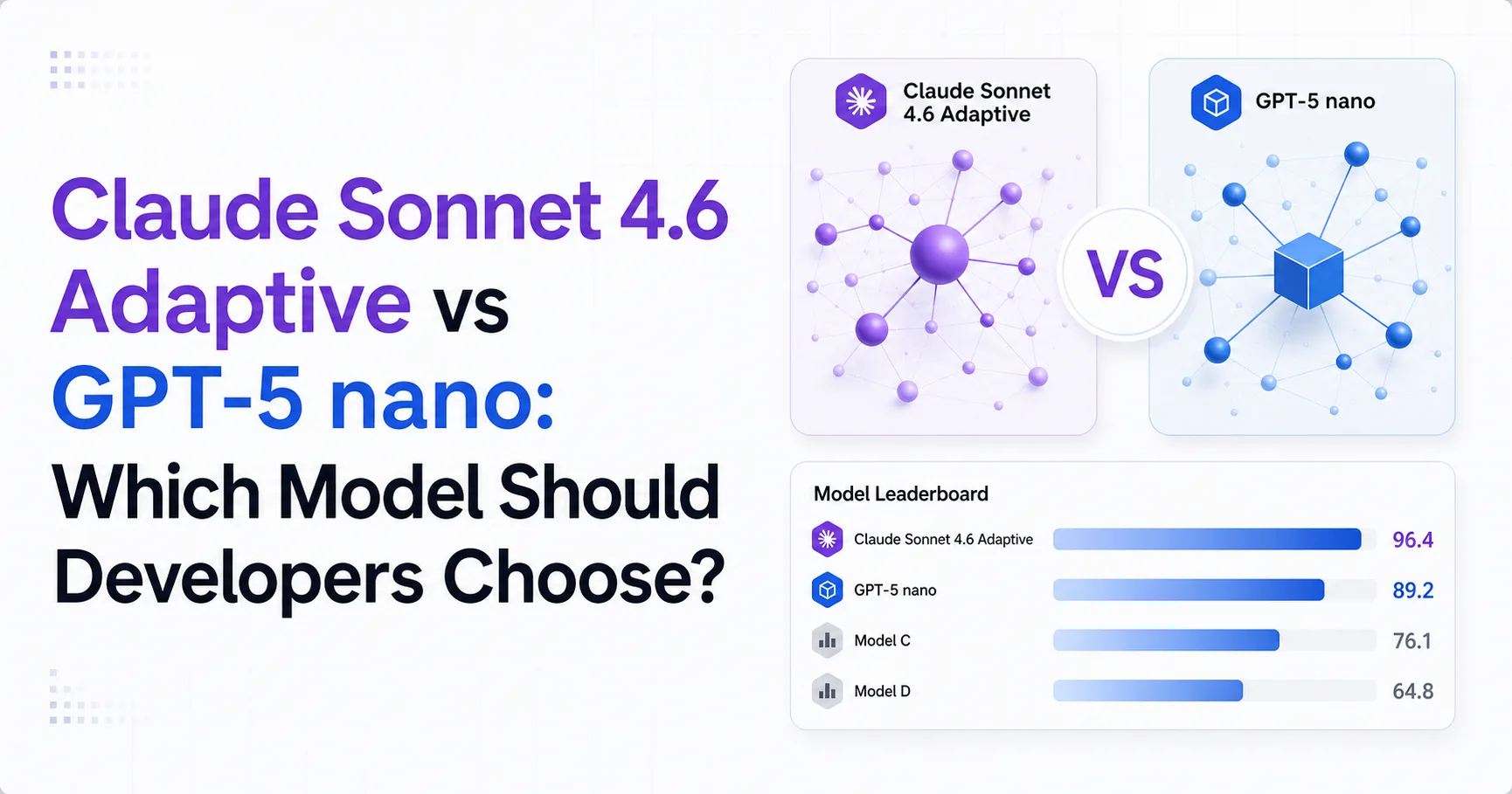
- **Winner overall:** Claude Sonnet 4.6 (Adaptive Reasoning, Max Effort), with an Artificial Analysis Intelligence Index of 47.2 vs 19.9 - **Cheaper:** GPT-5 nano (high) at $0.1375 vs $6 per 1M blended tokens - **Faster:** Neither model, with both at 0.3 seconds latency - **Pick GPT-5 nano when:** low blended cost and an Artificial Analysis Math Index of 83.7 matter more than broad measured intelligence - **Watch out:** Official OpenAI pages do not currently list GPT-5 nano, so its present availability and exact API contract remain unverified
Claude Sonnet 4.6 Adaptive vs GPT-5 nano
Claude Sonnet 4.6 is the stronger measured general-purpose choice, while GPT-5 nano is the dramatically cheaper option with a high math score.
The decision is therefore not a simple quality ranking. It is a deployment-risk decision between a model with stronger broad evaluation evidence and a model whose current official listing is difficult to verify. Artificial Analysis reports an Intelligence Index of 47.2 for Claude Sonnet 4.6 and 19.9 for GPT-5 nano. The same dataset reports a Math Index of 83.7 for GPT-5 nano, while no comparable math value is provided for Claude Sonnet 4.6. Artificial Analysis provides the comparison data used in this article.
Anthropic currently lists Claude Sonnet 4.6 in its pricing documentation, where the model is not marked as retired. Anthropic’s pricing documentation therefore gives Claude a clearer present-day commercial status. OpenAI’s current model directory does not list GPT-5 nano, gpt-5-nano, or gpt-5-nano-2025-08-07. OpenAI’s model documentation does not establish whether the model remains directly callable.
For a production system, Claude is the safer default when broad task coverage, documented status, and coding relevance matter. GPT-5 nano deserves consideration for cost-sensitive workloads, especially math-oriented tasks, but teams should verify access, model identifiers, limits, and behavior before committing to it.
Executive summary for developers
Claude Sonnet 4.6 offers the stronger documented selection case, while GPT-5 nano offers the stronger price case.
| Decision factor | Claude Sonnet 4.6 (Adaptive Reasoning, Max Effort) | GPT-5 nano (high) |
|---|---|---|
| Artificial Analysis Intelligence Index | 47.2 | 19.9 |
| Artificial Analysis Coding Index | 63 | Not provided |
| Artificial Analysis Math Index | Not provided | 83.7 |
| Latency | 0.3 seconds | 0.3 seconds |
| Blended price per 1M tokens | $6 | $0.1375 |
| Input price per 1M tokens | $3 | $0.05 |
| Output price per 1M tokens | $15 | $0.4 |
Claude’s measured advantage is broad rather than universal. The Intelligence Index favors Claude, and the available Coding Index value is 63. However, the dataset does not provide a directly comparable GPT-5 nano coding score. GPT-5 nano’s Math Index is 83.7, but Claude has no corresponding value in the supplied data. These missing cells prevent a complete capability ranking.
The commercial evidence points in the opposite direction. GPT-5 nano’s blended price is $0.1375 per 1M tokens, compared with $6 for Claude. That price gap can dominate infrastructure decisions for high-volume classification, extraction, routing, or short-form generation. It does not prove that GPT-5 nano is cheaper per successful task, because the supplied material does not report retry rates, output quality at a fixed task threshold, or production failure rates.
Claude’s official documentation describes Claude 4.6 models as fixed, undated snapshots rather than aliases that continuously move to a newer version. The Anthropic models overview supports a more stable versioning expectation, although it does not provide a complete platform-by-platform availability list.
Performance: what the scores mean in real applications
Claude Sonnet 4.6 has the stronger broad-performance signal, but GPT-5 nano may be the better specialist choice for math-heavy workloads.
The Intelligence Index gap is substantial in the supplied snapshot: Claude Sonnet 4.6 scores 47.2, while GPT-5 nano scores 19.9. That result supports Claude for applications that combine several kinds of reasoning, follow detailed instructions, and move between coding, analysis, and general knowledge tasks. It does not establish that Claude wins every prompt. An aggregate index compresses many task types into one number, so product teams still need task-specific acceptance tests. Artificial Analysis is the stated provider of the evaluation data.
The coding comparison is incomplete. Claude Sonnet 4.6 has a Coding Index of 63, but the data snapshot provides no GPT-5 nano coding value. A developer should not turn that missing value into an assumed loss. The evidence supports saying that Claude has measured coding evidence, not that GPT-5 nano is incapable of coding. The research brief also found no independently verifiable community coding reports for either exact model configuration, so anecdotal preference should not fill the gap. Anthropic’s model overview does not publish an independent Sonnet 4.6 benchmark table.
GPT-5 nano has a Math Index of 83.7, which creates a credible reason to test it for arithmetic, symbolic reasoning, numerical validation, or other math-centered workflows. The supplied materials do not explain the benchmark composition, error profile, or relationship between that score and production success. The score is a signal for evaluation, not a guarantee of reliable answers.
Latency does not separate the models in the snapshot. Both are listed at 0.3 seconds. Neither model has a supplied median output speed value, so streaming throughput, long-response completion time, and token-generation behavior remain unknown. Teams with interactive user interfaces should measure time to first token and full completion in their own region and API path.
Cost: the cheaper model can still cost more per successful result
GPT-5 nano is the clear listed-price winner, but Claude Sonnet 4.6 can become economically rational when quality reduces downstream work.
The supplied blended prices are $0.1375 per 1M tokens for GPT-5 nano and $6 per 1M tokens for Claude Sonnet 4.6. That difference makes GPT-5 nano the natural first candidate for workloads dominated by large request counts, short prompts, or low-value individual operations. Input and output prices also favor GPT-5 nano, at $0.05 and $0.4 per 1M tokens, compared with Claude’s $3 and $15. Artificial Analysis supplies these comparison values.
Price per token is not the same as price per accepted answer. A cheaper model can become more expensive if it needs extra verification calls, human review, retries, fallback routing, or complex post-processing. The research brief provides no measured failure rate, retry rate, quality threshold, or token consumption pattern for either model. That evidence is insufficient to calculate total cost per successful task.
Claude’s pricing model also requires careful accounting for prompt caching. Anthropic lists standard input at $3 per MTok and output at $15 per MTok. The same pricing page lists 5-minute cache writes at $3.75 per MTok, 1-hour cache writes at $6 per MTok, and cache hits and refreshes at $0.30 per MTok. Anthropic’s pricing page documents these separate operations. A workload with repeated long instructions may have a different cost profile from a simple blended estimate.
Data-region requirements can change the Claude estimate. Anthropic states that inference_geo: "us" applies a 1.1x multiplier to Claude 4.6 and later models, while global uses standard pricing. The supplied material does not identify an equivalent GPT-5 nano regional multiplier. Teams should treat that comparison as unresolved rather than assuming identical regional economics.
The practical cost test is simple: measure accepted outputs, not tokens alone. Record model calls, retries, verification calls, reviewer interventions, and latency during a representative pilot. The available brief does not provide those production measurements, so no stronger total-cost conclusion is justified.
Recommendation by workload
Claude Sonnet 4.6 is the recommended default for mixed developer workloads, while GPT-5 nano is the recommended experiment for high-volume and math-focused paths.
Choose Claude Sonnet 4.6 when one model must cover coding, general reasoning, document analysis, and multimodal input. Anthropic’s model overview describes Claude models as supporting text and image input, text output, multilingual capability, and vision. Anthropic’s model overview presents those as family-level capabilities, so teams should confirm the exact API behavior for their selected identifier. Claude also has a Coding Index value of 63 and an Intelligence Index value of 47.2 in the supplied data.
Choose GPT-5 nano when token economics are the primary constraint and the workload can tolerate a verification layer. Its blended price is $0.1375 per 1M tokens, and its Math Index is 83.7. Those characteristics make it worth testing for bulk scoring, mathematical transformations, structured extraction, lightweight routing, and other tasks where each request has limited business value. The supplied research does not verify the model’s current OpenAI catalog status, stable alias, context window, output limit, or parameter support. OpenAI’s model directory is the relevant place to verify those details before deployment.
Use a two-model route only when the routing logic has a measurable benefit. GPT-5 nano can handle cheap, narrow, or math-oriented requests, while Claude can receive cases requiring broader reasoning or stronger coding evidence. However, the materials do not provide classifier accuracy, escalation rates, or combined system cost. A routing architecture is therefore a testable option, not an established recommendation.
Before production approval, run the same task set against both models, verify the exact API identifiers, confirm context and output limits, test structured-output behavior, and measure retries. This is especially important for GPT-5 nano because the current official directory does not list the model. Claude’s status is clearer, but its exact platform availability and stable API alias are also not fully established by the supplied research.
Questions to answer before choosing
Claude Sonnet 4.6 should be the initial production candidate when the team cannot tolerate uncertainty about model availability and broad capability evidence.
The comparison has clear signals, but it also has important missing data. The official OpenAI pages do not list GPT-5 nano, and the supplied research found no exact-model community evaluations. Anthropic’s public documentation confirms Claude Sonnet 4.6 pricing and model-family behavior, yet it does not publish a complete platform availability matrix or an independent Sonnet 4.6 benchmark table. OpenAI pricing documentation also does not list GPT-5 nano; it lists a different nano model, gpt-5.4-nano, whose information must not be transferred to GPT-5 nano.
Those gaps matter because developers select APIs, not abstract benchmark entries. A model with excellent economics is not useful if access is unavailable, the identifier is unstable, or its limits do not fit the request shape. A model with stronger broad scores is not automatically the lowest-cost option if its outputs require fewer retries and less review. The supplied materials do not measure either production outcome.
The safest process is to treat the data snapshot as a shortlist filter. Treat official documentation as the availability and billing authority. Then use a small, representative evaluation set to decide whether the measured advantage survives the actual workload.
Frequently asked questions
Which model is better for general coding tasks?
Claude Sonnet 4.6 is the better-supported choice for general coding tasks because the supplied data reports a Coding Index of 63, while GPT-5 nano has no comparable coding score. The missing GPT-5 nano score is evidence of an incomplete comparison, not proof that it cannot code.
Which model is cheaper for production workloads?
GPT-5 nano is cheaper by listed token price, at $0.1375 per 1M blended tokens versus $6 for Claude Sonnet 4.6. Actual production cost remains uncertain because the materials do not report retries, verification calls, failure rates, or accepted-answer rates.
Does GPT-5 nano outperform Claude Sonnet 4.6 at mathematics?
GPT-5 nano has the only supplied Math Index, at 83.7, so the data creates a strong reason to test it for math-focused work. The comparison cannot prove superiority because Claude Sonnet 4.6 has no Math Index value in the snapshot.
Are the two models equally fast?
The supplied snapshot lists both Claude Sonnet 4.6 and GPT-5 nano at 0.3 seconds latency. It does not provide median output tokens per second for either model, so teams cannot infer equal streaming throughput or equal long-response completion time.
Is GPT-5 nano safe to adopt without further verification?
GPT-5 nano should not be adopted without further verification because the current OpenAI model directory does not list the model or establish its stable API identifier, context window, output limit, or current availability. A direct access test and contract check are required.
Sources
- Artificial AnalysisAll benchmark, latency, pricing comparison, release-date, and data snapshot values supplied for the two models.
- Anthropic Models OverviewClaude 4.6 model identifier rules, Batch API output behavior, family-level capabilities, and model documentation status.
- Anthropic PricingClaude Sonnet 4.6 listed status, standard pricing, prompt-caching prices, tokenizer information, and regional pricing multiplier.
- OpenAI ModelsVerification of the current OpenAI model directory, GPT-5 nano listing status, general capability documentation, and missing model-specific limits.
- OpenAI API PricingVerification that the current pricing page does not list GPT-5 nano and distinguishes it from gpt-5.4-nano.
Published: