
AI model analysis
Claude Sonnet 4.6 Adaptive vs o3: Which Model Should Developers Choose?
A developer-focused comparison of Claude Sonnet 4.6 Adaptive Reasoning, Max Effort and o3 across measured quality, speed, cost, availability, and selection risk.
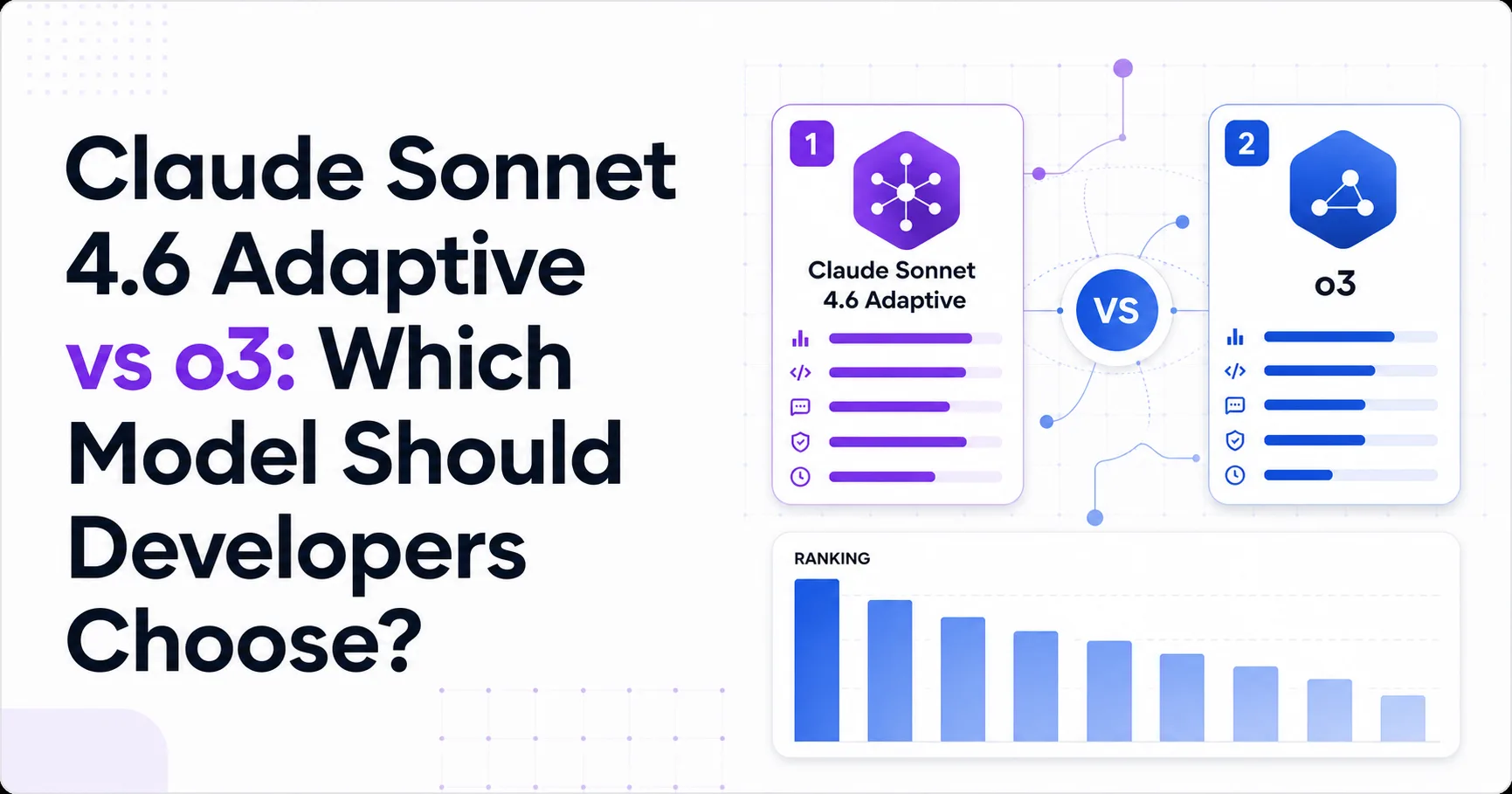
- **Winner overall:** Claude Sonnet 4.6 (Adaptive Reasoning, Max Effort), with a 47.2 Artificial Analysis Intelligence Index versus 30.4 for o3 - **Cheaper:** o3 at $3.5 vs $6 per 1M blended tokens - **Faster:** o3 at 128.056 median output tokens per second - **Pick Claude Sonnet 4.6 when:** broad intelligence and coding quality matter more than token price - **Watch out:** coding, context-window, and current API availability evidence is incomplete for at least one model
Claude Sonnet 4.6 Adaptive vs o3
Claude Sonnet 4.6 is the safer overall choice for developers who prioritize broad measured intelligence, while o3 is the faster and cheaper option.
The available evidence does not support a universal winner for every engineering workload. Claude Sonnet 4.6 records an Artificial Analysis Intelligence Index of 47.2, compared with 30.4 for o3. o3 has a reported median output speed of 128.056 tokens per second, while Claude Sonnet 4.6 has no corresponding speed value in the supplied data. The two models share a reported latency of 0.3 seconds.
The comparison also has an important operational asymmetry. Claude Sonnet 4.6 remains visible in Anthropic’s current pricing table and is not marked retired, while the current OpenAI model directory does not list o3. Anthropic’s model overview describes fixed, undated snapshot IDs for Claude 4.6 and later models. OpenAI’s current model directory does not provide an equivalent current listing for o3.
Treat this as a selection decision under incomplete evidence. The supplied materials do not establish a reliable comparison of context windows, synchronous output limits, stable aliases, platform availability, or model-specific failure modes.
Executive summary for developers
Claude Sonnet 4.6 offers the stronger measured general capability signal, while o3 offers the stronger efficiency signal.
The clearest quality result comes from the Artificial Analysis Intelligence Index. Claude Sonnet 4.6 scores 47.2, and o3 scores 30.4. The supplied comparison does not include a coding score for o3 or a math score for Claude Sonnet 4.6, so neither model can be declared the winner across those domains. Claude Sonnet 4.6 has a reported coding index of 63, while o3 has a reported math index of 88.3. Those are useful signals, but they are not directly comparable scores.
| Decision area | Better-supported choice | Why it matters |
|---|---|---|
| General capability | Claude Sonnet 4.6 | Higher reported Intelligence Index, 47.2 versus 30.4 |
| Coding evidence | Claude Sonnet 4.6, provisionally | Claude has a reported coding index of 63, but o3 has no supplied coding score |
| Math evidence | o3, provisionally | o3 has a reported math index of 88.3, but Claude has no supplied math score |
| Output speed | o3 | Reported median output speed is 128.056 tokens per second |
| Latency | Tie | Both models are reported at 0.3 seconds |
| Blended token cost | o3 | $3.5 versus $6 per 1M blended tokens |
| Current public visibility | Claude Sonnet 4.6 | Anthropic lists it in current pricing; OpenAI’s current model page does not list o3 |
The official documentation is also uneven. Anthropic documents Claude 4.6 model-ID behavior and Batch API output up to 300,000 tokens with a specified beta header, but it does not provide a standalone specification page for this exact adaptive-reasoning configuration. Anthropic’s model overview is therefore useful for lifecycle and API caveats, not for filling missing benchmark details.
The practical summary is simple: choose Claude when quality breadth and coding evidence dominate; choose o3 when throughput and spend dominate, provided your deployment can still access it.
Performance: what the chart does not show
Claude Sonnet 4.6 has the stronger measured general-intelligence result, while o3 has the only reported generation-speed result.
A higher general score matters most when a request mixes several forms of work. A developer assistant may need to interpret unfamiliar code, preserve constraints, explain a tradeoff, and produce a usable patch in one turn. Claude Sonnet 4.6’s 47.2 Intelligence Index gives it the better available signal for that mixed workload. It does not prove that Claude wins every task, because the supplied data does not identify the benchmark composition or provide a matching o3 coding result.
o3’s 128.056 median output tokens per second changes the economics of interactive work. Faster generation can reduce the time a developer watches a response stream, especially for long explanations, large patches, or repeated agent steps. That advantage does not automatically make o3 better. The user-visible experience also depends on prompt preparation, tool calls, retries, output length, and whether the application waits for a complete answer.
The equal reported latency of 0.3 seconds means the first-response experience is not separated by the supplied latency metric. The distinction appears after generation starts: o3 has a measured output-speed value, while Claude Sonnet 4.6 does not. The evidence therefore supports a speed advantage for o3, but not a complete end-to-end responsiveness comparison.
The benchmark coverage points in different directions. Claude Sonnet 4.6 has a coding index of 63. o3 has a math index of 88.3. Since the other model’s corresponding score is missing in each case, these figures should guide test design rather than settle the choice. A team selecting for code generation should run its own repository tasks. A team selecting for symbolic or quantitative reasoning should test o3 against representative cases and inspect error severity, not just answer rate.
The official materials do not fill the missing operational details. Anthropic’s model overview does not provide an independent specification table for this exact Claude configuration. OpenAI’s model directory does not list o3 in the supplied current catalog. Context-window limits, synchronous output limits, stable aliases, and tool behavior remain evidence gaps.
Cost: when the cheaper model becomes more expensive
o3 has the lower listed token cost, but Claude Sonnet 4.6 can still be cheaper for a workflow that avoids retries and corrective turns.
The supplied blended comparison prices o3 at $3.5 per 1M blended tokens and Claude Sonnet 4.6 at $6. That makes o3 the obvious first candidate for high-volume workloads where output quality is already sufficient. The input prices also favor o3, at $2 versus $3 per 1M input tokens. Output prices widen the gap further, at $8 for o3 versus $15 for Claude Sonnet 4.6.
Those numbers describe token billing, not total task cost. A model that produces a superficially plausible answer but needs an additional review, retry, or repair can consume more tokens and engineering time. The supplied data does not measure retry rates, tool-call success, patch acceptance, or human review effort, so it cannot prove that Claude’s higher quality signal offsets its higher price. That is the key cost uncertainty for production selection.
Prompt caching adds another important condition for Claude deployments. Anthropic’s pricing documentation lists separate prices for five-minute cache writes, one-hour cache writes, and cache hits or refreshes. A workload with a large repeated system prompt may have a different effective cost from a stateless request pattern. The cache operation and cache duration must be modeled separately from standard input tokens.
Data residency can also change Claude’s estimate. Anthropic states that the US inference geography for Claude 4.6 and later models uses a 1.1x price multiplier, while global is the default standard price. Teams requiring US inference should include that multiplier in their budget model. The supplied materials do not provide a comparable o3 regional multiplier or current price, because OpenAI’s pricing page does not list o3.
Use o3 as the cost baseline, then compare completed-task cost rather than raw token price. Measure successful first-pass completion, average retries, output length, and review time on your own workload. Without those measurements, declaring the cheaper model the cheaper system is only an assumption.
Recommendation by developer workload
Claude Sonnet 4.6 is the better default for mixed coding and reasoning work, while o3 is the better candidate for speed-sensitive and budget-sensitive workloads.
Pick Claude Sonnet 4.6 when your application must handle varied engineering requests with limited routing logic. Its reported Intelligence Index of 47.2 is the strongest broad capability signal in the supplied data. Its reported coding index of 63 also makes it the more defensible starting point for repository assistance, although the absence of an o3 coding score prevents a conclusive coding comparison.
Pick o3 when response throughput and token spend are primary constraints. Its reported median output speed of 128.056 tokens per second and blended price of $3.5 per 1M tokens support interactive, high-volume use cases. These advantages are most valuable when the model’s answers pass your acceptance checks without repeated correction. The supplied materials do not provide reliable community tests or failure reports, so validate quality before committing to broad deployment.
Use o3 as a specialist candidate for math-heavy work. The supplied data reports an o3 math index of 88.3, while no matching Claude math score is provided. That result supports targeted evaluation, not a blanket claim that o3 is better for every quantitative task. Test exactness, units, derivations, refusal behavior, and tool-assisted calculations using your own examples.
Treat Claude’s deployment path as better documented, but not fully documented. Anthropic currently lists Claude Sonnet 4.6 in its pricing table and explains its fixed snapshot-ID approach. The same documentation says that a 300,000-token output limit is available through Batch API with the output-300k-2026-03-24 beta header. That limit should not be assumed for synchronous Messages API calls. Anthropic’s model overview supports this distinction.
Treat o3 availability as a release-management risk. OpenAI’s current model directory does not list o3, and OpenAI’s current pricing page does not list its Standard, Batch, Flex, or Fast mode prices. The materials do not establish whether o3 remains directly callable, has a stable alias, or has a formal successor. Confirm access, endpoint behavior, and commercial terms immediately before implementation.
A sensible evaluation sequence is: start with Claude for the general-purpose baseline, test o3 on the same accepted-task set, then compare completed-task cost and latency. Keep the final choice workload-specific because the evidence is incomplete in exactly the domains developers care about most.
Questions to answer before production
Claude Sonnet 4.6 is easier to justify as a default, but neither model has complete production evidence in the supplied materials.
The largest unknowns are not minor specification details. They affect procurement, architecture, and rollback planning. Teams should verify model access and limits directly in the target platform before building hard dependencies. Anthropic’s public pages establish several Claude pricing and lifecycle facts, while OpenAI’s current pages leave o3’s current status and price unresolved. Anthropic’s pricing documentation and OpenAI’s pricing documentation should be checked again during implementation review.
The following FAQ keeps the decision boundary explicit. It separates measured evidence from missing evidence, so a benchmark result is not mistaken for a complete deployment guarantee.
Frequently asked questions
Is Claude Sonnet 4.6 better than o3 for coding?
Claude Sonnet 4.6 is the better-supported coding choice, because its supplied coding index is 63 while the materials provide no comparable o3 coding score. That is not a conclusive head-to-head result. The evidence supports Claude as the safer starting point, but developers should test repository navigation, patch correctness, test creation, and regression handling on representative code before selecting a production default.
Is o3 cheaper than Claude Sonnet 4.6?
o3 is cheaper on the supplied token prices, at $3.5 versus $6 per 1M blended tokens, with lower input and output prices as well. Raw token price does not equal completed-task cost. Retries, rejected patches, additional review, and longer workflows can reduce or erase the savings. The supplied materials do not measure those factors, so teams should compare cost per accepted task.
Which model is faster for developer-facing applications?
o3 is the faster model on the available generation metric, with a reported median output speed of 128.056 tokens per second. Both models have a reported latency of 0.3 seconds, so the supplied data does not show a first-response advantage. Claude Sonnet 4.6 has no corresponding output-speed value in the data, and complete end-to-end responsiveness remains unverified.
Can I assume Claude Sonnet 4.6 supports 300,000-token responses synchronously?
You cannot assume that limit applies to synchronous Messages API requests. Anthropic documents up to 300,000 output tokens for Claude Sonnet 4.6 through Batch API with the output-300k-2026-03-24 beta header. The supplied materials explicitly distinguish this Batch API capability from synchronous behavior. Confirm the limit and request mode in your target integration before designing around it.
Is o3 still available through the OpenAI API?
The supplied materials do not establish that o3 remains directly callable through the OpenAI API. OpenAI’s current model directory does not list o3, and its current pricing page does not provide an o3 price. The evidence is therefore insufficient to confirm availability, a stable alias, an endpoint, or a formal replacement. Verify access in the account and platform you intend to deploy.
Sources
- Anthropic Models overviewClaude Sonnet 4.6 model-ID behavior, Batch API output limit, multimodal positioning, and missing standalone specification details
- Anthropic PricingClaude Sonnet 4.6 token prices, prompt-caching prices, inference geography multiplier, tokenizer note, and current listing status
- OpenAI ModelsCurrent OpenAI model-directory visibility, product positioning, and missing o3 availability and specification details
- OpenAI API PricingCurrent OpenAI pricing-page visibility and missing o3 pricing
- Artificial AnalysisSupplied comparison data for intelligence, coding, math, latency, output speed, and token pricing
Published: