
AI model analysis
Claude Sonnet 4.6 Low Effort vs GPT-5 High: Which Model Should Developers Choose?
A developer-focused comparison of Claude Sonnet 4.6 Non-reasoning Low Effort and GPT-5 High across quality, coding evidence, speed, cost, API clarity, and production risk.
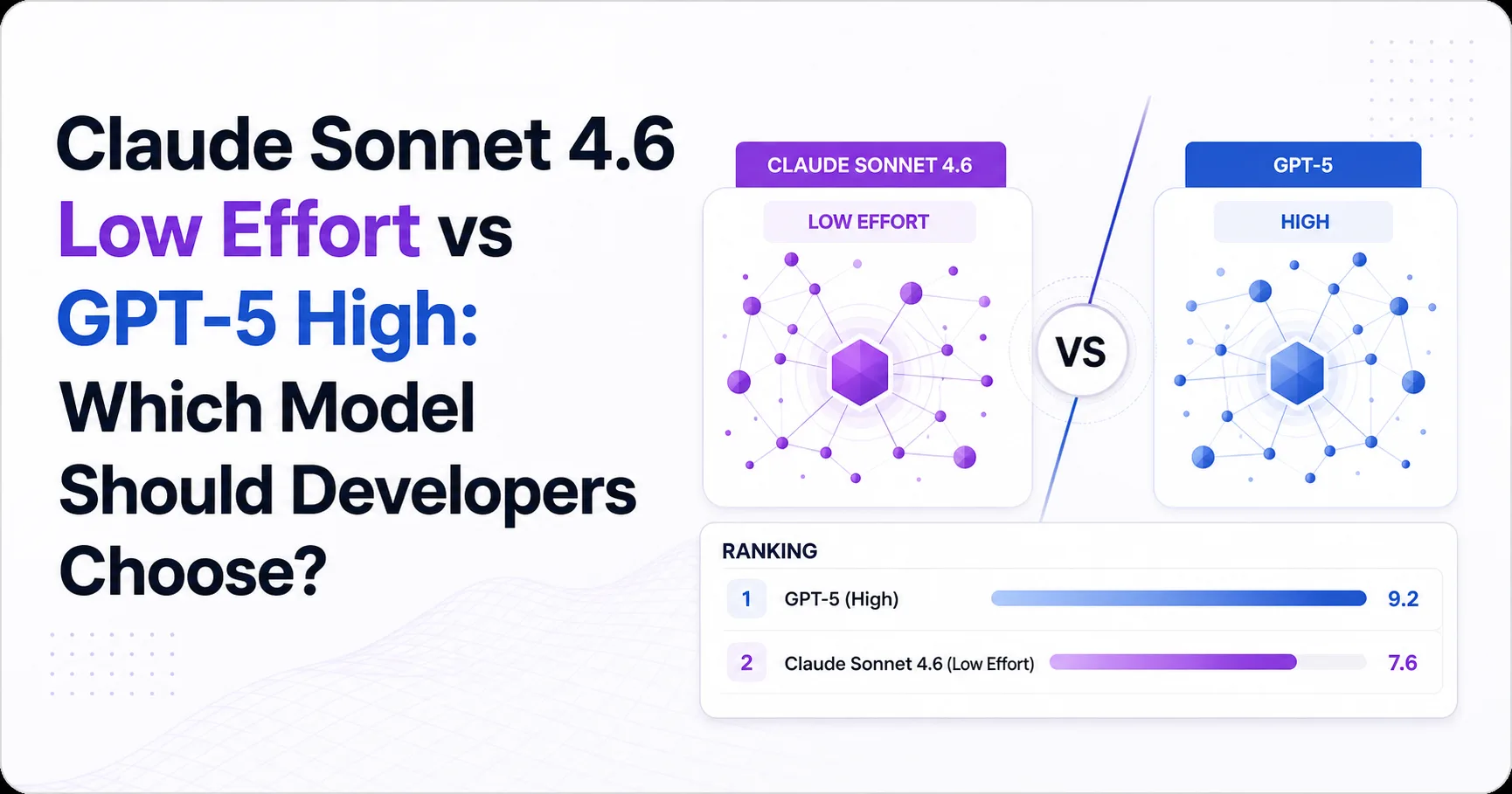
- **Winner overall:** GPT-5 (high), with an Artificial Analysis Intelligence Index of 34.7 vs 34.3 and additional coding and math scores - **Cheaper:** GPT-5 (high) at $3.4375 vs $6 per 1M blended tokens - **Faster:** Claude Sonnet 4.6 (Non-reasoning, Low Effort) at 56.53 median output tokens per second - **Pick GPT-5 (high) when:** coding, mathematical work, tool use, or lower token cost matters most - **Watch out:** Claude Sonnet 4.6 lacks comparable published coding and math scores, while GPT-5 high-speed data is unavailable
Claude Sonnet 4.6 Low Effort vs GPT-5 High
GPT-5 (high) is the stronger default for developers because it combines a slightly higher Intelligence Index with published coding and math evidence at a lower blended token price.
The comparison is less settled than a simple leaderboard suggests. Claude Sonnet 4.6 (Non-reasoning, Low Effort) has measured output speed, while GPT-5 (high) has no corresponding speed value in the supplied data. Their latency is tied at 0.3 seconds, so interactive responsiveness cannot be decided from latency alone.
The model labels also describe different kinds of configuration. OpenAI documents “high” as a reasoning_effort setting on gpt-5, not as a separate API model. Anthropic’s official material does not clearly establish whether “Non-reasoning, Low Effort” is an independent API model or a benchmark configuration. See GPT-5 for developers and Anthropic’s Claude models overview.
Data provided by https://artificialanalysis.ai/ supplies the comparative performance, latency, speed, and pricing snapshot used here.
Executive summary for model selection
GPT-5 (high) offers the more defensible general-purpose choice because its evidence covers intelligence, coding, and math, while Claude Sonnet 4.6 has a narrower documented comparison.
| Decision factor | Claude Sonnet 4.6 (Non-reasoning, Low Effort) | GPT-5 (high) | Practical meaning |
|---|---|---|---|
| Overall Artificial Analysis Intelligence Index | 34.3 | 34.7 | GPT-5 has the higher supplied score, but the gap is small |
| Coding evidence | Not supplied | 37.8 | GPT-5 has direct comparative evidence for software work |
| Math evidence | Not supplied | 94.3 | GPT-5 has direct evidence for mathematical tasks |
| Blended price per 1M tokens | $6 | $3.4375 | GPT-5 costs less under the supplied blend |
| Input price per 1M tokens | $3 | $1.25 | GPT-5 is cheaper for prompt-heavy workloads |
| Output price per 1M tokens | $15 | $10 | GPT-5 is also cheaper for generation-heavy workloads |
| Median output speed | 56.53 tokens per second | Not supplied | Claude has the measurable speed advantage in this snapshot |
| Latency | 0.3 seconds | 0.3 seconds | The supplied latency result is a tie |
The evidence does not prove that GPT-5 will win every coding task. Its coding score is available, but Claude has no matching value in the supplied data. That is an evidence asymmetry, not a demonstrated failure by Claude.
Anthropic still lists Claude Sonnet 4.6 in its official pricing system, while OpenAI’s model documentation lists gpt-5 as callable but describes the fixed snapshot as deprecated and recommends GPT-5.6. These statuses create different migration concerns. Read Claude pricing alongside the GPT-5 model documentation before committing to a long-lived integration.
Performance: what the chart cannot tell you
GPT-5 (high) has the stronger measured capability profile, but Claude Sonnet 4.6 may feel faster during long streamed responses.
GPT-5 leads the supplied Intelligence Index at 34.7 versus 34.3 for Claude. The difference is small enough that it should not determine a purchase decision by itself. A narrow overall gap can hide large task-specific differences, especially because GPT-5 has supplied coding and math scores while Claude has no corresponding values.
The clearest practical signal favors GPT-5 for work where developers need explicit evidence around code or mathematical reasoning. Its supplied coding score is 37.8, and its supplied math score is 94.3. Those results do not establish production accuracy for a specific repository, test suite, or domain. They do indicate that GPT-5 has a documented evaluation footprint that Claude lacks in this dataset.
Claude’s measurable median output speed is 56.53 tokens per second. GPT-5 has no speed value in the supplied snapshot, so declaring a speed winner would exceed the evidence. Both models show 0.3 seconds of latency. That tie says little about total completion time, because generation duration, reasoning work, streaming behavior, retries, and tool calls can dominate the user experience.
The configuration difference matters. GPT-5 high is explicitly represented as high reasoning effort in OpenAI’s material. Anthropic does not clearly document the tested Claude configuration as a standalone API model or publish its dedicated effort semantics. Developers should therefore reproduce representative tasks with the exact production parameters before treating the chart as a final ranking.
Community evidence adds a caution for GPT-5 rather than a verdict. A Reddit user reported that GPT-5 was useful for small bug fixes but could produce simplified application interfaces or incorrect changes in complex existing codebases. The account was not a controlled benchmark. See Tried GPT-5 Here Are My First Impressions. No equally reliable community evidence was found for this exact Claude configuration.
Cost: when the cheaper model is actually cheaper
GPT-5 (high) is the cheaper choice for the supplied token mix, but workload shape and cache behavior can change the operational advantage.
The supplied blended price is $3.4375 per 1M tokens for GPT-5 and $6 for Claude Sonnet 4.6. GPT-5 also has the lower input price, at $1.25 versus $3, and the lower output price, at $10 versus $15. This makes GPT-5 the safer starting point for applications with substantial prompt volume, generated code, or repeated batch processing.
The price gap matters most when model calls are frequent or outputs are large. A cheaper input rate can reduce the cost of repository context, documentation, and long instructions. A cheaper output rate can reduce the cost of generated patches, explanations, structured results, and agent traces. The supplied data does not provide traffic proportions beyond the blended comparison, so a team should validate the result against its own input-to-output distribution.
Claude has documented prompt caching prices of $3.75 per MTok for a 5-minute write, $6 per MTok for a 1-hour write, and $0.30 per MTok for cache hits and refreshes. Those prices create a meaningful exception for workloads that repeatedly reuse large stable prompts. The supplied GPT-5 material lists cached input at $0.125 per 1M tokens, but the two pricing descriptions use different units and cache terminology. Developers should confirm billing semantics before comparing cache-heavy workloads directly.
Tokenizer behavior is another hidden cost variable. Anthropic says Claude Sonnet 4.6 uses its previous-generation tokenizer, while later Claude models use a newer tokenizer that usually produces about 30% more tokens for the same text. That statement does not make Claude cheaper or more expensive by itself. It means token counts from another Claude generation should not be copied into a Sonnet 4.6 budget.
Regional inference can also affect Claude pricing. Anthropic documents a 1.1 multiplier for inference_geo: "us", with global as the default standard price. The chart’s $6 Claude blended value should therefore be treated as a baseline rather than a universal invoice estimate. Pricing details are documented in Claude pricing and GPT-5 model documentation.
Recommendation by developer workload
GPT-5 (high) is the best first choice for most new developer workflows, while Claude Sonnet 4.6 deserves a focused trial when streaming speed or Anthropic-specific integration matters.
Choose GPT-5 high when the product depends on code generation, mathematical reasoning, structured tool use, or cost control. OpenAI documents function calling, structured outputs, streaming, and custom tools with grammar-constrained output. GPT-5 also has supplied coding and math evidence, which gives engineering teams more concrete material for an initial risk assessment. These capabilities are described in GPT-5 for developers and the GPT-5 model documentation.
Choose Claude Sonnet 4.6 when measured output speed is a priority and the team already operates comfortably within Anthropic’s API and pricing model. Its 56.53 median output tokens per second is the only supplied speed measurement, so it may be attractive for applications where users watch long responses arrive. That advantage remains provisional because GPT-5 speed data is missing.
For an existing-codebase agent, neither model should receive unrestricted write access based on this evidence alone. GPT-5 has a reported community risk of hallucinated or incorrect modifications in complex repositories. Claude has no reliable community evidence for this exact low-effort configuration, which means its risk is unknown rather than lower. Use tests, patch review, constrained tools, and rollback controls for either model.
The largest selection risk is lifecycle ambiguity. OpenAI marks the fixed GPT-5 snapshot as deprecated, although the gpt-5 alias remains documented. Anthropic still lists Sonnet 4.6 for pricing, but the supplied research did not confirm a stable API alias, model ID, or platform availability. Teams that value predictable deployment should verify the exact endpoint, model identifier, retirement policy, and regional availability before launch.
A sensible decision is to start with GPT-5 high for the general path, then run Claude Sonnet 4.6 against the same production-shaped prompts. Reverse that choice only if Claude’s measured speed or task-specific quality produces a clear user benefit that offsets its higher supplied token cost.
FAQ before you choose
GPT-5 (high) is the safer default for evidence-backed developer selection, but the final choice depends on workload-specific testing and lifecycle requirements.
Frequently asked questions
Which model is better for coding, Claude Sonnet 4.6 Low Effort or GPT-5 High?
GPT-5 (high) is the better-supported coding choice because the supplied data includes a coding score of 37.8, while no comparable Claude coding score is provided. That evidence supports GPT-5 as the starting point, not a universal guarantee for every repository or programming language.
Which model is cheaper for production API usage?
GPT-5 (high) is cheaper in the supplied comparison, costing $3.4375 versus $6 per 1M blended tokens. It also has lower input and output prices, although Claude prompt caching, regional inference, tokenizer behavior, and your actual traffic mix can change the final invoice.
Which model responds faster?
Claude Sonnet 4.6 (Non-reasoning, Low Effort) has the only supplied output-speed measurement, at 56.53 median output tokens per second. GPT-5 speed is not provided, so the evidence cannot establish a complete speed ranking. Latency is tied at 0.3 seconds.
Does GPT-5 High mean there is a separate gpt-5-high API model?
GPT-5 (high) is not documented as a separate API model ID. OpenAI describes high as the reasoning_effort=high setting for gpt-5, so applications should use the documented model alias and parameter rather than inventing a gpt-5-high endpoint.
Can I treat Claude Sonnet 4.6’s 300k output capability as its normal API limit?
Claude Sonnet 4.6’s output-300k-2026-03-24 capability is documented for the Message Batches API beta path. It should not be treated as the synchronous Messages API default until Anthropic explicitly confirms that behavior for your endpoint and configuration.
Which model should I use for an autonomous coding agent?
GPT-5 (high) is the stronger initial candidate because it has supplied coding evidence, structured tool support, and a lower blended price. Neither model is proven safe for unrestricted repository edits, so use tests, approval gates, constrained tools, and rollback controls before autonomous deployment.
Sources
- Artificial AnalysisComparative Intelligence Index, coding and math scores, pricing, latency, and output-speed data supplied in the data brief
- Claude models overviewClaude Sonnet 4.6 positioning, Message Batches output capability, model configuration ambiguity, and official capability documentation
- Claude pricingClaude Sonnet 4.6 pricing, prompt caching, inference geography multiplier, tokenizer information, and current pricing status
- GPT-5 for developersGPT-5 positioning, reasoning effort, tool support, official evaluation context, and configuration semantics
- GPT-5 model documentationGPT-5 API alias, context and modality documentation, pricing, endpoint availability, and deprecated snapshot status
- Tried GPT-5 Here Are My First ImpressionsUncontrolled community observations about small bug fixes, simplified application generation, and incorrect changes in complex codebases
Published: