
AI model analysis
Claude Sonnet 4.6 vs o3: Which Model Should Developers Choose?
A developer-focused comparison of Claude Sonnet 4.6 Non-reasoning Low Effort and OpenAI o3 across intelligence, mathematics, speed, latency, pricing, and API certainty.
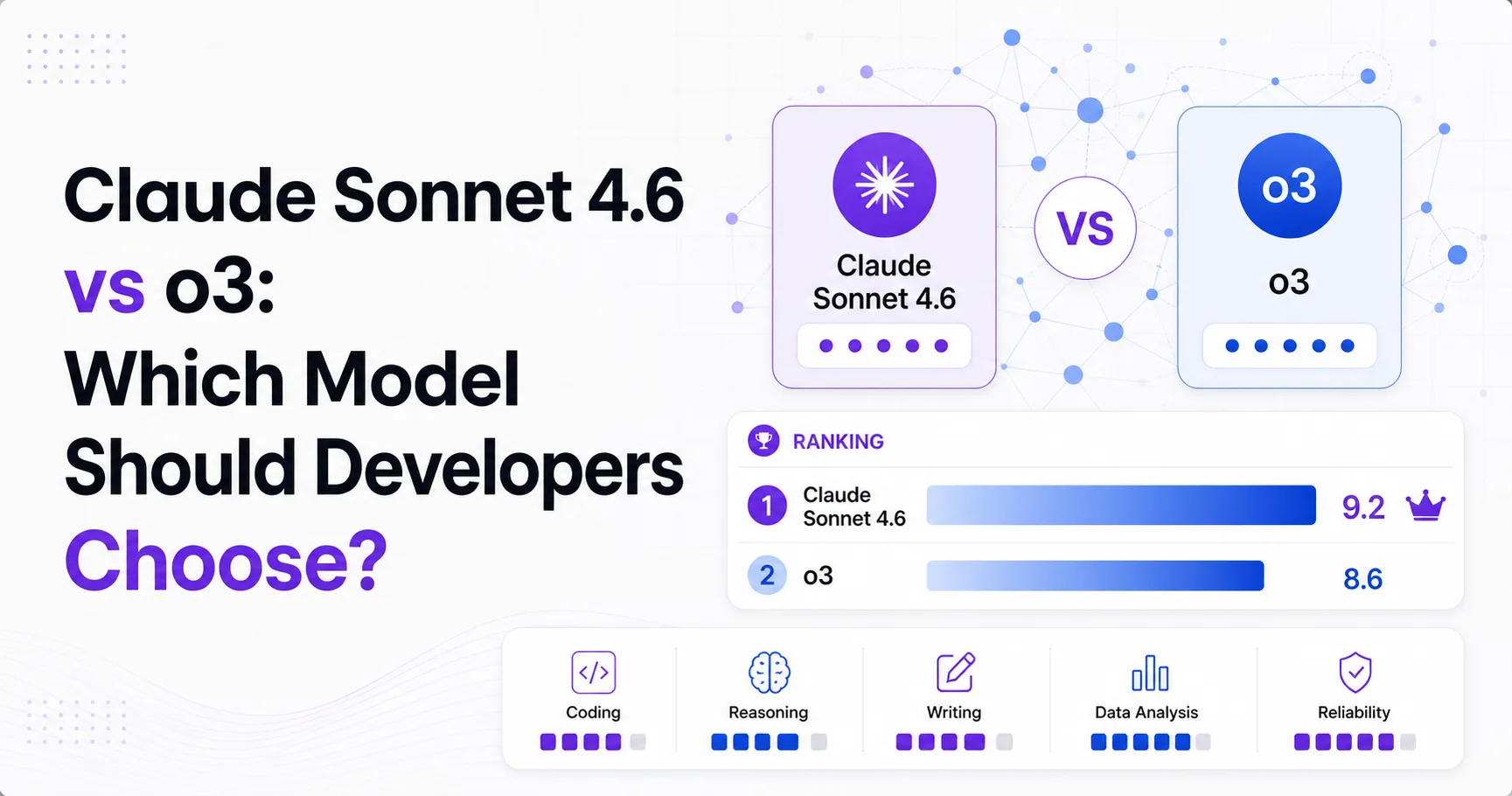
- **Winner overall:** Claude Sonnet 4.6 (Non-reasoning, Low Effort), with an Artificial Analysis Intelligence Index of 34.3 vs 30.4 for o3 - **Cheaper:** o3 at $3.5 vs $6 per 1M blended tokens - **Faster:** o3 at 128.056 median output tokens per second - **Pick Claude Sonnet 4.6 when:** general intelligence quality matters more than throughput and price - **Watch out:** Neither model has a confirmed context window in the supplied evidence, and o3 has no current official price listing
Claude Sonnet 4.6 vs o3 for developers
Claude Sonnet 4.6 (Non-reasoning, Low Effort) is the stronger general-intelligence choice, while o3 is faster and materially cheaper. The supplied Artificial Analysis snapshot gives Claude Sonnet 4.6 an Intelligence Index of 34.3, compared with 30.4 for o3. o3 leads on median output speed at 128.056 tokens per second, versus 56.53 for Claude Sonnet 4.6. Both models show 0.3 seconds of latency in the supplied data. Data provided by https://artificialanalysis.ai/ .
This comparison is useful for developers choosing between quality, throughput, and deployment certainty. It is less useful as a complete API procurement guide because the supplied official documentation does not confirm several operational details for either model. Anthropic’s model overview does not provide a dedicated capability table for this Claude configuration, while OpenAI’s current model directory does not list o3. See Anthropic’s Claude models overview and OpenAI’s Models documentation.
Executive summary
Claude Sonnet 4.6 (Non-reasoning, Low Effort) wins the supplied general-intelligence comparison, but o3 offers the better economics and interactive throughput. The practical choice depends on whether the application is constrained by answer quality, generation time, or token spend.
| Decision area | Better choice | Evidence | Developer meaning |
|---|---|---|---|
| General intelligence | Claude Sonnet 4.6 | 34.3 vs 30.4 Intelligence Index | Prefer Claude for broad knowledge-work quality in the supplied evaluation |
| Mathematics | o3 | 88.3 Math Index | Prefer o3 for workloads where the available mathematics evidence is directly relevant |
| Output speed | o3 | 128.056 tokens per second | Better fit for streaming interfaces and high-throughput generation |
| Latency | Tie | 0.3 seconds each | The speed difference appears after generation begins, not in initial latency |
| Blended price | o3 | $3.5 vs $6 per 1M tokens | Lower cost for mixed input and output workloads |
The mathematics comparison is incomplete because no Claude Sonnet 4.6 Math Index appears in the data snapshot. That absence prevents a direct mathematical winner, even though o3 has a reported score of 88.3. The official documentation also leaves important deployment questions unresolved. Anthropic still lists Claude Sonnet 4.6 in its pricing documentation, but OpenAI’s current pricing page does not list o3. These are different kinds of evidence, so a visible benchmark advantage should not be confused with current API availability.
Performance: quality, mathematics, and response behavior
o3 is the better throughput choice, while Claude Sonnet 4.6 has the higher supplied general-intelligence score. Claude Sonnet 4.6 reaches 34.3 on the Artificial Analysis Intelligence Index, compared with 30.4 for o3. That gap suggests Claude may be the safer default for mixed developer work such as explanation, transformation, planning, and code-adjacent reasoning, but the evidence does not identify which individual tasks create the difference.
The speed gap is more operationally visible. o3’s median output rate is 128.056 tokens per second, compared with 56.53 for Claude Sonnet 4.6. For streaming code assistance, terminal copilots, and user-facing drafting, o3 can finish long responses sooner after the first token arrives. The equal 0.3-second latency values mean that faster generation should not automatically be interpreted as faster request startup.
The mathematics evidence needs careful handling. o3 has an Artificial Analysis Math Index of 88.3, while Claude Sonnet 4.6 has no corresponding value in the supplied snapshot. The result supports testing o3 first for math-heavy workflows, but it does not establish that o3 is superior across every reasoning task.
Neither source set supplies reliable community reports for this exact Claude configuration or for o3. The official pages also do not provide model-specific failure patterns. Developers should therefore run task-level evaluations for tool use, code edits, structured output, refusal behavior, and long-context work before committing to either model.
Cost: o3 is cheaper, but workload shape still matters
o3 is the clear price winner in the supplied snapshot, with a blended price of $3.5 versus $6 per 1M tokens. The gap is large enough to affect high-volume applications, especially when generation is frequent and responses are long.
The cost advantage is stronger on output than on input. o3 is listed at $8 per 1M output tokens, while Claude Sonnet 4.6 is listed at $15. That difference matters for agents, coding assistants, and report generators that produce substantial text. Input pricing also favors o3 at $2 versus Claude’s $3 per 1M tokens, but the output difference is the more important budget risk for verbose workflows.
Claude’s official pricing page lists prompt caching rates of $3.75 per 1M tokens for 5-minute writes, $6 for 1-hour writes, and $0.30 for cache hits and refreshes. These options can change the effective economics of applications with repeated system prompts or large stable documents. Claude also uses an older tokenizer, and Anthropic says newer tokenizers usually produce about 30% more tokens for the same text. Teams migrating between model generations should measure actual tokenization rather than reuse an old budget assumption. See Claude pricing.
A cheaper model can become more expensive if lower task quality causes retries, human review, or longer prompts. Conversely, Claude’s higher price may be justified when its general-intelligence advantage reduces correction work. The supplied evidence does not include success rates, retry rates, or production token distributions, so it cannot determine total cost per completed task.
Recommendation by developer scenario
Claude Sonnet 4.6 (Non-reasoning, Low Effort) is the safer quality-first pick, while o3 is the safer speed-and-cost pick. Choose Claude when the application needs broad, dependable output quality and the extra token cost is acceptable. Its supplied Intelligence Index is 34.3, the highest of the two models.
Choose o3 for interactive products where response throughput affects perceived usability. Its median output speed is 128.056 tokens per second, and its blended price is $3.5 per 1M tokens. Those properties favor streaming assistants, high-volume automation, and workloads with long generated answers. The available Math Index of 88.3 also makes o3 a sensible first candidate for mathematics-heavy prototypes, although Claude lacks a comparable score in the supplied data.
Use a bake-off rather than a single universal winner when the product combines general assistance, code generation, mathematics, and structured tool calls. Score completed-task success, not only benchmark results. Include retries, validation failures, time to useful answer, and cost per accepted result.
Deployment certainty is a separate risk. Anthropic’s official overview confirms that Claude Sonnet 4.6 is part of the Claude model family and documents a 300k-token output option for Message Batches with the output-300k-2026-03-24 beta header, but that does not establish a synchronous Messages API limit. OpenAI’s current model directory does not list o3 or confirm a stable alias. Check account-specific availability before building a production dependency. Sources: Anthropic Claude models overview and OpenAI Models.
Evidence gaps developers should resolve first
Claude Sonnet 4.6 (Non-reasoning, Low Effort) and o3 both require direct validation before production selection because key API limits are absent from the supplied evidence. Neither model has a confirmed context window in the data snapshot. The supplied research also does not establish o3’s current endpoint, stable alias, or official price.
Anthropic’s documentation does not clearly define whether Non-reasoning, Low Effort is an independent API model or a configuration with specific parameters. It also distinguishes the 300k-token batch beta capability from the synchronous Messages API. OpenAI’s current documentation instead presents newer model families and does not list o3. These documentation states create an availability risk that benchmark data alone cannot resolve.
Community evidence is also insufficient. No reliably verified Reddit, Hacker News, or X posts were found for this exact Claude variant or for o3 with reproducible methods. Developers should treat claims about coding style, refusal behavior, and speed beyond the supplied measurements as unverified until their own tests produce evidence.
Frequently asked questions
Which model is better overall for developers, Claude Sonnet 4.6 or o3?
Claude Sonnet 4.6 is the better overall choice in the supplied evidence because it scores 34.3 versus o3’s 30.4 on the Artificial Analysis Intelligence Index. That result supports a quality-first decision, but it does not prove superiority on every coding, tool-use, or reasoning task. The comparison lacks production success rates and a direct Claude mathematics score, so teams should validate their own workload before standardizing.
Which model is cheaper for API workloads?
o3 is cheaper in the supplied pricing snapshot, costing $3.5 versus $6 per 1M blended tokens. Its input price is $2 versus $3, and its output price is $8 versus $15. However, OpenAI’s current official pricing page does not list o3, so developers must confirm that the model is actually available under their account and endpoint before treating the snapshot price as a production procurement quote. See OpenAI API Pricing.
Which model is faster for streaming applications?
o3 is faster after generation starts, with a median output rate of 128.056 tokens per second versus 56.53 for Claude Sonnet 4.6. Both models have 0.3 seconds of latency in the supplied data, so the advantage concerns sustained token generation rather than initial request startup. Actual user-perceived speed can still change with prompt length, streaming implementation, retries, tool calls, and service availability.
Is o3 better for mathematics?
o3 is the only model with a supplied mathematics score, reaching 88.3 on the Artificial Analysis Math Index. That makes o3 the better-supported candidate for math-heavy testing, but the evidence does not prove a direct win because Claude Sonnet 4.6 has no Math Index in the snapshot. Developers should run matched mathematical tasks and measure correctness, verification effort, and retry frequency before making a final choice.
Can developers assume Claude Sonnet 4.6 supports a 300k-token synchronous output?
Developers should not assume that limit for synchronous requests. Anthropic documents output-300k-2026-03-24 as a beta header for the Message Batches API, and the supplied research explicitly separates that capability from the default synchronous Messages API limit. The official overview also does not provide a complete capability table for this configuration. Confirm the endpoint-specific limit in the account and API documentation before designing around it. See Claude models overview.
Sources
- Artificial AnalysisPerformance, pricing, latency, release-date, and evaluation values supplied in the data snapshot.
- Claude models overviewClaude Sonnet 4.6 model-family positioning, batch output beta, capability-documentation gaps, and effort-configuration uncertainty.
- Claude pricingClaude Sonnet 4.6 pricing, prompt caching, inference geography multiplier, and tokenizer information.
- OpenAI ModelsCurrent OpenAI model-directory visibility, o3 availability documentation gaps, and missing official o3 API details.
- OpenAI API PricingCurrent official pricing-page visibility and the absence of a listed o3 price.
Published: