
AI model analysis
Claude Sonnet 5 vs GPT-5: Which Model Should Developers Choose?
A developer-focused comparison of Claude Sonnet 5 and GPT-5 across coding, reasoning, cost, integration constraints, model status, and practical workload fit.
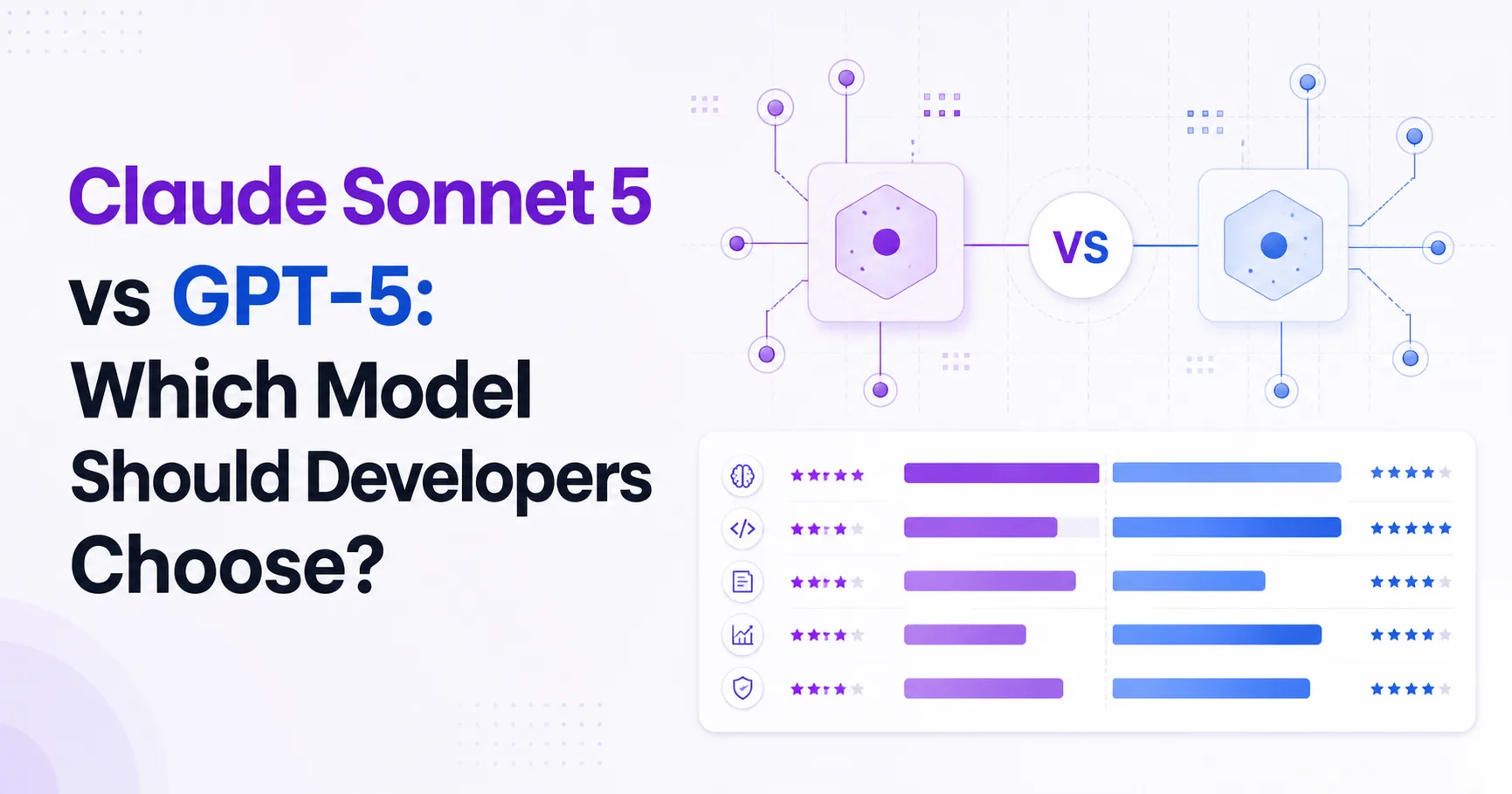
- **Winner overall:** Claude Sonnet 5 (Adaptive Reasoning, Max Effort), with a 71.5 coding index vs 37.8 for GPT-5 (high) - **Cheaper:** GPT-5 (high) at $3.4375 vs $4 per 1M blended tokens - **Faster:** Claude Sonnet 5 (Adaptive Reasoning, Max Effort) at 89.078 median output tokens per second - **Pick Claude Sonnet 5 when:** coding quality, long-context work, tool use, and agentic workflows matter more than the lowest blended price - **Watch out:** the supplied data does not provide a comparable GPT-5 output-speed value or a Claude Sonnet 5 math index
Claude Sonnet 5 vs GPT-5
Claude Sonnet 5 is the stronger default for developers who prioritize coding and broad reasoning quality, while GPT-5 remains cheaper and has a reported math index of 94.3. The supplied Artificial Analysis snapshot gives Claude Sonnet 5 a coding index of 71.5 and an intelligence index of 53.4, compared with GPT-5 at 37.8 and 34.7. Data provided by https://artificialanalysis.ai/.\n\nThe comparison is less simple than the scores suggest. Claude Sonnet 5 is currently listed as callable with the stable API alias claude-sonnet-5, while the fixed GPT-5 snapshot gpt-5-2025-08-07 is marked Deprecated and the model page recommends GPT-5.6. Anthropic’s model overview and OpenAI’s GPT-5 documentation therefore point to different operational risks.\n\nFor a new application, the practical choice is Claude Sonnet 5 unless input cost, mathematical workloads, or an existing OpenAI integration dominate the decision. GPT-5 can still be a rational choice when those factors outweigh its weaker supplied coding and intelligence scores.
Executive summary for developers
Claude Sonnet 5 offers the stronger supplied coding and intelligence results, while GPT-5 offers lower input and blended-token pricing plus a reported math result that Claude lacks.\n\nClaude Sonnet 5 scores 71.5 on the supplied coding index and 53.4 on the intelligence index. GPT-5 scores 37.8 and 34.7 on those same indexes. The comparison cannot establish a universal winner for mathematics because the snapshot reports 94.3 for GPT-5 and no Claude Sonnet 5 math value. The Artificial Analysis snapshot is therefore useful for directional selection, but it does not cover every workload equally.\n\nThe product interfaces also differ. Anthropic describes Claude Sonnet 5 as a model for coding, reasoning, tool use, knowledge work, agentic search, and computer use. Its documented context window is 1M tokens, with a maximum output of 128k tokens. Anthropic’s model overview\n\nOpenAI positions GPT-5 as a reasoning model for coding, reasoning, and agentic tasks. Its documented context window is 400,000 tokens, with a maximum output of 128,000 tokens. GPT-5 supports reasoning_effort, verbosity, function calling, structured outputs, streaming, and custom tools. GPT-5 for developers and GPT-5 model documentation\n\nThe main selection tension is clear: Claude Sonnet 5 appears better suited to broad software work and long-running agents, while GPT-5 gives teams a lower-cost route with a documented strength in mathematics. Neither supplied source provides a controlled, head-to-head test of the exact workloads most teams care about.
Performance: what the scores mean in production
Claude Sonnet 5 is the safer performance choice for coding-heavy workflows because its supplied coding index is 71.5, compared with 37.8 for GPT-5.\n\nThat gap should influence model selection, but it should not be read as a guaranteed reduction in bugs, tickets, or engineering time. The index is an aggregate signal, and the supplied brief does not define its task mix or provide a confidence interval. A team should therefore treat Claude Sonnet 5 as the stronger starting hypothesis, then validate it against representative repositories, tests, tool calls, and review criteria.\n\nThe real-world effect is likely to be largest in tasks that require maintaining a coherent plan across multiple edits. Anthropic explicitly highlights reasoning, coding, tool use, knowledge work, agentic search, and computer use as improvement areas. Anthropic’s launch announcement Community reports also describe strong results on complex coding tasks, but those reports do not disclose reproducible task lists or scoring methods. A Reddit coding experience\n\nGPT-5 has a different performance profile in the supplied evidence. OpenAI reports 74.9% on SWE-bench Verified, 88% on Aider polyglot, 96.7% on τ²-bench telecom, and 69.6% on Scale MultiChallenge. GPT-5 for developers Those figures are official, but they are not directly interchangeable with the Artificial Analysis indexes. OpenAI also states that the SWE-bench result excluded 23 problems from 500 because they could not pass reliably on its infrastructure.\n\nThe speed evidence favors Claude Sonnet 5 only in the supplied snapshot. Its median output speed is 89.078 tokens per second, while GPT-5 has no corresponding value. Both models have a latency value of 0.3 seconds. The evidence therefore supports a Claude throughput advantage, but it does not prove a complete end-to-end response advantage for every prompt, tool loop, or streaming configuration.\n\nCommunity evidence remains divided. Some users describe GPT-5 as useful for locating and fixing small bugs, while others report hallucinations or incorrect changes in complex existing codebases. GPT-5 first impressions Those observations are individual experiences, not controlled comparisons.
Cost: the cheaper model can still cost more
GPT-5 is cheaper on the supplied blended price, but Claude Sonnet 5 can be economically preferable when stronger first-pass work reduces retries and supervision.\n\nThe snapshot lists GPT-5 at $3.4375 per 1M blended tokens and Claude Sonnet 5 at $4. GPT-5 also has the lower input price at $1.25 versus $2, while output pricing is tied at $10. Data provided by https://artificialanalysis.ai/\n\nThe blended comparison assumes a 3 to 1 input-to-output mix. That assumption can reverse the practical result for applications with unusually large prompts, large generated patches, or repeated agent loops. GPT-5 keeps an input-price advantage, but the output-price tie means cheaper input does not automatically produce a large saving in output-heavy workflows. Claude Sonnet 5’s supplied output-speed value of 89.078 may also matter when developer wait time affects throughput, although the brief does not quantify the business value of faster responses.\n\nClaude Sonnet 5 introduces a separate accounting risk. Anthropic says its new tokenizer usually produces about 30% more tokens for the same text, with the exact increase depending on content. What’s new in Claude Sonnet 5 A migration based on old token estimates could therefore understate prompt cost, context consumption, or truncation risk.\n\nCaching can materially change the economics for repeated instructions, repository context, or stable tool definitions. Anthropic lists prompt-cache prices for 5-minute writes, 1-hour writes, and cache hits, while OpenAI documents cached input at $0.125 per 1M tokens. Anthropic pricing and GPT-5 model documentation The supplied materials do not provide a matched cache-hit workload, so a final cost decision requires replaying real traffic.\n\nTeams should compare cost per completed task, not only cost per token. A cheaper model that needs more retries, manual corrections, or longer prompts can lose its price advantage. The supplied research does not provide retry rates or task-completion costs, so this remains an evidence gap.
Recommendation by workload
Claude Sonnet 5 is the best default for new developer agents, while GPT-5 is the better targeted choice for lower input cost, mathematical work, or an established OpenAI tool stack.\n\nChoose Claude Sonnet 5 for repository-scale coding, multi-step implementation, tool-driven agents, and workflows that benefit from a 1M-token context window. Its supplied coding index of 71.5 and intelligence index of 53.4 are materially stronger than GPT-5’s corresponding values. Anthropic also describes adaptive thinking as enabled by default, with effort controlling the reasoning level. Effort documentation\n\nChoose GPT-5 when mathematical reasoning is central, because the supplied snapshot reports a math index of 94.3 for GPT-5 and no comparable Claude Sonnet 5 value. GPT-5 is also attractive for teams that need lower input pricing, custom tools, structured outputs, or existing Responses and Chat Completions integrations. GPT-5 for developers\n\nTreat version lifecycle as part of the recommendation. Claude Sonnet 5 remains listed in Anthropic’s current model overview with the stable alias claude-sonnet-5. Anthropic’s model overview GPT-5 remains available through the gpt-5 alias, but its fixed snapshot is marked Deprecated and the documentation recommends GPT-5.6. GPT-5 model documentation A production team choosing GPT-5 should define a migration plan for future model changes.\n\nClaude Sonnet 5 requires more integration discipline than its headline capability may imply. Non-default temperature, top_p, and top_k settings return HTTP 400, manual extended thinking returns HTTP 400, and assistant message prefilling is unsupported. What’s new in Claude Sonnet 5 Its adaptive thinking also shares the max_tokens budget with the final response, so old budgets can cause truncation.\n\nGPT-5 has fewer documented parameter warnings in the supplied material, but it lacks audio and video input and output, and fine-tuning is unsupported. GPT-5 model documentation Community evidence also suggests that full application generation may be too concise for teams expecting polished UI detail. GPT-5 first impressions That conclusion is based on one uncontrolled report, so it should be tested rather than treated as a product guarantee.
Questions to answer before rollout
Claude Sonnet 5 deserves a controlled pilot first, because the supplied evidence favors it overall but leaves important workload-specific questions unanswered.\n\nThe pilot should test the same repositories, prompts, tools, context sizes, output constraints, and review rubric on each model. Teams should record completed-task rate, retry count, human correction time, refusal behavior, truncation, and total spend. The supplied materials provide useful model scores and prices, but they do not provide a direct head-to-head benchmark, a comparable GPT-5 output-speed value, a Claude Sonnet 5 math index, or production retry data.\n\nThe final decision should therefore combine the supplied directional evidence with an internal evaluation. That is especially important for safety-sensitive tools, long-running agents, and integrations that depend on legacy prompting parameters.
Frequently asked questions
Is Claude Sonnet 5 better than GPT-5 for coding?
Claude Sonnet 5 is the stronger choice in the supplied comparison, with a coding index of 71.5 versus 37.8 for GPT-5, although teams should validate the result on their own repositories and review process.
Is GPT-5 cheaper than Claude Sonnet 5?
GPT-5 is cheaper in the supplied 3 to 1 blended comparison at $3.4375 versus $4 per 1M blended tokens, and its input price is also lower at $1.25 versus $2.
Which model is faster for developer applications?
Claude Sonnet 5 has the only supplied median output-speed value, at 89.078 tokens per second, while both models have a supplied latency value of 0.3 seconds and GPT-5 lacks a comparable throughput figure.
Should a new production application use the GPT-5 fixed snapshot?
A new production application should avoid depending on the fixed GPT-5 snapshot without a migration plan, because gpt-5-2025-08-07 is marked Deprecated even though the gpt-5 alias remains callable.
Which model should handle mathematical workloads?
GPT-5 is the better-supported candidate for mathematical workloads because the supplied snapshot reports a math index of 94.3, while no comparable Claude Sonnet 5 math value is provided.
What can break when migrating an existing integration to Claude Sonnet 5?
A Claude Sonnet 5 migration can break integrations that set non-default sampling parameters, use manual extended thinking, depend on assistant prefilling, or assume old token counts and output budgets remain valid.
Sources
- Artificial Analysis data snapshotSupplied comparison indexes, pricing, latency, output speed, and attribution
- Claude models overviewClaude Sonnet 5 identity, alias, availability, modalities, context window, and output limit
- What’s new in Claude Sonnet 5Adaptive thinking, parameter restrictions, tokenizer changes, prefilling, output budgeting, and platform limitations
- Claude effort documentationClaude Sonnet 5 effort parameter behavior
- Claude pricingClaude Sonnet 5 input, output, caching, and batch pricing
- Introducing Claude Sonnet 5Claude Sonnet 5 positioning, capability areas, safety behavior, and release context
- I tested Sonnet 5 on several complex coding tasksUncontrolled community coding experience
- Tried GPT-5 Here Are My First ImpressionsUncontrolled GPT-5 coding, debugging, application-generation, and existing-codebase observations
- GPT-5 for developersGPT-5 positioning, parameters, tools, official benchmarks, and developer capabilities
- GPT-5 model documentationGPT-5 availability, lifecycle status, context window, modalities, pricing, endpoints, and limitations
- GPT-5 first impressionsEvidence cited in the article body
Published: