
AI model analysis
Claude Sonnet 5 vs GPT-5 mini: Which Model Should Developers Choose?
A developer-focused comparison of Claude Sonnet 5 and GPT-5 mini across coding, reasoning, speed, price, availability, and integration risk.
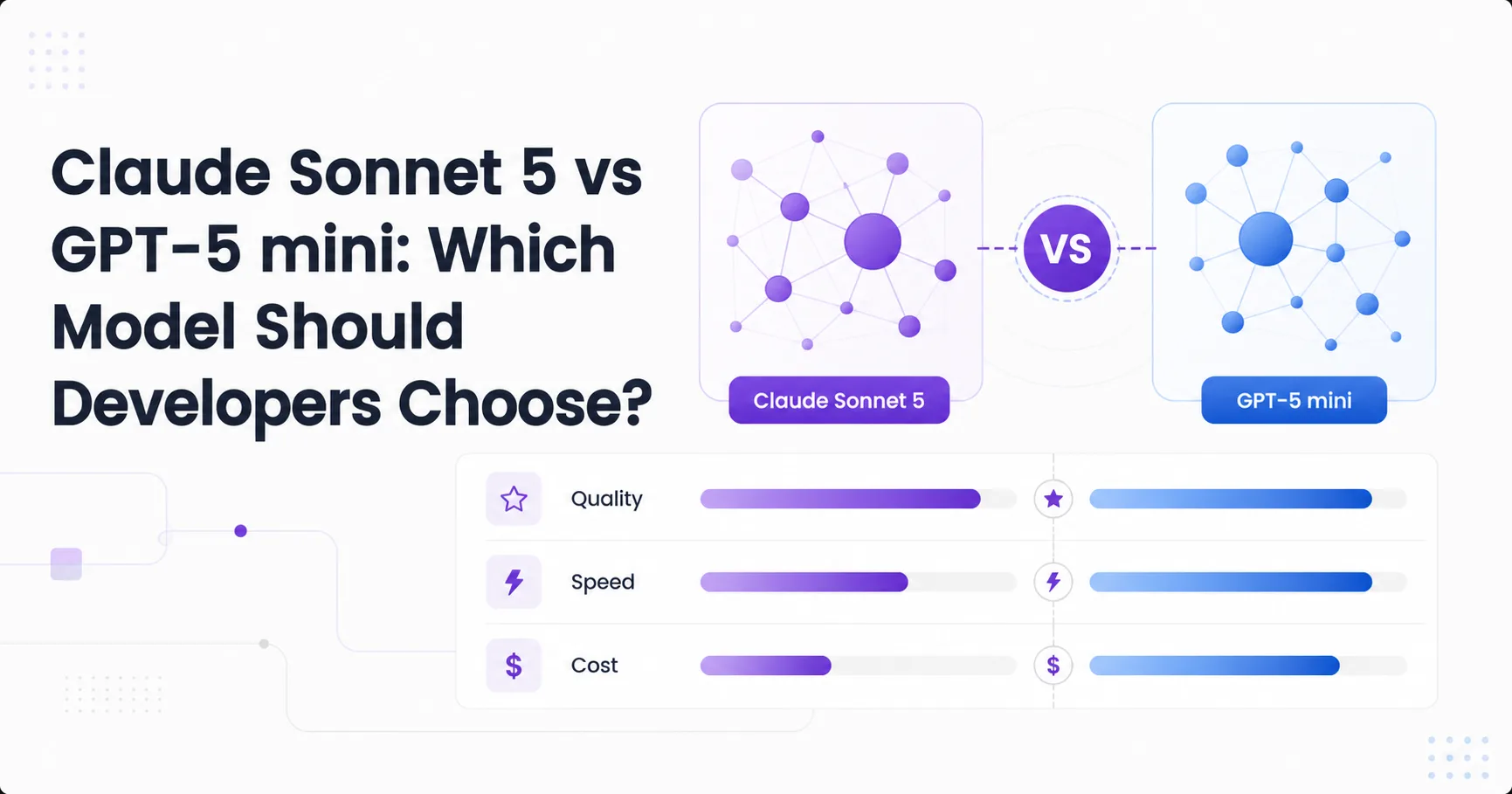
- **Winner overall:** Claude Sonnet 5 (Adaptive Reasoning, Max Effort), with an Artificial Analysis Intelligence Index of 53.4 vs 25.3 - **Cheaper:** GPT-5 mini (high) at $0.6875 vs $4 per 1M blended tokens - **Faster:** Claude Sonnet 5 (Adaptive Reasoning, Max Effort) at 89.078 median output tokens per second - **Pick GPT-5 mini when:** low token cost and math-heavy workloads matter more than verified availability or coding strength - **Watch out:** GPT-5 mini's current model status, API identity, context window, and speed are not verified by the supplied official sources
Claude Sonnet 5 vs GPT-5 mini
Claude Sonnet 5 is the safer overall choice for developers who need verified availability, stronger coding scores, and documented production behavior.
The supplied data gives Claude Sonnet 5 an Artificial Analysis Intelligence Index of 53.4 and a Coding Index of 71.5. GPT-5 mini records 25.3 and 15.6 on those same indexes, while its Math Index reaches 90.7. Data provided by https://artificialanalysis.ai/
The decision is less simple on cost. GPT-5 mini is listed at $0.6875 per 1M blended tokens, compared with $4 for Claude Sonnet 5. That difference can dominate high-volume applications, especially when prompts are short and outputs are tightly constrained.
Availability changes the risk profile. Anthropic currently documents claude-sonnet-5 as a callable model with a stable alias. OpenAI’s current model directory does not list gpt-5-mini, and OpenAI’s current pricing page does not list its prices. The data brief therefore supports a performance and cost comparison, but not a fully verified deployment comparison.
Executive summary
Claude Sonnet 5 offers the stronger documented general-purpose profile, while GPT-5 mini offers the lower listed cost and a standout math score.
| Decision factor | Claude Sonnet 5 (Adaptive Reasoning, Max Effort) | GPT-5 mini (high) |
|---|---|---|
| Artificial Analysis Intelligence Index | 53.4 | 25.3 |
| Artificial Analysis Coding Index | 71.5 | 15.6 |
| Artificial Analysis Math Index | Not provided | 90.7 |
| Blended price per 1M tokens | $4 | $0.6875 |
| Input price per 1M tokens | $2 | $0.25 |
| Output price per 1M tokens | $10 | $2 |
| Median output speed | 89.078 tokens per second | Not provided |
| Latency | 0.3 seconds | 0.3 seconds |
Data provided by https://artificialanalysis.ai/
Claude’s advantage is clearest when the model must modify code, reason through a repository, use tools, or complete knowledge-work tasks. Anthropic explicitly positions Sonnet 5 around reasoning, tool use, coding, agentic search, and computer use. Anthropic’s announcement supports that positioning, although it does not provide the complete benchmark values shown in the data brief.
GPT-5 mini remains an attractive candidate for workloads where price is the primary constraint and mathematical accuracy is the central requirement. However, the supplied OpenAI sources do not confirm the exact model identity represented by “GPT-5 mini (high).” That uncertainty matters for production systems because a benchmark label is not enough to establish a stable API contract.
The practical conclusion is conditional: choose Claude for verified general-purpose engineering work, and investigate GPT-5 mini only after confirming that the model can still be called under the intended account, endpoint, and configuration.
Performance: coding strength matters more than raw response speed
Claude Sonnet 5 is the stronger documented engineering model, but the supplied evidence does not establish a complete speed comparison.
The largest practical gap appears in coding. Claude Sonnet 5 scores 71.5 on the Artificial Analysis Coding Index, while GPT-5 mini scores 15.6. Data provided by https://artificialanalysis.ai/ That gap suggests a materially different starting point for repository changes, debugging, code review, and tool-driven implementation. It does not prove that Claude will win every code task, because the brief does not identify the benchmark tasks, prompts, or scoring rubric.
The general intelligence comparison points in the same direction. Claude scores 53.4, compared with 25.3 for GPT-5 mini. Developers should interpret this as evidence for broader task reliability, not as a guarantee of lower latency or fewer retries in their own application.
Math reverses the visible ranking. GPT-5 mini records a Math Index of 90.7, while the data brief provides no Claude math value. That makes GPT-5 mini worth testing for symbolic reasoning, quantitative explanation, and math-focused evaluation sets. It does not justify claiming that GPT-5 mini is better for general reasoning, because the supplied evidence does not compare the models on the same math result from both sides.
Claude has a reported median output speed of 89.078 tokens per second, while GPT-5 mini has no supplied output-speed value. Both models show 0.3 seconds of latency in the data brief. The available evidence therefore supports a Claude throughput observation, but not a defensible speed winner.
Claude’s adaptive reasoning can also change the shape of a request. Anthropic states that thinking tokens and final response tokens share the max_tokens limit. The Sonnet 5 release notes warn that budgets copied from non-thinking workloads can cause truncation. A developer evaluating performance should measure completed-task rate, retries, tool calls, and output truncation, not only first-token latency.
Cost: GPT-5 mini wins the listed price comparison, with a verification risk
GPT-5 mini is the cheaper listed option, but its apparent savings are useful only if the model identity and access path are confirmed.
The data brief lists GPT-5 mini at $0.6875 per 1M blended tokens, compared with $4 for Claude Sonnet 5. Data provided by https://artificialanalysis.ai/ For large-volume classification, extraction, routing, or short-answer workloads, that price difference can outweigh moderate quality improvements from a more capable model.
The cost conclusion can reverse when a request requires substantial engineering supervision. A weaker coding model may need more retries, additional validation calls, larger tool traces, or human correction. The brief does not provide retry rates, task completion costs, or production token distributions, so no total-cost-of-ownership winner can be proven from the listed prices alone.
Claude’s pricing is easier to interpret operationally because Anthropic documents the model and its pricing schedule together. The introductory price is $2 per 1M input tokens and $10 per 1M output tokens through 2026-08-31. Standard pricing begins at $3 per 1M input tokens and $15 per 1M output tokens from 2026-09-01. Anthropic’s pricing page provides those dates and rates.
Claude’s tokenizer creates another cost consideration. Anthropic says the same text usually produces about 30% more tokens with the new tokenizer, depending on content. The Sonnet 5 release notes mean that estimates copied from an older model may understate prompt size, context pressure, and output-budget risk.
GPT-5 mini is therefore the cost-first choice only after a live billing test. OpenAI’s supplied pricing page does not list gpt-5-mini, so the data brief’s price should be treated as a comparison input, not as independently verified current commercial availability.
Recommendation by workload
Claude Sonnet 5 is the default recommendation for production coding agents, while GPT-5 mini deserves a controlled trial for cost-sensitive math workloads.
Choose Claude Sonnet 5 when the application must understand a large codebase, perform multi-step edits, call tools, or produce a high-quality first attempt. Anthropic documents a 1M-token context window and a maximum output of 128k tokens for Sonnet 5. The model overview also identifies text and image input, text output, multilingual support, and visual capabilities. Those documented properties make Claude easier to evaluate as a real integration target.
Choose GPT-5 mini when every request must be inexpensive, the workflow is narrow, and the team can validate the model behind its actual endpoint. The Math Index of 90.7 is the strongest supplied result for either model on a named specialist dimension. Data provided by https://artificialanalysis.ai/ The evidence does not show whether that score transfers to the application’s own math prompts.
Treat Claude’s API behavior as part of the engineering decision. Sonnet 5 rejects non-default temperature, top_p, and top_k settings with HTTP 400. Manual extended thinking also returns HTTP 400, because the model expects adaptive thinking and the effort parameter. Assistant message prefilling is unsupported. Anthropic’s Sonnet 5 release notes document these constraints.
Security-sensitive products need an additional test. Anthropic says some high-risk cybersecurity requests may return HTTP 200 with stop_reason: "refusal". Anthropic’s announcement means callers must inspect the response body, not only the transport status.
The supplied GPT evidence is too thin for a confident production recommendation. The official OpenAI directory does not verify the model’s current listing, API name, context window, output limit, parameters, or tool support. A live smoke test should precede any commitment.
What to verify before choosing
Claude Sonnet 5 is easier to validate from public documentation, while GPT-5 mini requires more direct verification before deployment.
The central unresolved issue is not which score is higher. It is whether the GPT-5 mini label in the data brief maps to a currently callable OpenAI model with the same behavior and price. The supplied official OpenAI pages do not establish that mapping.
Developers should run a small task set covering code changes, math, tool calls, long-context prompts, refusal handling, output truncation, and billing. The test should record completed tasks and total tokens, because benchmark rankings and nominal token prices do not capture operational failure costs.
Community evidence is asymmetric. Some Reddit users describe Sonnet 5 as strong on complex coding tasks, while others report long autonomous runs or excessive pushback. Those reports lack reproducible methods and should guide test design, not replace testing. A Sonnet 5 first-impressions thread and a coding-experience thread illustrate the disagreement. The brief contains no similarly reliable GPT-5 mini community evidence.
Frequently asked questions
Is Claude Sonnet 5 better than GPT-5 mini for coding?
Claude Sonnet 5 is the stronger documented coding choice because its Artificial Analysis Coding Index is 71.5, compared with 15.6 for GPT-5 mini. The supplied benchmark does not prove universal superiority on every programming task.
Which model is cheaper for API workloads?
GPT-5 mini is cheaper according to the supplied data, at $0.6875 per 1M blended tokens versus $4 for Claude Sonnet 5. OpenAI’s current pricing page does not independently verify that GPT-5 mini price.
Which model should developers choose for math-heavy applications?
GPT-5 mini is the more promising candidate for math-heavy applications because its Math Index is 90.7. Claude’s corresponding math value is not provided, so the evidence does not establish a complete head-to-head math ranking.
Is GPT-5 mini ready for production use?
GPT-5 mini should pass a live availability and billing check before production use. The supplied OpenAI model directory does not list it, and the supplied pricing page does not confirm its current API identity, limits, or price.
Does Claude Sonnet 5 have any integration risks?
Claude Sonnet 5 has several documented integration constraints. Non-default sampling parameters, manual extended thinking, and assistant message prefilling can return HTTP 400, while adaptive reasoning shares the output budget with final text.
Does the faster model necessarily reduce application latency?
Claude Sonnet 5 has a supplied median output speed of 89.078 tokens per second, but both models show 0.3 seconds of latency. The data does not provide GPT-5 mini output speed, so end-to-end latency remains unproven.
Sources
- Artificial AnalysisBenchmark scores, pricing comparison, latency, and output-speed data
- Claude Models OverviewClaude Sonnet 5 model identity, availability, capabilities, context window, and output limit
- What's new in Claude Sonnet 5Adaptive reasoning, parameter restrictions, tokenizer changes, output budgeting, and prefilling limitations
- Anthropic API PricingClaude Sonnet 5 introductory and standard pricing
- Introducing Claude Sonnet 5Official positioning, capability areas, release date, and cybersecurity refusal behavior
- OpenAI ModelsVerification of the current OpenAI model directory and the absence of a listed gpt-5-mini entry
- OpenAI API PricingVerification of the current OpenAI pricing directory and the absence of a listed gpt-5-mini price
- Sonnet 5 First Impressions ThreadCommunity reports about autonomous work, output length, and usage friction
- I tested Sonnet 5 on several complex coding tasksCommunity coding experience, with an explicit caveat about incomplete methodology
Published: