
AI model analysis
Cogito v2.1 (Reasoning) vs GPT-5 nano (high): Which Model Should Developers Choose?
A developer-focused comparison of Cogito v2.1 (Reasoning) and GPT-5 nano (high), covering benchmark trade-offs, pricing, availability uncertainty, and practical model selection.
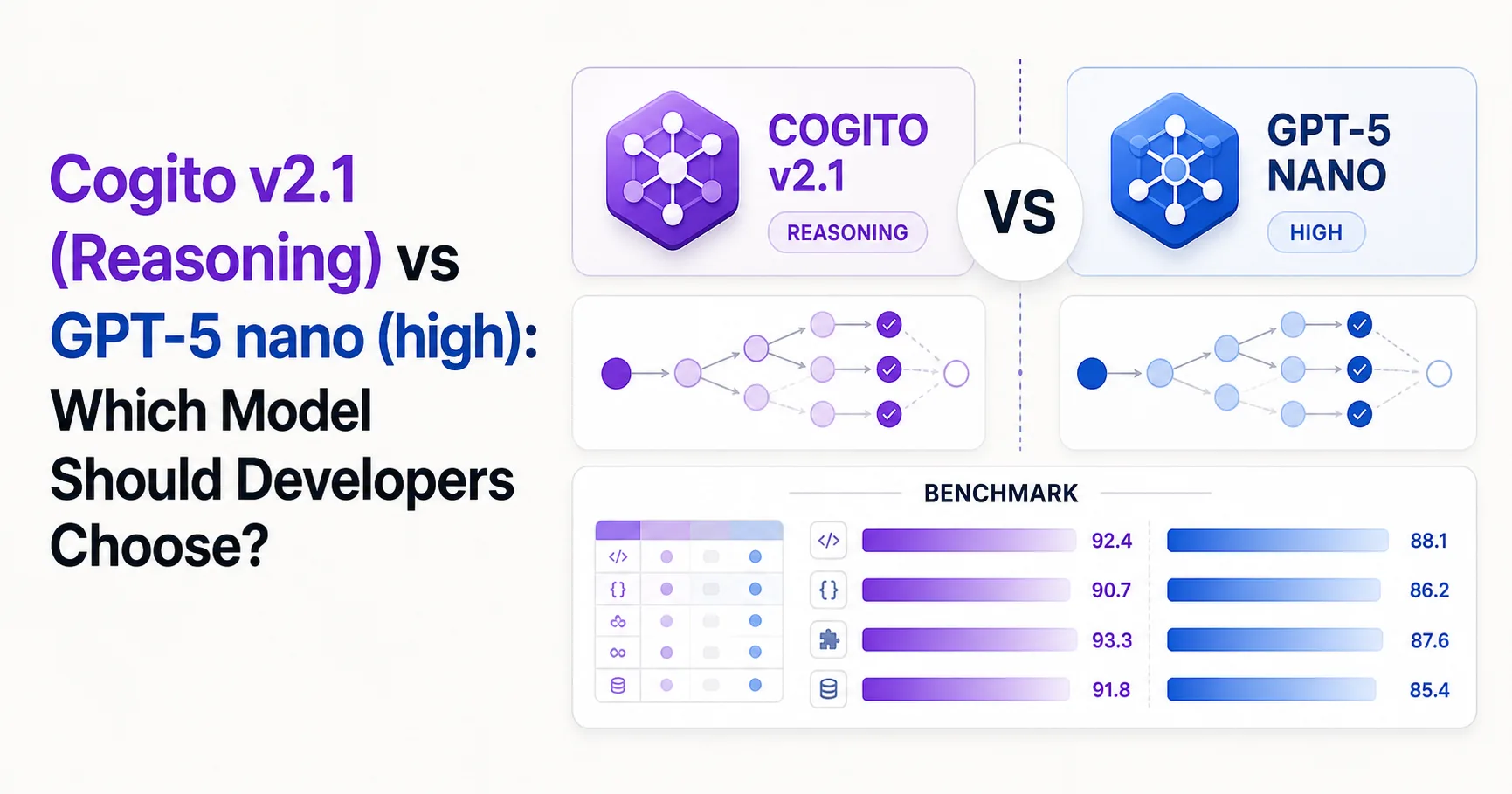
- **Winner overall:** GPT-5 nano (high), stronger coding and instruction-following results, including 0.789 on LiveCodeBench and 0.675510204081633 on IFBench - **Cheaper:** GPT-5 nano (high) at $0.138 vs $1.25 per 1M blended tokens - **Faster:** Neither model, because the supplied data reports 0 median output tokens per second for both models - **Pick Cogito v2.1 (Reasoning) when:** your workload prioritizes GPQA at 0.768, MMLU-Pro at 0.849, or TerminalBench Hard at 0.166666666666667 - **Watch out:** neither model has a clearly verified current API identity, official context limit, or reliable community usage record
Cogito v2.1 (Reasoning) vs GPT-5 nano (high)
GPT-5 nano (high) is the stronger default for developers because it combines the lower listed blended price of $0.138 per 1M tokens with higher results on several coding, mathematics, and instruction-following evaluations.\n\nCogito v2.1 (Reasoning) remains competitive on knowledge-heavy and difficult reasoning evaluations. It scores 0.849 on MMLU-Pro, 0.768 on GPQA, and 0.166666666666667 on TerminalBench Hard. Those results make Cogito relevant for teams testing specialist reasoning behavior rather than selecting only for broad developer throughput.\n\nThe central problem is operational certainty. The supplied research found no reliable public source for Cogito v2.1 (Reasoning), while the current OpenAI model directory does not list GPT-5 nano or its possible aliases. The comparison therefore supports a benchmark-based preference, but not a confident production-readiness claim.\n\nData provided by https://artificialanalysis.ai/.
Executive summary for model selection
GPT-5 nano (high) is the better first candidate for general developer workloads, but Cogito v2.1 (Reasoning) deserves a targeted evaluation for expert reasoning tasks.\n\nThe supplied results show a meaningful split rather than a universal winner. GPT-5 nano (high) leads on the Artificial Analysis Math Index at 83.7 versus Cogito’s 72.7. It also leads on AIME 25 at 0.836666666666667 versus 0.726666666666667, LiveCodeBench at 0.789 versus 0.688, IFBench at 0.675510204081633 versus 0.462585034013605, and LCR at 0.436666666666667 versus 0.22. These results point toward better performance on mathematical problem solving, coding evaluation, instruction following, and long-context retrieval-style behavior within the tested set.\n\nCogito v2.1 (Reasoning) leads on MMLU-Pro at 0.849 versus 0.78, GPQA at 0.768 versus 0.676, SciCode at 0.41 versus 0.366, HLE at 0.12 versus 0.095, and TerminalBench Hard at 0.166666666666667 versus 0.121212121212121. Those advantages may matter when the task rewards difficult academic reasoning, broad professional knowledge, or hard terminal interactions.\n\n| Decision factor | Current evidence | Practical reading |\n| — | — | — |\n| General default | GPT-5 nano (high) leads on more developer-relevant evaluations | Start validation with GPT-5 nano (high) |\n| Specialist reasoning | Cogito leads on GPQA, MMLU-Pro, HLE, SciCode, and TerminalBench Hard | Test Cogito for expert or adversarial tasks |\n| Listed cost | GPT-5 nano (high) is $0.138 blended versus Cogito at $1.25 | Cogito needs a clear quality benefit to justify selection |\n| Operational confidence | Evidence is incomplete for both models | Confirm endpoint, alias, limits, and availability before launch |\n\nData provided by https://artificialanalysis.ai/.
Performance: the score pattern matters more than the headline winner
GPT-5 nano (high) is the more convincing choice for mixed developer work because its strongest advantages align with coding and instruction-following tasks.\n\nThe LiveCodeBench result of 0.789 versus 0.688 suggests an advantage for evaluated coding problems, but it does not prove that GPT-5 nano (high) will produce better patches in every repository. Real engineering work includes codebase navigation, dependency awareness, test interpretation, tool calls, and recovery from failed attempts. The supplied data does not identify which of those behaviors produced the observed difference. Teams should therefore treat the coding result as a screening signal, not as a complete software-engineering verdict.\n\nThe larger IFBench gap, 0.675510204081633 versus 0.462585034013605, points to a stronger fit for tasks where the model must follow detailed constraints. That can matter in structured generation, code transformations, configuration editing, and output formats that are checked automatically. GPT-5 nano (high) also leads LCR at 0.436666666666667 versus 0.22, which may indicate better behavior on the tested retrieval-style workload. The evidence still does not reveal the context size or the input patterns behind that result.\n\nCogito v2.1 (Reasoning) is more attractive when correctness depends on difficult knowledge and reasoning rather than only on routine code production. Its GPQA result is 0.768 versus 0.676, and its MMLU-Pro result is 0.849 versus 0.78. Its TerminalBench Hard result is also higher, at 0.166666666666667 versus 0.121212121212121. Those differences suggest a possible advantage for research assistants, technical analysis, and demanding command-line workflows. They do not establish a reliable failure boundary because the research brief found no direct documentation or community reports describing Cogito’s actual failure modes.\n\nNeither model has a measured speed advantage in the supplied snapshot. Both report 0 median output tokens per second and 0 latency seconds. That value should be read as missing or non-actionable measurement, not as proof that requests complete instantly. A production choice still needs direct tests for time to first token, sustained generation speed, retries, and tool-call latency.\n\nData provided by https://artificialanalysis.ai/.
Cost: GPT-5 nano (high) changes the burden of proof
GPT-5 nano (high) is the cost leader by a wide margin, so Cogito v2.1 (Reasoning) must deliver a repeatable quality advantage to be economically justified.\n\nThe blended price is $0.138 per 1M tokens for GPT-5 nano (high) and $1.25 for Cogito v2.1 (Reasoning). The supplied input prices are $0.05 and $1.25, while output prices are $0.4 and $1.25. This makes Cogito materially harder to defend for high-volume workloads, especially when requests contain repeated context, generate long responses, or run inside automated developer tools.\n\nPrice alone can still mislead. A cheaper model becomes more expensive in practice if it needs extra retries, produces unusable code, requires a larger review queue, or forces a second model call to repair formatting. The benchmark pattern gives GPT-5 nano (high) an advantage on LiveCodeBench and IFBench, which reduces that risk for some automated workflows. Cogito’s higher GPQA, MMLU-Pro, and TerminalBench Hard results could offset its price if they translate into fewer expert-review cycles for your specific tasks. The supplied evidence does not include retry rates, token usage by task, human review time, or production success rates, so no total-cost conclusion can be proven.\n\nThe official pricing evidence also requires caution. The current OpenAI pricing page lists gpt-5.4-nano at $0.20 input, $0.02 cached input, and $1.25 output, but it does not list gpt-5-nano. Those figures must not be transferred to GPT-5 nano (high). The data brief supplies comparison prices, while the official page does not confirm that model’s current commercial status.\n\nData provided by https://artificialanalysis.ai/.
Recommendation: choose by workload and verify access first
GPT-5 nano (high) should be the default shortlist candidate, while Cogito v2.1 (Reasoning) should remain a specialist challenger until access and behavior are verified.\n\nChoose GPT-5 nano (high) when the product needs affordable automated coding assistance, structured outputs, instruction-heavy transformations, or broad coverage across mixed developer requests. Its supplied results lead on LiveCodeBench at 0.789, IFBench at 0.675510204081633, and the Artificial Analysis Math Index at 83.7. The lower blended price of $0.138 per 1M tokens also makes it the safer starting point for experiments with uncertain traffic.\n\nChoose Cogito v2.1 (Reasoning) when your evaluation set is dominated by difficult technical questions, academic reasoning, expert knowledge, or hard terminal tasks. Its supplied results lead on GPQA at 0.768, MMLU-Pro at 0.849, and TerminalBench Hard at 0.166666666666667. Those are meaningful selection signals, but they are not enough to prove that Cogito will improve a real product without task-specific testing.\n\nBefore committing either model, verify four operational facts in a live environment: the callable model identifier, the supported API path, the context and output limits, and the current price. The OpenAI model directory does not list GPT-5 nano, and the research brief found no reliable public source for Cogito v2.1 (Reasoning). The official OpenAI documentation describes current models as supporting text and image input, text output, and multilingual use through the Responses API and official SDKs, but that statement does not explicitly cover GPT-5 nano.\n\nThe evidence is insufficient to conclude which model is safer for production operations, which one has better tool use, or which one fails more gracefully. A short, task-specific bake-off should measure accepted code changes, successful tool runs, retries, review time, and cost per completed task. Those measurements would answer questions that the supplied benchmark and research briefs leave open.\n\nData provided by https://artificialanalysis.ai/.
Questions developers should answer before adopting either model
GPT-5 nano (high) has the clearer default case, but neither model has enough public operational documentation to support an assumption-free production decision.\n\nThe questions below focus on the gaps most likely to change a developer’s choice: current availability, pricing accuracy, context limits, speed, and task fit. The supplied research found no reliable community discussions for either exact model identity, so community sentiment cannot resolve these uncertainties.
Frequently asked questions
Is GPT-5 nano (high) better than Cogito v2.1 (Reasoning) for coding?
GPT-5 nano (high) is the stronger benchmark candidate for coding because it scores 0.789 on LiveCodeBench versus Cogito v2.1 (Reasoning) at 0.688, although repository-specific patch quality remains unverified.
Which model is cheaper for a typical developer application?
GPT-5 nano (high) is cheaper in the supplied comparison at $0.138 per 1M blended tokens, compared with $1.25 for Cogito v2.1 (Reasoning), but real cost also depends on retries and review work.
Does Cogito v2.1 (Reasoning) have any important advantages?
Cogito v2.1 (Reasoning) leads GPT-5 nano (high) on GPQA at 0.768, MMLU-Pro at 0.849, SciCode at 0.41, HLE at 0.12, and TerminalBench Hard at 0.166666666666667.
Can developers still call GPT-5 nano through the OpenAI API?
The supplied evidence cannot confirm current direct access because the OpenAI model directory does not list GPT-5 nano, gpt-5-nano, or gpt-5-nano-2025-08-07.
Which model is faster?
Neither model has a demonstrated speed advantage in the supplied snapshot because both report 0 median output tokens per second and 0 latency seconds, values that require live verification before operational use.
Sources
- Artificial AnalysisBenchmark values, pricing comparison, model metadata, and the data snapshot attribution.
- OpenAI ModelsChecking the current OpenAI model directory, documented model capabilities, API information, and the absence of GPT-5 nano from the listed models.
- OpenAI API PricingChecking current OpenAI pricing listings and confirming that the page lists gpt-5.4-nano rather than gpt-5-nano.
Published: