
AI model analysis
DeepSeek V4 Pro High Effort vs GPT-5.6 Sol Max: Which Model Should Developers Choose?
A developer-focused comparison of DeepSeek V4 Pro (Reasoning, High Effort) and GPT-5.6 Sol (max), covering measured capability, latency, cost, API certainty, and operational risk.
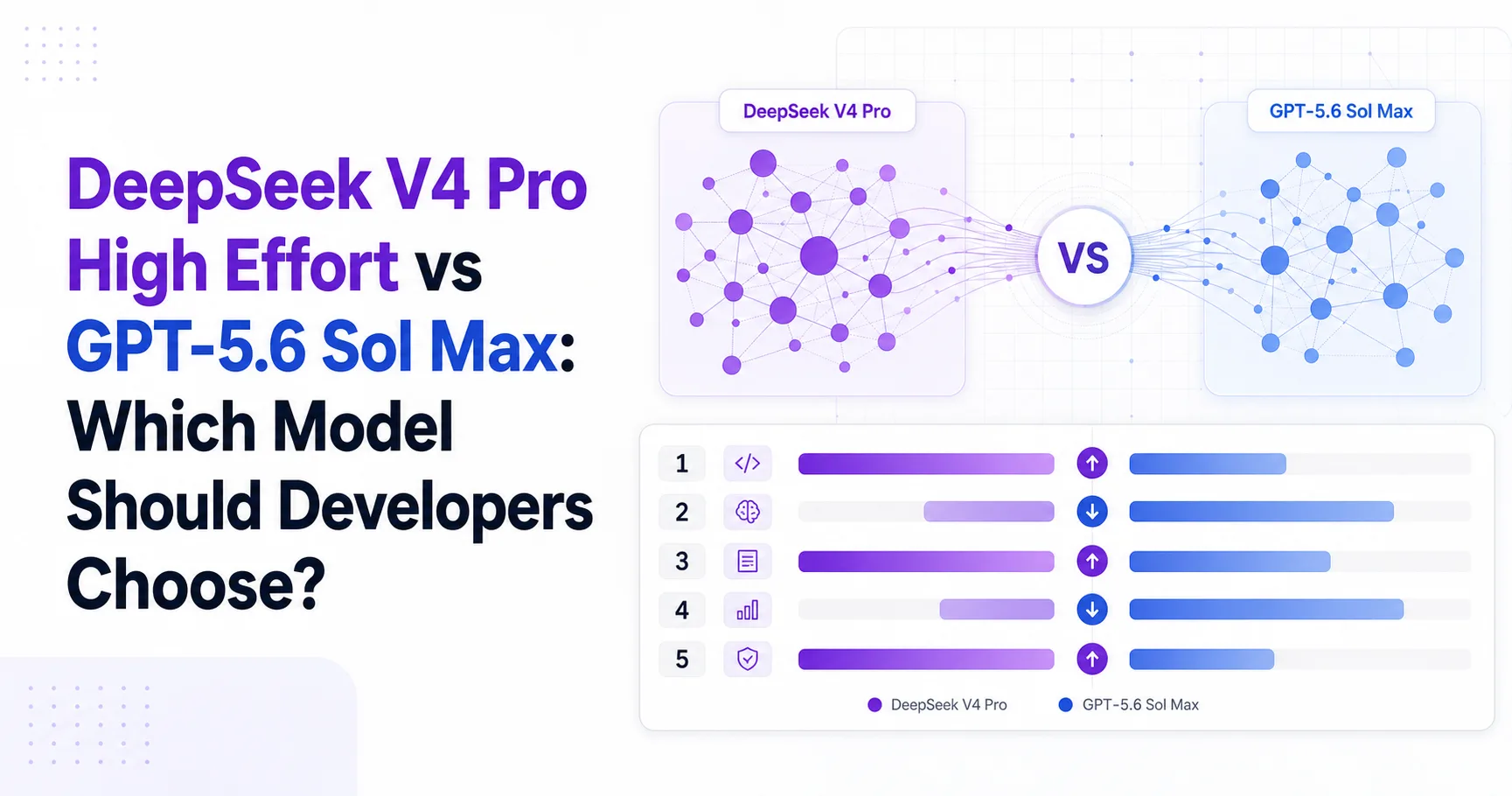
- **Winner overall:** GPT-5.6 Sol (max), with a 77.4 Coding Index and 60.9 Intelligence Index. - **Cheaper:** DeepSeek V4 Pro (Reasoning, High Effort) at $0.544 vs $11.25 per 1M blended tokens. - **Faster:** DeepSeek V4 Pro (Reasoning, High Effort) at 33.973 seconds latency. - **Pick GPT-5.6 Sol (max) when:** difficult coding or terminal work needs its 77.4 Coding Index and 0.880149812734082 Terminal-Bench v2.1 result. - **Watch out:** DeepSeek V4 Pro (Reasoning, High Effort) lacks verifiable official documentation for the measured 0424-high version.
GPT-5.6 Sol wins capability, while DeepSeek V4 Pro wins cost and response latency
GPT-5.6 Sol (max) is the stronger default for high-stakes development work because its measured coding and agent-task results lead DeepSeek V4 Pro (Reasoning, High Effort). DeepSeek is the practical alternative when budget and first-response delay matter more than maximum task success.
The comparison has an important asymmetry. GPT-5.6 Sol is a current, documented API model with a stable alias, a published tool surface, and a clear max reasoning setting in the official documentation. OpenAI describes gpt-5.6-sol as its flagship model for complex reasoning, coding, and professional work in its model documentation.
DeepSeek V4 Pro (Reasoning, High Effort) has strong measured data in this snapshot, but its exact historical identifier, deepseek-v4-pro-0424-high, has no located official release page or documented replacement. DeepSeek’s current pricing page documents a different version, DeepSeek-V4-Pro-0813, not the compared 0424-high model. That means developers can compare measured outcomes, but cannot confirm that a newly created DeepSeek integration will reproduce those outcomes.
Data provided by https://artificialanalysis.ai/. The core decision is therefore simple: buy GPT-5.6 Sol for documented, difficult agentic work, or choose DeepSeek only after verifying availability and behavior in your own account.
GPT-5.6 Sol offers the clearer production contract, while DeepSeek V4 Pro offers the lower-risk budget experiment
GPT-5.6 Sol (max) is easier to approve for production because its current version, alias, APIs, tool support, and constraints are publicly specified. OpenAI lists gpt-5.6-sol in its model catalog, and documents gpt-5.6 as its stable alias in the model details.
| Decision factor | Better choice | Why it matters |
|---|---|---|
| Difficult coding and terminal tasks | GPT-5.6 Sol (max) | It leads the measured Coding Index and both listed Terminal-Bench results. |
| Cost-sensitive repeated workloads | DeepSeek V4 Pro (Reasoning, High Effort) | Its $0.544 blended price creates more room for retries and wider internal access. |
| Lower initial waiting time | DeepSeek V4 Pro (Reasoning, High Effort) | Its measured latency is 33.973 seconds. |
| API and feature certainty | GPT-5.6 Sol (max) | Official documentation specifies current APIs, reasoning controls, and tool support. |
| Visual input workflows | GPT-5.6 Sol (max) | Official documentation supports image input, although not audio or video input. |
GPT-5.6 Sol supports text and image input, text output, Responses API, Chat Completions API, structured output, function calling, and several hosted tools according to its model details. Its reasoning settings include none, low, medium, high, xhigh, and max, as documented in the reasoning guide.
DeepSeek’s current Pro page lists JSON output, tool calling, Responses API, Anthropic-compatible access, and completion features. However, that evidence belongs to DeepSeek-V4-Pro-0813, so it cannot establish the feature set of the compared 0424-high version. This is the most important evidence gap for teams that need reproducible deployments.
GPT-5.6 Sol is the better choice for hard implementation tasks, but DeepSeek V4 Pro reaches users sooner
GPT-5.6 Sol (max) leads most measured capability signals, making it the safer bet when a failed implementation costs more than a slower response. Its 77.4 Artificial Analysis Coding Index exceeds DeepSeek’s 58.7, while its 60.9 Intelligence Index exceeds DeepSeek’s 43.7.
The chart matters most for work that chains several decisions. Terminal tasks, code changes, debugging, and research agents often fail because an early mistake changes every later step. GPT-5.6 Sol leads on SciCode, Live Code-related coverage is unavailable for both models, and it leads on both listed Terminal-Bench measures. That pattern supports choosing Sol for repository-level changes, command-line investigation, and tasks where the model must maintain a plan across tools.
The advantage is not universal. DeepSeek V4 Pro leads TAU2 at 0.941520467836257, compared with 0.850877192982456 for GPT-5.6 Sol. Developers should not convert a broad coding lead into a claim that Sol wins every workflow. The available benchmark set does not tell us which model better follows your internal conventions, uses your tool schemas correctly, or produces fewer review comments in your repository.
Speed has two different meanings here. GPT-5.6 Sol produces 63.925 median output tokens per second, compared with 61.151 for DeepSeek. Yet DeepSeek’s 33.973-second latency is far below Sol’s 113.767 seconds. For interactive editing, an earlier usable answer can matter more than a slightly higher generation rate. For a long task that already needs heavy reasoning, raw output speed may matter less.
OpenAI also warns that higher reasoning effort raises token use, latency, and cost, and recommends higher settings only when evaluation proves the gain is worth it in the reasoning guide. Community reports reinforce the need for local testing, but not as proof: a Reddit discussion and a Hacker News discussion describe overbuilt code and exploratory drift under some Sol workflows. Neither provides a controlled benchmark.
DeepSeek V4 Pro is the cost winner, but its historical-version uncertainty can make the apparent saving less reliable
DeepSeek V4 Pro (Reasoning, High Effort) is the cost winner at $0.544 per 1M blended tokens, versus $11.25 for GPT-5.6 Sol (max). That difference makes DeepSeek attractive for high-volume drafting, routine classification, low-risk code assistance, and experiments that need many attempts.
The chart already shows the token prices. The operational question is whether token price reflects total delivery cost. A lower-priced model becomes more expensive when developers must add extra prompts, manual review, retry loops, or a second model for difficult cases. The supplied data suggests that risk is higher for hard coding and terminal work, where GPT-5.6 Sol leads the measured results. The evidence does not quantify retry rates or developer review time, so no total-cost winner can be proven from these materials.
GPT-5.6 Sol has an additional cost trap for large requests. OpenAI states that requests above 272K input tokens trigger higher whole-request pricing, with 2 times input pricing and 1.5 times output pricing. Reasoning tokens also consume context capacity and are billed as output tokens, according to the model details and reasoning guide. A large repository dump, long incident log, or oversized retrieval payload can therefore change the cost decision.
OpenAI offers Standard, Batch, Flex, and Fast pricing modes in its pricing documentation. Batch and Flex can fit asynchronous jobs, while Fast mode is relevant when time matters more than spend. The data brief uses the stated blended prices, so it should remain the basis for this direct comparison.
DeepSeek’s official page introduces a different uncertainty. Its current page lists prices for DeepSeek-V4-Pro-0813, and says prices may change. Those current figures cannot validate the 0424-high model’s supplied historical price. Before setting a budget, verify the exact model identifier, account routing, price card, rate limits, and whether High Effort remains selectable.
GPT-5.6 Sol should handle difficult production agents, while DeepSeek V4 Pro should begin as a controlled cost-saving candidate
GPT-5.6 Sol (max) should be the primary model for complex coding agents because it combines stronger measured results with a documented current API contract. Choose it for tasks where an incomplete fix, unsafe terminal action, or wrong architectural decision costs more than token spend.
Use GPT-5.6 Sol when the workflow needs image input, hosted tooling, structured outputs, function calls, or explicit reasoning controls. OpenAI’s model details document these capabilities, and the GPT-5.6 announcement reports official benchmark claims for coding, browsing, operating systems, and security work. Those publication results are OpenAI’s own claims, not independent proof, so treat them as vendor evidence rather than a replacement for your test suite.
Use DeepSeek V4 Pro only for a narrowly validated lane at first. Good candidates include cost-sensitive requests with clear acceptance checks, short feedback loops, and an easy fallback to another model. Its measured latency and blended token price make that lane compelling. Do not base a production dependency on assumptions about its context window, High Effort behavior, multimodal support, or historical API compatibility, because the supplied research could not verify them for deepseek-v4-pro-0424-high.
A practical selection policy has three rules. First, route difficult code changes and terminal work to GPT-5.6 Sol (max). Second, test DeepSeek on your actual low-risk workload before routing meaningful traffic. Third, record completion quality, human correction, token use, elapsed time, and fallback frequency. These materials provide benchmark scores and API documentation, but not a controlled comparison of those business outcomes.
GPT-5.6 Sol also needs prompt discipline. Community reports describe cases of excess code and broad investigation, while the official reasoning guide advises matching effort to task difficulty. Start with a narrowly scoped task definition and use a lower reasoning setting when your own evaluation shows no benefit from max.
GPT-5.6 Sol and DeepSeek V4 Pro require local evaluation before either can be called a universal winner
GPT-5.6 Sol (max) is the evidence-backed overall choice, but neither model has enough shared evidence to guarantee better results in every codebase. The data has missing values for several benchmarks, while the research does not provide a reproducible head-to-head study of tool reliability, bug rates, review burden, or real deployment uptime.
The missing DeepSeek documentation is especially material. Its measured release date is 2026-04-24, but the located official documentation describes DeepSeek-V4-Pro-0813. A developer can use the current DeepSeek pricing page to inspect current Pro capabilities, but should not treat it as proof of the historical model’s behavior.
The missing Sol evidence is different. Sol is documented and available, but its max setting can increase latency and billed reasoning output. That means the best configuration may be GPT-5.6 Sol at a lower effort level, not GPT-5.6 Sol (max). The available data brief measures only the supplied max configuration, so it cannot answer that configuration question.
The FAQ below turns these gaps into purchase decisions rather than hiding them behind a single benchmark ranking.
Frequently asked questions
Which model should I choose for a coding agent that edits a real repository?
GPT-5.6 Sol (max) is the stronger starting choice for difficult repository work because it leads the supplied Coding Index and Terminal-Bench results. Validate it on your repository, because benchmarks do not measure your tests, conventions, tools, or reviewer expectations.
Is DeepSeek V4 Pro safe to use because it is much cheaper?
DeepSeek V4 Pro is financially attractive, but the compared 0424-high version has important documentation gaps. Verify direct availability, exact pricing, supported features, limits, and fallback behavior before making it a production dependency or routing important customer workflows.
Does GPT-5.6 Sol always produce answers faster than DeepSeek V4 Pro?
GPT-5.6 Sol does not always feel faster because its output speed is slightly higher while DeepSeek has much lower measured latency. Interactive users may value DeepSeek’s earlier response, whereas long tasks may benefit more from Sol’s stronger measured capability.
Should I always use GPT-5.6 Sol with max reasoning effort?
GPT-5.6 Sol should not always use max reasoning effort because OpenAI says higher effort raises latency, token usage, and cost. Compare lower settings on your real tasks, then reserve max for work where quality gains clearly justify the extra spend.
Sources
- Artificial AnalysisData attribution for the supplied benchmark, latency, and pricing snapshot.
- DeepSeek Models & PricingCurrent DeepSeek Pro version identity, documented features, endpoints, and version mismatch with the compared historical model.
- OpenAI ModelsCurrent GPT-5.6 Sol catalog status and model positioning.
- GPT-5.6 Sol Model DetailsGPT-5.6 Sol alias, modalities, APIs, tools, context behavior, and large-request pricing rule.
- OpenAI Reasoning Models GuideReasoning effort controls, pro mode, token behavior, latency, and cost considerations.
- OpenAI API PricingStandard, Batch, Flex, and Fast pricing modes.
- GPT-5.6: Frontier intelligence that scales with your ambitionOpenAI’s published model positioning and official benchmark claims.
- I spent two weeks testing GPT-5.6. Here’s what I found.Uncontrolled community reports about coding behavior and usage variation.
- Ask HN: How are you productive with GPT 5.6 Sol?Uncontrolled community reports about investigation drift and reasoning effort.
Published: