
AI model analysis
DeepSeek V4 Pro High vs GPT-5 High: Which Model Should Developers Choose?
A developer-focused comparison of DeepSeek V4 Pro High and GPT-5 High across coding, reasoning, mathematics, speed, pricing, API maturity, and migration risk.
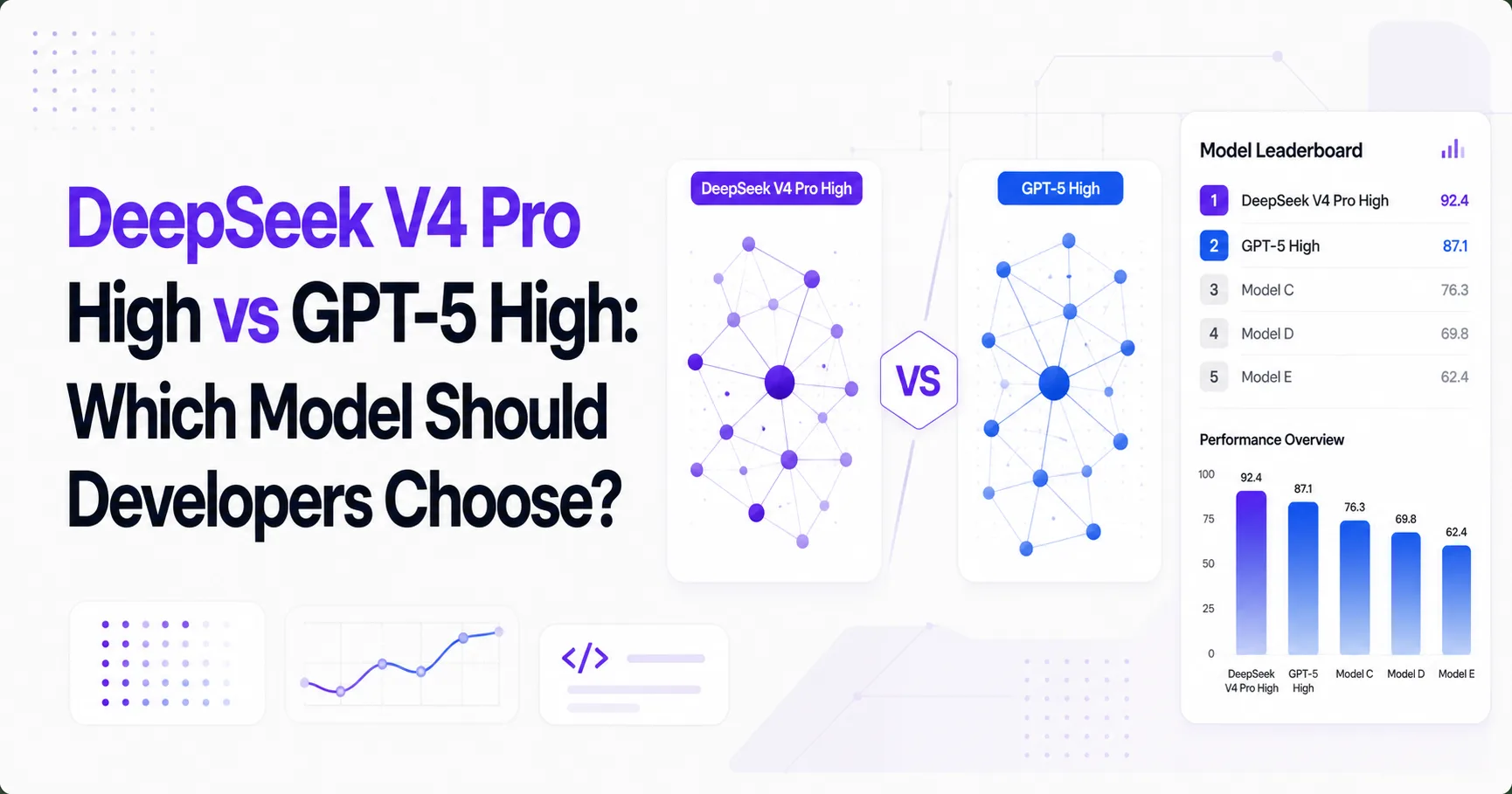
- **Winner overall:** DeepSeek V4 Pro (Reasoning, High Effort), with a 58.7 coding index and 43.1 intelligence index versus GPT-5's 37.8 and 34.7 - **Cheaper:** DeepSeek V4 Pro (Reasoning, High Effort) at $0.54375 vs $3.4375 per 1M blended tokens - **Faster:** DeepSeek V4 Pro (Reasoning, High Effort) at 69.83 median output tokens per second, while both models show 0.3-second latency - **Pick GPT-5 (high) when:** mathematical reasoning is central, because GPT-5 records a 94.3 math index while DeepSeek has no supplied math score - **Watch out:** GPT-5's fixed snapshot is Deprecated, while DeepSeek's Responses API support is still pending despite both models showing 0.3-second latency
DeepSeek V4 Pro High vs GPT-5 High
DeepSeek V4 Pro (Reasoning, High Effort) is the stronger default for most developer workloads because the supplied data shows higher coding and intelligence scores at a lower blended price. Artificial Analysis reports a 58.7 coding index and a 43.1 intelligence index for DeepSeek, compared with 37.8 and 34.7 for GPT-5 (high). The same dataset lists DeepSeek at $0.54375 per 1M blended tokens, compared with $3.4375 for GPT-5. Data provided by https://artificialanalysis.ai/
GPT-5 (high) remains the more defensible choice for mathematics-heavy systems and mature Responses API integrations. GPT-5 has a supplied math index of 94.3, while this comparison has no DeepSeek math score. The recommendation therefore depends on workload shape, API requirements, and how much uncertainty your team can accept around model naming and lifecycle status.
Executive summary for developers
DeepSeek V4 Pro (Reasoning, High Effort) offers the better measured coding and general intelligence profile, while GPT-5 (high) offers the only supplied mathematics result. Artificial Analysis reports DeepSeek at 58.7 on coding and 43.1 on intelligence, versus GPT-5 at 37.8 and 34.7. Those gaps suggest that DeepSeek is the safer first candidate for code generation, repository work, and general agent tasks, assuming your evaluation resembles the supplied index methodology. Data provided by https://artificialanalysis.ai/
The naming also needs careful interpretation. DeepSeek’s official page identifies the callable model as deepseek-v4-pro and the version as DeepSeek-V4-Pro. It does not list a separate deepseek-v4-pro-high API model. DeepSeek Models & Pricing GPT-5’s official API uses gpt-5, while “high” describes reasoning_effort=high, not a separate model identifier. GPT-5 for developers GPT-5 model documentation
Lifecycle risk points in opposite directions. DeepSeek’s official pricing page still lists deepseek-v4-pro and does not say that it has been replaced. GPT-5 remains callable through the gpt-5 alias, but the fixed snapshot gpt-5-2025-08-07 is marked Deprecated, and OpenAI recommends GPT-5.6. GPT-5 model documentation
Evidence is incomplete for community experience. The supplied research found no reliable, model-specific Reddit, Hacker News, or X consensus for DeepSeek. GPT-5 has one uncontrolled Reddit report describing useful small debugging work but weaker completeness in full application and UI generation. Reddit: Tried GPT-5 Here Are My First Impressions
Performance: translate the scores into engineering work
DeepSeek V4 Pro (Reasoning, High Effort) is the stronger measured coding candidate, but the score gap does not prove that it will win every repository or agent workflow. Artificial Analysis reports a 58.7 coding index for DeepSeek and 37.8 for GPT-5. For developers, that difference is most relevant when the model must inspect unfamiliar code, propose coordinated edits, or sustain multi-step implementation work. Data provided by https://artificialanalysis.ai/
A benchmark index is a screening signal, not a substitute for a task replay. Your result can reverse if your workload depends on a capability that the supplied comparison does not measure, such as a particular language, framework, tool protocol, or repository convention. The research brief does not provide a controlled head-to-head test of patch correctness, test-pass rate, regression rate, or review burden. It also does not provide reliable public failure records for DeepSeek’s coding behavior.
GPT-5 (high) has stronger official positioning for coding, reasoning, and agentic tasks. OpenAI reports 74.9% on SWE-bench Verified, 88% on Aider polyglot, 96.7% on τ²-bench telecom, and 69.6% on Scale MultiChallenge. The SWE-bench result excluded 23 of 500 problems that could not be stably passed on OpenAI’s infrastructure, and the Aider result used high reasoning effort. GPT-5 for developers These results are useful evidence, but they are not directly comparable to the Artificial Analysis indices in this dataset.
The speed evidence favors DeepSeek only partially. Artificial Analysis reports 69.83 median output tokens per second for DeepSeek, while GPT-5 has no supplied output-speed value. Both models have a listed latency of 0.3 seconds. Data provided by https://artificialanalysis.ai/ That means DeepSeek has a measured streaming advantage in the available data, but the evidence cannot establish a complete response-time comparison.
GPT-5 is the safer mathematical specialist in this dataset. Its math index is 94.3, while DeepSeek has no supplied math score. That is an evidence gap, not proof that DeepSeek performs poorly at mathematics. Teams building symbolic, quantitative, or verification-heavy workflows should test both models directly before treating the coding lead as a universal quality lead.
Cost: the cheaper model can still become expensive
DeepSeek V4 Pro (Reasoning, High Effort) is the clear price leader in the supplied blended-token comparison, but workload mix and operational friction determine the real bill. Artificial Analysis lists DeepSeek at $0.54375 per 1M blended tokens and GPT-5 at $3.4375. Data provided by https://artificialanalysis.ai/ The gap matters most for high-volume coding assistants, batch analysis, and agents that generate substantial output.
The cost advantage is especially relevant for reasoning workflows because output is often the expensive part of a request. DeepSeek’s official page lists uncached input at $0.435 per 1M tokens and output at $0.87 per 1M tokens. GPT-5’s documentation lists input at $1.25 per 1M tokens and output at $10 per 1M tokens. DeepSeek Models & Pricing GPT-5 model documentation A system that asks for long plans, patches, explanations, or repeated retries may therefore experience a larger practical difference than a short-answer service.
GPT-5 can still be cheaper at the system level if it avoids retries, human review, or tool failures. The supplied research does not provide pass rates, correction rates, or total task cost, so neither model has a proven cost-per-successful-change advantage. A less expensive token may become more expensive after additional calls or manual intervention.
Caching also changes the comparison. DeepSeek lists cached input at $0.003625 per 1M tokens, while GPT-5 lists cached input at $0.125 per 1M tokens. DeepSeek Models & Pricing GPT-5 model documentation Repositories with repeated context may benefit strongly from either cache, but the research does not state cache-hit rates. Treat the blended figures as planning inputs, then measure cost per accepted task in your own traffic.
DeepSeek’s official page lists a concurrency limit of 500 and warns that prices may rise substantially. DeepSeek Models & Pricing A capacity queue or future price increase can erase part of the apparent savings. GPT-5’s lifecycle guidance creates a different cost risk: migration work may be required if you depend on its deprecated fixed snapshot.
Recommendation by workload
DeepSeek V4 Pro (Reasoning, High Effort) should be the first model developers pilot for production coding agents, repository maintenance, and cost-sensitive high-volume automation. The supplied Artificial Analysis data gives DeepSeek a 58.7 coding index, a 43.1 intelligence index, and a $0.54375 blended price per 1M tokens. Data provided by https://artificialanalysis.ai/ Those results create a strong starting point for teams that can integrate through DeepSeek’s supported API surface and validate behavior on their own repositories.
Choose GPT-5 (high) when mathematical reasoning, OpenAI-specific tooling, or existing Responses API architecture is central. GPT-5 has the only supplied math result, 94.3, and its official documentation lists Responses among its available endpoints. GPT-5 model documentation OpenAI also documents structured outputs, function calling, streaming, custom tools, and adjustable reasoning effort. GPT-5 for developers These capabilities may reduce integration changes for an existing OpenAI stack.
Do not assume the comparison’s “high” names are deployable IDs. DeepSeek’s official page documents deepseek-v4-pro, not a separate high-effort alias. GPT-5 documents gpt-5 with reasoning_effort=high, not gpt-5-high. DeepSeek Models & Pricing GPT-5 for developers Resolve model IDs in configuration and record the exact request parameters used in evaluation.
DeepSeek needs an API-compatibility check before adoption. The official page says Responses API support is not yet available for deepseek-v4-pro and was planned for early August 2026. DeepSeek Models & Pricing Teams built around Responses should either wait for confirmed support or adapt the integration. FIM Completion is also marked Beta and available only in non-thinking mode, which matters for completion-oriented developer tools. DeepSeek Models & Pricing
GPT-5 needs a lifecycle check before lock-in. The fixed snapshot is Deprecated, even though the gpt-5 alias remains listed. GPT-5 model documentation Pinning GPT-5 therefore requires a migration plan. The most reliable decision is a short replay using representative coding, math, tool-use, and long-context tasks, with success measured by accepted changes and total workflow cost. The research brief does not supply those task-level results, so a universal winner cannot be established beyond the evidence shown.
FAQ before choosing a model
DeepSeek V4 Pro (Reasoning, High Effort) is the better starting point for most coding-focused pilots because its supplied coding index is 58.7, compared with 37.8 for GPT-5 (high). Data provided by https://artificialanalysis.ai/
Frequently asked questions
Which model is better for coding agents?
DeepSeek V4 Pro (Reasoning, High Effort) is the better initial choice for coding agents because the supplied coding index is 58.7 versus 37.8 for GPT-5 (high). That result still needs validation on your repositories, languages, tests, and tool workflow.
Which model is cheaper for production use?
DeepSeek V4 Pro (Reasoning, High Effort) is cheaper in the supplied blended comparison at $0.54375 per 1M tokens versus $3.4375 for GPT-5 (high). Retry rates, review effort, concurrency, and future price changes can alter total cost.
Which model is better for mathematics?
GPT-5 (high) is the safer mathematics choice in this dataset because it has a 94.3 math index and DeepSeek has no supplied math score. The missing DeepSeek result is an evidence gap, not a demonstrated failure.
Can I call DeepSeek V4 Pro High as deepseek-v4-pro-high?
The official DeepSeek page documents deepseek-v4-pro as the stable model identifier and does not list a separate deepseek-v4-pro-high pricing entry. Confirm the accepted model ID before deploying configuration.
Does DeepSeek support the Responses API?
DeepSeek’s official page says Responses API support is not available for deepseek-v4-pro at the stated time and was planned for early August 2026. Confirm current support before building a Responses-dependent integration.
Is GPT-5 safe to pin permanently?
GPT-5 remains available through the gpt-5 alias, but the fixed snapshot gpt-5-2025-08-07 is marked Deprecated. Teams that pin the snapshot should maintain migration tests and monitor OpenAI’s model documentation.
Sources
- Artificial AnalysisComparison indices, blended pricing, output speed, and latency data supplied in the data brief.
- DeepSeek Models & PricingDeepSeek model identifier, API endpoints, context and output limits, capabilities, pricing, concurrency, Responses API status, FIM limitation, and pricing-risk statements.
- GPT-5 for developersGPT-5 positioning, reasoning parameters, tool capabilities, official benchmark results, and model naming.
- GPT-5 model documentationGPT-5 API alias, snapshot status, context and output limits, modalities, endpoints, pricing, and unsupported features.
- Tried GPT-5 Here Are My First ImpressionsUncontrolled community observations about debugging, application generation, UI completeness, hallucinations, and incorrect edits.
Published: