
AI model analysis
DeepSeek V4 Pro vs GPT-5: Which Model Should Developers Choose?
A developer-focused comparison of DeepSeek V4 Pro and GPT-5 across coding quality, reasoning, speed, pricing, API compatibility, and operational risk.
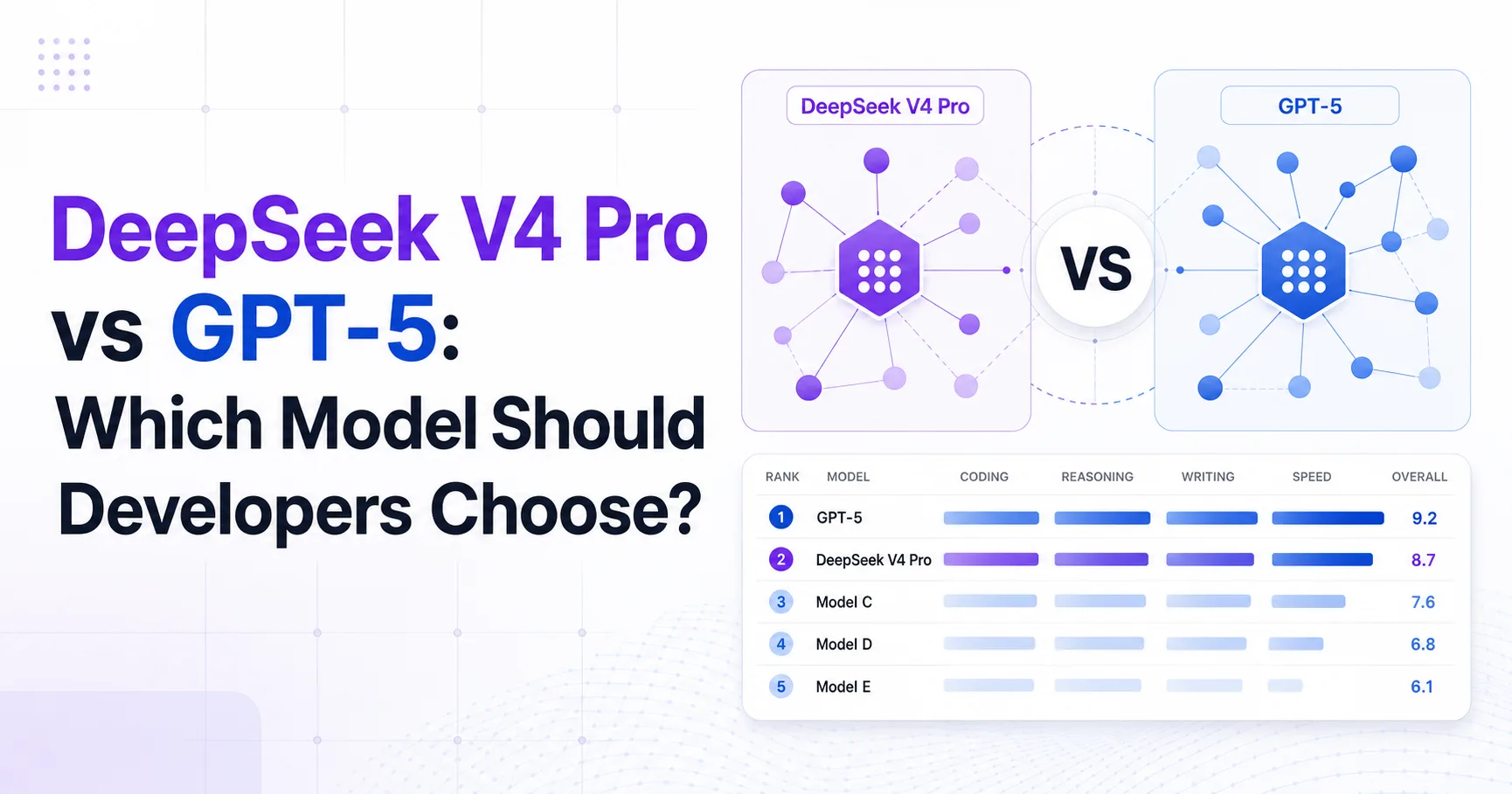
- **Winner overall:** DeepSeek V4 Pro (Reasoning, Max Effort), with an Artificial Analysis Coding Index of 59.4 versus GPT-5 at 37.8 - **Cheaper:** DeepSeek V4 Pro at $0.54375 vs $3.4375 per 1M blended tokens - **Faster:** DeepSeek V4 Pro at 59.583 median output tokens per second - **Pick GPT-5 when:** mathematical reasoning is central, because GPT-5 records a 94.3 Artificial Analysis Math Index - **Watch out:** GPT-5 has no reported output-speed value in the snapshot, while DeepSeek V4 Pro reports 59.583 tokens per second
DeepSeek V4 Pro vs GPT-5
DeepSeek V4 Pro is the stronger default for cost-sensitive coding workloads, while GPT-5 remains the clearer choice for mathematical reasoning. The data snapshot gives DeepSeek V4 Pro a 59.4 Artificial Analysis Coding Index versus 37.8 for GPT-5, and a blended price of $0.54375 versus $3.4375 per 1M tokens. GPT-5 is the only model with a reported Artificial Analysis Math Index, at 94.3. These results describe different strengths, not a universal ranking. Data provided by Artificial Analysis.
Executive summary for developers
DeepSeek V4 Pro offers the better economic and coding profile, but GPT-5 offers broader documented reasoning controls and a stronger mathematical signal. Artificial Analysis reports DeepSeek V4 Pro at 59.4 on its Coding Index and 44.3 on its Intelligence Index. GPT-5 records 37.8 and 34.7 on those same indexes. The snapshot does not provide a directly comparable DeepSeek mathematics score, so the math comparison cannot establish a winner.
DeepSeek V4 Pro is officially listed as deepseek-v4-pro, with 1M tokens of context and a 384K-token maximum output. DeepSeek’s pricing documentation lists JSON Output, Tool Calls, Anthropic API access, and OpenAI-format API access. The same page says Responses API support is not currently available and is planned for 2026年8月初.
GPT-5 is officially available through the gpt-5 alias, while “high” describes reasoning_effort=high, not a separate gpt-5-high model ID. OpenAI’s developer announcement documents reasoning effort controls, verbosity controls, function calling, structured outputs, streaming, and custom tools. The model documentation lists 400,000 tokens of context and 128,000 tokens of maximum output.
The operational distinction is important. GPT-5 has a documented Responses endpoint, but its fixed snapshot gpt-5-2025-08-07 is marked Deprecated in the model documentation. DeepSeek V4 Pro remains listed in its official model and pricing table, but the documentation does not state whether a later version has replaced it. Neither model has enough independent community evidence here to support a firm claim about reliability or typical coding experience.
Performance: what the scores mean in real projects
DeepSeek V4 Pro has the stronger measured coding signal, but GPT-5 has the stronger documented mathematics signal. Artificial Analysis reports a Coding Index of 59.4 for DeepSeek V4 Pro and 37.8 for GPT-5. That gap supports choosing DeepSeek for tasks dominated by code generation, code transformation, and software-oriented evaluation behavior. It does not prove that DeepSeek will produce fewer regressions in every repository.
The benchmark evidence also has different coverage. GPT-5 has a reported Math Index of 94.3, while the data snapshot contains no DeepSeek mathematics result. GPT-5 therefore has a meaningful selection advantage for applications where mathematical reasoning is a primary acceptance criterion, but the available data does not quantify how much better it is than DeepSeek.
GPT-5’s official developer material presents the model as designed for coding, reasoning, and agentic tasks. It also reports SWE-bench Verified at 74.9%, Aider polyglot at 88%, τ²-bench telecom at 96.7%, and Scale MultiChallenge at 69.6%. The SWE-bench result excluded 23 of 500 problems because they could not be passed reliably on OpenAI’s infrastructure, and the Aider result used high reasoning effort. OpenAI’s benchmark announcement provides those conditions.
Those official results are useful evidence for GPT-5, but they should not be merged directly with the Artificial Analysis indexes. They use different tasks, methods, and reporting choices. A developer should treat the results as directional signals, then test representative repository tasks before committing to a provider.
The speed evidence is asymmetric. DeepSeek V4 Pro reports 59.583 median output tokens per second, while GPT-5 has no output-speed value in the snapshot. Both models report 0.3 seconds of latency. The available data therefore supports a latency tie and a documented DeepSeek throughput signal, but it cannot establish that DeepSeek feels faster across complete agent loops. Community evidence is also insufficient for a stable speed consensus.
Cost: the cheaper model can still be the expensive choice
DeepSeek V4 Pro is the clear price winner, but workflow shape determines whether the listed price becomes a lower system cost. Artificial Analysis lists a blended price of $0.54375 per 1M tokens for DeepSeek V4 Pro and $3.4375 for GPT-5. It also lists output pricing of $0.87 for DeepSeek V4 Pro and $10 for GPT-5 per 1M tokens. The output difference matters most for agents that repeatedly request plans, patches, explanations, and tool results.
A low token price can become less attractive if the model needs more retries, more verification passes, or more human review. The supplied materials do not contain controlled retry rates, error rates, or production quality measurements for either model. That means no evidence-based total-cost claim can be made beyond the listed API prices.
DeepSeek’s official pricing page lists cached input at $0.003625 per 1M tokens and uncached input at $0.435 per 1M tokens. It also warns that API prices may increase substantially in the near term. DeepSeek’s official documentation makes the future-price warning explicit, so teams choosing DeepSeek should record the pricing date and monitor the page before launch.
GPT-5’s official model documentation lists input at $1.25, cached input at $0.125, and output at $10 per 1M tokens. The fixed snapshot’s Deprecated status adds migration work as a possible operational cost, even though the materials do not provide a migration estimate. Pricing alone favors DeepSeek; predictable lifecycle requirements may favor the model with the clearer endpoint and versioning documentation.
Recommendation by workload
DeepSeek V4 Pro is the best first candidate for high-volume coding workflows, while GPT-5 is the safer candidate for math-heavy or broadly documented agent integrations. The recommendation follows the available evidence, but neither model has a complete independent reliability study in the supplied materials.
Choose DeepSeek V4 Pro for repository maintenance, code transformation, automated patch generation, and other workloads where token volume is substantial and coding performance is the main selection axis. Its Artificial Analysis Coding Index is 59.4, its reported median output speed is 59.583 tokens per second, and its blended price is $0.54375 per 1M tokens. Its official API documentation also lists Tool Calls, JSON Output, OpenAI-format access, and Anthropic-format access. DeepSeek’s documentation supports those integration claims.
Choose GPT-5 when mathematical reasoning is central, when image input is required, or when the documented tool surface matters more than price. GPT-5’s Math Index is 94.3 in the supplied snapshot. Its model documentation says it accepts text and image input but does not support audio or video input or output. The same documentation lists Chat Completions, Responses, and Batch endpoints, while the developer announcement documents reasoning effort and verbosity controls. OpenAI’s model documentation and developer announcement provide those details.
Do not treat “DeepSeek V4 Pro (Reasoning, Max Effort)” or “GPT-5 (high)” as guaranteed standalone API model IDs. The official DeepSeek page lists deepseek-v4-pro, and OpenAI documents “high” as a parameter value. Version management also differs: GPT-5’s fixed snapshot is Deprecated, while DeepSeek’s page does not explain whether a successor has replaced the listed model.
Before production, evaluate both models on the same repository tasks, with the same tool permissions, patch checks, retry policy, and acceptance tests. The research materials contain no controlled comparison of hallucination frequency, stability, UI quality, or complex-codebase error rates. One Reddit post reports that GPT-5 helped with small debugging tasks but could produce simplified application interfaces or incorrect changes in complex repositories. That account is subjective and non-reproducible. The Reddit discussion should be treated as a risk signal, not a benchmark.
What the evidence does not settle
GPT-5 and DeepSeek V4 Pro still have important unanswered production questions. The supplied research found no controlled community evaluation for DeepSeek V4 Pro, no stable Hacker News or X consensus for GPT-5, and no directly comparable mathematics result for DeepSeek. The right conclusion is conditional: the available measurements favor DeepSeek for coding economics and favor GPT-5 for the documented math signal, while reliability remains an application-specific question.
Frequently asked questions
Is DeepSeek V4 Pro better than GPT-5 for coding?
DeepSeek V4 Pro is the stronger measured coding candidate in this snapshot, with a 59.4 Artificial Analysis Coding Index versus 37.8 for GPT-5. That result is directional rather than universal because the materials do not provide a controlled repository-level comparison using identical tasks, prompts, tools, and acceptance tests.
Is GPT-5 better for mathematical reasoning?
GPT-5 is the only model with a reported mathematics result here, scoring 94.3 on the Artificial Analysis Math Index. DeepSeek V4 Pro has no corresponding mathematics value in the supplied data, so GPT-5 has the stronger available evidence, but the materials do not quantify a direct score gap.
Which model is cheaper for production API use?
DeepSeek V4 Pro is cheaper on every listed blended and token-based measure, including $0.54375 versus $3.4375 per 1M blended tokens and $0.87 versus $10 per 1M output tokens. Actual total cost can still change if one model requires more retries, verification, or human correction.
Does GPT-5 high mean a separate API model?
GPT-5 high is not documented as a separate API model ID. OpenAI documents gpt-5 as the stable alias and “high” as the reasoning_effort parameter value, so applications should configure the parameter rather than assume a model named gpt-5-high exists.
Which model should a developer choose for an agent?
DeepSeek V4 Pro is the better first test for cost-sensitive coding agents, while GPT-5 is the better first test for math-heavy agents or integrations requiring its documented Responses endpoint and reasoning controls. Neither choice is fully validated for reliability because the supplied research lacks a controlled production comparison.
Sources
- Artificial AnalysisData snapshot values for coding, intelligence, mathematics, pricing, latency, and output speed
- DeepSeek Models and PricingDeepSeek model ID, context and output limits, pricing, API capabilities, concurrency, and Responses API status
- GPT-5 for developersGPT-5 positioning, reasoning and verbosity controls, tools, official benchmarks, and benchmark conditions
- GPT-5 model documentationGPT-5 alias, context and output limits, modalities, endpoints, pricing, and deprecated snapshot status
- Tried GPT-5 Here Are My First ImpressionsSubjective community reports about debugging, application generation, and complex-codebase risks
Published: