
AI model analysis
DeepSeek V4 Pro 0813 vs Qwen3.8 Max: Which Model Should Developers Choose?
A developer-focused comparison of DeepSeek V4 Pro 0813 and Qwen3.8 Max across benchmark results, speed, pricing, API readiness, and deployment risk.
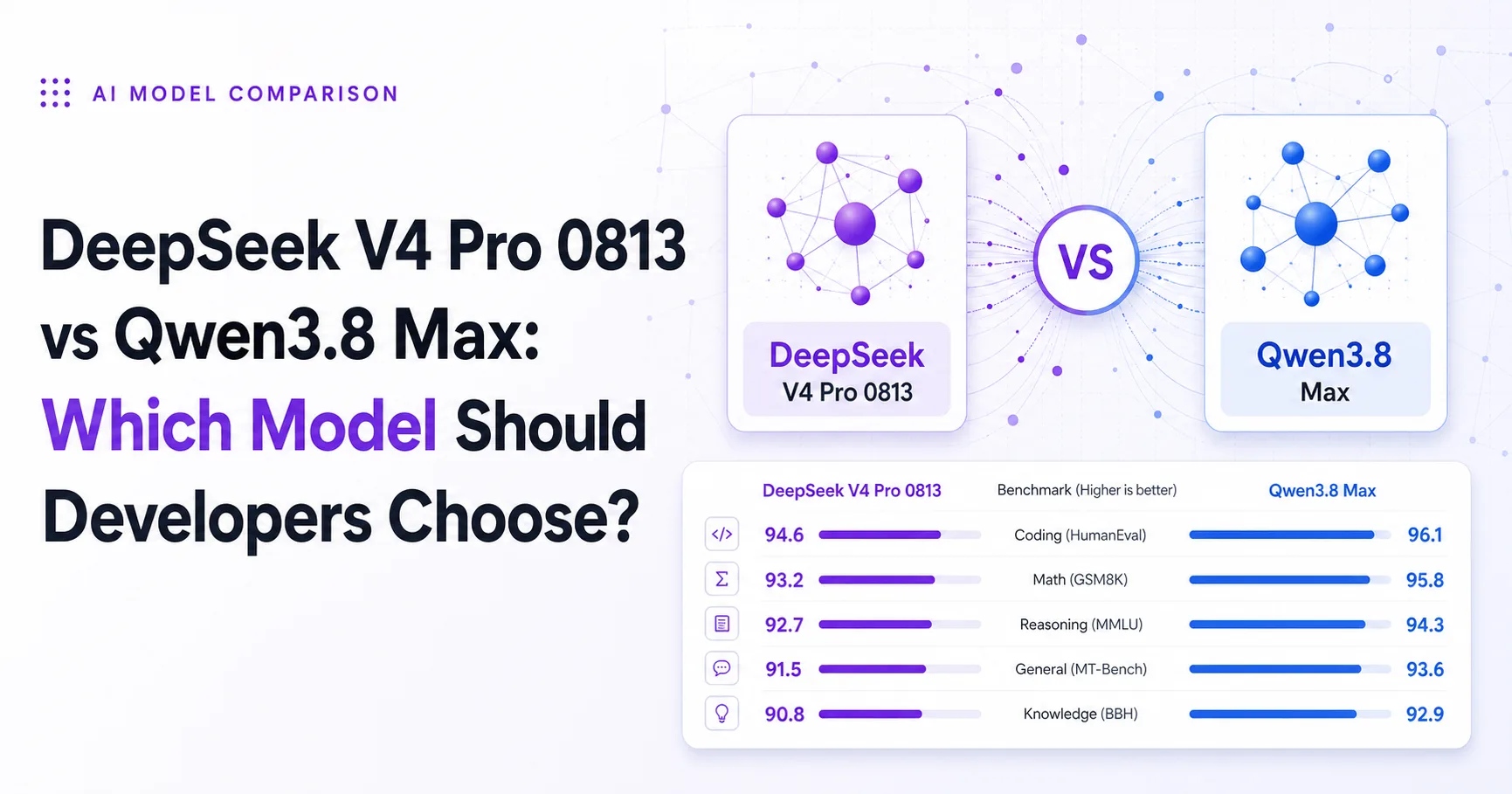
- **Winner overall:** DeepSeek V4 Pro 0813, because it is faster at 67.102 median output tokens per second and costs $0.544 per 1M blended tokens. - **Cheaper:** DeepSeek V4 Pro 0813 at $0.544 vs $3 per 1M blended tokens. - **Faster:** DeepSeek V4 Pro 0813 at 67.102 median output tokens per second. - **Pick Qwen3.8 Max when:** your workflow values its higher Artificial Analysis Intelligence Index of 58.1 and stronger task scores despite higher cost. - **Watch out:** Qwen3.8 Max has no verified Alibaba model listing, API documentation, or public community evidence in the supplied research.
DeepSeek V4 Pro 0813 vs Qwen3.8 Max
DeepSeek V4 Pro 0813 is the safer default for developers because it combines verified API availability, lower cost, and faster responses, while Qwen3.8 Max shows stronger aggregate benchmark results but lacks confirmed official product evidence. The benchmark snapshot supplied for this comparison comes from Artificial Analysis. DeepSeek is listed by its provider as DeepSeek-V4-Pro-0813, with an OpenAI-compatible endpoint at api.deepseek.com and an Anthropic-compatible endpoint at the same official pricing page. Alibaba’s official Model Studio model directory does not list qwen3-8-max in the supplied research. That difference changes the buying question. You are not comparing two equally documented products. You are comparing a callable, documented service with a higher-scoring but unverified model identity. Developers should therefore treat Qwen3.8 Max benchmark results as conditional evidence, not deployment proof. DeepSeek’s release date is 2026-08-13, while Qwen3.8 Max is dated 2026-08-03 in the benchmark data. Neither supplied source establishes a stable long-term support policy for Qwen3.8 Max, and DeepSeek warns that its prices may rise substantially in the future. The practical decision is to validate Qwen in a controlled test before making it a production dependency.
Executive summary for model selection
DeepSeek V4 Pro 0813 wins the operational comparison, while Qwen3.8 Max wins several quality indicators that may matter for complex agent workflows. Qwen3.8 Max leads the Artificial Analysis Intelligence Index at 58.1 versus DeepSeek’s 53, and it also leads the coding index at 71.8 versus 68.8. Its advantage is clearer on HLE, where it scores 0.43 versus 0.393, SciCode at 0.529 versus 0.492, TerminalBench v2.1 at 0.812734082397004 versus 0.786516853932584, and τ-bench banking at 0.51340206185567 versus 0.395876288659794. These results suggest a potential edge in broad reasoning, scientific coding, terminal tasks, and banking-style tool interactions. DeepSeek still wins GPQA narrowly at 0.928 versus 0.927, and LCR at 0.753333333333333 versus 0.743333333333333. More importantly, DeepSeek is the only model with provider documentation in the supplied evidence. Its official page states a 1M context length, 384K maximum output, JSON output, tool calling, Responses API support, Anthropic API support, and Chat Prefix Completion in beta. Qwen3.8 Max has no verified context limit, output limit, API alias, multimodal specification, or official benchmark page in the supplied research. The trade-off is therefore quality potential versus product certainty. Choose DeepSeek for a build that must ship. Choose Qwen only after Alibaba confirms the exact model ID and endpoint.
Performance: benchmark quality versus user-visible speed
DeepSeek V4 Pro 0813 provides the faster interactive experience, while Qwen3.8 Max offers higher scores on several demanding evaluations. The supplied measurements put DeepSeek at 67.102 median output tokens per second and 30.851 seconds of latency, compared with Qwen at 47.553 tokens per second and 43.993 seconds of latency. That gap affects more than dashboard rankings. In an IDE assistant, faster output can reduce the time a developer waits before reviewing a patch. In an agent loop, lower latency can shorten every planning, tool, and verification turn. The effect compounds when a task requires multiple calls. Qwen’s quality lead may still justify the wait when a single answer must handle difficult reasoning or tool coordination. Its higher HLE, SciCode, TerminalBench v2.1, and τ-bench banking scores indicate a plausible advantage for those workloads. However, the benchmark data does not reveal prompt mix, model settings, rate limits, or confidence intervals. It also does not prove that Qwen’s measured endpoint is publicly callable, because the supplied Alibaba directory lacks qwen3-8-max. DeepSeek’s official documentation confirms tool calling and JSON output, which makes its measured speed easier to connect to a real integration. Qwen’s missing API evidence prevents a fair production latency comparison. Treat Qwen’s quality advantage as a reason to run task-specific evaluations, not as a reason to skip availability checks. For interactive coding, streaming reviews, and multi-step automation, DeepSeek’s speed is the stronger default. For high-value tasks where one better answer can avoid manual rework, Qwen may earn a place after verification.
Cost: the cheaper model is not always cheaper in practice
DeepSeek V4 Pro 0813 is dramatically cheaper on the supplied price snapshot, but Qwen3.8 Max could still be economically rational when quality reduces human review. DeepSeek costs $0.544 per 1M blended tokens, compared with Qwen’s $3. Input pricing is $0.435 for DeepSeek and $2 for Qwen, while output pricing is $0.87 and $6 respectively. The chart below already shows those line-item differences, so the decision depends on workload shape rather than arithmetic alone. Output-heavy agents feel Qwen’s premium most strongly because its output rate is much higher. Long responses, repeated tool traces, and autonomous retries can therefore push Qwen’s bill beyond the simple blended estimate. DeepSeek’s official page also lists cached input at $0.003625 per 1M tokens, which may improve economics for repeated system prompts and stable context. That benefit depends on cache-hit behavior and is not represented by the blended figure. Qwen’s missing official pricing page creates a second risk: the benchmark price may not correspond to a stable public endpoint, account tier, or future commercial offer. A cheaper token price can become more expensive if the model needs extra retries, stricter validation, or manual correction. Conversely, Qwen’s higher task scores could lower total cost if they reduce failed tool calls or engineer review time. The supplied evidence does not measure error rates, retry counts, or human correction cost, so no total-cost winner can be proven beyond token pricing. Use DeepSeek for predictable budget control. Test Qwen on your own failure-sensitive tasks before paying for its possible quality premium.
Recommendation by developer scenario
DeepSeek V4 Pro 0813 is the recommended starting point for most production teams because its integration path is documented and its operating profile is faster and cheaper. Select DeepSeek when your priority is shipping an API-backed feature with known model identifiers, tool calling, JSON output, and clear context and output limits. Its official documentation also gives you OpenAI and Anthropic API entry points, reducing migration friction for existing clients. DeepSeek’s concurrency limit is 500, so high-volume systems still need queueing, rate control, and retry handling according to the provider’s warning. The official DeepSeek pricing page also says future prices may increase substantially, so record the current price in your procurement assumptions rather than treating it as permanent. Consider Qwen3.8 Max for research, internal evaluations, or narrow workflows where its higher aggregate and task-specific scores could matter more than speed and price. Qwen leads the overall intelligence index, coding index, HLE, SciCode, TerminalBench v2.1, and τ-bench banking in the supplied snapshot. Before adoption, require Alibaba to confirm that qwen3-8-max is an official, callable model with a stable alias, documented limits, and published pricing. The supplied Alibaba Model Studio directory does not provide that confirmation. A sensible selection rule is simple: deploy DeepSeek first, then challenge it with your hardest representative tasks. Add Qwen only if a verified endpoint delivers a material quality gain that offsets its higher token price and slower response profile. Evidence is insufficient to recommend Qwen as a production default today.
Questions developers should answer before switching
DeepSeek V4 Pro 0813 is easier to validate before launch because the supplied evidence includes provider documentation, while Qwen3.8 Max still requires identity and access verification. The following questions focus on risks that the benchmark chart cannot resolve.
Frequently asked questions
Is DeepSeek V4 Pro 0813 the better production choice?
Yes, DeepSeek V4 Pro 0813 is the better production starting point because its official API, model version, tool support, context limits, and pricing are documented, while Qwen3.8 Max lacks equivalent verification in the supplied research.
Why would a developer choose Qwen3.8 Max despite its higher price?
A developer may choose Qwen3.8 Max when difficult reasoning, scientific coding, terminal tasks, or banking-style tool use are more valuable than speed and token cost, because Qwen leads several supplied evaluation scores.
Can I assume Qwen3.8 Max is available through Alibaba Cloud Model Studio?
No, you cannot assume availability because the supplied Alibaba Cloud Model Studio directory does not list qwen3-8-max, and the research found no confirmed endpoint, stable alias, pricing page, or official release notice.
Does DeepSeek’s lower price guarantee a lower total project cost?
No, lower token pricing does not guarantee lower total cost because retries, validation, failed tool calls, human review, and future price changes are not measured in the supplied data.
What should I test before selecting either model?
Test representative coding changes, tool-call reliability, structured JSON compliance, latency under concurrency, retry frequency, and human correction effort, because the supplied benchmarks do not cover your prompts or operating conditions.
Sources
- DeepSeek Models and PricingVerified DeepSeek V4 Pro 0813 model identity, API endpoints, context and output limits, supported features, pricing, concurrency limit, and future pricing warning.
- Alibaba Cloud Model Studio modelsChecked whether Qwen3.8 Max or qwen3-8-max appears in Alibaba’s official model directory; the supplied research found no listing.
- Artificial AnalysisAttribution for the supplied benchmark, speed, latency, pricing, and evaluation snapshot.
Published: