
AI model analysis
EXAONE 4.5 33B vs GPT-5 mini (high): Which Model Should Developers Choose?
A developer-focused comparison of EXAONE 4.5 33B (Non-reasoning) and GPT-5 mini (high), covering evidence quality, benchmark visibility, pricing, availability, and selection risk.
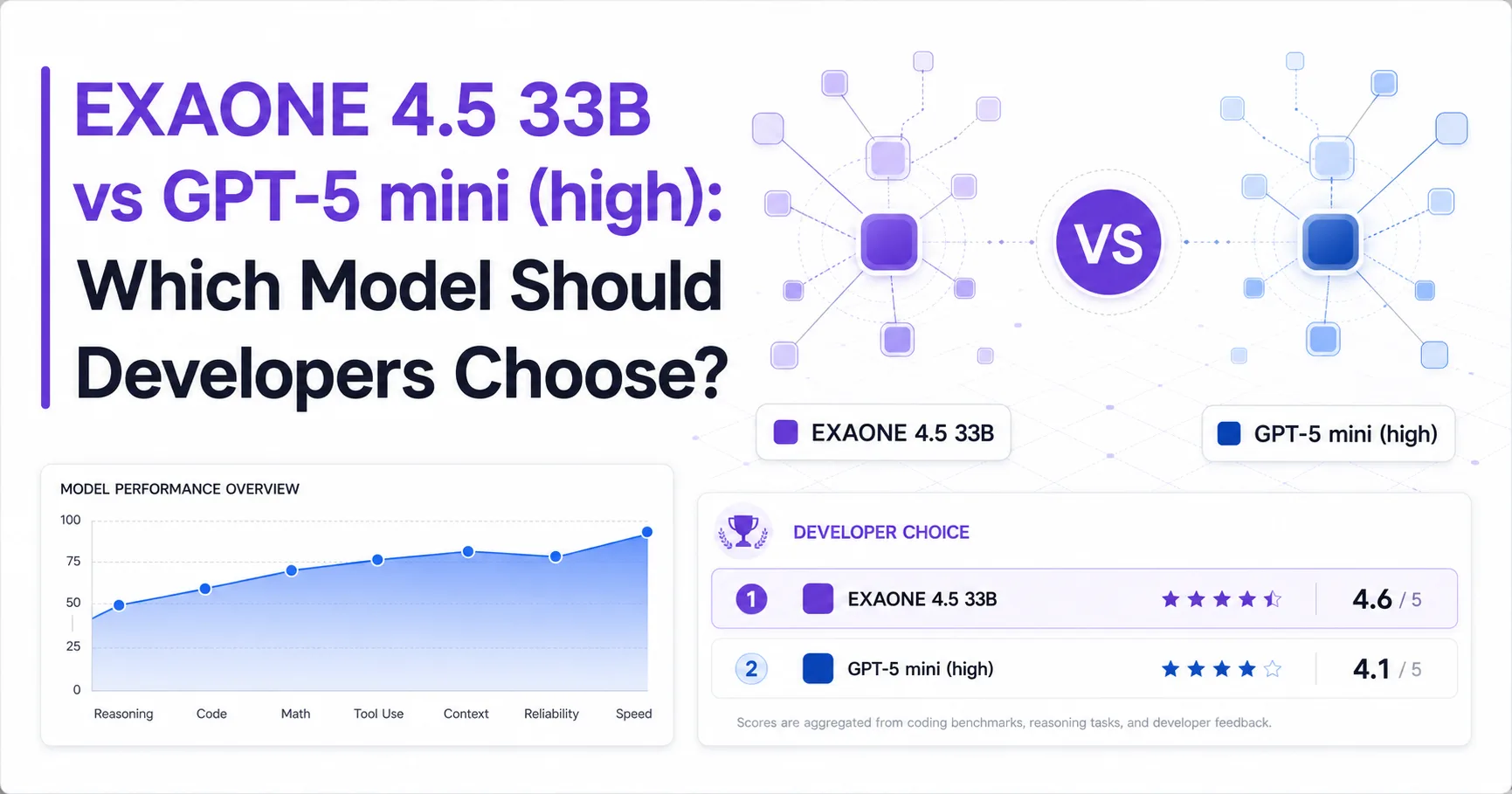
- **Winner overall:** GPT-5 mini (high), the only model with reported evaluation results, including 90.7 on the Artificial Analysis Math Index and 0.838 on LiveCodeBench - **Cheaper:** EXAONE 4.5 33B (Non-reasoning) at $0 vs $0.688 per 1M blended tokens - **Faster:** Neither model, both at 0 median output tokens per second in the supplied snapshot - **Pick GPT-5 mini (high) when:** you need measurable reasoning, coding, instruction-following, or tool-oriented evidence before choosing a production model - **Watch out:** EXAONE 4.5 33B (Non-reasoning) has no reported evaluation results, while GPT-5 mini (high) is not listed as an independent current model in the cited OpenAI directory
EXAONE 4.5 33B vs GPT-5 mini (high)
EXAONE 4.5 33B (Non-reasoning) is cheaper on the supplied snapshot, but GPT-5 mini (high) is the safer developer choice because it has measurable capability evidence.\n\nThe comparison has an unusual shape. EXAONE 4.5 33B (Non-reasoning) is recorded with a blended price of $0 per 1M tokens, while GPT-5 mini (high) is recorded at $0.688. However, EXAONE has no reported benchmark results, context window, latency, output speed, or verified product documentation in the supplied material. GPT-5 mini (high) has reported scores across mathematics, coding, general intelligence, instruction following, and tool-oriented evaluations.\n\nThat does not prove that GPT-5 mini (high) will outperform EXAONE on every developer workload. It shows that GPT-5 mini (high) is the only option here with enough measured evidence to support a capability-led decision. The larger risk is operational: the cited OpenAI directory does not list gpt-5-mini or GPT-5 mini (high) as an independent current model entry. Developers should therefore verify the exact model identifier and access path before committing to an integration. OpenAI Models
Executive summary
GPT-5 mini (high) offers the stronger evidence base, while EXAONE 4.5 33B (Non-reasoning) offers only a recorded zero-price signal.\n\nThe supplied data gives GPT-5 mini (high) an Artificial Analysis Math Index of 90.7, a LiveCodeBench result of 0.838, an MMLU-Pro result of 0.837, and a GPQA result of 0.828. Those figures do not answer every practical engineering question, but they indicate that the model has been measured on several kinds of demanding work. Its Artificial Analysis Coding Index is 15.6, so developers should avoid treating the strong mathematics result as a complete proxy for software development quality.\n\nGPT-5 mini (high) also has reported results for instruction following, long-context retrieval, science code, terminal interaction, and task-oriented tool use. The spread matters because production applications rarely ask only one kind of question. A coding assistant may need to follow repository rules, retrieve an earlier decision, produce structured output, and interact with tools in the same request.\n\nEXAONE 4.5 33B (Non-reasoning) has no reported evaluation values in the supplied snapshot. The research brief also found no verifiable vendor announcement, developer documentation, pricing page, or reliable community discussion. That absence is evidence about decision confidence, not proof of poor quality. The model may work well in a specific environment, but this material cannot establish where or why.\n\nOpenAI’s current directory describes the latest OpenAI models as supporting text and image input, text output, and multiple languages, but the page does not confirm that those statements apply to the historical gpt-5-mini name. OpenAI Models
Performance: what the available evidence means
GPT-5 mini (high) is the performance choice because it has broad measured coverage, although the supplied evidence cannot establish its live production speed.\n\nThe most useful difference is not a single score. It is the difference between an observable model and an unobservable model. GPT-5 mini (high) has a 90.7 Artificial Analysis Math Index, a 0.906666666666667 AIME 25 result, and a 0.838 LiveCodeBench result. In practical terms, these results support testing GPT-5 mini (high) for mathematical reasoning, competitive programming-style tasks, and code generation or repair. They still do not guarantee success on a particular repository, language, framework, or test suite.\n\nThe coding evidence deserves careful interpretation. GPT-5 mini (high) has a 15.6 Artificial Analysis Coding Index, a 0.392 SciCode result, a 0.333333333333333 TerminalBench Hard result, and a 0.0374531835205993 TerminalBench v2.1 result. These values suggest that coding performance is task-dependent. A developer should test the exact workflow, especially if the product depends on terminal operations, multi-step debugging, or code that must interact with external tools.\n\nGPT-5 mini (high) also records 0.754421768707483 on IFBench, 0.71 on LCR, 0.684210526315789 on tau2, and 0.154639175257732 on tau-banking. These results make instruction adherence, retrieval behavior, and tool-oriented workflows relevant evaluation targets. They do not provide a complete reliability profile.\n\nThe supplied performance data records both models at 0 median output tokens per second and 0 seconds of latency. That means the snapshot cannot distinguish their speed. It should not be read as proof that either model responds instantly or produces no output. EXAONE’s missing results also prevent a fair capability comparison. The correct next step is a workload test with representative prompts, expected outputs, tool calls, and failure review.
Cost: the zero-price signal needs verification
EXAONE 4.5 33B (Non-reasoning) is cheaper in the supplied data, but its $0 price cannot yet be treated as a dependable production cost.\n\nThe snapshot records EXAONE 4.5 33B (Non-reasoning) at $0 for input tokens, $0 for output tokens, and $0 per 1M blended tokens. GPT-5 mini (high) is recorded at $0.25 for input tokens, $2 for output tokens, and $0.688 per 1M blended tokens. These figures make EXAONE the apparent cost winner for any workload that can actually access it under those terms.\n\nThe key condition is access. The research brief found no verifiable EXAONE pricing page, stable alias, or confirmation that the model remains directly callable. The same brief found that OpenAI’s current pricing page does not list gpt-5-mini or provide standard, Batch, Flex, or Fast mode prices for it. OpenAI Pricing\n\nThis creates a cost comparison with uncertainty on both sides. EXAONE may be inexpensive because it is self-hosted, included in a platform, temporarily available, or represented by an incomplete price record. GPT-5 mini (high) may have a historical or environment-specific price that differs from the current public catalog. The supplied evidence does not identify the reason for either condition.\n\nA lower token price can also become a higher business cost if the model needs more retries, more validation, slower human review, or a separate hosting arrangement. The price chart can show the listed rates, but it cannot show engineering effort, failure recovery, or availability risk. Developers should compare total task cost after measuring successful outputs, not token price alone.
Recommendation for developers
GPT-5 mini (high) is the default recommendation for evidence-led selection, while EXAONE 4.5 33B (Non-reasoning) is a candidate for controlled experiments.\n\nChoose GPT-5 mini (high) when the team needs a model with documented evaluation coverage in the supplied dataset. Its reported results span mathematics, coding, instruction following, retrieval, science code, terminal tasks, and tool interaction. That breadth makes it easier to define acceptance tests and explain a model decision to other engineers or product stakeholders. The model’s reported 90.7 Artificial Analysis Math Index and 0.838 LiveCodeBench result are useful starting signals, not substitutes for application testing.\n\nChoose EXAONE 4.5 33B (Non-reasoning) when the team already has a verified access route and wants to investigate whether the recorded $0 pricing creates a meaningful advantage. The model should begin in a bounded test environment. Test prompt quality, structured output, code correctness, multilingual behavior, context handling, retry rate, and operational stability. The current material gives no reliable basis for predicting its strengths or failure modes.\n\nThe recommendation can reverse if EXAONE passes the team’s acceptance tests and its access terms are stable. A zero-price model with adequate task success could be the right choice for high-volume workloads. The recommendation can also reverse against GPT-5 mini (high) if the exact API identifier cannot be confirmed, if the listed price is unavailable to the team, or if its measured strengths do not match the application’s dominant tasks.\n\nThe largest unresolved issue is version identity. The supplied data labels GPT-5 mini (high) with a release date of 2025-08-07, but the current OpenAI model directory does not list gpt-5-mini or GPT-5 mini (high) as an independent entry. The directory also does not confirm that its general capability description applies to this historical label. OpenAI Models\n\nBefore implementation, confirm the exact callable model name, the actual billing terms, and the model behavior in a small representative evaluation. Keep the decision reversible until those checks are complete.
Questions to answer before choosing
GPT-5 mini (high) has more decision evidence, but neither model has a fully verified current product profile in the supplied research.\n\nThe questions below focus on risks that the benchmark and price charts cannot resolve. They are especially important for teams choosing a model for a real application rather than a one-off experiment.
Frequently asked questions
Is EXAONE 4.5 33B (Non-reasoning) the best choice because its listed price is $0?
EXAONE 4.5 33B (Non-reasoning) is only the apparent price winner, because the supplied research cannot verify whether the model is currently callable, what access conditions apply, or whether the recorded $0 represents a stable production price.
Does GPT-5 mini (high) definitely outperform EXAONE 4.5 33B (Non-reasoning)?
GPT-5 mini (high) is better supported by available evidence, but the supplied research cannot prove that it outperforms EXAONE 4.5 33B (Non-reasoning) because EXAONE has no reported benchmark results or reliable task-level evaluation.
Can developers rely on the current OpenAI documentation for GPT-5 mini (high)?
Developers should verify the exact model identifier before relying on the current OpenAI documentation, because the cited directory does not list gpt-5-mini or GPT-5 mini (high) as an independent current model entry.
Which model is faster for an interactive developer tool?
The supplied snapshot cannot identify a faster model, because EXAONE 4.5 33B (Non-reasoning) and GPT-5 mini (high) are both recorded at 0 median output tokens per second and 0 seconds of latency.
Which model should a team test first for coding work?
GPT-5 mini (high) should be tested first for coding work because it has reported coding and code-related results, including a 15.6 Artificial Analysis Coding Index and a 0.838 LiveCodeBench result, while EXAONE has no comparable values.
Sources
- OpenAI ModelsVerifying the current model directory, general capability description, and the absence of an independent gpt-5-mini or GPT-5 mini (high) entry.
- OpenAI PricingVerifying the current pricing catalog and the absence of a listed gpt-5-mini price.
Published: