
AI model analysis
Gemini 1.5 Pro vs GPT-5.6 Sol (high): Which Model Should Developers Choose?
A developer-focused comparison of Gemini 1.5 Pro and GPT-5.6 Sol (high), covering capability, operational availability, pricing, speed, evidence quality, and migration risk.
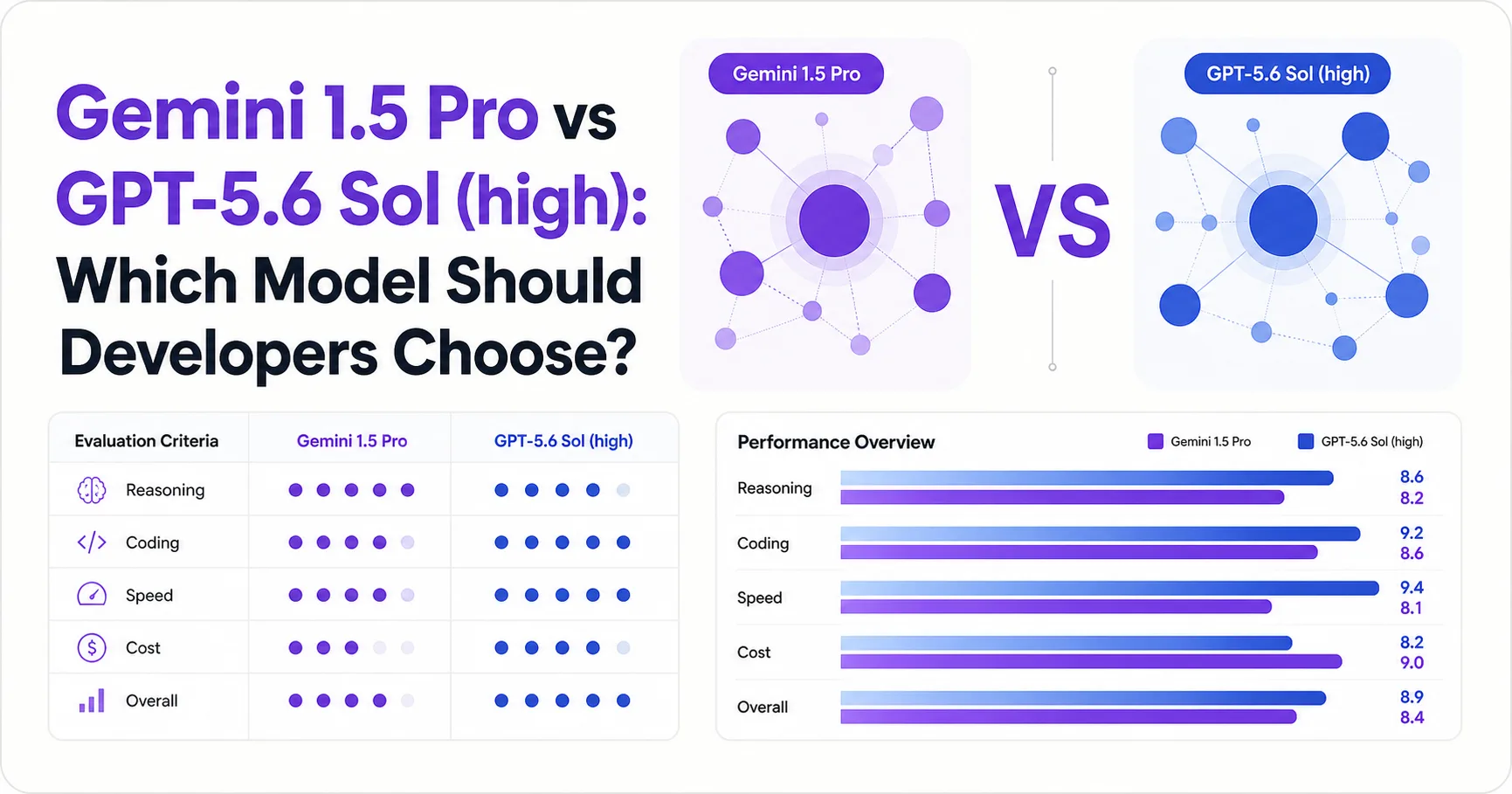
- **Winner overall:** GPT-5.6 Sol (high), with an Artificial Analysis Coding Index of 77.2 vs 23.6 and Intelligence Index of 55.9 vs 10 - **Cheaper:** GPT-5.6 Sol (high) at $11.25 vs $15 per 1M blended tokens - **Faster:** GPT-5.6 Sol (high) at 73.648 median output tokens per second, while Gemini 1.5 Pro has no reported value - **Pick GPT-5.6 Sol (high) when:** you need complex coding, structured tool use, or a currently documented API model - **Watch out:** Gemini 1.5 Pro’s current endpoint and price are unavailable in official documentation, so its practical availability cannot be confirmed
Gemini 1.5 Pro vs GPT-5.6 Sol (high)
GPT-5.6 Sol (high) is the safer choice for a new developer project because it combines stronger measured capability with a documented, active API path. Artificial Analysis reports a Coding Index of 77.2 for GPT-5.6 Sol (high), compared with 23.6 for Gemini 1.5 Pro (Sep '24), and an Intelligence Index of 55.9 compared with 10. Data provided by https://artificialanalysis.ai/
The comparison is not simply a contest between an older model and a newer model. Gemini 1.5 Pro was designed for complex multimodal work and long-context use, but Google’s current model documentation no longer presents an active model card for the September version. Gemini API model documentation GPT-5.6 Sol remains listed in OpenAI’s current model catalog, with an official model page, API identifiers, reasoning controls, and tool support. OpenAI model catalog
Developers should therefore separate historical capability from present deployment risk. Gemini may still be relevant in an existing system that already depends on its behavior. For a new system, GPT-5.6 Sol (high) offers clearer evidence and a more defensible integration decision.
Executive summary for model selection
GPT-5.6 Sol (high) leads the measurable comparison while Gemini 1.5 Pro remains relevant mainly when an existing Google integration or multimodal workflow outweighs availability concerns. Data provided by https://artificialanalysis.ai/
The largest practical difference is not latency. The data brief reports 0.3 seconds for each model, so the available latency evidence does not establish a winner. GPT-5.6 Sol (high) does have a reported median output speed of 73.648 tokens per second, while Gemini 1.5 Pro has no reported output-speed value. That makes GPT-5.6 Sol easier to assess for interactive generation, but it does not prove that every application will feel faster.
The capability gap is substantial in the supplied evaluation data. GPT-5.6 Sol (high) scores 77.2 on the Artificial Analysis Coding Index against Gemini’s 23.6. Its Intelligence Index is 55.9 against 10. These scores support GPT-5.6 Sol for code generation, debugging, planning, and complex task execution, but they do not specify the exact tasks, prompts, or production conditions a developer will face.
The deployment evidence also favors GPT-5.6 Sol. OpenAI documents gpt-5.6-sol as the fixed model ID and gpt-5.6 as the stable alias. GPT-5.6 Sol model page Gemini 1.5 Pro is absent from Google’s active model list, and Google’s current pricing page does not list a current price for it. Gemini API pricing
Performance: what the chart means in production
GPT-5.6 Sol (high) is the stronger measured performer for developer workloads, but the evidence does not establish universal superiority across every task type. Data provided by https://artificialanalysis.ai/
The Coding Index gap is large enough to change engineering workflow. A higher coding score can reduce the number of correction cycles needed for repository changes, tests, debugging, and multi-step implementation. It can also make an agent more useful when the task requires preserving constraints across several files. The score alone cannot tell you whether the model writes safer code, follows a project’s conventions, or avoids unnecessary edits. Those questions require a task-specific evaluation.
GPT-5.6 Sol is officially positioned for complex professional work, complex reasoning, and coding. Its model documentation lists structured outputs, function calling, file search, web search, prompt caching, and several additional tools. GPT-5.6 Sol model page Gemini 1.5 Pro was positioned as a multimodal model accepting text, images, video, and audio while producing text, according to Google’s model documentation. Gemini API model documentation
That creates a capability boundary the chart cannot show. GPT-5.6 Sol has documented text and image input, while Gemini’s historical positioning included a broader input modality set. Developers building around audio or video should not infer that the higher coding score settles the decision.
The speed evidence is incomplete. GPT-5.6 Sol reports 73.648 median output tokens per second, but Gemini has no supplied value. Equal reported latency of 0.3 seconds does not resolve streaming behavior, queueing, reasoning duration, or tool-call overhead. Official documentation also does not provide a separate latency, token-consumption, or success-rate profile for the high reasoning setting. Reasoning models guide
Community reports add risk signals, not verified benchmarks. Reddit users describe slow subjective performance and over-engineering, while a Hacker News report describes investigation drift and excessive defensive code. Reddit discussion Hacker News discussion These reports lack standardized tasks and measurements, so teams should test their own repositories before committing to high.
Cost: why the cheaper listed price is not the whole decision
GPT-5.6 Sol (high) is cheaper on the supplied blended and input prices, but Gemini 1.5 Pro’s current real-world cost is unknown because Google no longer lists a current price. Data provided by https://artificialanalysis.ai/
The data brief reports $11.25 per 1M blended tokens for GPT-5.6 Sol (high), compared with $15 for Gemini 1.5 Pro. Input pricing is $5 versus $10, while output pricing is $30 for each model. The result is a clear listed-price advantage for GPT-5.6 Sol when input tokens form a meaningful share of traffic.
That advantage can reverse at the application level. A model that needs more retries, more tool calls, longer prompts, or more human correction may consume more total tokens than a simpler model. The supplied materials do not provide retry rates, token consumption by reasoning setting, or production success rates. OpenAI also explains that reasoning tokens consume the context window and count as output tokens for billing. Reasoning models guide
Long-context workflows need separate budgeting. OpenAI’s pricing documentation states that requests above its long-context threshold receive higher input pricing. OpenAI API pricing The chart can show the listed rates, but it cannot show how often your workload crosses that threshold or whether a shorter prompt would preserve task quality.
Gemini’s historical price cannot be treated as a current procurement quote. Google’s current pricing page does not list Gemini 1.5 Pro, and the current model page does not expose an active endpoint for the September version. Gemini API pricing A team that chooses Gemini based on an old integration estimate may face migration work, unavailable access, or compatibility changes. The evidence does not reveal whether an existing account can still invoke the model.
Recommendation by developer scenario
GPT-5.6 Sol (high) should be the default selection for new coding and agent projects, while Gemini 1.5 Pro should be retained only with a verified existing integration or a specific multimodal requirement. Data provided by https://artificialanalysis.ai/
Choose GPT-5.6 Sol (high) when the system must handle repository-level coding, complex debugging, structured tool calls, or long multi-step plans. OpenAI documents the model ID, stable alias, supported APIs, reasoning controls, and tool capabilities. GPT-5.6 Sol model page Reasoning models guide The supplied evaluation data also gives it the stronger Coding Index and Intelligence Index.
Use Gemini 1.5 Pro only after confirming that the exact model remains callable in your account and that its behavior is required. Its historical multimodal positioning may matter for applications involving audio or video input. Gemini API model documentation However, the current official catalog does not show an active entry for the September version, and the materials do not provide a current endpoint, price, output limit, or maintained limitation list.
A staged decision is appropriate for teams with an existing Gemini dependency. First, verify invocation and billing in the target environment. Next, run representative tasks against the current production prompts. Then compare correction cycles, total tokens, tool-call errors, and human review time against GPT-5.6 Sol. The research brief does not supply those production measurements, so no universal return-on-investment conclusion is justified.
For GPT-5.6 Sol, treat high as a quality-oriented configuration rather than a guaranteed efficiency setting. OpenAI describes high reasoning effort for complex debugging, deep planning, and high-value coding, but does not publish configuration-specific success or latency data. Reasoning models guide A lower setting may be preferable for routine edits, but the supplied evidence is insufficient to prescribe one setting for every workload.
Questions developers should answer before switching
GPT-5.6 Sol (high) is the better starting point for most new developer evaluations because its current API status and measured capability are clearer. OpenAI model catalog
The remaining uncertainty concerns workload fit rather than the headline ranking. Teams should validate modality requirements, tool behavior, total token consumption, correction effort, and availability in their own environment. The research brief does not provide a standardized head-to-head production test, so the comparison supports a default choice, not a substitute for acceptance testing.
Frequently asked questions
Which model should a developer choose for a new coding project?
GPT-5.6 Sol (high) is the stronger default for a new coding project because it has the higher supplied Coding Index, a documented current API model, and official support for reasoning and developer tools. The evidence does not guarantee success on every repository.
Is Gemini 1.5 Pro cheaper than GPT-5.6 Sol (high)?
GPT-5.6 Sol (high) is cheaper in the supplied price comparison at $11.25 versus $15 per 1M blended tokens, while input pricing is $5 versus $10 and output pricing is $30 for each. Gemini’s current official price remains unlisted.
Which model is faster for interactive applications?
GPT-5.6 Sol (high) has the only supplied output-speed measurement, at 73.648 median output tokens per second, while both models show 0.3 seconds of latency. The evidence is insufficient to prove a universal interactive-speed winner.
Should an existing Gemini 1.5 Pro integration be migrated?
An existing Gemini 1.5 Pro integration should be migrated only after verifying that the current account can still call the exact model and that replacement testing covers quality, cost, modalities, and compatibility. The official current pages do not confirm an active endpoint.
Does the high reasoning setting guarantee better value?
The high reasoning setting does not guarantee better value because official documentation does not publish configuration-specific latency, token-consumption, or success-rate data. It is described for complex debugging and planning, so teams should compare total task cost on representative workloads.
Sources
- Artificial AnalysisSupplied benchmark, pricing, latency, and output-speed data
- Gemini API model documentationGemini 1.5 Pro positioning, current model-list status, and historical multimodal capabilities
- Gemini API pricingCurrent absence of a listed Gemini 1.5 Pro price
- GPT-5.6 Sol model pageModel ID, alias, API support, tools, modalities, and current model details
- OpenAI model catalogCurrent GPT-5.6 Sol product-line status
- OpenAI API pricingPricing structure and long-context pricing rules
- Reasoning models guideReasoning effort, reasoning tokens, billing behavior, and incomplete-response constraints
- GPT-5.6 Sol / Codex Release Discussion MegathreadUnstandardized community reports about speed and over-engineering
- Ask HN: How are you productive with GPT 5.6 Sol?Unstandardized community reports about investigation drift, defensive code, and reasoning settings
Published: