
AI model analysis
Gemini 1.5 Pro vs GPT-5.6 Terra: Which Model Should Developers Choose?
A developer-focused comparison of Gemini 1.5 Pro (Sep '24) and GPT-5.6 Terra (max), covering capability evidence, operational risk, pricing, speed, and model selection.
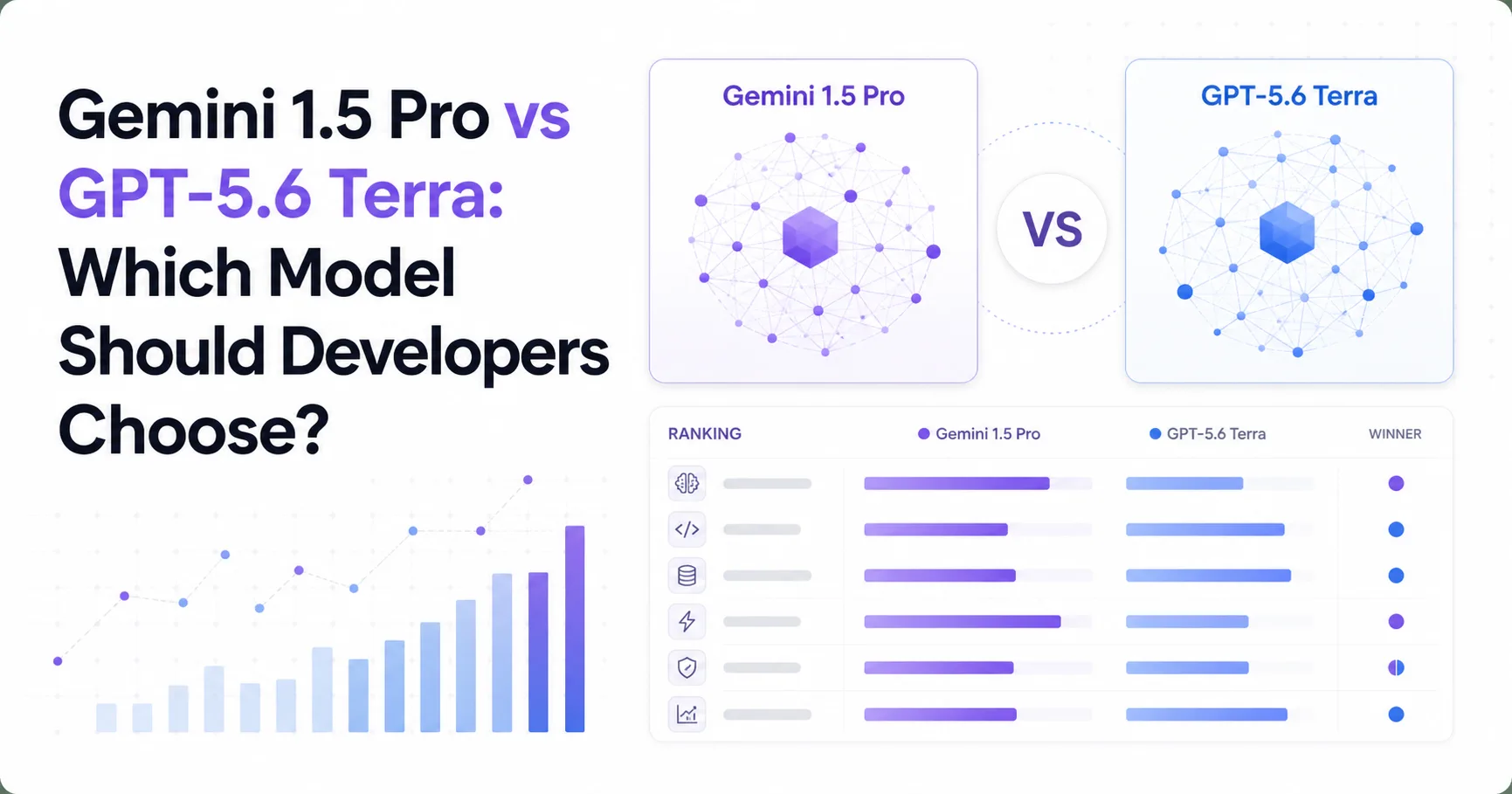
- **Winner overall:** GPT-5.6 Terra (max), with an Artificial Analysis Intelligence Index of 55 vs 10 and Coding Index of 76.7 vs 23.6 - **Cheaper:** GPT-5.6 Terra (max) at $4.500000000000001 vs $15 per 1M blended tokens - **Faster:** GPT-5.6 Terra (max) at 144.252 median output tokens per second, while Gemini 1.5 Pro has no reported value - **Pick GPT-5.6 Terra (max) when:** You need a currently documented reasoning model for coding, tool use, structured output, and production integration - **Watch out:** Gemini 1.5 Pro's current endpoint, pricing, and version-specific limits are not confirmed in the official documentation
Gemini 1.5 Pro vs GPT-5.6 Terra at a Glance
GPT-5.6 Terra (max) is the safer default for new developer projects because it has a current model ID, documented APIs, published pricing, and stronger available evaluation results. The supplied data gives GPT-5.6 Terra an Artificial Analysis Intelligence Index of 55 and Coding Index of 76.7, compared with 10 and 23.6 for Gemini 1.5 Pro (Sep '24). Data provided by https://artificialanalysis.ai/
The comparison is asymmetric in an important way. Gemini 1.5 Pro was released on 2024-09-24, while GPT-5.6 Terra was released on 2026-07-09. The older Google model is no longer shown as an active model entry in the current Gemini API model documentation, while OpenAI documents gpt-5.6-terra as a directly callable model on its GPT-5.6 Terra Model page.
Gemini 1.5 Pro remains relevant only for a constrained case: an existing system that already depends on a confirmed Gemini deployment and values its historical multimodal and long-context positioning. The supplied research does not confirm that the specific Sep '24 version remains callable, nor does it provide a reproducible community or official benchmark record for that exact version.
The Decision Depends More on Operational Certainty Than Feature Parity
GPT-5.6 Terra (max) offers the stronger documented production baseline, while Gemini 1.5 Pro offers the more uncertain legacy option.
| Selection factor | Gemini 1.5 Pro (Sep '24) | GPT-5.6 Terra (max) |
|---|---|---|
| Current model status | No active model entry found | Current stable model ID: gpt-5.6-terra |
| Input and output modes | Text, image, video, and audio input with text output historically described | Text and image input with text output |
| Documented context | Historical materials described up to 2 million tokens, but version-specific confirmation is unavailable | 1,050,000-token context window, with 922,000 maximum input and 128,000 maximum output |
| Intelligence Index | 10 | 55 |
| Coding Index | 23.6 | 76.7 |
| Blended price per 1M tokens | $15 | $4.500000000000001 |
| Median output speed | No reported value | 144.252 tokens per second |
The official Gemini API pricing page does not list a current Gemini 1.5 Pro price, free tier, paid tier, or batch price. That makes the data brief’s historical price useful for comparison, but insufficient for a new procurement decision.
GPT-5.6 Terra is documented as a reasoning model positioned to balance intelligence and cost in the current OpenAI models lineup. The OpenAI API Changelog identifies its 2026-07-09 release, while the current Deprecations page does not list it as deprecated. These facts reduce integration risk, although they do not prove future availability or task-level quality for every workload.
Performance: Terra Has the Evidence Advantage, Not a Universal Guarantee
GPT-5.6 Terra (max) is the performance choice when coding and general intelligence scores are the deciding evidence. The Artificial Analysis Coding Index is 76.7 for Terra and 23.6 for Gemini 1.5 Pro, while the Artificial Analysis Intelligence Index is 55 and 10 respectively. Data provided by https://artificialanalysis.ai/
Those results suggest a meaningful advantage for repository work, code generation, debugging, and multi-step reasoning. They do not establish a guaranteed win on every prompt. The supplied research does not disclose the benchmark prompts, test harness, model configuration, or reproducibility conditions, so an engineering team should treat the indexes as directional selection evidence rather than a substitute for task-specific evaluation.
The available speed evidence is also uneven. Terra reports 144.252 median output tokens per second, while Gemini 1.5 Pro has no reported value in the supplied data. Both models have a latency value of 0.3 seconds in the data brief, so the available latency evidence does not separate them. Output speed and request latency measure different parts of the user experience. A coding assistant may still feel different from a batch evaluator because reasoning time, output length, tool calls, and streaming behavior affect the total interaction.
Terra’s documented reasoning controls create a useful tuning path. The Reasoning models guide describes standard and pro reasoning modes, supported effort values, and multi-turn reasoning context. However, the same guide warns that reasoning tokens consume the output budget and that an overly low max_output_tokens value can produce an incomplete response before visible text appears. Developers should test answer completeness, not only token throughput.
Cost: Terra Is Cheaper on the Supplied Rates, but Long Requests Can Change the Equation
GPT-5.6 Terra (max) is the lower-cost option on every supplied headline token rate, but its long-context surcharge makes workload shape more important than the blended figure alone. The data brief lists $4.500000000000001 per 1M blended tokens for Terra versus $15 for Gemini 1.5 Pro. Input pricing is $2 versus $10, and output pricing is $12 versus $30. Data provided by https://artificialanalysis.ai/
The comparison does not support a simple claim that Terra will always cost less in a real application. The GPT-5.6 Terra Model page states that requests above 272K input tokens receive higher input and output pricing, with cache writes priced separately. A workload that repeatedly sends large documents can therefore spend more than a short-context estimate suggests. The same page documents cached input, cache writes, and the model’s context limits, which should be included in a production cost model.
Processing mode also matters. The supplied pricing research lists lower Batch and Flex rates than standard processing, while Fast mode uses higher rates. These modes are not interchangeable operationally. Batch and Flex may fit asynchronous evaluation, indexing, or offline code analysis. Fast mode may fit latency-sensitive interactive workflows, but the premium requires measurable user value.
Gemini 1.5 Pro creates a different cost problem. Its data brief includes a comparison price, but the current Gemini API pricing page does not confirm a current listing. Developers cannot safely budget a new deployment from an unverified historical rate. Before choosing Gemini, the team needs a live account-level quote, callable endpoint, quota behavior, and migration path. The research does not provide those details.
Recommendation: Choose Terra for New Builds and Gemini Only With Existing Deployment Proof
GPT-5.6 Terra (max) should be the default choice for a new developer-facing application because its documented interface and supplied evaluation results align with lower integration and model-selection risk. The GPT-5.6 Terra Model page documents Responses API, Chat Completions API, Batch API, structured outputs, function calling, file search, web search, prompt caching, and image input. That gives teams a clearer path from prototype to production.
Choose Terra when the application needs code assistance, structured tool orchestration, reasoning controls, or a current stable model ID. The supplied Coding Index difference is large enough to justify starting with Terra in repository analysis and implementation workflows, although the team should still run private acceptance tests against its own codebase. Terra’s text-only output also fits applications where the model produces code, explanations, plans, or machine-readable responses.
Consider Gemini 1.5 Pro only when a deployed system already proves that its exact version is callable and its current account terms are known. Its historical support for text, image, video, and audio input could matter for an existing multimodal pipeline. Its historical long-context positioning could also matter for a legacy document workflow. However, the current official Gemini API model documentation does not show an active entry for the Sep '24 model, and the supplied research does not identify a clear retirement date, valid stable alias, or current endpoint.
The main unresolved question is not which model scores higher. The supplied evidence already favors Terra on the available indexes and listed prices. The unresolved question is whether Gemini 1.5 Pro can be procured and called reliably today under the exact version assumptions. The research does not answer that question, so Gemini should require an explicit deployment verification gate before selection.
Questions Developers Should Resolve Before Choosing
GPT-5.6 Terra (max) is the more defensible starting point for most new development teams because the available documentation answers more integration questions than the Gemini material does. The remaining FAQ focuses on conditions that could still reverse or narrow that recommendation.
Frequently asked questions
Is GPT-5.6 Terra better than Gemini 1.5 Pro for coding?
GPT-5.6 Terra is the stronger coding choice in the supplied evidence, with a Coding Index of 76.7 versus 23.6, although private tests remain necessary because benchmark methods are not disclosed.
Which model is cheaper for API usage?
GPT-5.6 Terra is cheaper on the supplied blended, input, and output rates, but requests above 272K input tokens can trigger higher pricing and change the effective cost.
Does Gemini 1.5 Pro still have a usable production endpoint?
Gemini 1.5 Pro’s current production endpoint is not confirmed by the supplied research because the official model directory lacks an active entry and a stable alias.
Which model should support a long-context application?
GPT-5.6 Terra has the clearer currently documented context limits, while Gemini 1.5 Pro has historical long-context claims but no confirmed Sep '24 parameter record in the supplied official material.
Can GPT-5.6 Terra generate images, audio, or video?
GPT-5.6 Terra accepts text and image input but produces text output, so applications requiring native image, audio, or video generation need another model or an additional service.
Sources
- Gemini API model documentationCurrent Gemini model directory, historical model status, endpoint availability, and documented multimodal positioning
- Gemini API pricingCurrent Gemini pricing availability and the absence of a listed Gemini 1.5 Pro price
- GPT-5.6 Terra ModelModel ID, context limits, supported modalities, APIs, tools, reasoning-related constraints, and long-context pricing behavior
- Reasoning modelsReasoning modes, effort controls, reasoning context, token budgeting, and incomplete response behavior
- OpenAI ModelsCurrent product-line positioning for GPT-5.6 Terra
- OpenAI API ChangelogGPT-5.6 Terra release timing and GPT-5.6 model-family alias information
- OpenAI DeprecationsChecking whether GPT-5.6 Terra is currently listed as deprecated
- Artificial AnalysisSupplied evaluation, price, latency, and output-speed data
Published: