
AI model analysis
Gemini 1.5 Pro (Sep '24) vs Kimi K3 (max): Which Model Should Developers Choose?
A developer-focused comparison of Kimi K3 (max) and Gemini 1.5 Pro (Sep '24), covering capability, operational status, pricing, integration risk, and practical model selection.
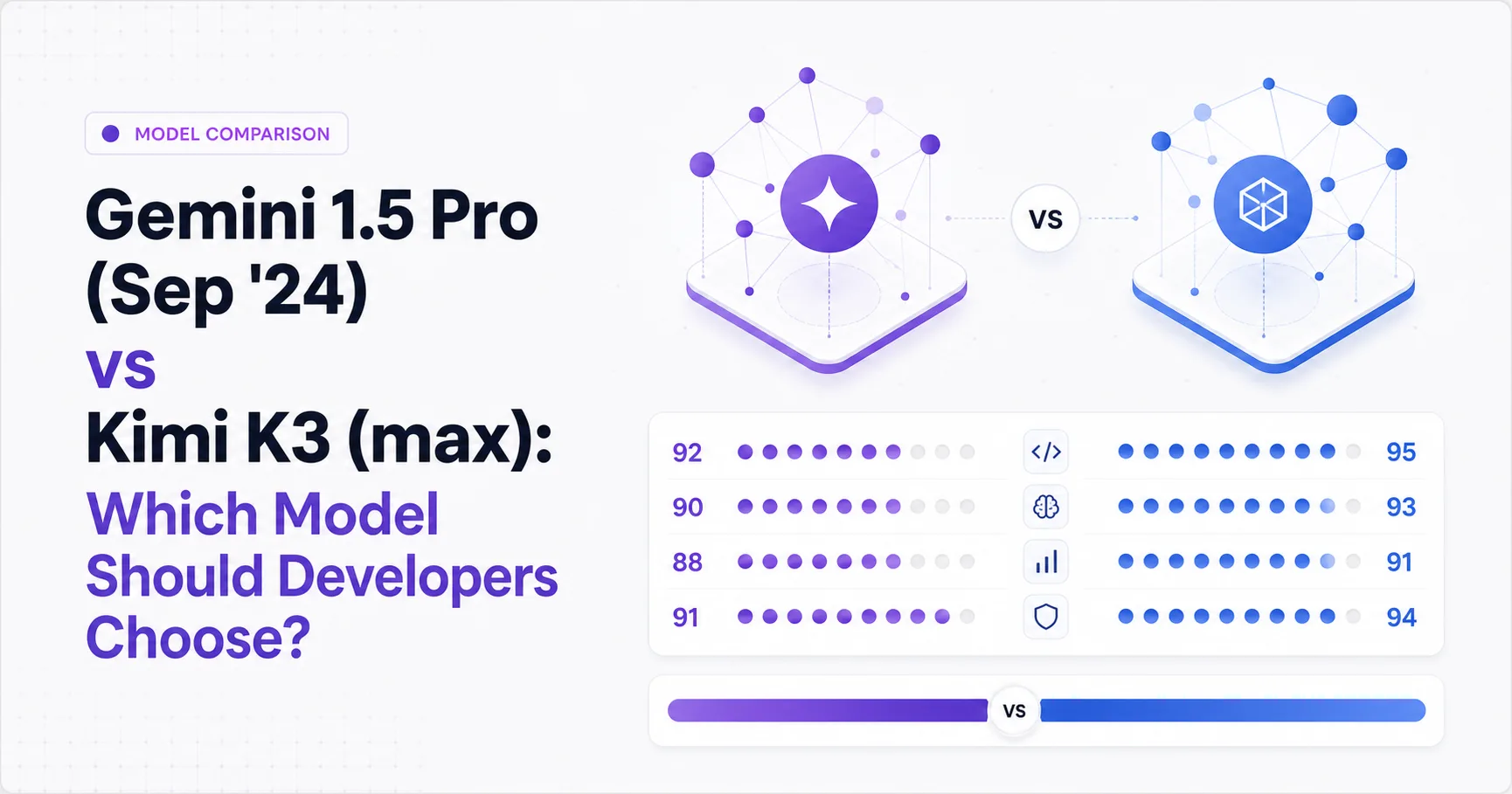
- **Winner overall:** Kimi K3 (max), with an intelligence index of 57.1 and coding index of 76.2 - **Cheaper:** Kimi K3 (max) at $6 vs $15 per 1M blended tokens - **Faster:** Kimi K3 (max) at 34.453 (median output tokens per second) - **Pick Gemini 1.5 Pro (Sep '24) when:** your existing Google API dependency matters more than uncertain current availability, despite a 0.3-second latency tie - **Watch out:** Kimi K3 (max) has 34.453 measured output tokens per second, but reliable community evidence about production speed remains limited
Gemini 1.5 Pro (Sep '24) vs Kimi K3 (max)
Kimi K3 (max) is the stronger default for new developer projects because it combines higher measured capability scores, lower listed prices, and a current API model name. The comparison data gives Kimi K3 an Artificial Analysis intelligence index of 57.1 and a coding index of 76.2. Gemini 1.5 Pro records 10 and 23.6 on those measures. Data provided by https://artificialanalysis.ai/.
The operational difference is more important than the benchmark gap. Google’s current model documentation no longer shows an active model card for Gemini 1.5 Pro (Sep '24), and Google’s pricing documentation does not list a current price for that specific model. Kimi K3 remains listed as kimi-k3 in the official model list.
Gemini 1.5 Pro can still make sense inside an existing Google-based system that has already validated its calls, prompts, and fallback behavior. New systems should treat its current endpoint and pricing as unresolved dependencies. Kimi K3 is the practical starting point, provided the application uses a compatible agent harness and accepts its documented behavior constraints.
Executive summary for developers
Kimi K3 (max) wins the new-project comparison, while Gemini 1.5 Pro (Sep '24) remains relevant mainly as a legacy integration choice. The available measurements favor Kimi K3 across capability, cost, and observed output speed, while latency is tied at 0.3 seconds. Data provided by https://artificialanalysis.ai/.
| Decision area | Practical conclusion | Evidence |
|---|---|---|
| General capability | Kimi K3 is ahead in the available intelligence comparison | 57.1 vs 10 |
| Coding work | Kimi K3 is the clearer choice for code generation and agentic development | 76.2 vs 23.6 |
| Blended token cost | Kimi K3 is cheaper | $6 vs $15 per 1M blended tokens |
| Input cost | Kimi K3 is cheaper for large prompts | $3 vs $10 per 1M input tokens |
| Output cost | Kimi K3 is cheaper for generated responses | $15 vs $30 per 1M output tokens |
| Latency | No measured advantage appears in the supplied comparison | 0.3 seconds for each model |
| Current API status | Kimi K3 has a documented active model name; Gemini’s current status is uncertain | Kimi model list, Google model docs |
The important caveat is evidence quality. The supplied comparison provides no current Gemini context-window value and no Gemini median output-speed value. It also does not establish a reproducible community consensus for Kimi K3’s production latency or throughput. Those gaps prevent a complete operational verdict.
Kimi K3’s official materials describe native vision, video input, tool calls, JSON Mode, JSON Schema output, partial mode, dynamic tool loading, and automatic context caching in the Kimi K3 Quickstart. Gemini 1.5 Pro’s official model documentation describes the family as multimodal, but the current page does not preserve a complete active parameter record for this specific version.
Performance: what the chart means in real development work
Kimi K3 (max) is the stronger performance choice for coding and reasoning workflows because its measured coding index is 76.2 versus Gemini 1.5 Pro’s 23.6. Data provided by https://artificialanalysis.ai/.
That difference should change how developers design their evaluation. A higher coding score does not guarantee that Kimi K3 will finish every repository task without supervision. The available Reddit report describes a Kimi K3 run through Hermes on a personal hardware display project. The author reported substantial progress and several bottlenecks resolved, but the run reached its token limit before completion and required manual review and another model. The report gives useful failure context, but it does not provide a reproducible benchmark script or a quantitative success rate. Read the community report.
The intelligence index points in the same direction as the coding index. Kimi K3 scores 57.1, while Gemini 1.5 Pro scores 10. That supports Kimi K3 for tasks that combine planning, implementation, and judgment. It does not prove superiority for every modality, framework, language, or prompt style. The data brief contains no task-level breakdown that would show where the gap narrows.
Speed needs a more careful reading. Kimi K3 has a reported median output rate of 34.453 tokens per second, while the supplied comparison has no Gemini value. The latency value is 0.3 seconds for each model, so Kimi’s output-rate result should not be interpreted as lower request latency. A user may still experience a longer total response if Kimi’s always-on reasoning produces more internal work or a larger answer.
Kimi K3 also requires harness discipline. The official technical blog warns that quality can become unstable when a harness does not return the full reasoning history or when a session switches models midway. The same source says the model can act too proactively when intent is unclear. Developers should therefore test repository continuation, tool-call recovery, context trimming, and human approval points, rather than relying on a single prompt benchmark.
Gemini 1.5 Pro has one performance advantage that is difficult to score from the supplied data: teams may already have working Google API integration, operational controls, and prompt behavior around it. That is an integration advantage, not evidence that the model is technically stronger. The current Google documentation does not preserve enough version-specific detail to validate fresh deployments.
Cost: lower prices do not automatically mean lower bills
Kimi K3 (max) is the lower-cost option on every supplied token-price measure, but workload shape and migration cost determine the actual economic winner. Data provided by https://artificialanalysis.ai/.
The comparison lists Kimi K3 at $6 per 1M blended tokens, compared with $15 for Gemini 1.5 Pro. Kimi’s input price is $3 per 1M input tokens, compared with $10 for Gemini. Its output price is $15 per 1M output tokens, compared with $30 for Gemini. These values make Kimi K3 attractive for coding agents, document workflows, and applications that send large histories or generate substantial responses.
The blended figure is useful for a first screen, but it hides the cost drivers that matter in production. A workload dominated by repeated context sends will respond mainly to input pricing and cache behavior. A workflow that asks for long plans, patches, or structured results will respond more strongly to output pricing. Kimi’s documentation describes automatic context caching, and the official Kimi pricing page separates cached-hit input from uncached input. Developers should measure cache-hit behavior with their own conversation patterns before converting the listed prices into a budget forecast.
Gemini 1.5 Pro creates a different cost problem: the comparison supplies historical-style price values, but Google’s current pricing page does not list a current price for this specific model. A lower migration cost could make an existing Gemini deployment rational for a short-lived system. A new deployment cannot confidently forecast long-term availability, endpoint continuity, or current billing from the supplied official page.
Kimi K3 is not cost-free operationally. The Kimi Quickstart says the flagship model requires a successfully funded account and that cumulative funding affects concurrency and rate limits. The page also identifies web search as an updating feature that is not currently recommended for production workflows. If an application depends on web search, retries, or high concurrency, engineering controls may outweigh the token-price advantage.
The sound decision is to compare complete task cost: tokens, retries, human review, migration work, and service risk. The supplied data supports Kimi K3 on direct token price, but it does not provide enough usage data to estimate an application-specific monthly bill.
Recommendation by project situation
Kimi K3 (max) should be the default choice for a new developer-facing system that values coding quality, reasoning, and lower token prices. The supplied comparison reports a coding index of 76.2, an intelligence index of 57.1, and a blended price of $6 per 1M tokens. Data provided by https://artificialanalysis.ai/.
Choose Kimi K3 for repository agents, code review, long-running implementation tasks, structured tool workflows, and applications that need native visual or video inputs. Confirm that the selected harness preserves the model’s expected reasoning history. Keep model switching at clear session boundaries. Add explicit system instructions or an AGENTS.md policy if the agent must ask before making consequential changes. These controls follow the warnings in Kimi’s technical blog.
Choose Gemini 1.5 Pro only when an existing, tested Google integration is itself a major asset. This can include a system with validated authentication, observability, prompt compatibility, and a proven fallback path. The choice should be treated as a continuity decision, not as a fresh capability or cost decision. Google’s model documentation does not currently show an active model card for the specific Sep '24 entry, and Google’s pricing documentation does not provide a current listing for it.
Do not select either model solely from the latency figure. Both models show 0.3 seconds in the supplied comparison, but only Kimi K3 has a reported median output rate, at 34.453 tokens per second. The evidence does not establish end-to-end latency under your provider, region, prompt length, tool loop, or concurrency profile.
Before production approval, run a task set that includes codebase edits, visual input, tool calls, structured output, session continuation, model switching, context reuse, and failure recovery. Record completion quality, retries, review time, and total token use. The available materials do not answer which model is more stable across those exact workloads, so your own acceptance test is necessary.
Questions to answer before committing
Kimi K3 (max) is the safer starting point for a new evaluation, but unresolved availability and harness questions still require explicit checks. The official model list identifies kimi-k3 as the callable model name, while Google’s current documentation leaves the specific Gemini 1.5 Pro entry without an active model card. The Kimi Quickstart also documents important request-format and tool behavior that should be included in integration tests.
The evidence is asymmetric. Kimi K3 has current official API and pricing material, plus a limited community report. Gemini 1.5 Pro has current family-level documentation, but the supplied sources do not confirm a current endpoint, current price, or version-specific limits. That makes uncertainty itself part of the selection decision.
Frequently asked questions
Is Kimi K3 (max) the better model for coding agents?
Kimi K3 (max) is the better default for coding agents in this comparison because its coding index is 76.2 versus 23.6 for Gemini 1.5 Pro. The result still requires harness testing, repository-level evaluation, and human review because the available community evidence reports an unfinished long-running task.
Should a new project still use Gemini 1.5 Pro (Sep '24)?
Gemini 1.5 Pro (Sep '24) should usually be reserved for an existing, validated Google integration rather than selected for a new project. Google’s current model documentation does not show an active model card for this specific version, and the current pricing page does not list its price.
Is Kimi K3 actually faster than Gemini 1.5 Pro?
Kimi K3 has the only reported median output rate, at 34.453 tokens per second, so the supplied data cannot establish a complete speed win. Latency is tied at 0.3 seconds, and Gemini’s median output-speed value is unavailable.
Which model is cheaper for a typical developer workload?
Kimi K3 is cheaper on the supplied blended, input, and output prices: $6 versus $15 per 1M blended tokens, $3 versus $10 per 1M input tokens, and $15 versus $30 per 1M output tokens. Actual bills still depend on caching, retries, and workload shape.
What is the largest Kimi K3 production risk?
Kimi K3’s largest documented production risks are harness compatibility, overly proactive decisions, and an updating web search feature that is not recommended for production workflows. The official materials also warn that incomplete reasoning history or mid-session model switching can make output unstable.
Sources
- Artificial AnalysisSupplied comparison scores, pricing values, latency, and output-speed data
- Gemini API models documentationCurrent Gemini model directory, model status, and available version-specific documentation
- Gemini API pricingCurrent Gemini pricing availability and the absence of a current listing for Gemini 1.5 Pro (Sep '24)
- Kimi K3 official technical blogKimi K3 positioning, harness warnings, proactive behavior, and model usage guidance
- Kimi K3 QuickstartAPI model behavior, reasoning controls, multimodal inputs, tool features, caching, account requirements, and web search warning
- Flagship Model Kimi K3 PricingCurrent Kimi K3 pricing and callable model pricing details
- Model ListCurrent Kimi K3 model availability and model naming
- Just tested Kimi K3 with HermesCommunity coding experience, unfinished long-running task, and limits of available reproducible evidence
Published: