
AI model analysis
Gemini 3.5 Flash-Lite vs GPT-5 (high): Which Model Should Developers Choose?
A developer-focused comparison of Gemini 3.5 Flash-Lite and GPT-5 (high), covering coding quality, reasoning, speed, pricing, modality, version status, and evidence limits.
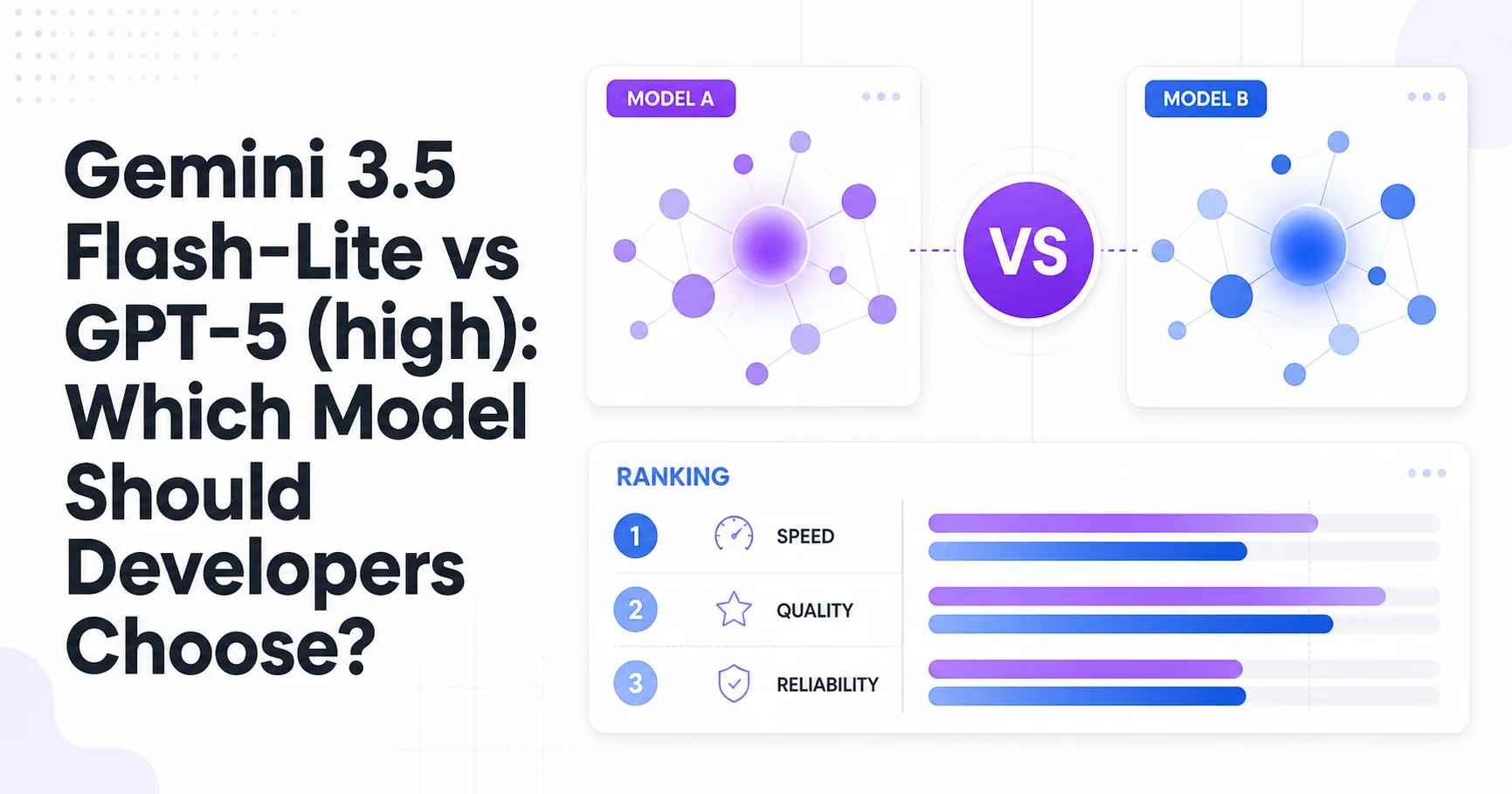
- **Winner overall:** Gemini 3.5 Flash-Lite, with a 49.3 coding index, a 36.5 intelligence index, and lower blended pricing - **Cheaper:** Gemini 3.5 Flash-Lite at $0.8500000000000001 vs $3.4375 per 1M blended tokens - **Faster:** Gemini 3.5 Flash-Lite at 381.175 median output tokens per second - **Pick GPT-5 (high) when:** math performance matters, with a 94.3 math index, or when its documented reasoning and tool controls fit the workflow - **Watch out:** Gemini 3.5 Flash-Lite has no verified public context-window, output-limit, or complex-reasoning evidence
Gemini 3.5 Flash-Lite vs GPT-5 (high)
Gemini 3.5 Flash-Lite is the stronger default for developers optimizing throughput, coding results, and API cost, while GPT-5 (high) remains the more defensible choice for math-heavy reasoning workflows.\n\nThe measured comparison favors Gemini 3.5 Flash-Lite on the coding index, intelligence index, blended price, input price, output price, and observed output speed. GPT-5 (high) has the only listed math score, at 94.3, so the comparison is not a universal capability verdict.\n\nThe models also present different operational risks. Google lists Gemini 3.5 Flash-Lite as Stable and positions it for high-volume agent tasks, translation, and simple data processing. OpenAI documents GPT-5 as a reasoning model for coding, reasoning, and agentic tasks, but its fixed snapshot is marked Deprecated.\n\nData provided by https://artificialanalysis.ai/.
Executive summary for model selection
Gemini 3.5 Flash-Lite is the better general-purpose selection when a developer needs many responses at predictable cost and strong measured coding performance.\n\nThe Artificial Analysis comparison gives Gemini 3.5 Flash-Lite a coding index of 49.3, compared with 37.8 for GPT-5 (high). Its intelligence index is also higher, at 36.5 versus 34.7. Those results support Gemini for code generation, routine refactoring, extraction, classification, and other workloads where aggregate task quality and unit economics matter together.\n\nGPT-5 (high) has a clear evidence-based reason to remain in consideration: its listed math index is 94.3, while no Gemini math score is provided. That missing Gemini value prevents a direct math comparison. Developers should treat GPT-5 as a specialist candidate for mathematically demanding work, not automatically as the stronger model for every reasoning task.\n\nThe official capability descriptions point in different directions. Google’s Gemini API models documentation describes Gemini 3.5 Flash-Lite as Stable and identifies gemini-3.5-flash-lite as its API alias. Google’s pricing documentation describes it as a GA model for high-capacity agent tasks, translation, and simple data processing.\n\nOpenAI’s GPT-5 developer announcement emphasizes coding, reasoning, agentic tasks, adjustable reasoning effort, verbosity controls, and tool calling. The GPT-5 model documentation lists GPT-5 as callable through the gpt-5 alias, while describing the fixed snapshot as Deprecated and recommending a later generation. This creates a practical difference: Gemini appears easier to adopt as the named stable endpoint, while GPT-5 requires more attention to model lifecycle and migration planning.
Performance: what the scores mean in real applications
Gemini 3.5 Flash-Lite is the stronger measured coding choice, but GPT-5 (high) retains the only reported math result and a broader documented reasoning control surface.\n\nThe coding-index gap is 11.5 points in Gemini’s favor. For developers, that difference is most relevant when the application repeatedly asks for code edits, implementation drafts, repository-level transformations, or structured programming output. It does not prove that Gemini will make fewer mistakes in every codebase. The research brief contains no controlled community comparison between the two models, and GPT-5’s reported community evidence is a single non-controlled Reddit experience.\n\nThat Reddit account describes GPT-5 as useful for locating and fixing small bugs, but less complete in full application and UI generation. Comments also mention hallucinations or incorrect edits in complex existing codebases. These observations are useful risk signals, not benchmark results, because the post does not provide a reproducible test protocol. See the Reddit experience report.\n\nThe intelligence-index difference is only 1.7999999999999972 points, so the aggregate result should not be read as a decisive reasoning separation. The missing Gemini math value is more important for quantitative selection than the small intelligence-index difference. GPT-5’s listed math index is 94.3, but the materials do not establish whether that advantage transfers to the developer’s specific mathematical workload.\n\nGemini 3.5 Flash-Lite records 381.175 median output tokens per second, while GPT-5 has no corresponding speed value in the data brief. Both models show 0.3 seconds of latency. That means Gemini has measured throughput evidence, but not a complete end-to-end responsiveness advantage. Application latency can still depend on prompt size, tool calls, network behavior, streaming, and downstream processing.\n\nThe modality boundary is also material. OpenAI’s model documentation lists GPT-5 for text and image input with text output, but not audio or video input or output. Google’s pricing page lists unified pricing items for text, image, video, and audio inputs for Gemini 3.5 Flash-Lite. The brief does not provide a matching capability matrix for every modality, so developers should validate the exact endpoint behavior before committing to media-heavy workflows.
Cost: when the cheaper model is actually cheaper
Gemini 3.5 Flash-Lite is the economic default, but GPT-5 (high) can still be cheaper when its higher task success rate prevents retries, review, or multi-step repair.\n\nThe blended price is $0.8500000000000001 per 1M tokens for Gemini 3.5 Flash-Lite and $3.4375 for GPT-5 (high). Gemini also costs $0.3 per 1M input tokens and $2.5 per 1M output tokens, compared with $1.25 input and $10 output for GPT-5. The chart below the section shows the full price comparison, so the practical question is how those rates interact with workload behavior.\n\nOutput-heavy workflows expose the largest listed price difference. Long code patches, generated documents, agent plans, and verbose structured responses accumulate output charges quickly. A cheaper model can become more expensive operationally if it produces unusable code, requires repeated prompts, or causes manual review. The research brief does not provide failure rates, retry rates, or task-success costs, so no break-even claim can be established.\n\nGemini’s batch price is $0.15 per 1M input tokens and $1.25 per 1M output tokens. That option matters for offline enrichment, translation queues, evaluations, and other jobs where interactive latency is less important. Google also lists 5,000 free Google Search grounding requests per month, with a price of $14 per 1,000 requests after the free allowance. Those terms can change the effective cost of retrieval-heavy applications, but the brief does not describe GPT-5’s equivalent grounding economics.\n\nGPT-5 has a documented cached-input price of $0.125 per 1M tokens. For applications with repeated long prefixes, caching may narrow the practical gap on input cost, although output remains priced at $10 per 1M tokens. The available evidence is insufficient to estimate cache hit rates or determine whether a specific prompt architecture benefits enough to reverse the overall cost conclusion.\n\nData provided by https://artificialanalysis.ai/.
Recommendation by developer workload
Gemini 3.5 Flash-Lite is the recommended first choice for high-volume coding assistance, extraction, translation, and simple data processing with a strong cost constraint.\n\nChoose Gemini 3.5 Flash-Lite when the product needs fast response generation, large request volume, multimodal input coverage, or routine code work. Its 49.3 coding index and 381.175 median output tokens per second make it the strongest measured fit for throughput-oriented developer products. Its Stable status also reduces the immediate lifecycle concern documented for GPT-5’s fixed snapshot.\n\nChoose GPT-5 (high) when mathematical reasoning is central, when the documented reasoning-effort control is valuable, or when custom tool formats and structured outputs are part of the integration design. OpenAI documents reasoning_effort, verbosity, function calling, structured outputs, streaming, and custom tools in its developer announcement. These controls may simplify a demanding agent architecture even when the token price is higher.\n\nDo not choose solely from the aggregate intelligence index. Gemini leads by 1.7999999999999972 points, but the available material does not define the index composition or show how either score maps to the target product. Do not choose GPT-5 solely from the 94.3 math index either, because the brief provides no Gemini math value and no workload-specific validation.\n\nThe safest production decision is a task-level pilot with the developer’s own prompts, repositories, tool schemas, and acceptance tests. The supplied evidence supports Gemini as the default and GPT-5 as a focused alternative. It does not support a universal claim about reliability, complex reasoning, context limits, or failure rates.\n\nThe API naming issue deserves explicit planning. OpenAI’s model documentation says the gpt-5 alias remains callable, while the fixed snapshot is Deprecated. Google’s model documentation lists gemini-3.5-flash-lite as Stable. Teams selecting GPT-5 should isolate the model identifier and maintain a migration path.
Evidence gaps developers should test before launch
Gemini 3.5 Flash-Lite has the larger public evidence gap around limits, while GPT-5 (high) has the clearer documented feature set but a more visible fixed-version lifecycle risk.\n\nThe research brief does not provide Gemini’s context window, maximum output, API parameter list, tool-calling boundaries, official benchmark scores, or verified failure modes. Google’s positioning around simple data processing should not be expanded into a claim that complex reasoning fails, because the official material does not define that boundary.\n\nGPT-5 has documented context, output, modality, parameter, and tool capabilities in the model documentation, but the materials do not provide a complete official failure-mode list. The Reddit evidence adds concerns about concise application generation and incorrect edits in complex repositories, yet those claims remain anecdotal.\n\nCommunity speed consensus is unavailable for both models. The Gemini brief contains no reliable public coding or behavior reports, and the GPT-5 brief contains no sufficient Hacker News or X evidence for a stable community conclusion. Developers should therefore measure first-token latency, completion latency, tool-call accuracy, repair frequency, and human review effort in their own environment.
Frequently asked questions
Is Gemini 3.5 Flash-Lite the better model for most developers?
Yes, Gemini 3.5 Flash-Lite is the better default for most throughput-sensitive developer applications because it combines a 49.3 coding index, a 36.5 intelligence index, and lower listed token prices. The evidence does not prove superior reliability for every repository, reasoning task, or production workflow.
When should a developer choose GPT-5 (high) instead?
Choose GPT-5 (high) when mathematical reasoning, adjustable reasoning effort, structured outputs, or custom tool calling matters more than minimum token cost. Its listed math index is 94.3, but the supplied evidence cannot establish a direct advantage for the developer’s specific workload.
Is GPT-5 (high) a separate API model?
No, GPT-5 (high) is not presented as a separate API model identifier in the supplied material. The documented model is gpt-5, while high refers to the reasoning_effort=high parameter described by OpenAI.
Which model is cheaper for production use?
Gemini 3.5 Flash-Lite is cheaper on the listed blended, input, and output rates, with $0.8500000000000001 per 1M blended tokens compared with $3.4375 for GPT-5. Actual total cost can change if the cheaper model causes more retries, repairs, or human review.
Which model is faster?
Gemini 3.5 Flash-Lite is the only model with a reported median output speed, at 381.175 tokens per second. Both models show 0.3 seconds of latency, while GPT-5 has no comparable output-speed value in the supplied data brief.
Can GPT-5 replace Gemini for audio and video input?
No direct replacement claim is supported. GPT-5 documentation lists text and image input with text output, while Google lists unified pricing items for Gemini text, image, video, and audio inputs. Exact application support still requires endpoint-level validation.
Sources
- Gemini API Models验证 Gemini 3.5 Flash-Lite 的 Stable 状态、API 别名和官方模型定位
- Gemini API Pricing验证 Gemini 的 GA 定位、输入模态、标准价格、Batch 价格和 Google Search grounding 价格
- GPT-5 for developers验证 GPT-5 的开发者定位、reasoning_effort、verbosity、工具调用和官方能力说明
- GPT-5 model documentation验证 GPT-5 的 API 别名、固定快照状态、价格、模态和模型能力边界
- Tried GPT-5 Here Are My First Impressions引用 GPT-5 的非受控社区编码体验、完整应用生成反馈和复杂代码库风险
- Artificial Analysis注明对比数据的提供方,并支持模型价格、速度和评测数据的归属
Published: