
AI model analysis
Gemini 3.5 Flash (high) vs GPT-5 nano (high): Which Model Should Developers Choose?
A developer-focused comparison of Gemini 3.5 Flash (high) and GPT-5 nano (high), covering capability evidence, speed, cost, availability, and production risk.
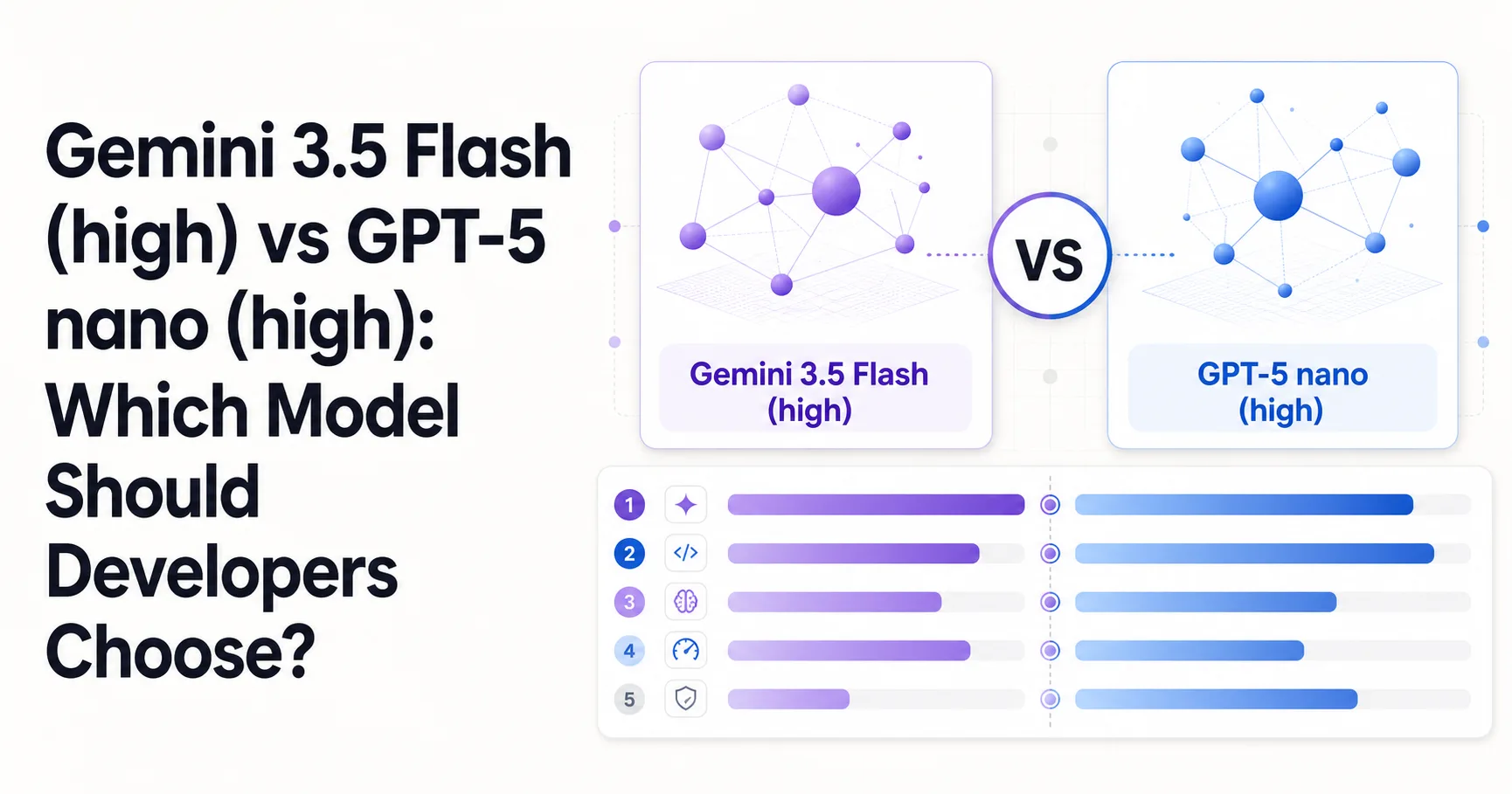
- **Winner overall:** Gemini 3.5 Flash (high), with an Artificial Analysis Intelligence Index of 50.2 vs 19.9 - **Cheaper:** GPT-5 nano (high) at $0.1375 vs $3.375 per 1M blended tokens - **Faster:** Gemini 3.5 Flash (high) at 270.227 median output tokens per second - **Pick Gemini 3.5 Flash (high) when:** you need agentic coding, multimodal inputs, tool use, and a documented stable API model - **Watch out:** GPT-5 nano (high) has an Artificial Analysis Math Index of 83.7, but comparable coding, speed, context, and current availability evidence is insufficient
Gemini 3.5 Flash (high) vs GPT-5 nano (high)
Gemini 3.5 Flash (high) is the safer production choice for developers who need documented agentic and coding capabilities, while GPT-5 nano (high) is the far cheaper option when its reported math strength fits the workload. The comparison is asymmetric because the two models do not have comparable public documentation. Google documents Gemini 3.5 Flash as a Stable model for agentic and coding tasks in its model overview, release announcement, and model page. The current OpenAI model directory does not list GPT-5 nano or a matching API alias. That absence does not prove that the model cannot be called in every environment, but it creates a material availability and support risk. Artificial Analysis reports identical latency of 0.3 seconds for the two entries, yet only Gemini has a reported median output speed of 270.227 tokens per second. Developers should therefore treat Gemini as the evidence-backed default and GPT-5 nano as a cost-sensitive candidate requiring direct validation.
Executive summary for model selection
Gemini 3.5 Flash (high) leads the available general capability evidence, while GPT-5 nano (high) leads the available cost and math evidence. Artificial Analysis reports an Intelligence Index of 50.2 for Gemini and 19.9 for GPT-5 nano. It reports a Math Index of 83.7 for GPT-5 nano, but no matching Gemini math score. It reports a Coding Index of 70.1 for Gemini, but no comparable GPT-5 nano coding score. Those missing cells matter more than a simple winner label because coding is a primary part of the stated Gemini positioning, while math is the only task-specific strength reported for GPT-5 nano. The available official documentation also points in different directions. Google describes Gemini 3.5 Flash as GA and Stable, with a stable alias and documented tooling. OpenAI’s current directory provides general information about recent models, but does not identify GPT-5 nano specifically. The result is a clear decision boundary: Gemini offers broader, inspectable production evidence, while GPT-5 nano offers a compelling price and one strong reported specialty with substantially weaker current documentation.
Where the evidence supports each model
Gemini 3.5 Flash (high) has the broader documented capability surface for modern application workflows. Its model page documents text, image, video, audio, and PDF input, plus text output. It also documents context caching, code execution, file search, function calling, Google Search grounding, Google Maps grounding, structured output, Thinking, and URL Context. Computer Use is listed as Preview, so it should be treated as an evaluation item rather than a settled production dependency. Google’s release announcement positions the model for complex, long-running agentic workflows and coding tasks, and reports Terminal-Bench 2.1 at 76.2%, GDPval-AA at 1656 Elo, MCP Atlas at 83.6%, and CharXiv Reasoning at 84.2%. These are vendor-reported results, so they establish positioning rather than an independent head-to-head verdict. GPT-5 nano (high) has no equivalent model-specific capability record in the supplied OpenAI documentation. The page describes current OpenAI models in general terms, including text and image input and text output, but does not confirm that those properties apply to GPT-5 nano. Developers should not transfer capabilities from another nano model to this one.
Performance: what the chart cannot tell you
Gemini 3.5 Flash (high) is the only model in this snapshot with a reported output-speed measurement, so it is the more defensible choice for interactive generation. Its median output speed is 270.227 tokens per second, while GPT-5 nano has no reported value. Both entries show latency of 0.3 seconds, which suggests that the first response may arrive under similar measured conditions. It does not establish equal user experience because streaming speed, output length, tool-call pauses, queueing, retries, and infrastructure location can dominate a real application. Gemini’s reported speed is especially relevant to coding assistants and agent loops, where users notice the time spent receiving intermediate reasoning or tool-directed output. However, the high thinking setting can increase reasoning depth, tool-call opportunities, and output-token consumption, according to Google’s Gemini three point five update notes. That means a faster token stream can still produce a slower or more expensive end-to-end task if the model reasons longer. GPT-5 nano’s missing speed value prevents a fair throughput comparison. Developers should benchmark complete workflows, including tool calls and retries, before treating the latency tie as a practical tie.
Cost: cheap inference can still be expensive workflow design
GPT-5 nano (high) is dramatically cheaper in the supplied pricing snapshot, but Gemini 3.5 Flash (high) can justify its higher cost when stronger task completion reduces retries and orchestration work. Artificial Analysis lists blended pricing at $0.1375 per 1M tokens for GPT-5 nano and $3.375 for Gemini. It also lists input pricing of $0.05 and $1.5, and output pricing of $0.4 and $9, respectively. The page chart already shows the direct price gap, so the practical question is where that gap changes the architecture. GPT-5 nano is attractive for high-volume classification, routing, lightweight extraction, and math-focused workloads, provided the model is actually available through the intended OpenAI path. Gemini’s higher output price becomes easier to defend when a task needs multimodal input, structured tool use, grounding, or long agentic execution. Google’s pricing documentation also documents caching, Batch, Flex, Priority, and grounding charges, which can change the effective cost pattern. The supplied evidence does not provide equivalent current GPT-5 nano pricing or service details from OpenAI. Therefore, GPT-5 nano is the price winner on the snapshot, but not yet the fully verified procurement winner.
Recommendation by workload
Gemini 3.5 Flash (high) should be the default pick for production coding agents, multimodal assistants, and tool-using workflows. Google documents the model’s stable alias, input modalities, tool integrations, Thinking controls, and production status through its model page and model overview. That documentation makes integration risks visible before deployment. Use Gemini when the application must inspect documents, images, audio, video, or URLs, call external functions, ground answers with Google services, or sustain complex coding work. Keep the high thinking setting for difficult reasoning, difficult mathematics, complex coding, or difficult agent tasks, as described in the official update notes. Use GPT-5 nano (high) only after confirming a callable endpoint, model alias, limits, and operational support in your environment. Its $0.1375 blended price and reported Math Index of 83.7 make it worth testing for inexpensive, math-heavy or high-volume tasks. Do not infer its context window, output limit, parameters, or failure modes from another OpenAI nano model. The current OpenAI model directory and OpenAI pricing page do not verify those details for GPT-5 nano. The missing evidence is itself a selection factor.
Integration risks that can reverse the recommendation
Gemini 3.5 Flash (high) has documented integration constraints that developers must encode into their test plan. Google recommends the thinking_level parameter for Gemini three point x models and warns against combining it with the older thinking_budget parameter, because sending both can return a 400 error. Function responses must preserve matching identifiers, names, and counts, and multimodal function responses must appear inside the function-response content structure. These requirements are documented in the official update notes. Gemini also lacks native audio generation, image generation, and Live API support, according to the model page, so it cannot serve as the sole model for applications requiring those outputs. A Reddit user reported positive coding speed and quality after using Gemini 3.5 Flash high in Antigravity CLI, while also reporting rapid quota consumption during sustained work. The Reddit post discloses a practical usage process but not a reproducible benchmark. GPT-5 nano has an even larger evidence gap: the supplied research found no verified community test and no model-specific public failure guidance. That makes operational validation mandatory before adoption.
Questions to answer before shipping
GPT-5 nano (high) requires stronger pre-production verification than Gemini 3.5 Flash (high) because its current public documentation is incomplete. The supplied research found no official GPT-5 nano entry, matching stable alias, model-specific context limit, output limit, parameter list, or failure-mode documentation in the current OpenAI pages. The supplied research also found no verified Reddit, Hacker News, or X post that discloses a reproducible GPT-5 nano evaluation. Gemini has more visible constraints, but visible constraints are easier to test and monitor. Teams should confirm endpoint availability, request schemas, usage accounting, tool behavior, and fallback behavior for both models. They should also test the exact high-thinking configuration rather than assuming that a model label alone defines runtime behavior. A useful acceptance test should cover representative coding tasks, math tasks, multimodal inputs, tool calls, long responses, retries, and quota exhaustion. The snapshot supports a directional recommendation, not a substitute for a workload-specific bake-off. The strongest unresolved question is whether GPT-5 nano’s low price remains actionable in the developer’s target environment.
Frequently asked questions
Which model should developers choose overall?
Gemini 3.5 Flash (high) is the stronger overall choice when production documentation, agentic coding support, multimodal input, and visible integration constraints matter more than minimum token cost. GPT-5 nano (high) is worth a controlled pilot when its endpoint is confirmed and the workload is strongly cost-sensitive or math-focused.
Which model is cheaper for large-scale inference?
GPT-5 nano (high) is cheaper in the supplied snapshot, at $0.1375 per 1M blended tokens versus $3.375 for Gemini 3.5 Flash (high). That price advantage matters most for workloads that do not require Gemini’s documented multimodal tooling, grounding, or agent-oriented capabilities.
Is GPT-5 nano faster than Gemini 3.5 Flash?
The available evidence cannot establish that GPT-5 nano (high) is faster. Both models have a reported latency of 0.3 seconds, but only Gemini has a reported median output speed, at 270.227 tokens per second. A direct workflow benchmark is still required.
Which model is better for coding agents?
Gemini 3.5 Flash (high) is the better-supported choice for coding agents because Google explicitly positions it for coding and agentic workflows and reports a Coding Index of 70.1. GPT-5 nano has no comparable coding score or model-specific public documentation in the supplied research.
Is GPT-5 nano better for mathematics?
GPT-5 nano (high) has the stronger available mathematics signal, with an Artificial Analysis Math Index of 83.7. The comparison remains incomplete because no matching Gemini math score is supplied, so the result should guide testing rather than replace a representative evaluation.
Can Gemini 3.5 Flash replace a model that generates audio or images?
Gemini 3.5 Flash (high) cannot replace a model that must natively generate audio or images because its official model page lists text output and does not support audio generation or image generation. Applications needing those outputs require another model or service.
Sources
- Gemini API ModelsGemini 3.5 Flash 的 Stable 状态、定位与稳定别名
- Gemini 3.5 Flash model page输入模态、输出能力、工具支持、Computer Use 状态与已知不支持能力
- What’s new in Gemini 3.5 Flashthinking_level 配置、参数限制、函数调用约束与高思考级别适用场景
- Gemini API PricingGemini 价格、缓存、Batch、Flex、Priority 与 grounding 计费
- Gemini 3.5: frontier intelligence with actionGemini 发布公告、官方定位与厂商公布的基准结果
- Gemini 3.5 Flash is amazing (speed, quality) with the new Antigravity CLI but...社区编码体验、速度质量反馈、配额消耗与测试方法披露情况
- OpenAI ModelsGPT-5 nano 当前官方目录缺失、OpenAI 通用模型能力说明与可用性证据
- OpenAI API PricingGPT-5 nano 当前官方定价目录缺失的核查
Published: