
AI model analysis
Gemini 3.6 Flash (high) vs GPT-5 (high): Which Model Should Developers Choose?
A developer-focused comparison of Gemini 3.6 Flash (high) and GPT-5 (high), covering coding, reasoning, latency, pricing, API constraints, version risk, and practical fit.
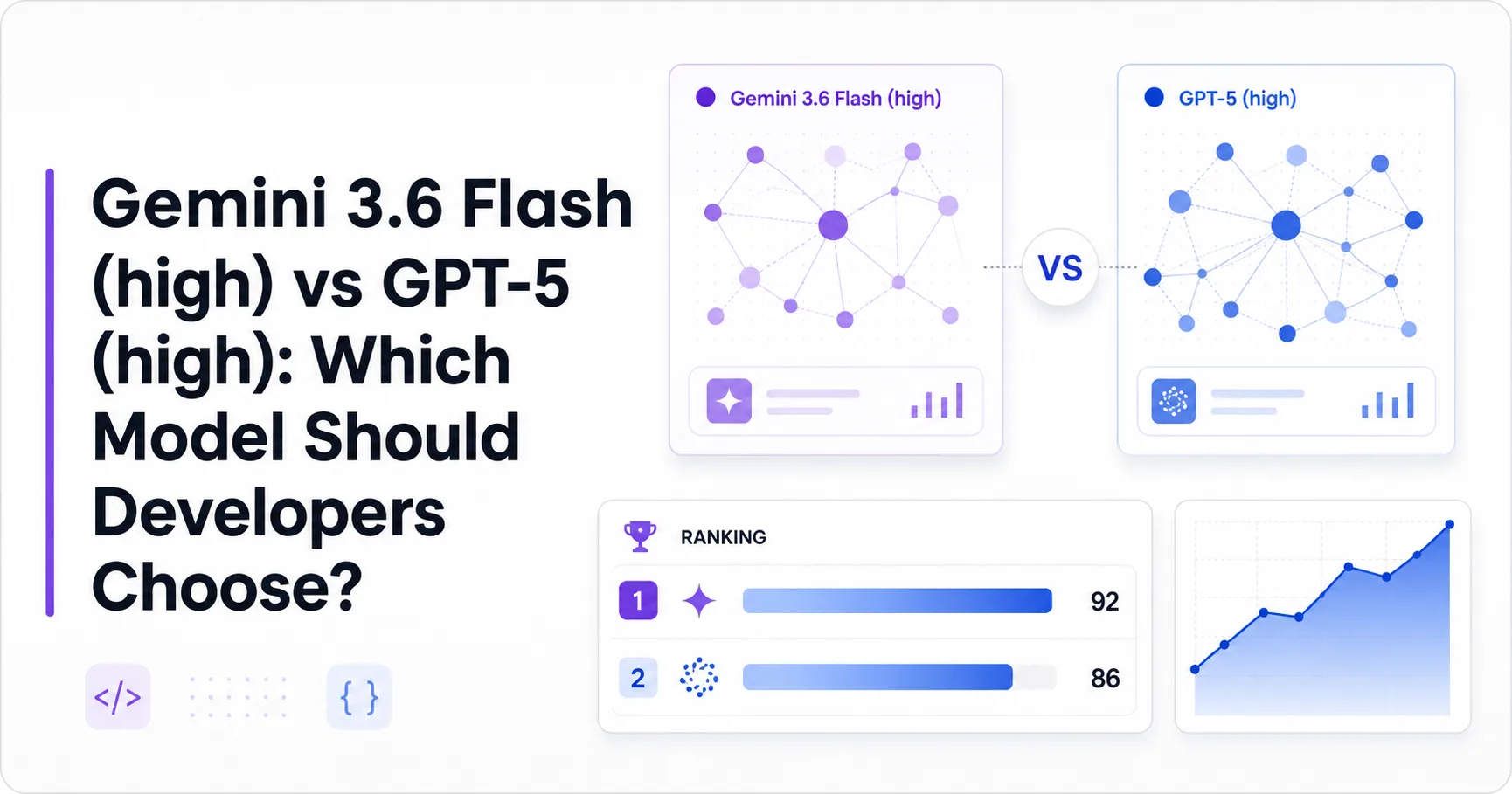
- **Winner overall:** Gemini 3.6 Flash (high), with a 69.2 coding index and 50.1 intelligence index versus 37.8 and 34.7 for GPT-5 (high) - **Cheaper:** Gemini 3.6 Flash (high) at $3 vs $3.4375 per 1M blended tokens - **Faster:** Gemini 3.6 Flash (high) at 230.958 median output tokens per second, while GPT-5 (high) has no reported value - **Pick GPT-5 (high) when:** mathematical reasoning is central, because its math index is 94.3 and Gemini has no reported math index - **Watch out:** Gemini’s high setting is not an official API model ID, while GPT-5’s fixed snapshot is marked Deprecated
Gemini 3.6 Flash (high) vs GPT-5 (high)
Gemini 3.6 Flash (high) is the stronger default for most developer workloads, while GPT-5 (high) remains a focused choice for mathematics and selected reasoning tasks. The comparison data gives Gemini a 69.2 coding index and a 50.1 intelligence index, versus 37.8 and 34.7 for GPT-5. Gemini also has a lower blended price at $3 per 1M tokens versus $3.4375, and its reported median output speed is 230.958 tokens per second. Both models have a latency value of 0.3 seconds. Data provided by https://artificialanalysis.ai/.
The practical decision
Gemini 3.6 Flash (high) offers the broader practical fit for agentic applications, multimodal pipelines, and coding workflows, but GPT-5 (high) has the clearer case for math-heavy reasoning. Google describes Gemini as a model for agentic and multimodal work, with support for text, images, video, audio, and PDF input, plus code execution, file search, function calling, structured output, thinking, and grounding features (Gemini model overview, Gemini 3.6 Flash documentation).
GPT-5 is positioned by OpenAI for coding, reasoning, and agentic tasks. Its API supports text and image input, structured output, function calling, streaming, and configurable reasoning effort (GPT-5 for developers, GPT-5 model documentation).
The important qualification is model identity. Google’s API documentation names the model gemini-3.6-flash; the high label appears to describe a product-level reasoning setting rather than a separate API model ID. OpenAI likewise documents gpt-5 with a high reasoning setting, rather than an official gpt-5-high model alias. Therefore, an application should record the provider model ID and reasoning configuration separately.
The evidence does not establish a universal winner for every workload. The Artificial Analysis comparison reports no Gemini math index and no GPT-5 output-speed value, so claims about mathematical parity or relative generation speed remain incomplete.
Performance: what the scores imply in production
Gemini 3.6 Flash (high) is the safer first candidate for coding agents because its coding index is 69.2 versus 37.8 for GPT-5 (high). That gap is large enough to change engineering workflow, especially when the model must inspect files, call tools, apply patches, and recover from intermediate errors. It does not prove that Gemini will win every repository task, because benchmark composition, prompting, tool wrappers, and verification loops can change the result.
GPT-5 (high) is the better-supported option for math-centered systems because its math index is 94.3, while the comparison provides no Gemini math value. This is a meaningful asymmetry in evidence, not proof that Gemini performs poorly at mathematics. Developers choosing a model for symbolic work, quantitative checking, or mathematical explanation should run a task-specific evaluation before switching away from GPT-5.
Gemini’s reported median output speed is 230.958 tokens per second, while GPT-5 has no corresponding value in the data snapshot. That makes Gemini the only model with a reported throughput advantage, but it does not support a complete speed ranking. Both models show 0.3 seconds for latency, so the first visible response may feel similar even if Gemini produces longer responses more quickly.
Official results reinforce the idea that the models have different strengths. Google reports Gemini results for software engineering, terminal work, machine learning, computer interaction, visual reasoning, and long-context retrieval in its model card (Gemini 3.6 Flash model card). OpenAI reports GPT-5 results for software engineering, code editing, agent interaction, and multi-challenge evaluation (GPT-5 for developers). These evaluations are not directly interchangeable, so the Artificial Analysis indices are the cleaner cross-model signal here.
Community evidence is mixed for both models. Hacker News users describe Gemini as fast and adequate for many daily tasks, while coding opinions range from capable to unsuitable for important engineering work (Hacker News discussion). A Reddit user reports that GPT-5 helped with small debugging tasks but could produce simplified application work or incorrect changes in complex repositories (GPT-5 user impressions). Neither source is a controlled benchmark.
Cost: blended price matters more than input price
Gemini 3.6 Flash (high) is cheaper for mixed workloads because its blended price is $3 per 1M tokens versus $3.4375 for GPT-5 (high). The blended result favors Gemini even though GPT-5 has the lower input price, at $1.25 versus Gemini’s $1.50. Gemini’s output price is $7.50, compared with $10 for GPT-5, which explains why output-heavy agent workflows can widen the cost difference.
The cheaper input price can still make GPT-5 the better choice for applications that send large prompts but receive short answers. Retrieval-heavy systems, codebase inspection, and repeated context submission may be dominated by input volume. In those cases, the relevant budget is not the blended figure alone. Developers should measure input-to-output ratios, cache usage, tool-call frequency, and retry behavior using their own traffic.
Gemini becomes especially attractive when an agent generates substantial text, executes multiple steps, or needs multimodal context. Google also documents cached input, Batch, Flex, Priority, Search grounding, and Maps grounding pricing (Gemini API pricing). Those options can change the effective cost, but the supplied comparison does not provide an equivalent GPT-5 blended calculation for alternative traffic patterns.
GPT-5’s lower input price does not automatically make it cheaper in production. A model that requires more output, more retries, or more corrective tool calls can cost more even with inexpensive prompt tokens. Conversely, Gemini’s lower blended price is not a guarantee of lower total cost if its agent behavior causes repeated execution loops. Community reports mention possible verbosity and repeated process text for Gemini, but the evidence lacks reproducible testing (Hacker News discussion).
The data does not provide quality-adjusted cost, success-per-dollar, or task completion cost. Those missing measures are the main reason teams should treat the price comparison as a starting point rather than a final procurement decision.
Recommendation by workload
Gemini 3.6 Flash (high) should be the default shortlist choice for coding agents, multimodal automation, and cost-sensitive production systems. Its coding index is 69.2, its intelligence index is 50.1, its blended price is $3, and it is the only model with a reported output-speed value. Google also documents broad input modalities and agent tools, including video, audio, PDF, code execution, file search, grounding, and structured output (Gemini 3.6 Flash documentation).
GPT-5 (high) should remain on the shortlist for mathematical reasoning, carefully controlled code edits, and systems that already depend on its API behavior. Its math index is 94.3, and OpenAI documents configurable reasoning effort and structured tool interactions (GPT-5 for developers). The model may also be attractive when lower input pricing matters more than output cost.
Version governance changes the recommendation. Google’s model page still describes Gemini 3.6 Flash as Stable, while OpenAI’s fixed GPT-5 snapshot is marked Deprecated and the documentation recommends a newer model (Gemini model overview, GPT-5 model documentation). Teams selecting GPT-5 should therefore test the stable alias and snapshot behavior separately, define migration ownership, and avoid assuming that a fixed version will remain the long-term production target.
The cleanest rollout is a workload split: use Gemini for the general agent path, retain GPT-5 for math-sensitive routes, and route ambiguous tasks through an internal evaluation set. The supplied materials do not say how either model performs on your repository, domain vocabulary, security constraints, or tool protocol. Those gaps require local testing before a final commitment.
What remains uncertain
Gemini 3.6 Flash (high) has the broader documented modality and tool surface, but the evidence does not prove it is more reliable in every agent workflow. Google lists hallucination, occasional slowness, and timeout risks in the model card (Gemini 3.6 Flash model card). OpenAI’s materials provide strong benchmark results and API details, but they do not offer a complete official failure-mode list for GPT-5 (GPT-5 model documentation).
The largest unresolved questions are production reliability, quality-adjusted cost, and task-specific math performance for Gemini. Community posts provide useful hypotheses, but they do not provide controlled evidence. Developers should validate these points with representative prompts, real tools, failure recovery, and human review.
Frequently asked questions
Is Gemini 3.6 Flash (high) better than GPT-5 (high) for coding?
Gemini 3.6 Flash (high) is the stronger initial coding choice because its Artificial Analysis coding index is 69.2 versus 37.8 for GPT-5 (high). The result still requires repository-specific validation because public user reports disagree and do not use controlled testing.
Which model is cheaper for production traffic?
Gemini 3.6 Flash (high) is cheaper on the supplied blended measure at $3 per 1M tokens versus $3.4375 for GPT-5 (high). GPT-5 has cheaper input tokens, so prompt-heavy workloads can produce a different total-cost result.
Should developers use the name Gemini 3.6 Flash high as an API model ID?
Developers should use the documented API model ID gemini-3.6-flash and treat high as a reasoning or product configuration. Google’s documentation does not list gemini-3.6-flash-high as an independent API model.
When is GPT-5 (high) the better choice?
GPT-5 (high) is the better-supported choice when mathematical reasoning is central, because its math index is 94.3 and the comparison supplies no Gemini math score. It also fits teams already invested in its documented reasoning and tool APIs.
Does Gemini have lower latency than GPT-5?
The supplied data does not show lower latency for Gemini 3.6 Flash (high), because both models have a latency value of 0.3 seconds. Gemini has a reported median output speed of 230.958 tokens per second, while GPT-5 has no reported value.
Is GPT-5 safe for a long-term fixed-version integration?
GPT-5 is not the safer fixed-version assumption because the documented snapshot gpt-5-2025-08-07 is marked Deprecated. Teams using GPT-5 should define migration testing and confirm whether the stable alias remains appropriate for their deployment.
Sources
- Artificial AnalysisCross-model pricing, latency, output speed, and evaluation data supplied in the data brief.
- Gemini API ModelsGemini model status, stable naming, positioning, and availability.
- Gemini 3.6 Flash documentationGemini API model ID, supported modalities, tools, limits, and capability boundaries.
- Gemini 3.6 Flash Model CardGemini official evaluations, knowledge cutoff, hallucination risk, and timeout limitations.
- Gemini API PricingGemini input, output, blended alternatives, caching, batch, priority, and grounding prices.
- Introducing Gemini 3.6 FlashGoogle’s positioning of Gemini for agentic workflows, coding, and enterprise processes.
- Gemini 3.6 Flash community discussionSubjective community feedback about Gemini speed, usefulness, coding, verbosity, and execution behavior.
- GPT-5 for developersGPT-5 positioning, reasoning controls, tool calling, and OpenAI benchmark disclosures.
- GPT-5 model documentationGPT-5 model IDs, modalities, pricing, endpoints, output limits, and deprecation status.
- Tried GPT-5 Here Are My First ImpressionsSubjective community feedback about GPT-5 debugging, application generation, and complex codebase risks.
Published: