
AI model analysis
Gemini 3 Deep Think vs GPT-5 mini (high): What Developers Can Actually Choose
A developer-focused comparison of Gemini 3 Deep Think and GPT-5 mini (high), emphasizing availability, evidence quality, performance signals, pricing uncertainty, and practical model-selection risk.
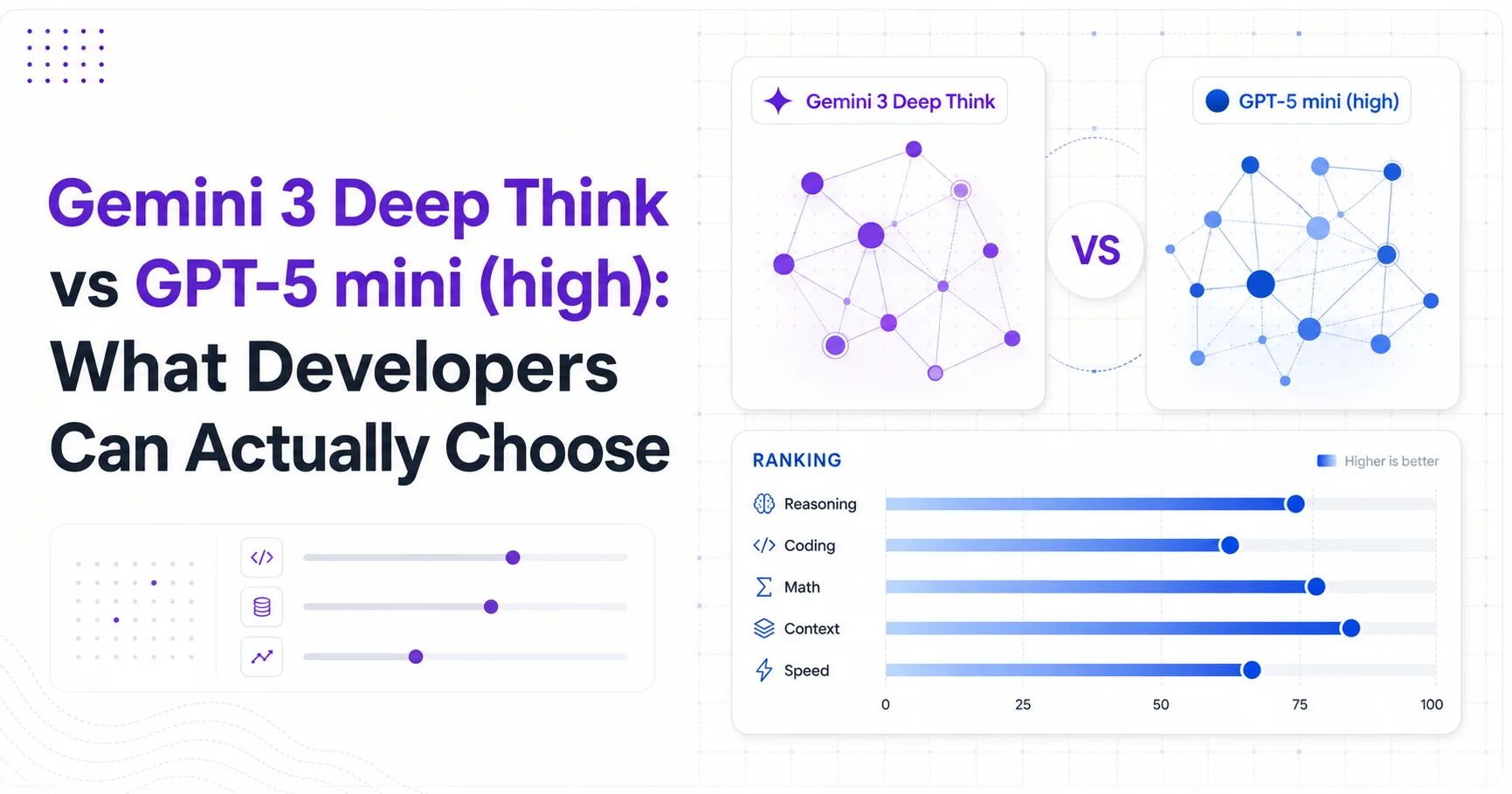
- **Winner overall:** GPT-5 mini (high), the only model with reported evaluation results, including 90.7 on the Artificial Analysis math index - **Cheaper:** Gemini 3 Deep Think at $0 vs $0.688 per 1M blended tokens - **Faster:** Gemini 3 Deep Think and GPT-5 mini (high) tie at 0 median output tokens per second - **Pick GPT-5 mini (high) when:** you need a model with published evaluation evidence, including 0.838 on LiveCodeBench and 0.906666666666667 on AIME 25 - **Watch out:** Gemini 3 Deep Think has 0 recorded pricing but no verified API listing or official price, so the apparent cost advantage is unconfirmed
Gemini 3 Deep Think vs GPT-5 mini (high): the short answer
GPT-5 mini (high) is the safer developer choice because the comparison data contains measurable evaluation results and official OpenAI documentation, while Gemini 3 Deep Think has no verified API entry in the cited Google model documentation. The difference is not a clean capability win. It is an evidence and procurement win.
The supplied dataset lists Gemini 3 Deep Think with a release date of 2026-02-05 and GPT-5 mini (high) with a release date of 2025-08-07. However, the current Gemini API model documentation does not list Gemini 3 Deep Think by that name. The current OpenAI Models directory does not list gpt-5-mini or GPT-5 mini (high) as an independent entry either.
That creates an unusual selection problem. GPT-5 mini (high) has useful benchmark signals, including 90.7 on the Artificial Analysis math index, 0.838 on LiveCodeBench, and 0.837 on MMLU Pro. Gemini 3 Deep Think has null values across the supplied evaluation fields. Those nulls do not prove weak performance. They prove that this brief does not provide a verified basis for comparing the models directly.
Data provided by https://artificialanalysis.ai/
What the evidence says before you build
GPT-5 mini (high) has the stronger documented case for evaluation, while Gemini 3 Deep Think has the stronger apparent price only because its actual commercial status is unresolved.
The most important distinction is availability. Google’s Gemini API model documentation contains no model named Gemini 3 Deep Think, no confirmed API alias, no context-window value, and no output limit for that name. Google’s Gemini API pricing documentation also contains no independent price for it. A developer therefore cannot treat the dataset’s price of $0 per 1M blended tokens as a confirmed free tier.
OpenAI has a similar documentation gap. The cited OpenAI Models directory does not list gpt-5-mini or GPT-5 mini (high) as a current independent model entry. The cited OpenAI Pricing page does not list standard, Batch, Flex, or Fast mode pricing for it. The dataset still reports $0.25 per 1M input tokens, $2 per 1M output tokens, and $0.688 per 1M blended tokens.
This means the comparison supports a practical conclusion, not a definitive model leaderboard. GPT-5 mini (high) is the better-supported candidate because it has reported results and a known vendor ecosystem. Gemini 3 Deep Think remains a watchlist candidate until Google confirms a callable model name and price.
The evidence does not answer whether either model supports a particular tool-calling pattern, context size, structured-output contract, or production service-level target. Those details require direct vendor confirmation or a controlled test.
Performance: benchmark evidence favors GPT-5 mini, but direct parity is unavailable
GPT-5 mini (high) is the only model in this brief with reported benchmark results, so developers can assess its task profile even though Gemini 3 Deep Think has no comparable scores.
GPT-5 mini (high) records 90.7 on the Artificial Analysis math index and 0.906666666666667 on AIME 25. Those values suggest that mathematical reasoning is the clearest documented strength in this dataset. GPT-5 mini (high) also records 0.828 on GPQA, 0.837 on MMLU Pro, and 0.215 on HLE. These results cover different kinds of difficult knowledge and reasoning tasks, but they do not establish production reliability for a specific application.
For coding, GPT-5 mini (high) records 15.6 on the Artificial Analysis coding index, 0.838 on LiveCodeBench, and 0.392 on SciCode. It also records 0.333333333333333 on TerminalBench Hard and 0.0374531835205993 on TerminalBench v2.1. A developer should read that pattern as a reason to test repository-level work, terminal workflows, and code execution separately. One coding score cannot predict success across all three environments.
The comparison cannot show whether GPT-5 mini (high) beats Gemini 3 Deep Think on any benchmark. Gemini 3 Deep Think has null values for the supplied evaluation fields, so there is no measured difference and no defensible performance winner based on head-to-head results. The absence of a Gemini score is an evidence gap, not a negative score.
Speed is equally unresolved. The dataset records 0 median output tokens per second and 0 latency seconds for both models. Those values do not provide a usable response-time ranking. They may represent unavailable measurements, so developers should not promise faster user experiences from either model without an application-specific test.
The official documentation gap also matters operationally. The Gemini API model documentation does not confirm Gemini 3 Deep Think’s callable interface. The OpenAI Models directory does not confirm the GPT-5 mini name or the meaning of the high label. Neither source settles the integration contract for the exact comparison labels.
Cost: Gemini looks cheaper on paper, but GPT-5 mini has the usable price signal
Gemini 3 Deep Think appears cheaper in the dataset, but GPT-5 mini (high) has the only non-zero price values that can be interpreted as a conventional token-cost signal.
The data records Gemini 3 Deep Think at $0 per 1M blended tokens, $0 per 1M input tokens, and $0 per 1M output tokens. Those values should not be read as a confirmed commercial offer because Google’s Gemini API pricing documentation does not list Gemini 3 Deep Think or provide an independent price for it.
GPT-5 mini (high) is listed at $0.25 per 1M input tokens and $2 per 1M output tokens, with a reported blended price of $0.688 per 1M tokens. The blended figure is useful for a first-pass budget comparison, but real application cost depends on the ratio of input to output, prompt caching, retries, tool calls, and routing decisions. The supplied brief does not provide those operating assumptions, so it cannot produce a more specific cost forecast.
The apparent free-model advantage can also reverse in practice. If Gemini 3 Deep Think is unavailable, requires a different access path, or lacks a stable alias, engineering time and migration risk become part of the cost. A nominal $0 price is not cheaper if the team cannot deploy the model reliably.
OpenAI’s Pricing page does not currently list gpt-5-mini, so the GPT-5 mini values in the dataset should also be verified before procurement. The right decision is therefore to treat $0.688 as a planning signal, not a final invoice rate, and to treat Gemini’s $0 as unconfirmed rather than free.
Recommendation for developers choosing a model
GPT-5 mini (high) is the recommended starting point for production evaluation because it offers measurable task evidence, while Gemini 3 Deep Think first needs identity, access, and pricing verification.
Choose GPT-5 mini (high) when the team needs a candidate for mathematical reasoning, general knowledge work, or coding experiments that can be compared against reported results. The available data includes 90.7 on the Artificial Analysis math index, 0.837 on MMLU Pro, 0.838 on LiveCodeBench, and 0.906666666666667 on AIME 25. These values do not guarantee application success, but they give the team concrete starting points for acceptance tests.
Choose Gemini 3 Deep Think only after Google confirms that the name maps to a callable API model. The Gemini API model documentation does not currently provide that confirmation, and the Gemini API pricing documentation does not confirm the $0 values in the dataset. Until those facts are resolved, Gemini is better treated as an unverified option than as a production alternative.
The first practical test should measure task success on the team’s own prompts. Include code changes, mathematical explanations, structured outputs, and failure recovery if those tasks matter. The second test should verify integration behavior, including model ID, authentication, tool calling, output limits, and error handling. The third check should validate the commercial terms against the vendor’s current documentation.
This recommendation is intentionally conservative because the brief lacks direct side-by-side tests. It does not establish that GPT-5 mini (high) is intrinsically smarter, faster, or more reliable. It establishes that GPT-5 mini (high) is easier to evaluate from the supplied evidence. Developers who value a different criterion should require new evidence before changing the choice.
Questions to answer before committing
GPT-5 mini (high) can begin a controlled evaluation sooner, but neither model has a fully verified contract in the cited current documentation.
Developers should confirm the exact API model ID, pricing tier, supported input and output types, context limits, tool behavior, and rate limits before production approval. The cited OpenAI Models directory, OpenAI Pricing page, Gemini API model documentation, and Gemini API pricing documentation do not fully resolve those details for the exact labels used in this comparison.
The supplied research also found no reliably verifiable Reddit, Hacker News, or X posts for either model. Developers therefore should not use community sentiment as a deciding factor from this brief. A small internal test with representative prompts will provide more relevant evidence than an unsupported reputation claim.
Data provided by https://artificialanalysis.ai/
Frequently asked questions
Is Gemini 3 Deep Think free to use?
Gemini 3 Deep Think is not confirmed to be free because the dataset records $0 prices, but Google’s current pricing documentation does not list the model or verify those values. Developers should confirm access and billing directly before budgeting around a free service.
Which model is better for coding?
GPT-5 mini (high) is the better-supported coding candidate because the dataset reports 15.6 on the Artificial Analysis coding index, 0.838 on LiveCodeBench, 0.392 on SciCode, and additional TerminalBench results. Gemini 3 Deep Think has no reported coding scores here, so no direct winner is proven.
Which model is faster?
Neither model has a demonstrated speed advantage in this brief because both are recorded at 0 median output tokens per second and 0 latency seconds. Those values do not establish real-world response speed, so developers need a controlled latency test.
Should a production team choose GPT-5 mini (high) today?
A production team should start with GPT-5 mini (high) only as a verification candidate, not as an unquestioned final choice. The model has reported results and listed prices in the dataset, but the cited current OpenAI directory does not independently list its exact model name or the meaning of high.
Why is the comparison inconclusive despite the benchmark data?
The comparison is inconclusive because Gemini 3 Deep Think has null values for every supplied evaluation field, while GPT-5 mini (high) has results across several benchmarks. GPT-5 mini therefore has stronger evidence, but the brief cannot calculate a direct performance gap or prove a head-to-head winner.
Sources
- Gemini API model documentationVerifying whether Gemini 3 Deep Think is listed as a callable model and whether its official capabilities are documented.
- Gemini API pricing documentationChecking whether Gemini 3 Deep Think has official input, output, blended, batch, cached, or priority pricing.
- OpenAI ModelsChecking whether gpt-5-mini or GPT-5 mini (high) is listed and whether the current general capability description applies to the exact model label.
- OpenAI PricingChecking whether GPT-5 mini has current standard, Batch, Flex, or Fast mode pricing.
- Artificial AnalysisAttribution for the supplied release dates, pricing values, benchmark values, and performance records.
Published: