
AI model analysis
Gemini 3 Pro Preview (high) vs GPT-5 mini (high): Which Model Should Developers Choose?
A source-backed comparison of Gemini 3 Pro Preview (high) and GPT-5 mini (high), covering measured intelligence, mathematics, coding evidence, latency, pricing, and model availability uncertainty.
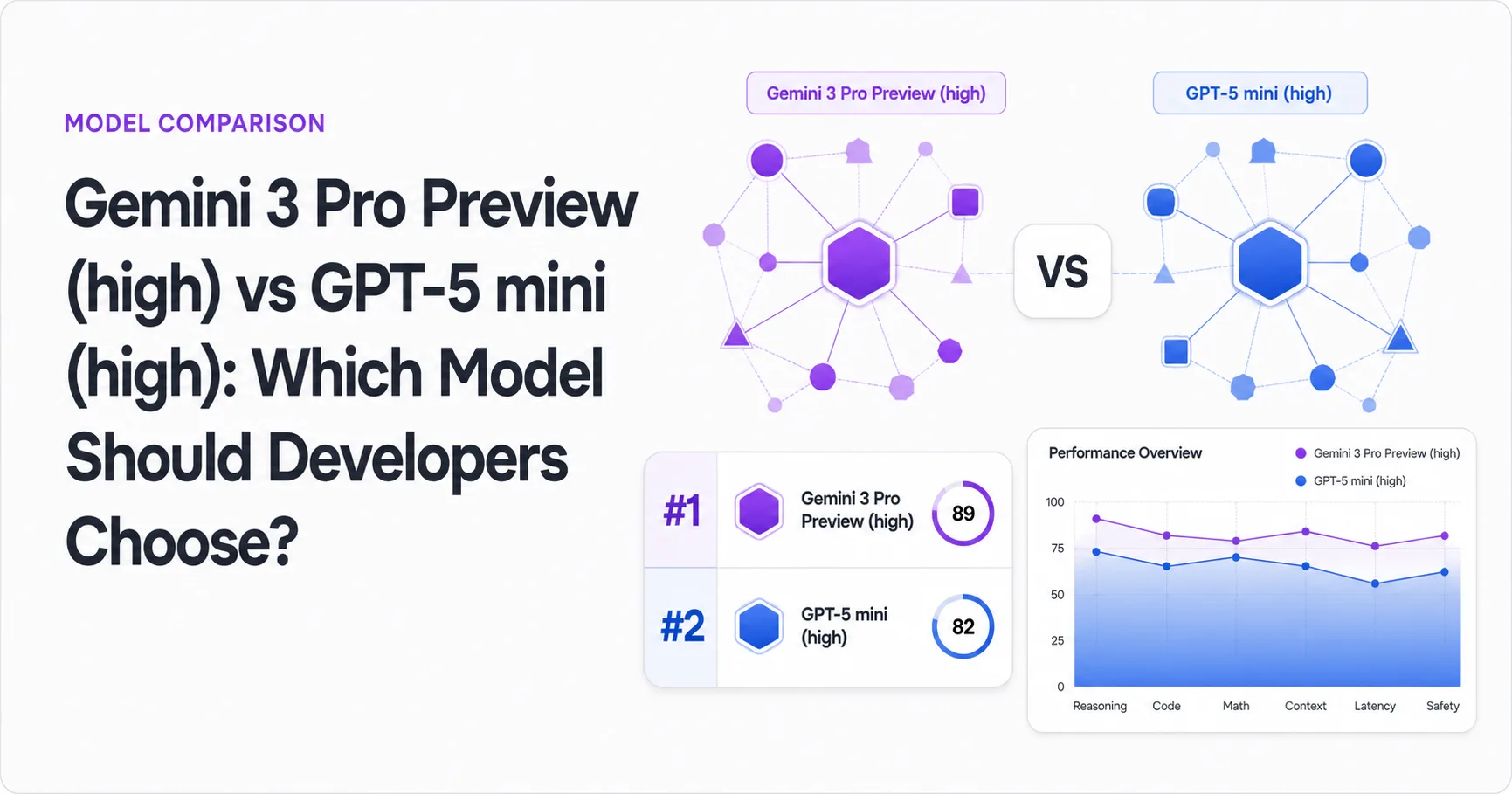
- **Winner overall:** Gemini 3 Pro Preview (high), with a 39.6 intelligence index and 95.7 math index - **Cheaper:** GPT-5 mini (high) at $0.6875 vs $4.500000000000001 per 1M blended tokens - **Faster:** Tie, with both models at 0.3 seconds latency - **Pick Gemini 3 Pro Preview (high) when:** general intelligence and mathematical performance matter more than verified model availability or cost - **Watch out:** Coding evidence is incomplete because Gemini has no coding index, while GPT-5 mini has 15.6
Gemini 3 Pro Preview (high) vs GPT-5 mini (high)
Gemini 3 Pro Preview (high) leads the measured quality comparison, while GPT-5 mini (high) is the safer cost choice for developers who need predictable economics. The Artificial Analysis snapshot gives Gemini an intelligence index of 39.6 and a math index of 95.7. GPT-5 mini records 25.3 and 90.7 on those same measures. The snapshot lists both models at 0.3 seconds latency, so latency does not separate them.\n\nThe harder issue is availability. Google’s current Gemini API model documentation does not list Gemini 3 Pro Preview (high) or gemini-3-pro. OpenAI’s current model documentation does not list gpt-5-mini or GPT-5 mini (high). The comparison therefore supports a capability and price judgment, but not a confident production-deployment judgment.\n\nData provided by https://artificialanalysis.ai/
Executive summary for model selection
Gemini 3 Pro Preview (high) is the measured quality leader, but GPT-5 mini (high) offers a much lower listed snapshot price and the only coding score in the comparison.\n\nThe quality gap is clearest on the Artificial Analysis intelligence index, where Gemini scores 39.6 and GPT-5 mini scores 25.3. Mathematics also favors Gemini, at 95.7 versus 90.7. Those results make Gemini the stronger candidate for difficult analytical workloads, especially when mathematical reliability is a central requirement. They do not prove superiority for every software engineering task.\n\nCoding is the key evidence gap. GPT-5 mini has a coding index of 15.6, but Gemini has no coding index in the supplied snapshot. A missing score is not a loss, and it is not evidence of parity. Developers should treat coding selection as unresolved until they run a task set that reflects their own repository, languages, tools, and acceptance tests.\n\nThe pricing result is decisive inside the supplied data. GPT-5 mini costs $0.6875 per 1M blended tokens, compared with $4.500000000000001 for Gemini. That makes GPT-5 mini attractive for high-volume workloads, but the lower price cannot compensate for a model that fails more often on the specific task.\n\nAvailability creates a second unresolved issue. Google’s model directory currently describes gemini-3.1-pro-preview, not the target Gemini model. OpenAI’s model directory likewise does not provide a dedicated gpt-5-mini entry. The supplied official sources do not establish stable aliases, context windows, output limits, or tool support for either target.
Performance: quality signals are useful, but incomplete
Gemini 3 Pro Preview (high) has the stronger measured intelligence and mathematics profile, while the available coding evidence cannot establish a programming winner.\n\nThe intelligence index favors Gemini at 39.6 against GPT-5 mini at 25.3. In practical selection terms, that gap supports testing Gemini first for tasks that require broad problem decomposition, judgment across several constraints, or difficult multi-step analysis. The score still remains an aggregate signal. It does not reveal which prompts, datasets, tools, or failure costs produced the result.\n\nThe math index also favors Gemini, at 95.7 against 90.7. A five-point gap in the supplied comparison may matter for quantitative reasoning, formula transformation, verification, and structured analytical work. It does not guarantee that Gemini will be more reliable on a developer’s domain-specific calculations. Teams should validate representative examples, including cases where an incorrect confident answer would be expensive.\n\nThe coding comparison is not symmetric. GPT-5 mini has a coding index of 15.6, while the Gemini value is null. The data therefore cannot show whether Gemini is better, worse, or similar for coding. This is the most important performance limitation in the comparison because developers may interpret a general intelligence lead as a coding lead without direct evidence.\n\nLatency is also a tie in the snapshot, with both models at 0.3 seconds. That result removes one obvious reason to choose between them, but it does not establish output speed, streaming behavior, rate-limit behavior, or tail latency. The supplied data reports no median output-token rate for either model.\n\nThe official documentation is similarly incomplete for the target versions. Google’s model documentation does not provide dedicated context, output, parameter, or multimodal details for Gemini 3 Pro Preview (high). OpenAI’s model documentation does not verify those details for GPT-5 mini (high).
Cost: GPT-5 mini wins the price case, subject to task quality
GPT-5 mini (high) is the clear cost leader in the supplied snapshot, but a lower token price is valuable only if its error rate and workflow overhead remain acceptable.\n\nThe blended price is $0.6875 per 1M tokens for GPT-5 mini and $4.500000000000001 for Gemini. GPT-5 mini also has lower input pricing at $0.25 versus $2, and lower output pricing at $2 versus $12. The output price difference is especially relevant for agentic coding, long explanations, generated patches, and workflows that produce more output than expected.\n\nThe price advantage makes GPT-5 mini the natural first candidate for large request volumes, background classification, routine transformations, and applications where a small per-request saving compounds across many calls. It also makes experimentation cheaper when a team needs to test several prompt or tool designs.\n\nThe conclusion can reverse when model quality changes the number of calls required. A cheaper model may become more expensive at the workflow level if it needs retries, additional verification calls, human review, or a stronger fallback model. The supplied data does not include error rates, retry rates, token usage by task, or total workflow cost, so it cannot quantify that crossover.\n\nCurrent price documentation does not resolve the availability question. Google’s pricing documentation does not list Gemini 3 Pro Preview (high) or a dedicated gemini-3-pro price. OpenAI’s pricing documentation does not list GPT-5 mini or GPT-5 mini (high). The snapshot prices are therefore useful for comparison, but developers must verify the active endpoint and current billing terms before procurement.
Recommendation by workload
GPT-5 mini (high) is the pragmatic default for cost-sensitive production workloads, while Gemini 3 Pro Preview (high) deserves priority testing for difficult reasoning and mathematical tasks.\n\nChoose Gemini first when the workload’s main risk is insufficient reasoning quality. The supplied scores favor Gemini on intelligence, 39.6 versus 25.3, and mathematics, 95.7 versus 90.7. That evidence supports a focused evaluation for research assistants, analytical copilots, complex planning, and quantitative workflows. The recommendation remains conditional because the official Google model directory does not list the target model or confirm its current API identity.\n\nChoose GPT-5 mini first when request volume, output volume, or budget discipline dominates. Its blended price is $0.6875 per 1M tokens, and its output price is $2 per 1M tokens. Those economics suit routine generation, extraction, routing, summarization, and applications where quality can be bounded with deterministic checks. Its listed coding index of 15.6 is relevant, but Gemini has no corresponding coding score, so the data cannot support a direct coding ranking.\n\nDo not make a final coding decision from this comparison alone. Build a small private test set from real repository tasks, then score patch correctness, test survival, tool-call accuracy, and review effort. The supplied research contains no reliable community evidence for either target model’s coding experience, speed perception, or recurring failure patterns.\n\nBefore deployment, verify the exact model ID, availability, context window, output limit, supported inputs, and price in the live provider console. Google’s model documentation and pricing documentation leave those target-specific points unresolved. OpenAI’s model documentation and pricing documentation do the same for GPT-5 mini.
What this comparison cannot establish
Gemini 3 Pro Preview (high) and GPT-5 mini (high) cannot be treated as verified current API products from the supplied official documentation alone.\n\nThe research brief found no dedicated current model entry for Gemini 3 Pro Preview (high), gemini-3-pro, GPT-5 mini, or the high display label. The official pages also do not confirm target-specific context windows, output limits, API parameters, tool support, or known failure modes. Google’s model page points to a different Pro preview listing, while OpenAI’s model page provides no dedicated GPT-5 mini record.\n\nThe community evidence is equally limited. The supplied research found no reliably verifiable Reddit, Hacker News, or X posts with model identifiers, prompts, methods, and reproducible conditions for either target. Developers therefore should not convert the absence of community complaints into evidence of stability.\n\nThe comparison is strongest as a decision frame around the supplied benchmark and price snapshot. It is weakest as evidence about production availability, coding performance, operational limits, and real workflow cost. A live API check and a task-specific evaluation are required before adoption.
Frequently asked questions
Which model is better overall for difficult reasoning tasks?
Gemini 3 Pro Preview (high) is the stronger measured choice for difficult reasoning because its intelligence index is 39.6 versus 25.3 for GPT-5 mini, although the target model’s current API availability is unverified.
Which model is cheaper for high-volume applications?
GPT-5 mini (high) is cheaper in the supplied snapshot at $0.6875 per 1M blended tokens versus $4.500000000000001 for Gemini, but teams should include retries, verification, and review in total workflow cost.
Which model should developers choose for coding?
The supplied evidence cannot identify a coding winner because GPT-5 mini has a coding index of 15.6 while Gemini has no coding index, so developers need a task-specific repository evaluation.
Are the listed models currently available through their providers?
The supplied official documentation does not confirm current availability for either target: Google’s model directory omits Gemini 3 Pro Preview (high), and OpenAI’s directory omits GPT-5 mini.
Do the models differ in latency?
The supplied snapshot shows a latency tie at 0.3 seconds for both models, but it does not provide output speed, streaming behavior, rate limits, or tail-latency evidence.
Sources
- Gemini API models documentationVerifying Google's current model directory, model naming, and the absence of a dedicated Gemini 3 Pro Preview (high) entry.
- Gemini API pricing documentationVerifying Google's current pricing coverage, billing modes, and the absence of a dedicated target-model price.
- OpenAI ModelsVerifying OpenAI's current model directory and the absence of a dedicated GPT-5 mini entry.
- OpenAI PricingVerifying OpenAI's current pricing coverage and the absence of a dedicated GPT-5 mini price.
- Artificial AnalysisAttribution for the supplied benchmark, latency, release, and pricing snapshot.
Published: