
AI model analysis
GLM-5.1 vs GPT-5 mini: Which Model Should Developers Choose?
A practical comparison of GLM-5.1 (Reasoning) and GPT-5 mini (high) for coding, reasoning, mathematics, latency, and API cost.
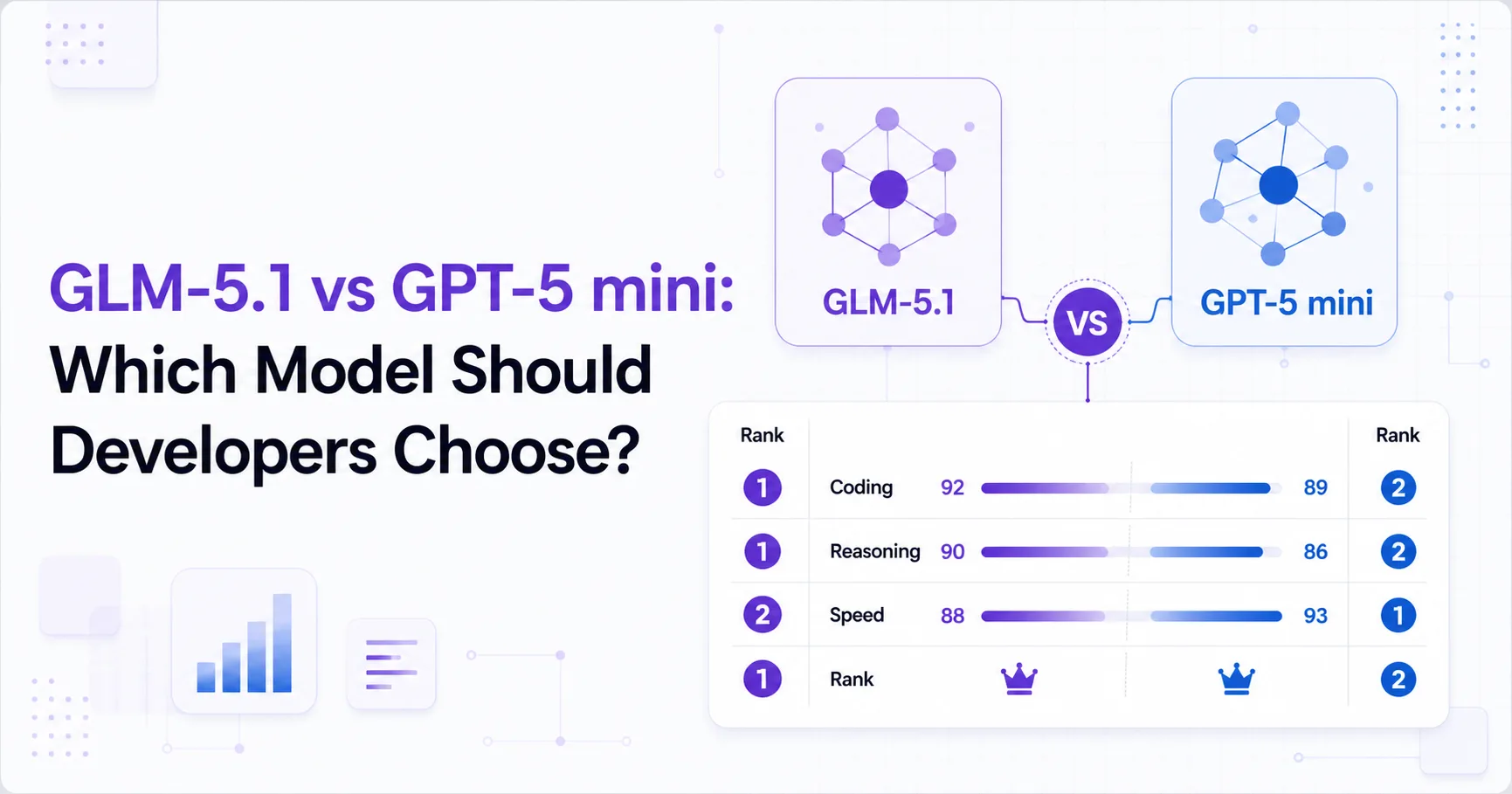
- **Winner overall:** GLM-5.1 (Reasoning), with a 55.8 coding index and 40.2 intelligence index - **Cheaper:** GPT-5 mini (high) at $0.6875 vs $2.135 per 1M blended tokens - **Faster:** Tie, with both models at 0.3 seconds latency - **Pick GLM-5.1 (Reasoning) when:** coding quality and broad intelligence matter more than token cost - **Watch out:** Official availability, API identity, context limits, and failure modes remain unverified for both models
GLM-5.1 vs GPT-5 mini at a glance
GLM-5.1 (Reasoning) is the stronger measured choice for coding and general intelligence, while GPT-5 mini (high) is the lower-cost option with a strong mathematics result. Artificial Analysis reports a coding index of 55.8 for GLM-5.1 (Reasoning) and 15.6 for GPT-5 mini (high), plus intelligence index values of 40.2 and 25.3 respectively. The same dataset reports a mathematics index of 90.7 for GPT-5 mini (high), while GLM-5.1 (Reasoning) has no mathematics score in the supplied snapshot. Data provided by Artificial Analysis
That split creates a clear selection question. A developer building code generation, repository maintenance, or mixed reasoning workflows has measured evidence favoring GLM-5.1 (Reasoning). A team optimizing recurring API spend has measured evidence favoring GPT-5 mini (high), whose blended price is $0.6875 per 1M tokens compared with $2.135 for GLM-5.1 (Reasoning).
The evidence has an important boundary. No supplied source verifies either model’s context window, output ceiling, API parameters, tool support, or failure behavior. The comparison therefore supports a benchmark-led shortlist, not a production readiness decision. Teams should verify model identifiers, access, quotas, and representative workload quality before committing to either model.
Summary: capability and price pull in opposite directions
GLM-5.1 (Reasoning) leads the supplied coding and intelligence measurements, but GPT-5 mini (high) is substantially cheaper and has the only reported mathematics score. The coding gap is the most consequential result for software teams. A coding index of 55.8 versus 15.6 suggests that GLM-5.1 (Reasoning) deserves priority testing for tasks where code correctness, repair quality, and multi-step implementation determine product value. The intelligence index also favors GLM-5.1 (Reasoning), at 40.2 versus 25.3. Artificial Analysis data
GPT-5 mini (high) remains attractive for workloads where cost dominates and mathematics performance is central. Its mathematics index is 90.7, but the supplied snapshot contains no matching GLM-5.1 (Reasoning) result. That absence prevents a fair mathematics winner declaration. It may indicate missing coverage rather than weaker performance.
The official-source picture is less decisive than the benchmark picture. OpenAI’s current model directory does not list gpt-5-mini or GPT-5 mini (high) as an independent entry in the supplied research. The research also found no verifiable official announcement or documentation for GLM-5.1 (Reasoning). Developers should treat the displayed names as dataset labels until API access and stable identifiers are confirmed.
Performance: benchmark differences matter only for the right workload
GLM-5.1 (Reasoning) has the clearest measured advantage for coding-oriented evaluation, while GPT-5 mini (high) has the clearest measured advantage for mathematics coverage. The coding index difference is large enough to change engineering economics. If a model regularly produces unusable patches, the lower token price can be offset by review time, retries, and human correction. The supplied data does not measure those operational costs, so the practical impact must be validated on the team’s own repositories. Artificial Analysis
GLM-5.1 (Reasoning) should therefore enter tests for code completion, bug fixing, test generation, and structured implementation tasks. The available evidence supports that prioritization, but it does not prove superiority on every programming language, framework, or repository size. No community material in the research provides a verified coding workflow, testing method, or failure analysis for this model.
GPT-5 mini (high) deserves a separate mathematics and cost-sensitive track. Its reported mathematics index of 90.7 is useful evidence for quantitative tasks, but the lack of a GLM-5.1 mathematics result makes the comparison incomplete. The data also reports equal latency of 0.3 seconds and no output-speed value for either model. Developers cannot infer a throughput winner from this snapshot.
The most important missing performance evidence is task-level reliability. Neither supplied research source establishes context limits, long-document behavior, tool-calling behavior, or recovery from ambiguous requirements. Those omissions are material for production systems and should be tested directly.
Cost: GPT-5 mini is cheaper, but workload shape decides the bill
GPT-5 mini (high) is the cost leader across the supplied input, output, and blended pricing measures, yet GLM-5.1 (Reasoning) may still be cheaper for work that avoids expensive correction cycles. The blended price is $0.6875 per 1M tokens for GPT-5 mini (high), compared with $2.135 for GLM-5.1 (Reasoning). GPT-5 mini (high) also has lower input pricing at $0.25 versus $1.38 and lower output pricing at $2 versus $4.4. Artificial Analysis data
Those prices favor GPT-5 mini (high) for high-volume classification, drafting, extraction, and other workflows with predictable prompts and limited review. The advantage becomes less obvious when a coding task needs several retries or substantial human repair. A cheaper response is not necessarily a cheaper completed change if its output creates downstream work. The supplied dataset does not include retry rates, review time, success rates, or total task cost, so this conclusion remains conditional.
GLM-5.1 (Reasoning) can justify its higher price when its measured coding advantage reduces intervention. That hypothesis is plausible from the coding index, but the research does not provide production cost evidence. Teams should compare completed-task cost, not only token price.
Pricing availability is itself uncertain. OpenAI’s pricing page does not list standard, Batch, Flex, or Fast mode pricing for gpt-5-mini in the supplied research. No verifiable pricing page was found for GLM-5.1 (Reasoning). The dataset prices should therefore guide comparison, not replace account-level verification.
Recommendation: choose by failure cost and access certainty
GLM-5.1 (Reasoning) is the better first candidate for coding-heavy evaluation, while GPT-5 mini (high) is the better first candidate for cost-sensitive or mathematics-focused testing. Start with GLM-5.1 (Reasoning) if the product’s primary value comes from producing maintainable code, navigating multi-step changes, or reducing developer review. The supplied coding and intelligence indices support that test order. Artificial Analysis
Choose GPT-5 mini (high) when request volume and token spend are central constraints, or when mathematics tasks are a major part of the product. Its reported price is lower across every supplied pricing category, and its mathematics index is 90.7. The mathematics comparison is incomplete because GLM-5.1 (Reasoning) has no corresponding value in the snapshot.
Neither model should receive an unconditional production recommendation yet. OpenAI’s model directory does not independently confirm the GPT-5 mini label used here. The research found no verifiable official release, documentation, or pricing source for GLM-5.1 (Reasoning). The high suffix also has no confirmed relationship to a public API parameter in the supplied official material.
A sensible evaluation sequence is small and concrete: verify that each model can be called under the intended identifier, run the same repository tasks, record successful task completion, inspect generated tests, and measure total spend. The current evidence supports prioritization, not certainty. Access stability, context behavior, tool support, and failure modes remain evidence gaps.
Questions developers should answer before switching
GPT-5 mini (high) is the safer cost experiment, while GLM-5.1 (Reasoning) is the safer coding-quality experiment based on the supplied measurements. The research does not establish which model has better production reliability, context handling, or tool behavior. OpenAI’s model documentation does not independently verify the GPT-5 mini label, and no verifiable official source was found for GLM-5.1 (Reasoning). Artificial Analysis supplies the comparative benchmark and pricing snapshot, but it does not answer every deployment question.
The key unresolved issue is evidence completeness. A missing score is not a failing score. An absent official listing is not proof that a model cannot be accessed. Developers should keep these distinctions explicit in evaluation notes and avoid presenting the benchmark snapshot as a full product specification.
Frequently asked questions
Which model is better for coding?
GLM-5.1 (Reasoning) is the stronger measured coding choice because its Artificial Analysis coding index is 55.8, compared with 15.6 for GPT-5 mini (high). The result still requires repository-level validation because the supplied research contains no verified task methodology, community coding reports, or failure analysis for either model.
Which model is cheaper for API usage?
GPT-5 mini (high) is cheaper in the supplied pricing snapshot, at $0.6875 per 1M blended tokens compared with $2.135 for GLM-5.1 (Reasoning). Its input price is $0.25 versus $1.38, and its output price is $2 versus $4.4. Account-level availability and current pricing remain unverified.
Which model is better for mathematics?
GPT-5 mini (high) has the only reported mathematics result, with an Artificial Analysis mathematics index of 90.7. GLM-5.1 (Reasoning) has no mathematics value in the supplied snapshot, so the evidence cannot establish a measured head-to-head winner or show whether the missing result reflects coverage rather than capability.
Do the models have different latency?
The supplied data reports equal latency of 0.3 seconds for GLM-5.1 (Reasoning) and GPT-5 mini (high). It reports no median output-tokens-per-second value for either model, so developers cannot use this snapshot to identify a throughput winner or predict streaming behavior under production load.
Are these model names confirmed API identifiers?
The supplied research does not confirm either displayed name as a stable public API identifier. OpenAI’s current model directory does not list gpt-5-mini or GPT-5 mini (high) as an independent entry, while no verifiable official release or developer documentation was found for GLM-5.1 (Reasoning). Developers should verify access before implementation.
Sources
- Artificial AnalysisComparative benchmark values, pricing values, latency values, release metadata, and data attribution.
- OpenAI ModelsChecking the current OpenAI model directory and the official model capability information described in the research.
- OpenAI PricingChecking the current OpenAI pricing page and the absence of supplied gpt-5-mini pricing details.
Published: