
AI model analysis
GLM-5-Turbo vs GPT-5 (high): Which Model Should Developers Choose?
A developer-focused comparison of GLM-5-Turbo and GPT-5 (high), covering evidence quality, capability signals, latency, pricing, deployment risk, and practical model selection.
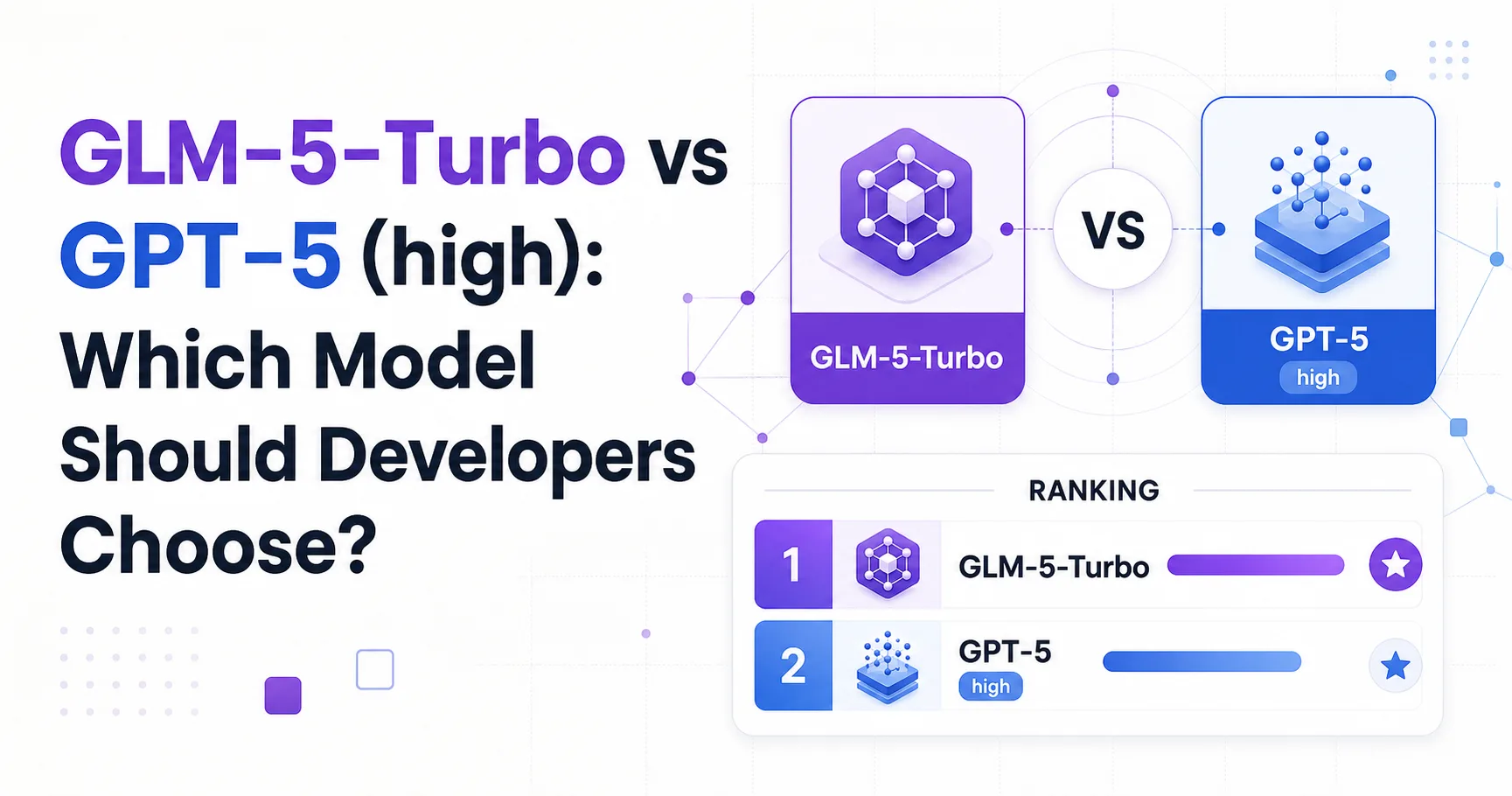
- **Winner overall:** GPT-5 (high), stronger documented developer capabilities and a 94.3 math index despite GLM-5-Turbo leading the intelligence index at 38.1 vs 34.7 - **Cheaper:** GPT-5 (high) at $3.4375 vs $15 per 1M blended tokens - **Faster:** GPT-5 (high) at 0.3 seconds (latency, tied with GLM-5-Turbo) - **Pick GPT-5 (high) when:** you need documented coding, reasoning, tool calling, image input, or a production API with a listed alias - **Watch out:** GLM-5-Turbo has a 38.1 intelligence index, but its documentation, context window, API access, and benchmark coverage are unverified
GLM-5-Turbo vs GPT-5 (high)
GPT-5 (high) is the safer developer choice because its API behavior, model identity, tools, and limitations are documented, while GLM-5-Turbo has no verifiable product or API source in the research brief.
The benchmark snapshot still gives GLM-5-Turbo a higher Artificial Analysis Intelligence Index, at 38.1 versus 34.7 for GPT-5 (high). That result does not establish a general production winner because the snapshot does not provide comparable coding or math values for GLM-5-Turbo. GPT-5 (high) has a 37.8 coding index and a 94.3 math index, but those values cannot be directly compared with missing GLM-5-Turbo scores.
The practical decision therefore depends on evidence requirements. GPT-5 (high) is the defensible default for applications that need a documented endpoint, structured outputs, function calling, or image input. GLM-5-Turbo remains a candidate for controlled experimentation where its measured intelligence score justifies validating access and behavior independently.
Data provided by https://artificialanalysis.ai/.
The evidence favors GPT-5 (high), while one measured index favors GLM-5-Turbo
GPT-5 (high) offers the stronger selection case because its documented interface and benchmark coverage reduce uncertainty before implementation begins.
| Decision factor | GLM-5-Turbo | GPT-5 (high) | What it means for developers |
|---|---|---|---|
| Artificial Analysis Intelligence Index | 38.1 | 34.7 | GLM-5-Turbo leads on the only directly comparable index in the snapshot |
| Artificial Analysis Coding Index | Not provided | 37.8 | Coding superiority cannot be established from the available comparison |
| Artificial Analysis Math Index | Not provided | 94.3 | GPT-5 (high) has a strong reported math signal, but no paired GLM value exists |
| Latency | 0.3 seconds | 0.3 seconds | The reported latency is tied |
| Blended price | $15 per 1M tokens | $3.4375 per 1M tokens | GPT-5 (high) has the lower listed blended price |
| API evidence | Not verified | Documented | GPT-5 (high) is easier to evaluate and integrate responsibly |
| Context window | Not verified | 400,000 tokens | GPT-5 (high) has a documented large context window |
| Input modalities | Not verified | Text and image | GLM-5-Turbo’s supported modalities remain unknown |
OpenAI positions GPT-5 as a reasoning model for coding, reasoning, and agentic tasks in GPT-5 for developers. Its model documentation lists the gpt-5 alias, the fixed snapshot gpt-5-2025-08-07, a 400,000-token context window, and a maximum output of 128,000 tokens in GPT-5 model documentation.
The research brief found no verifiable vendor announcement, developer documentation, model catalog, API entry point, or reliable community testing for GLM-5-Turbo. That absence does not prove that GLM-5-Turbo is unusable. It does mean developers cannot treat the available score as a complete deployment profile.
The key comparison is therefore not simply intelligence score against intelligence score. It is measured capability against documented capability. GLM-5-Turbo may be attractive in a benchmark-led shortlist, but GPT-5 (high) is easier to approve, test, monitor, and replace within a production engineering process.
Performance matters less than comparability and task fit
GPT-5 (high) provides the more actionable performance profile because its public benchmark results and API controls connect evaluation evidence to real developer workflows.
The page chart shows a 0.3-second latency for each model, so latency alone should not decide this selection. The snapshot provides no median output-tokens-per-second value for either model. Developers should therefore avoid claiming that one model streams faster or produces more tokens per second. A tied latency result can still hide differences in reasoning time, output length, retry frequency, or tool-call behavior, none of which the supplied data resolves.
GLM-5-Turbo leads the directly comparable intelligence index at 38.1 versus 34.7. That lead is a meaningful reason to keep GLM-5-Turbo in a validation set, especially for teams whose internal tasks resemble the benchmark’s coverage. The result is not enough to select GLM-5-Turbo for coding, mathematics, or agent orchestration because the brief supplies no GLM-5-Turbo coding index, math index, published test method, or tool-use documentation.
GPT-5 (high) has reported scores of 74.9% on SWE-bench Verified, 88% on Aider polyglot, 96.7% on τ²-bench telecom, and 69.6% on Scale MultiChallenge, according to GPT-5 for developers. Those figures are useful signals, but they are not universal guarantees. The SWE-bench result excluded 23 of 500 issues that could not be passed reliably on OpenAI’s infrastructure, and the Aider evaluation used high reasoning effort. Developers should reproduce the relevant workload with their own prompts, repository conventions, tests, and tool permissions.
The documented controls also affect performance engineering. GPT-5 supports reasoning_effort values of minimal, low, medium, and high, plus verbosity values of low, medium, and high, as described in GPT-5 model documentation. These settings create a practical way to trade response depth against application cost and latency. The research brief identifies no equivalent GLM-5-Turbo controls.
GPT-5 supports function calling, structured outputs, streaming, and custom tools that can be constrained with a developer-provided context-free grammar, according to GPT-5 for developers. For an agent that edits code, calls services, or returns machine-readable data, those documented interfaces may matter more than a small difference on a broad intelligence index.
The evidence is insufficient to declare a universal performance winner. The defensible conclusion is narrower: GPT-5 (high) has the stronger documented performance case, while GLM-5-Turbo has the stronger directly comparable intelligence-index result.
GPT-5 (high) is cheaper on listed token prices, but workload shape still controls the bill
GPT-5 (high) is the clear price leader in the supplied snapshot, with a $3.4375 blended price per 1M tokens versus $15 for GLM-5-Turbo.
The chart makes the list-price gap visible, but it cannot show how an application turns tokens into total operating cost. A short answer, a long generated patch, repeated retries, and a tool-heavy agent can produce very different bills even with the same request count. Developers should model their own input and output mix before treating the blended figure as a forecast.
GPT-5 (high) lists input at $1.25 per 1M tokens and output at $10 per 1M tokens. GLM-5-Turbo lists input at $10 and output at $30. The output rate matters especially for coding agents because repository explanations, patches, test results, and repair attempts can make generated tokens a substantial part of each task. A cheaper input rate does not rescue a workflow that repeatedly produces unnecessary output.
Caching can also change the comparison. GPT-5 lists cached input at $0.125 per 1M tokens in GPT-5 model documentation. The research brief does not provide a corresponding cached-input price for GLM-5-Turbo, so cache-sensitive cost comparisons are incomplete. Teams with large repeated system prompts should confirm GLM-5-Turbo’s cache policy before estimating savings.
The cheaper model can become more expensive in practice if it requires additional validation, retries, manual correction, or a second model to compensate for missing capabilities. That risk is difficult to quantify here because the brief contains no reliable GLM-5-Turbo failure-rate study, API stability record, or reproducible coding evaluation. GPT-5 also has reported community concerns about hallucinations or incorrect modifications in complex existing codebases, based on an uncontrolled Reddit discussion. Cost planning should therefore include review and repair work for either model.
GPT-5 (high) is the economical default when the listed prices and documented integration reduce engineering uncertainty. GLM-5-Turbo deserves a cost trial only after the team verifies that the model is callable, measures output behavior, and confirms that its higher token price buys enough task success to offset downstream work.
Choose GPT-5 (high) for production readiness, and test GLM-5-Turbo as an evidence gap
GPT-5 (high) should be the default production candidate, while GLM-5-Turbo should enter the shortlist only through a controlled access and task-validation process.
Choose GPT-5 (high) when the application needs a known API alias, documented endpoints, structured output, function calling, streaming, image input, or configurable reasoning effort. OpenAI documents gpt-5 as a callable alias and lists Chat Completions, Responses, and Batch endpoints in GPT-5 model documentation. The same documentation states that GPT-5 accepts text and image input and produces text output, but does not support audio or video input or output.
Choose GPT-5 (high) when approval depends on observable constraints. The documented 400,000-token context window and 128,000-token maximum output give architects concrete limits for repository analysis, long specifications, and generated artifacts. Fine-tuning and Predicted outputs are marked unsupported in the model documentation, so teams requiring either feature should not assume that GPT-5 satisfies the requirement.
Test GLM-5-Turbo when the Artificial Analysis Intelligence Index of 38.1 is relevant to the target workload and the team can verify access independently. The test should begin with a small, representative evaluation set. It should measure task success, repair rate, output length, tool behavior, context handling, and operational availability. The research brief provides no verified GLM-5-Turbo context window, output limit, API parameters, multimodal profile, benchmark methodology, or community test record. Those are gating questions, not implementation details.
Treat GPT-5’s version status as a migration concern. The fixed snapshot gpt-5-2025-08-07 is marked Deprecated, while the documentation describes GPT-5 as a previous-generation model and recommends GPT-5.6 in GPT-5 model documentation. The listed gpt-5 alias remains available according to the brief, but teams should test alias changes and maintain a migration plan.
Treat community feedback as a test hypothesis rather than a verdict. One Reddit author reported fast small-bug diagnosis but found complete application and UI generation too concise, with insufficient design detail. Comments also described possible hallucinations or incorrect modifications in complex existing repositories. The post reflects an individual, uncontrolled experience, as documented in Tried GPT-5 Here Are My First Impressions. The evidence is insufficient to generalize those observations to every coding workflow.
A sensible rollout is staged: verify access, run task-level evaluation, compare total correction work, then expose the chosen model to a limited production slice. On the supplied evidence, GPT-5 (high) wins that process because it offers lower listed cost and substantially more integration documentation. GLM-5-Turbo remains worth testing only if its intelligence-index lead translates into higher success on the team’s own tasks.
FAQ before choosing a model
GPT-5 (high) is easier to approve because developers can verify its API identity, capabilities, pricing, and documented constraints before building around it.
The central unresolved issue is GLM-5-Turbo’s evidence profile. The supplied research found no reliable official or community source confirming its availability, context window, output limit, API behavior, supported modalities, or failure patterns. That uncertainty should be handled as a validation task rather than silently converted into a capability claim.
The benchmark snapshot also requires careful reading. GLM-5-Turbo has the higher directly comparable intelligence index, but GPT-5 (high) is the only model with supplied coding and math index values. Missing values are not zero values, and they cannot establish a loss. The comparison supports a production recommendation, not a complete ranking across every developer workload.
Frequently asked questions
Is GPT-5 (high) better than GLM-5-Turbo for coding?
GPT-5 (high) is the safer coding choice because it has documented coding-oriented positioning, tool interfaces, and a 37.8 coding index, while GLM-5-Turbo has no supplied coding score or reproducible coding evaluation. The evidence does not prove GPT-5 (high) wins every repository task.
Which model is cheaper for developers?
GPT-5 (high) is cheaper at $3.4375 per 1M blended tokens, compared with $15 for GLM-5-Turbo. Its listed input price is $1.25 and output price is $10, while GLM-5-Turbo lists $10 input and $30 output. Actual savings still depend on retries, output volume, caching, and correction work.
Does GLM-5-Turbo have better overall intelligence?
GLM-5-Turbo leads the directly comparable Artificial Analysis Intelligence Index at 38.1 versus 34.7 for GPT-5 (high). That result supports further testing, but it does not establish broader superiority because the supplied brief does not provide comparable GLM-5-Turbo coding or math scores.
Which model is faster?
Neither model is faster on the supplied latency metric because both report 0.3 seconds. The snapshot provides no median output-tokens-per-second value for either model, so developers cannot responsibly claim a streaming-speed winner. Production tests should measure complete task time, tool calls, retries, and review effort.
Can GPT-5 (high) process images, audio, and video?
GPT-5 (high) supports text and image input with text output, but it does not support audio or video input or output according to the model documentation. The research brief does not verify GLM-5-Turbo’s modality support, so teams needing those inputs must validate alternatives directly.
Should a team use the fixed GPT-5 snapshot?
Teams should treat gpt-5-2025-08-07 as a migration risk because the model documentation marks that fixed snapshot Deprecated. The gpt-5 alias remains listed in the supplied brief, but production systems should test alias behavior and maintain a migration plan before depending on the model.
Sources
- Artificial AnalysisBenchmark, latency, pricing, release-date, and model comparison data supplied in the data brief.
- GPT-5 for developersGPT-5 positioning, reasoning parameters, tool calling, custom tools, and official benchmark results.
- GPT-5 model documentationAPI alias, endpoints, context window, output limit, modalities, pricing, cached input, unsupported features, and deprecation status.
- Tried GPT-5 Here Are My First ImpressionsUncontrolled community observations about small-bug debugging, application generation, UI detail, hallucinations, and incorrect repository modifications.
Published: