
AI model analysis
GPT-4 vs GPT-5.4 Pro (xhigh): Which Model Should Developers Choose?
A careful developer-focused comparison of GPT-4 and GPT-5.4 Pro (xhigh), covering measured capabilities, pricing, availability evidence, and the risks created by missing official documentation.
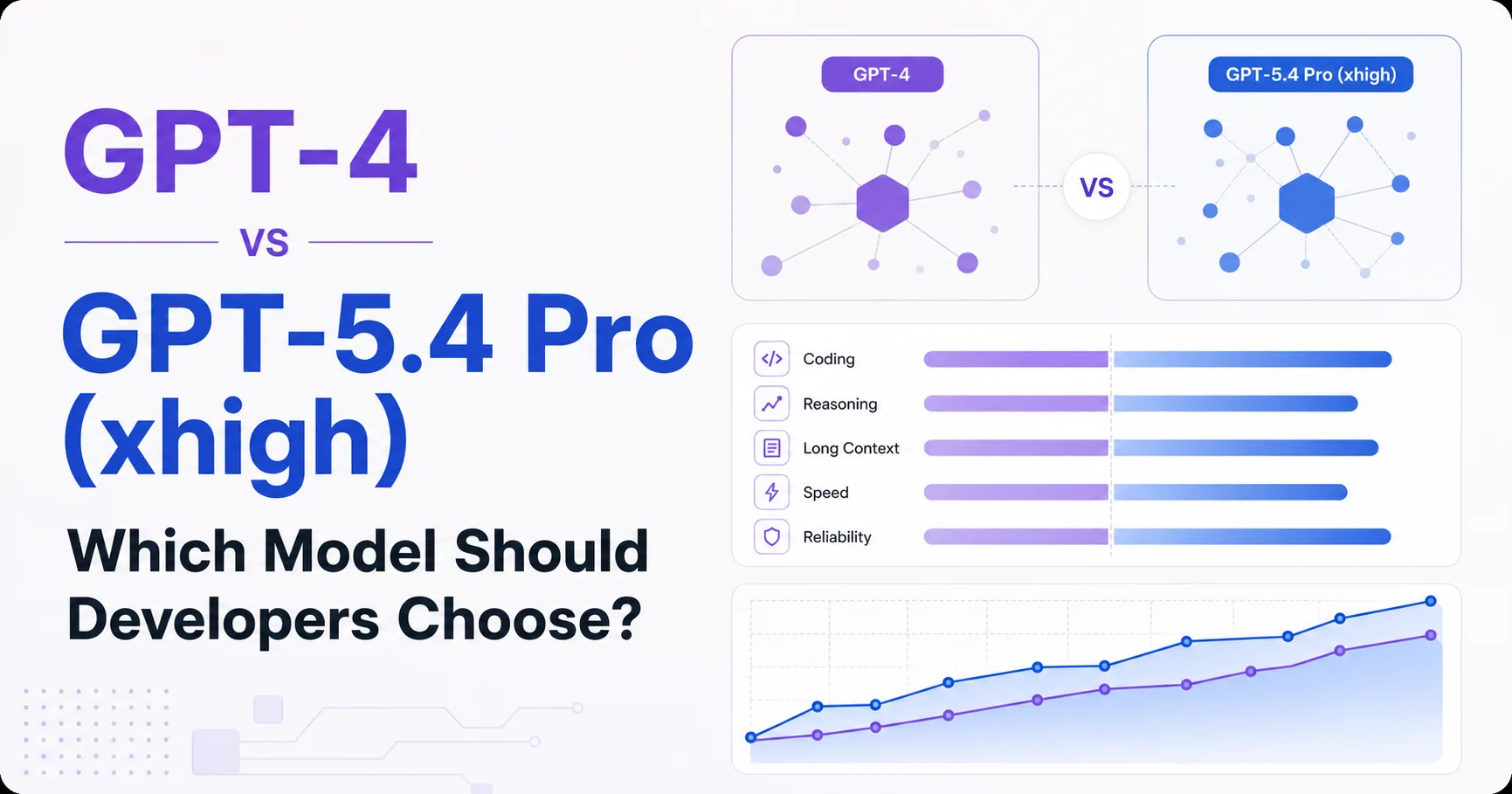
- **Winner overall:** GPT-4, because it is the only model in this comparison with reported evaluation results and it costs $37.5 vs $67.5 per 1M blended tokens - **Cheaper:** GPT-4 at $37.5 vs $67.5 per 1M blended tokens - **Faster:** GPT-4 and GPT-5.4 Pro (xhigh) tie at 0 median output tokens per second - **Pick GPT-4 when:** you need a model with at least some published evaluation evidence and a lower blended token price - **Watch out:** GPT-5.4 Pro (xhigh) has no reported evaluation, speed, latency, context, or current API availability evidence in the supplied materials
GPT-4 vs GPT-5.4 Pro (xhigh): the practical verdict
GPT-4 is the safer documented choice, while GPT-5.4 Pro (xhigh) cannot be judged as a production upgrade from the available evidence. The supplied data gives GPT-4 reported evaluation results, a blended price of $37.5 per 1M tokens, and listed input and output prices. GPT-5.4 Pro (xhigh) has a blended price of $67.5 per 1M tokens, but every listed evaluation is null. Both models show 0 median output tokens per second and 0 latency seconds in the supplied snapshot, so the data does not establish a speed winner.
The more important issue is not a benchmark gap. It is an evidence gap. The current OpenAI Models documentation does not list current capability parameters for gpt-4, and it also does not list gpt-5-4-pro or “GPT-5.4 Pro (xhigh).” The current OpenAI Pricing documentation does not list either comparison target as a current priced model.
That creates a selection problem for developers. GPT-4 has measurable historical or external evaluation data in the supplied snapshot, but its current official API status is unclear. GPT-5.4 Pro (xhigh) sounds newer by its name and release metadata, but the supplied sources do not prove that it is callable, stable, better, or supported. A production team should therefore treat this comparison as a documented-evidence decision, not as a simple old-model-versus-new-model upgrade story.
Summary: GPT-4 has evidence, GPT-5.4 Pro has uncertainty
GPT-4 is the only model with reported capability scores, so it currently has the stronger evidence position for a developer decision. The data snapshot reports GPT-4 at 6.8 on the Artificial Analysis Intelligence Index and 13.1 on the Artificial Analysis Coding Index. It also reports scores of 0.562 on MMLU-Pro, 0.349 on GPQA, 0.568 on Math-500, and 0.331972789115646 on IFBench. GPT-5.4 Pro (xhigh) has null values for all listed evaluations.
The comparison does not show that GPT-4 is more capable in every real task. It shows that GPT-4 is the only model for which this dataset provides task-related measurements. The difference matters because developers need more than a model name to estimate regression risk, testing effort, and expected behavior. A missing score is not a low score, but it is also not evidence of superiority.
GPT-4 also has the lower blended price, at $37.5 versus $67.5 per 1M tokens. Input pricing is listed as $30 per 1M tokens for both models, while output pricing is listed as $60 for GPT-4 and $180 for GPT-5.4 Pro (xhigh). The equal input price means the cost decision depends heavily on output volume and the actual task mix.
The official evidence is incomplete for both models. The OpenAI Models documentation does not confirm the context window, maximum output, input modalities, or parameter limits for either target. The OpenAI Pricing documentation does not confirm current direct API prices for either target. The supplied benchmark and pricing snapshot is provided by Artificial Analysis.
Performance: the available comparison cannot prove a newer-model advantage
GPT-4 is the only model with measurable task performance in the supplied comparison, but the evidence is too incomplete to establish a universal production winner. Its reported coding index is 13.1, and its reported intelligence index is 6.8. Those figures indicate that the dataset has evaluated GPT-4 across relevant capability dimensions. GPT-5.4 Pro (xhigh) has no reported value for either index, or for any other listed evaluation.
For a developer, the practical meaning is limited but useful. GPT-4 gives a team a starting point for test design. Coding-related scores can help justify focused checks around code generation, debugging, instruction following, and repository changes. General reasoning scores can help identify where broader task tests may be appropriate. They cannot predict a specific application without matching the evaluation setup to the application’s prompts, tools, context, and acceptance criteria.
The speed data does not separate the models. Both models report 0 median output tokens per second and 0 latency seconds. These values should be treated as unavailable or non-informative for a real latency decision, because they do not provide an observable difference between the models. The supplied materials also contain no verified community tests for coding experience, response speed, or model behavior.
The official documentation leaves another important performance question unanswered. The OpenAI Models documentation does not provide confirmed context-window, output-limit, or modality details for either target. Developers should not infer that GPT-5.4 Pro (xhigh) supports more context, better vision, or longer outputs from its name alone. The evidence is insufficient.
Cost: GPT-4 is cheaper on the supplied workload assumptions
GPT-4 is the lower-cost option in the supplied comparison, but the final choice depends on how much output the application generates. The blended price is $37.5 per 1M tokens for GPT-4 and $67.5 per 1M tokens for GPT-5.4 Pro (xhigh). Input pricing is equal at $30 per 1M tokens. Output pricing is where the visible difference appears, with GPT-4 at $60 and GPT-5.4 Pro (xhigh) at $180 per 1M tokens.
The chart below the article should be used for the exact price comparison. The key business implication is simpler: applications that produce substantial model output face a much higher cost exposure with GPT-5.4 Pro (xhigh), assuming the supplied prices describe the calls the application can actually make. Chatty coding agents, long explanations, multi-step tool workflows, and generated documentation can all make output pricing more important than input pricing.
The cheaper model can still become more expensive in practice if it requires retries, human correction, additional validation calls, or a larger orchestration layer. The supplied materials do not provide task success rates, retry rates, or quality-adjusted cost. That means no responsible conclusion can say whether GPT-5.4 Pro (xhigh) would repay its higher price through fewer failures. The evidence is insufficient on that point.
Current official pricing status is also unresolved. The OpenAI Pricing documentation does not list gpt-4 or gpt-5-4-pro, so the snapshot prices should be validated against the actual account, endpoint, and model identifier before procurement.
Recommendation: choose based on evidence and availability, then validate task quality
GPT-4 is the better default for a documented comparison, while GPT-5.4 Pro (xhigh) should be considered only after its access and quality are verified. GPT-4 has reported evaluation evidence and the lower blended price. That makes it easier to build an initial test plan and easier to control token spend. The recommendation does not mean GPT-4 is proven current, universally better, or officially supported for every deployment.
Choose GPT-4 when the team needs a lower-cost baseline, has an existing integration, or wants to compare application behavior against a model with reported scores. Its supplied scores include 13.1 on the Artificial Analysis Coding Index, 6.8 on the Artificial Analysis Intelligence Index, 0.562 on MMLU-Pro, and 0.568 on Math-500. These scores are useful as evidence that measurements exist, not as a guarantee of application success.
Choose GPT-5.4 Pro (xhigh) only when the team can confirm that the exact identifier is callable, the price is valid for the intended endpoint, and a task-specific test shows enough quality improvement to justify $67.5 per 1M blended tokens. The supplied sources do not confirm any of those conditions. The current OpenAI Models documentation does not list the model, and the current OpenAI Pricing documentation does not list its price.
The next decision should be a controlled application test. Use the same prompts, tools, context, output requirements, and acceptance checks for both models. Measure successful task completion, correction work, output length, and total spend. The supplied materials do not contain those results, so a production recommendation beyond the evidence above would be premature.
What developers should confirm before choosing
GPT-4 and GPT-5.4 Pro (xhigh) both require availability checks before a production commitment because neither target appears in the current official model and pricing pages supplied for this comparison. The OpenAI Models documentation is the relevant place to verify model listing and capability details, while the OpenAI Pricing documentation is the relevant place to verify current pricing. The supplied benchmark source is Artificial Analysis, which provides the comparison snapshot used here.
A developer should confirm the exact model identifier, endpoint support, context behavior, output limits, modality support, rate limits, and billing terms. The supplied research does not answer these questions for either target. It also does not provide reliable community testing or documented failure patterns. That uncertainty should be recorded as a launch risk rather than silently converted into an assumption about the newer model.
Frequently asked questions
Is GPT-5.4 Pro (xhigh) better than GPT-4 for coding?
The supplied evidence cannot prove that GPT-5.4 Pro (xhigh) is better for coding because it has no reported coding evaluation, while GPT-4 has a reported Artificial Analysis Coding Index of 13.1. A task-specific test is required.
Which model is cheaper for developers?
GPT-4 is cheaper in the supplied comparison at $37.5 per 1M blended tokens, versus $67.5 for GPT-5.4 Pro (xhigh). Input pricing is equal, while GPT-5.4 Pro (xhigh) has the higher listed output price.
Which model responds faster?
Neither model wins on speed in the supplied snapshot because GPT-4 and GPT-5.4 Pro (xhigh) both report 0 median output tokens per second and 0 latency seconds. Those values do not establish real-world latency.
Can I use GPT-4 or GPT-5.4 Pro (xhigh) through the current OpenAI API?
The supplied official documentation does not confirm current API availability for either model. The current OpenAI Models page does not list GPT-5.4 Pro (xhigh), and the current pricing page does not list either target.
Does GPT-5.4 Pro (xhigh) have a larger context window?
The supplied evidence does not confirm a context-window advantage for GPT-5.4 Pro (xhigh). The current official model documentation provides no confirmed context-window value for either comparison target.
Sources
- OpenAI ModelsVerifying the current official model directory, documented capabilities, API availability evidence, context information, and the absence of listed entries for the comparison targets.
- OpenAI PricingVerifying current official pricing listings, direct API price evidence, and the absence of listed prices or alias mappings for the comparison targets.
- Artificial AnalysisAttributing the supplied benchmark, pricing, speed, latency, release-date, and data snapshot values.
Published: