
AI model analysis
GPT-4 vs GPT-5.6 Sol (max): Which Model Should Developers Choose?
A developer-focused comparison of GPT-4 and GPT-5.6 Sol (max), covering capability evidence, speed, pricing, migration risk, and practical selection criteria.
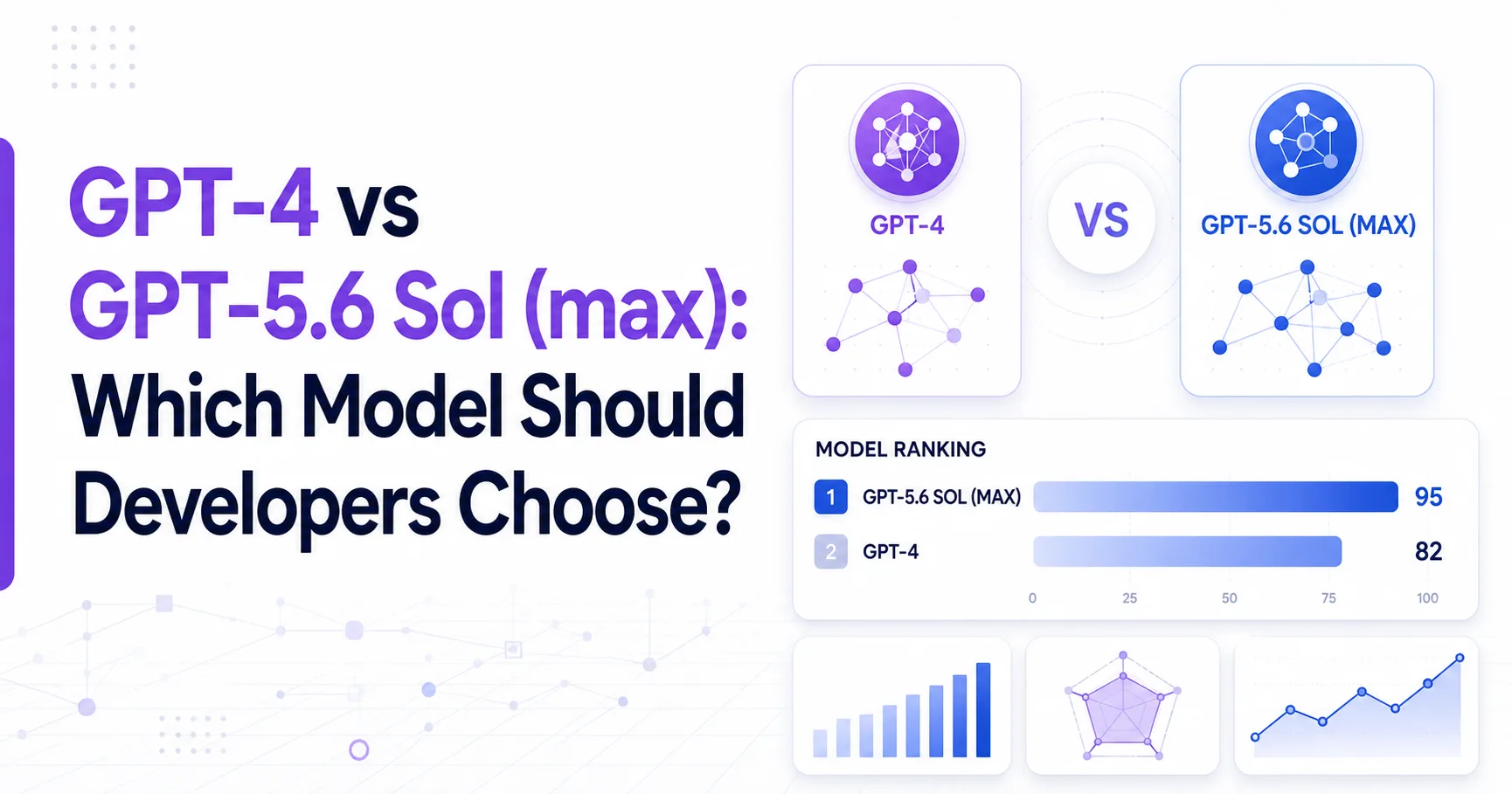
- **Winner overall:** GPT-5.6 Sol (max), with a 77.4 Artificial Analysis Coding Index score vs 13.1 for GPT-4 - **Cheaper:** GPT-5.6 Sol (max) at $11.25 vs $37.5 per 1M blended tokens - **Faster:** GPT-5.6 Sol (max) at 77.617 median output tokens per second, while GPT-4 has no reported value - **Pick GPT-5.6 Sol (max) when:** you need complex coding, reasoning, long-context work, or tool-enabled workflows - **Watch out:** GPT-4's current availability, stable API alias, context window, and output limit are not confirmed by the reviewed official documentation
GPT-4 vs GPT-5.6 Sol (max)
GPT-5.6 Sol (max) is the stronger default for new developer workloads because the available evaluation data favors it sharply while its listed blended price is lower.
The data brief reports an Artificial Analysis Coding Index score of 77.4 for GPT-5.6 Sol (max), compared with 13.1 for GPT-4. It reports an Artificial Analysis Intelligence Index score of 58.9 versus 7. The same snapshot lists GPT-5.6 Sol (max) at $11.25 per 1M blended tokens, compared with $37.5 for GPT-4.
Those figures do not prove that every application will improve after migration. They do establish a strong starting point for coding, reasoning, and cost-sensitive selection. GPT-4 remains a compatibility question rather than a clearly documented current product choice. OpenAI’s current model documentation does not provide current GPT-4 capability parameters, while the current pricing documentation does not list GPT-4 as a directly priced model.
Data provided by https://artificialanalysis.ai/
Executive summary for developers
GPT-5.6 Sol (max) offers the clearer production path, while GPT-4 is difficult to evaluate as a current API option from the reviewed evidence.
| Decision factor | GPT-4 | GPT-5.6 Sol (max) |
|---|---|---|
| Artificial Analysis Intelligence Index | 7 | 58.9 |
| Artificial Analysis Coding Index | 13.1 | 77.4 |
| Blended price per 1M tokens | $37.5 | $11.25 |
| Input price per 1M tokens | $30 | $5 |
| Output price per 1M tokens | $60 | $30 |
| Median output speed | Not reported | 77.617 tokens per second |
| Latency | 0.3 seconds | 0.3 seconds |
The comparison is unusually asymmetric. GPT-5.6 Sol has current model documentation, a documented model ID, a stable alias, capability details, API endpoints, tool support, and current pricing. OpenAI describes it as a flagship frontier model for complex reasoning, programming, and complex professional work in the model directory and the GPT-5.6 Sol model page.
GPT-4 has a much thinner current evidence trail. The reviewed official pages do not confirm its current context window, maximum output, input modalities, parameter limits, or direct API price. That absence does not prove that every GPT-4 endpoint has disappeared. It does mean a team should verify its exact account, endpoint, and contract before treating GPT-4 as a stable baseline.
The practical conclusion is simple: choose GPT-5.6 Sol for new systems, and retain GPT-4 only when an existing integration has a demonstrated compatibility reason that outweighs migration work.
Performance: what the score gap means in practice
GPT-5.6 Sol (max) has the stronger measured capability profile, but its reasoning behavior can require tighter task control and cost monitoring.
The data brief shows a 77.4 Coding Index score for GPT-5.6 Sol (max) and 13.1 for GPT-4. It also shows an Intelligence Index score of 58.9 versus 7. The gap is large enough to matter for tasks that combine code understanding, multi-step decisions, debugging, or unfamiliar repositories. It should not be read as a guaranteed percentage improvement in your application, because the brief does not provide the benchmark methodology or a task-by-task mapping to your workload.
The latency result is different. Both models are listed at 0.3 seconds, so the snapshot does not establish a latency advantage for GPT-5.6 Sol. GPT-4 has no reported median output speed, while GPT-5.6 Sol is listed at 77.617 median output tokens per second. That makes GPT-5.6 Sol easier to reason about for streaming output, but it does not create a direct apples-to-apples speed comparison.
GPT-5.6 Sol supports text and image input with text output. It supports Responses API and Chat Completions API, plus function calling, structured output, streaming, and a broad set of tools through Responses API, according to its model details. GPT-4’s current official page does not confirm equivalent capabilities.
The main performance tradeoff is reasoning control. The reasoning guide documents effort levels from none through max, and explains that higher effort can increase latency, reasoning-token usage, and cost. Community reports describe over-designed code, broad investigations, and inconsistent token usage, but the Reddit test report and Hacker News discussion do not provide controlled, reproducible experiments. Treat those reports as workflow warnings, not stable benchmark results.
Cost: why the cheaper model can still become expensive
GPT-5.6 Sol (max) has the lower listed token price, but maximum reasoning and long prompts can erase part of the apparent savings.
The data brief lists GPT-5.6 Sol at $11.25 per 1M blended tokens, compared with $37.5 for GPT-4. It also lists input pricing of $5 versus $30 and output pricing of $30 versus $60. These numbers make GPT-5.6 Sol the clear cost winner for the same token mix in the supplied snapshot.
The price chart cannot show how your application generates tokens. GPT-5.6 Sol can spend hidden reasoning tokens that count against the context window and are billed as output tokens, according to the reasoning documentation. A task that repeatedly triggers max effort may therefore cost more than a simple blended comparison suggests. The correct comparison is completed task cost, including retries, tool calls, rejected outputs, review cycles, and any extra context sent with each request.
Prompt size also changes the economics. The GPT-5.6 Sol model page states that a single request above 272K input tokens is charged at higher input and output multipliers. Teams processing large repositories, long documents, or accumulated conversation history should measure cache hit rates and input size before committing to a default configuration.
GPT-5.6 Sol also has documented Standard, Batch, Flex, and Fast mode prices in the OpenAI API pricing page. GPT-4’s current price is not confirmed by that page. The data brief supplies a comparison price for GPT-4, but the reviewed official pricing source does not establish whether that price remains available to a new caller. Cost planning for GPT-4 therefore needs account-level verification.
Recommendation by workload
GPT-5.6 Sol (max) should be the default choice for new developer products, while GPT-4 should be kept only behind a verified compatibility decision.
Choose GPT-5.6 Sol when the workload involves complex code changes, repository-level investigation, structured tool use, image-aware inputs, or long documents. Its documented 1,050,000-token context window and 128,000-token maximum output provide a much clearer capacity envelope than the reviewed GPT-4 materials. Its official model page also documents the gpt-5.6-sol model ID and the gpt-5.6 stable alias, which reduces ambiguity during implementation.
Choose GPT-5.6 Sol with a lower reasoning setting when the task is routine, latency-sensitive, or easy to verify. Reserve max for tasks where deeper reasoning has measurable value. The official reasoning guide specifically connects higher reasoning effort with more model work, higher latency, and higher token consumption.
Keep GPT-4 only when an existing system has a tested dependency on its behavior, prompt format, or integration path. That is a migration exception, not a performance recommendation. The reviewed GPT-4 evidence does not confirm a current stable alias, direct current pricing, context window, output limit, or current availability. A team should first identify the exact deployed model identifier, run regression tests, and obtain account-level confirmation before forecasting a long-term GPT-4 architecture.
The strongest migration plan is workload-based. Start with representative coding and reasoning tasks, compare completed-task success and total tokens, then inspect failure cases manually. Do not infer production reliability from the community anecdotes in the Reddit report or Hacker News thread, because neither reports a controlled comparison against GPT-4.
Questions to answer before adoption
GPT-5.6 Sol (max) is easier to adopt from public documentation, but teams still need workload-specific validation before changing a production default.
The central evidence gap concerns GPT-4. OpenAI’s current model directory focuses on newer model lines and does not state the current GPT-4 parameters reviewed for this comparison. The current pricing page also omits GPT-4 from its listed model prices. That leaves availability and migration compatibility unresolved.
GPT-5.6 Sol has more complete documentation, but completeness does not remove operational risks. Its reasoning tokens are hidden, its highest effort can consume more budget, and its community feedback includes reports of over-scoping and excessive code generation. Those reports remain qualitative and methodologically weak.
Before adoption, test the exact prompts, tools, repository sizes, output validators, retry rules, and budget limits used by your product. The data supports GPT-5.6 Sol as the default recommendation. It does not provide enough evidence to promise a universal success rate, universal latency improvement, or identical output behavior after migration.
Frequently asked questions
Is GPT-5.6 Sol (max) better than GPT-4 for coding?
GPT-5.6 Sol (max) is the stronger coding choice in the supplied evidence, with a 77.4 Coding Index score versus 13.1 for GPT-4, although your repository and evaluation method can change the practical result.
Is GPT-5.6 Sol (max) cheaper than GPT-4?
GPT-5.6 Sol (max) is cheaper in the supplied comparison at $11.25 versus $37.5 per 1M blended tokens, but maximum reasoning, retries, tools, and large prompts can increase completed-task cost.
Does GPT-5.6 Sol respond faster than GPT-4?
GPT-5.6 Sol (max) has a reported median output speed of 77.617 tokens per second, while GPT-4 has no reported value; both models are listed at 0.3 seconds latency.
Should a production GPT-4 integration migrate immediately?
A production GPT-4 integration should migrate after regression testing and account-level verification, because the reviewed evidence strongly favors GPT-5.6 Sol but does not establish identical behavior or compatibility.
What is the biggest risk of using GPT-5.6 Sol (max)?
The biggest documented risk is uncontrolled reasoning cost and latency, because higher reasoning effort can consume more hidden tokens, while community reports also describe over-scoping that lacks controlled validation.
Sources
- Artificial AnalysisData attribution for the supplied model comparison snapshot.
- OpenAI ModelsCurrent model directory, official model positioning, and the absence of current GPT-4 capability parameters.
- GPT-5.6 Sol model detailsGPT-5.6 Sol identity, alias, context window, output limit, modalities, APIs, tools, limitations, and long-context pricing behavior.
- Reasoning modelsReasoning effort settings, hidden reasoning tokens, cost behavior, latency considerations, and pro-mode guidance.
- OpenAI API pricingCurrent listed GPT-5.6 Sol pricing and the absence of GPT-4 from the reviewed current pricing page.
- GPT-5.6: Frontier intelligence that scales with your ambitionGPT-5.6 Sol release date, official positioning, and published benchmark claims.
- I spent two weeks testing GPT-5.6. Here’s what I found.Uncontrolled community reports about over-design, token usage, and coding workflow behavior.
- Ask HN: How are you productive with GPT 5.6 Sol?Uncontrolled community reports about investigation scope, defensive code, bugs, and reasoning-effort adjustments.
Published: