
AI model analysis
GPT-4 vs GPT-5.6 Sol (high): Which Model Should Developers Choose?
A developer-focused comparison of GPT-4 and GPT-5.6 Sol (high), covering capability, coding performance, cost, latency, evidence quality, and practical selection risks.
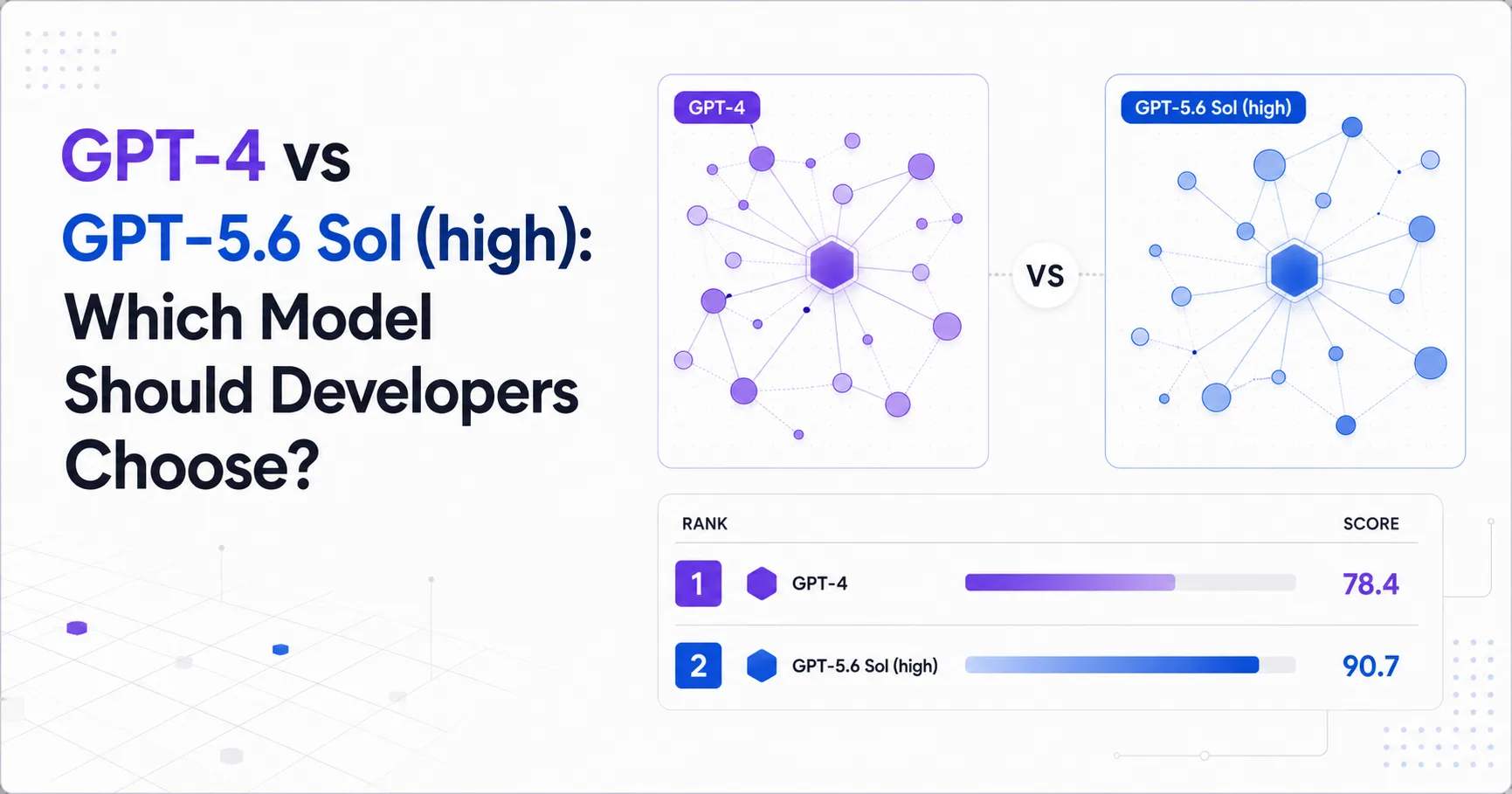
- **Winner overall:** GPT-5.6 Sol (high), with an Artificial Analysis Intelligence Index of 55.9 vs 7 and a Coding Index of 77.2 vs 13.1 - **Cheaper:** GPT-5.6 Sol (high) at $11.25 vs $37.5 per 1M blended tokens - **Faster:** GPT-5.6 Sol (high) at 73.648 median output tokens per second, while GPT-4 has no reported value - **Pick GPT-4 when:** you must preserve an existing GPT-4 integration and have verified that its current endpoint still works for your workload - **Watch out:** current official GPT-4 availability, version routing, context limits, and API pricing are not clearly documented
GPT-4 vs GPT-5.6 Sol (high)
GPT-5.6 Sol (high) is the stronger default for new developer workloads, combining a Coding Index of 77.2 with a blended price of $11.25 per 1M tokens. Data provided by https://artificialanalysis.ai/. GPT-4 remains relevant mainly as a legacy dependency, because its current official availability and configuration details are not clearly exposed in OpenAI’s active documentation. The comparison therefore has two layers: measured capability and deployment certainty. GPT-5.6 Sol (high) wins the measured comparison by a wide margin. GPT-4 can still be the safer short-term choice if an existing application depends on its behavior and migration risk matters more than capability.
Executive summary for developers
GPT-5.6 Sol (high) offers the clearer technical and economic case for new applications, while GPT-4 is defensible only when compatibility is the primary requirement. The data brief gives GPT-5.6 Sol (high) an Artificial Analysis Intelligence Index of 55.9 versus 7 for GPT-4, and a Coding Index of 77.2 versus 13.1. Those gaps suggest a large difference in general problem solving and software engineering tasks, although benchmark scores do not guarantee equal results on every repository or workflow.
OpenAI currently positions GPT-5.6 Sol as a flagship reasoning model for complex professional work, complex reasoning, and coding. The official model page documents text and image input, text output, Responses API, Chat Completions API, Batch API, structured outputs, function calling, file search, web search, and prompt caching. See the GPT-5.6 Sol model page for the documented interface and capabilities.
GPT-4 has a serious evidence problem. OpenAI’s current model directory focuses on newer model families and does not provide current GPT-4 parameters, context limits, output limits, or confirmed multimodal support. The current pricing page also does not list GPT-4 or its older dated variants. That omission does not prove that every GPT-4 endpoint is unavailable, but it does mean a new system should not treat GPT-4 as a well-documented current target without direct verification.
The practical conclusion is simple. Choose GPT-5.6 Sol (high) for new coding agents, complex analysis, long-running repository work, and systems that need documented tools. Keep GPT-4 only where an existing product has validated prompts, regression coverage, and a working deployment that would be costly to replace.
Performance: what the scores mean in real development
GPT-5.6 Sol (high) is the better candidate for difficult coding and reasoning workflows, but its high reasoning setting can trade throughput for deeper analysis. The data brief reports a Coding Index of 77.2 for GPT-5.6 Sol (high), compared with 13.1 for GPT-4. It also reports an Intelligence Index of 55.9 versus 7. These results support using GPT-5.6 Sol (high) for tasks where the model must inspect unfamiliar code, maintain constraints across files, reason about failure states, or produce a multi-step implementation plan.
The score gap matters most when a wrong answer creates follow-up work. A weaker model may still be adequate for short transformations, predictable boilerplate, or narrow prompts. It becomes less attractive when developers must repeatedly correct misunderstood requirements, repair incomplete changes, or review defensive code that does not solve the core problem. GPT-5.6 Sol (high) is more suitable for the latter category, subject to local testing and review.
The speed evidence is asymmetric. GPT-5.6 Sol (high) has a reported median output speed of 73.648 tokens per second. GPT-4 has no reported median output speed in the data brief, so the comparison cannot establish a throughput winner from that metric. Both models have a reported latency of 0.3 seconds, which makes initial responsiveness appear tied in the supplied data. Initial latency and total completion time are different operational concerns, especially for reasoning workloads.
OpenAI documents that reasoning tokens consume the context window and that the output limit includes visible output, reasoning tokens, and other generated tokens. The reasoning guide also warns that a response can end as incomplete when the configured limit is exhausted. This creates a practical tuning issue for GPT-5.6 Sol (high): a large token budget may improve completion reliability, while a small budget may reduce cost but terminate before the visible answer is ready.
Community reports reinforce this caution, but they do not prove a universal failure pattern. Reddit users describe slow subjective responses and a tendency toward over-engineering, while Hacker News users report occasional investigation drift and unnecessary defensive code. These reports come from Reddit’s GPT-5.6 Sol discussion and a Hacker News productivity discussion, but neither source provides standardized success-rate or latency data.
Cost: why the cheaper model can still cost more
GPT-5.6 Sol (high) is cheaper on every supplied token price, but its economic advantage depends on how much reasoning and review your workflow requires. The data brief lists a blended price of $11.25 per 1M tokens for GPT-5.6 Sol (high), compared with $37.5 for GPT-4. Input pricing is $5 versus $30, and output pricing is $30 versus $60. The page chart provides the detailed price comparison, so the key question is not which listed rate is lower. The key question is whether the model completes useful work with fewer retries and less human correction.
GPT-4 can become the more expensive option when its lower measured capability causes repeated calls, manual repair, or failed agent steps. A low-cost request that produces an unusable patch is not economically efficient. GPT-5.6 Sol (high) can reverse that advantage if its reasoning effort is excessive for a simple task, if it generates unnecessary implementation complexity, or if developers allocate more output budget than the task needs. Community reports about over-engineering make that a real cost-control concern, although the available reports lack a consistent test method.
The official pricing documentation adds an important boundary for GPT-5.6 Sol. Requests above 272K input tokens receive long-context pricing. The model page documents a context window of 1,050,000 tokens and a maximum input of 922,000 tokens, but capacity is not the same as affordability. Large repository snapshots, repeated conversation history, and tool output can move a request into a more expensive pricing band even when the application is technically within the context limit.
Batch and Flex pricing can change the operating decision for asynchronous workloads, while Standard may be simpler for interactive applications. Fast mode has a separate higher price where listed. These modes should be evaluated against service-level requirements, retry rates, and cache behavior rather than selected from the headline price alone. GPT-4 has no current directly listed official API price in the supplied documentation, so its real cost must be confirmed in the actual account and endpoint configuration before making a production decision.
Recommendation by workload
GPT-5.6 Sol (high) should be the default choice for new developer products, while GPT-4 should remain only behind a verified compatibility decision. GPT-5.6 Sol (high) has the stronger supplied Coding Index, the stronger Intelligence Index, the lower blended price, and documented support for modern APIs and developer tools. Its official model page also identifies the stable alias as gpt-5.6 and the fixed model ID as gpt-5.6-sol. The official model documentation does not identify a separate gpt-5.6-sol-high model ID, so applications should represent high reasoning as a configuration rather than inventing a model name.
Choose GPT-5.6 Sol (high) for repository-scale coding, difficult debugging, agentic workflows, tool use, structured outputs, image-assisted development, and tasks where a stronger first attempt can reduce correction work. Use an explicit evaluation set before enabling high reasoning for every request. The reasoning documentation explains that reasoning effort is configurable, so simpler requests may deserve a lower setting.
Choose GPT-4 only when an existing production system has tested prompts, known output behavior, and a confirmed endpoint. This is a continuity choice, not a capability recommendation. OpenAI’s current documentation does not clearly state whether GPT-4 remains directly callable, which version a stable alias would route to, or what current context and output limits apply. Those unknowns should be treated as migration and availability risks.
A sensible migration path is to keep the GPT-4 integration available for regression comparison, route new traffic to GPT-5.6 Sol (high), and compare task completion, review burden, total tokens, and incomplete responses. The supplied materials do not provide a standardized head-to-head production test, so no evidence-based claim can be made about success rate, total cost per completed task, or long-run stability for your specific codebase.
The GPT-5.6 release announcement supports the model’s positioning around advanced reasoning and coding, but the data brief does not provide separate benchmark results for the high reasoning configuration. That distinction matters. The available evidence supports GPT-5.6 Sol (high) as the stronger selection, not a guarantee that high is optimal for every workload.
What the evidence still cannot answer
GPT-5.6 Sol (high) has more current documentation than GPT-4, but the supplied evidence still cannot establish a universal winner for every production workload. The data brief reports benchmark, pricing, latency, and output-speed values, while the research materials provide official capability descriptions and unstandardized community observations. The materials do not provide a unified test of completion quality, total task cost, error recovery, or reliability on a representative developer repository. Teams should therefore validate the recommendation with their own prompts, tools, codebase, and review process.
Frequently asked questions
Should a new application use GPT-4 or GPT-5.6 Sol (high)?
A new application should generally use GPT-5.6 Sol (high) because it has the stronger supplied coding and intelligence scores, lower listed token prices, and clearer current documentation for APIs, tools, and model configuration. GPT-4 requires direct availability verification.
Is GPT-5.6 Sol (high) faster than GPT-4?
GPT-5.6 Sol (high) has a reported median output speed of 73.648 tokens per second, while GPT-4 has no reported value in the supplied data. Both models show 0.3 seconds of latency, so the evidence does not prove a complete end-to-end speed winner.
When can GPT-4 still be the better engineering choice?
GPT-4 can be the better engineering choice when an existing production integration depends on its tested behavior, migration risk is high, and the endpoint has been confirmed to remain available. That is a compatibility decision rather than evidence that GPT-4 is technically stronger.
Can GPT-5.6 Sol (high) reduce the total cost of a coding agent?
GPT-5.6 Sol (high) can reduce total cost when its stronger task performance lowers retries, failed patches, and manual correction. It can cost more than expected if high reasoning produces unnecessary complexity, consumes large token budgets, or sends inputs beyond the long-context pricing boundary.
Does the official API expose a gpt-5.6-sol-high model ID?
The official documentation does not identify a separate gpt-5.6-sol-high model ID. It documents gpt-5.6-sol and the gpt-5.6 stable alias, with high represented through the reasoning.effort configuration.
Sources
- Artificial AnalysisData attribution for benchmark, pricing, latency, and output-speed values.
- GPT-5.6 Sol model pageModel ID, stable alias, context limits, modalities, APIs, tools, and documented capabilities.
- OpenAI API model directoryCurrent model catalogue and the absence of current GPT-4 capability details.
- OpenAI API pricingCurrent GPT-5.6 Sol pricing, long-context pricing, and the absence of directly listed GPT-4 pricing.
- Reasoning models guideReasoning effort, reasoning tokens, output limits, incomplete responses, and configuration guidance.
- GPT-5.6 release announcementOfficial positioning of GPT-5.6 around advanced reasoning and coding.
- GPT-5.6 Sol / Codex Release Discussion MegathreadUnstandardized community reports about speed and over-engineering.
- Ask HN: How are you productive with GPT 5.6 Sol?Unstandardized community reports about investigation drift, defensive code, and reasoning settings.
Published: