
AI model analysis
GPT-4o mini vs Kimi K3 (max): Which Model Should Developers Choose?
A developer-focused comparison of GPT-4o mini and Kimi K3 (max), covering capability, latency, cost, API stability, and production fit.
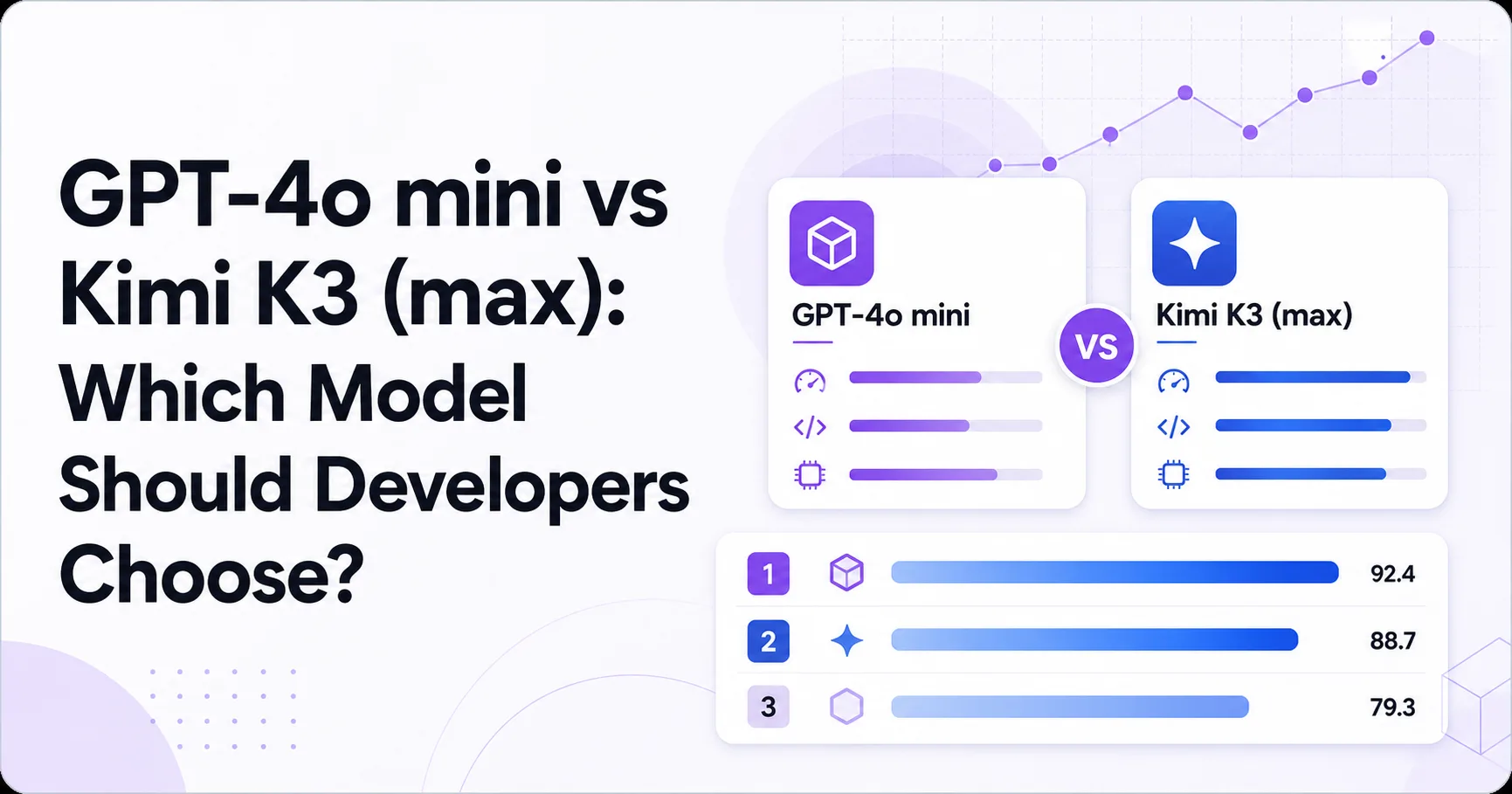
- **Winner overall:** Kimi K3 (max), with an Artificial Analysis Intelligence Index of 57.1 vs 6.9 and a Coding Index of 76.2 vs 11.4 - **Cheaper:** GPT-4o mini at $0.2625 vs $6 per 1M blended tokens - **Faster:** Kimi K3 (max) at 34.453 median output tokens per second - **Pick GPT-4o mini when:** predictable low-cost workloads matter more than maximum coding and reasoning scores - **Watch out:** GPT-4o mini's current availability and direct price are not confirmed on OpenAI's current model and pricing pages
GPT-4o mini vs Kimi K3 (max)
Kimi K3 (max) is the stronger capability choice, while GPT-4o mini remains the safer economic choice for high-volume applications. The Artificial Analysis snapshot gives Kimi K3 (max) an Intelligence Index of 57.1 and a Coding Index of 76.2, compared with 6.9 and 11.4 for GPT-4o mini. Artificial Analysis supplies the comparison data used here.
The models also represent different product situations. OpenAI introduced GPT-4o mini as a small, cost-efficient model for frequent tasks, with text and image input and text output. OpenAI’s launch announcement describes that original positioning. Kimi presents K3 as a flagship model for long-horizon coding, knowledge work, and reasoning, with native vision and a very large context window. Kimi’s technical blog describes that broader ambition.
For a new production integration, the central question is not simply which benchmark is higher. Developers must decide whether the workload rewards stronger autonomous coding and reasoning enough to justify Kimi’s much higher token cost, and whether the surrounding API behavior is stable enough for the intended workflow.
Executive summary for model selection
Kimi K3 (max) wins the measured capability comparison, but GPT-4o mini wins the direct cost comparison by a wide margin. Kimi’s Coding Index is 76.2 versus 11.4, and its Intelligence Index is 57.1 versus 6.9. GPT-4o mini’s Math Index is 14.7, while no corresponding Kimi value appears in the supplied data, so the math comparison is incomplete rather than a Kimi loss. Artificial Analysis provides these measurements.
GPT-4o mini is easier to justify for classification, extraction, routing, lightweight assistants, and other workloads where each request must be inexpensive. Its launch materials emphasize high-frequency, low-cost use cases and document text and image input. OpenAI’s launch announcement supports that positioning.
Kimi K3 (max) is more compelling for repository-scale coding agents, difficult multi-step analysis, and tasks that benefit from visual input, tool calls, structured output, or long-running reasoning. Kimi’s Quickstart documents those API capabilities. However, Kimi requires more operational discipline. The official blog warns that incomplete reasoning-history replay or switching models mid-session can make generation unstable. Kimi’s technical blog also warns that the model can act too proactively when instructions are unclear.
Performance: what the capability gap means in practice
Kimi K3 (max) is the better candidate for complex coding and reasoning loops, based on the available capability indexes. The Coding Index gap is large enough to change architecture decisions: a developer may reasonably test Kimi for planning, repository navigation, code generation, and iterative debugging, while GPT-4o mini is better treated as a lightweight component unless task-specific tests show otherwise. Artificial Analysis reports the Coding Index values, but the snapshot does not establish success rates for any particular repository or agent harness.
The Intelligence Index points in the same direction, with Kimi at 57.1 and GPT-4o mini at 6.9. That supports choosing Kimi for harder synthesis and multi-step judgment, but it does not prove that every production prompt will improve. GPT-4o mini’s official launch benchmarks include coding and general academic tests, yet OpenAI does not claim universal performance across all coding, reasoning, or vision tasks. OpenAI’s launch announcement makes that boundary clear.
Latency does not decide this comparison. Both models show 0.3 seconds in the supplied snapshot. Kimi additionally reports 34.453 median output tokens per second, while no GPT-4o mini value is supplied, so output-speed superiority cannot be established from the available data. Artificial Analysis is the source for these performance measurements.
Kimi’s practical advantage also depends on the harness. The model supports tool calls, JSON Mode, JSON Schema outputs, partial mode, dynamic tool loading, and native visual inputs. Kimi’s Quickstart documents these features. Its web search should not yet be treated as production-ready, and image inputs require Base64 or a platform file identifier rather than a public image URL.
Cost: when the cheaper model can still cost more
GPT-4o mini is the clear token-cost winner, but Kimi K3 (max) can still be economically rational when higher capability reduces human review or retry work. The blended price is $0.2625 for GPT-4o mini versus $6 for Kimi K3 (max) per 1M blended tokens. Input pricing is $0.15 versus $3, and output pricing is $0.6 versus $15. Artificial Analysis supplies the comparison prices.
Those figures make GPT-4o mini the natural default for high-volume traffic, especially when prompts are short, outputs are constrained, and the task can be validated with simple rules. Kimi’s price requires a stronger business case. A coding agent that repeatedly fails, asks for manual repair, or needs several alternative attempts may consume more engineering time even if its raw token bill is lower on another model. The supplied materials do not provide task-level success rates, retry counts, or human-review costs, so the break-even point cannot be calculated.
Cache behavior also matters. Kimi’s official pricing page lists separate prices for cached and uncached input, while GPT-4o mini’s launch price describes input and output rates from its release period. Kimi’s pricing page and OpenAI’s launch announcement provide those respective pricing contexts.
A major cost risk is availability, not arithmetic. OpenAI’s current pricing page does not list GPT-4o mini, so its release price should not be assumed to remain directly callable. OpenAI’s pricing page leaves that current status unresolved.
Recommendation by developer workload
GPT-4o mini is the better default for inexpensive, repeatable application operations, while Kimi K3 (max) is the better specialist for demanding agentic work. Choose GPT-4o mini for request classification, structured extraction, simple content transformation, support triage, and multimodal inputs that do not require extended autonomous reasoning. Its original product positioning focused on frequent, cost-efficient tasks, and its documented API alias is gpt-4o-mini. OpenAI’s launch announcement and GPT-4o mini model documentation support that interpretation.
Choose Kimi K3 (max) when coding quality, planning depth, and tool orchestration are more important than token efficiency. Kimi’s official materials describe native vision, tool calls, structured outputs, and a context window of 1,048,576 tokens. Kimi’s Quickstart and Kimi’s pricing page document the API surface and context value. The official blog reports a DeepSWE score of 67.3 and a BrowseComp score of 90.4 under stated evaluation setups, but those results should not be treated as guarantees for a developer’s own harness. Kimi’s technical blog explains the evaluation context.
Do not select Kimi solely because the product is labeled “max.” The official API uses reasoning_effort, with max as a reasoning setting rather than a separate model alias. Kimi’s Quickstart identifies the callable model as kimi-k3.
Before committing, run a representative evaluation with the exact tools, context replay, output schema, and review policy used in production. That test is essential because the supplied sources do not compare the models on one shared task suite, do not establish Kimi’s math result, and do not confirm GPT-4o mini’s current availability.
Risks to resolve before production
Kimi K3 (max) requires stronger integration controls before production use, while GPT-4o mini requires a current availability check. Kimi’s official documentation warns against incomplete reasoning-history replay and mid-session model switching, because either can make output unstable. Kimi’s technical blog provides that warning. Teams using an agent framework should verify that the harness preserves the expected conversation state.
Kimi also has an input-format constraint that can surprise multimodal integrations. Public image URLs are not accepted directly, so applications must send Base64 content or a platform file identifier in the required object-array format. Kimi’s Quickstart documents this requirement.
GPT-4o mini has a different risk profile. OpenAI’s current model directory focuses on the GPT-5 family and does not state a current product position for GPT-4o mini. OpenAI’s model directory therefore cannot confirm whether the model remains a recommended choice. The current pricing page also does not list it. OpenAI’s pricing page leaves the direct-call status and current price unresolved.
Community evidence does not settle the operational question. One Reddit report describes Kimi completing substantial work on a personal hardware project before reaching a token limit and requiring manual follow-up, but the report provides no reproducible benchmark or success rate. The Reddit report is useful as a caution, not as a performance estimate.
Frequently asked questions
Is Kimi K3 (max) better than GPT-4o mini for coding?
Kimi K3 (max) is the stronger measured coding option, with a Coding Index of 76.2 versus 11.4 for GPT-4o mini, but developers should validate the result on their own repository, tools, and review process.
Which model is cheaper for a production API?
GPT-4o mini is cheaper in the supplied comparison, costing $0.2625 versus $6 per 1M blended tokens, although OpenAI’s current pricing page does not list its direct price.
Does Kimi K3 (max) have a separate API model name?
Kimi K3 (max) does not appear to be a separate API model name; the callable model is kimi-k3, while max is the reasoning_effort setting documented by Kimi.
Can developers rely on the reported Kimi K3 benchmark scores?
Developers can use the reported Kimi K3 scores as directional evidence, but the evaluations use stated harnesses and are not a shared end-to-end test against GPT-4o mini for the same production task.
Should teams use Kimi K3 web search in production?
Teams should avoid depending on Kimi K3 web search in production for now, because the official Quickstart says that the feature is being updated and is not currently recommended for production workflows.
Sources
- Artificial AnalysisComparison indexes, pricing, latency, and output-speed data
- GPT-4o mini launch announcementGPT-4o mini positioning, capabilities, release benchmarks, and release pricing
- GPT-4o mini model documentationGPT-4o mini API alias and documented model capabilities
- OpenAI model directoryCurrent OpenAI model-line positioning and availability ambiguity
- OpenAI pricingCurrent GPT-4o mini price-listing check
- Kimi K3 official technical blogKimi K3 positioning, benchmark methodology, availability, and integration warnings
- Kimi K3 QuickstartReasoning settings, API parameters, multimodal input, tool features, and production limitations
- Flagship Model Kimi K3 PricingKimi K3 API model name, current pricing, and context-window information
- Kimi model listCurrent Kimi model availability and model-status context
- Just tested Kimi K3 with HermesAnecdotal community evidence about long-running coding work and manual follow-up
Published: