
AI model analysis
GPT-4o (Nov '24) vs GPT-5.6 Sol (high): Which Model Should Developers Choose?
A practical comparison of GPT-4o (Nov '24) and GPT-5.6 Sol (high) for developer workflows, covering capability evidence, cost, speed, reliability risks, and API availability.
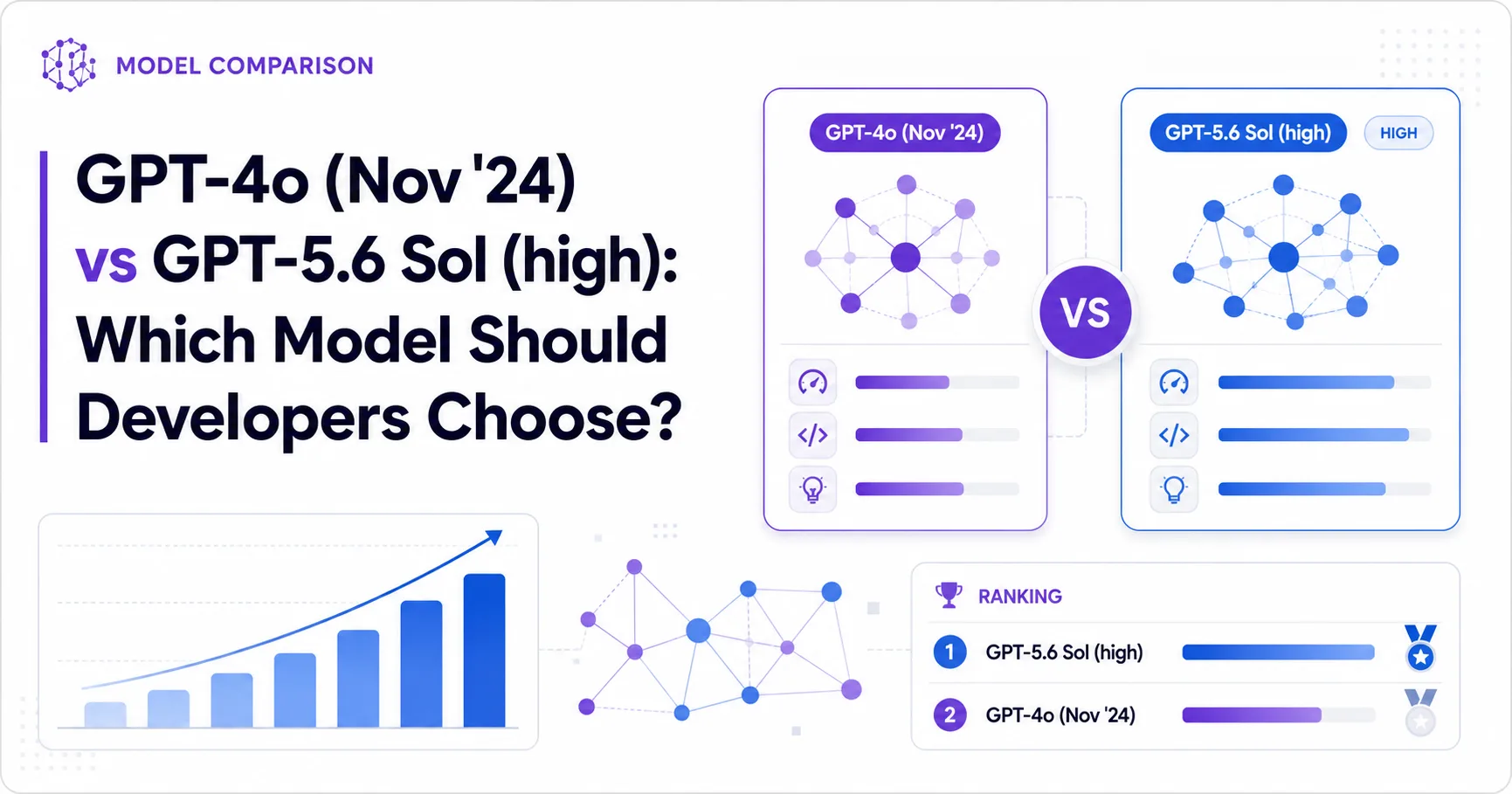
- **Winner overall:** GPT-5.6 Sol (high), with an Artificial Analysis Intelligence Index score of 55.9 versus 11.2 for GPT-4o (Nov '24) - **Cheaper:** GPT-4o (Nov '24) at $4.375 vs $11.25 per 1M blended tokens - **Faster:** GPT-5.6 Sol (high) at 73.648 median output tokens per second - **Pick GPT-5.6 Sol (high) when:** complex coding, investigation, planning, or long-context work justifies higher output quality - **Watch out:** comparable GPT-4o coding, output-speed, context-window, and GPT-5.6 Sol (high) reasoning-effort evidence is incomplete
GPT-4o (Nov '24) vs GPT-5.6 Sol (high)
GPT-5.6 Sol (high) is the stronger default for demanding developer work, while GPT-4o (Nov '24) remains the lower-cost option when workload complexity is modest.
The available data shows a large capability gap on the Artificial Analysis Intelligence Index, where GPT-5.6 Sol (high) scores 55.9 and GPT-4o (Nov '24) scores 11.2. The comparison does not establish a direct coding winner because the supplied data reports a coding score only for GPT-5.6 Sol (high). GPT-4o also has a reported math score, while GPT-5.6 Sol (high) does not have a matching value.
This is therefore a decision under uneven evidence, not a complete laboratory ranking. Data provided by supplies the quantitative comparison, while the linked OpenAI documentation establishes the current API status and feature boundaries.
Executive summary
GPT-5.6 Sol (high) offers the clearer technical fit for complex reasoning and coding, but GPT-4o (Nov '24) costs substantially less and may be easier to justify for routine requests.
| Decision factor | GPT-4o (Nov '24) | GPT-5.6 Sol (high) | What it means |
|---|---|---|---|
| Blended price per 1M tokens | $4.375 | $11.25 | GPT-4o is easier to scale for high-volume simple traffic |
| Reported intelligence index | 11.2 | 55.9 | GPT-5.6 Sol has the stronger measured general capability signal |
| Reported coding index | Not provided | 77.2 | The supplied comparison cannot prove a coding margin |
| Median output speed | Not provided | 73.648 | GPT-5.6 Sol has a measurable throughput signal |
| Latency | 0.3 seconds | 0.3 seconds | The available latency values are tied |
The product status is also materially different. The current OpenAI model directory does not list GPT-4o, so the supplied evidence cannot confirm whether that model remains directly callable, has been retired, or has been replaced. GPT-5.6 Sol remains listed as a flagship model in the current directory.
For implementation planning, GPT-5.6 Sol uses the official model ID gpt-5.6-sol, or the stable alias gpt-5.6, with high reasoning configured separately. GPT-4o has no stable alias evidence in the supplied material.
Performance: capability matters more than raw response time
GPT-5.6 Sol (high) is the better-supported choice for difficult engineering tasks, but the evidence does not prove that high reasoning effort is always faster or more efficient in production.
The most important performance difference is task depth. GPT-5.6 Sol is officially positioned for complex professional work, complex reasoning, and coding. Its documented tool surface includes structured outputs, function calling, file search, web search, code interpreter, hosted shell, computer use, MCP, and tool search. These features make it a stronger candidate for workflows that require planning, tool coordination, repository investigation, or multi-stage execution. The relevant model details are documented on the GPT-5.6 Sol model page.
The benchmark evidence supports that direction, but it has limits. GPT-5.6 Sol (high) has an Artificial Analysis Coding Index score of 77.2 and an Intelligence Index score of 55.9. GPT-4o (Nov '24) has no supplied coding score, so the data cannot quantify the coding gap. The math comparison is similarly incomplete because GPT-4o has a math score of 6 while GPT-5.6 Sol has no matching value.
The speed story is not simply “newer means faster.” GPT-5.6 Sol reports 73.648 median output tokens per second, while GPT-4o has no supplied output-speed value. Both models show latency of 0.3 seconds in the data, but latency and generation throughput answer different operational questions. A fast first response can still lead to more repair turns, while a slower reasoning process can be worthwhile if it reduces debugging effort.
Community reports add a risk signal rather than a benchmark conclusion. A Reddit release discussion describes slow subjective speed and over-engineering. A Hacker News discussion reports investigation drift and excessive defensive code, with improvement after lowering reasoning effort. These reports lack standardized tasks, so teams should test their own repositories before setting default effort to high.
Cost: GPT-4o wins the price comparison, but workload shape decides the bill
GPT-4o (Nov '24) is the lower-cost model by a wide margin, while GPT-5.6 Sol (high) can become economically preferable when stronger first-pass results reduce expensive follow-up work.
The supplied price data puts GPT-4o at $4.375 per 1M blended tokens, compared with $11.25 for GPT-5.6 Sol (high). GPT-4o is also listed at $2.5 per 1M input tokens and $10 per 1M output tokens, while GPT-5.6 Sol is listed at $5 and $30. The price gap is therefore most sensitive to generated output, especially in agentic workflows that produce plans, patches, explanations, tests, and tool calls.
A simple chat, autocomplete helper, or lightweight transformation usually gives the cheaper model a strong economic advantage. GPT-4o is the rational choice when requests are short, failure recovery is cheap, and the application can tolerate more limited evidence about current API availability. The problem is that the supplied official pricing page does not list gpt-4o, so the data price should not be treated as proof of a currently available public tariff. Consult OpenAI Pricing before production rollout.
GPT-5.6 Sol has more pricing complexity. Standard short-context input is $5, cached input is $0.5, and output is $30 per 1M tokens. The long-context prices are higher, and input beyond 272K tokens triggers the long-context pricing rule. That matters for repository analysis, long conversations, and document-heavy agents. The model page lists a context window of 1,050,000 tokens and a maximum input of 922,000 tokens, but capacity does not make long-context usage cheap.
The practical break-even question is not only token price. Measure successful task completion, repair turns, tool calls, and review time. The supplied data does not provide those production economics, so no exact cost-per-success conclusion is justified.
Recommendation by developer workload
GPT-5.6 Sol (high) should be the primary choice for high-consequence engineering tasks, while GPT-4o (Nov '24) should be reserved for low-cost work that does not depend on confirmed current availability.
| Workload | Recommended model | Reason |
|---|---|---|
| Complex debugging and architecture planning | GPT-5.6 Sol (high) | Official reasoning positioning and stronger intelligence evidence support the fit |
| Repository investigation with tools | GPT-5.6 Sol (high) | The documented tool surface supports multi-step workflows |
| High-volume classification or short transformations | GPT-4o (Nov '24) | The blended price is lower, assuming the endpoint remains available |
| Cost-sensitive output generation | GPT-4o (Nov '24) | Its reported output price is lower |
| Long-context analysis | GPT-5.6 Sol (high), with budget controls | Its documented context capacity is much larger, but long-context pricing is higher |
| Production migration decision | Validate both first | GPT-4o current availability and GPT-5.6 high-effort economics are not fully established |
Teams choosing GPT-5.6 Sol should call gpt-5.6-sol or gpt-5.6, then configure reasoning effort explicitly. The reasoning guide explains that reasoning tokens consume context and count toward output billing. A low max_output_tokens setting can produce an incomplete response before the visible answer is finished.
The safest rollout is workload routing. Send complex tasks to GPT-5.6 Sol, keep simple traffic on the lower-cost path where access is confirmed, and record completion quality, retry frequency, latency, output volume, and reviewer effort. Do not infer that the high setting has a proven return on investment. The official documentation does not disclose separate latency, token-consumption, or success-rate data for that setting.
The strongest public benchmark claims come from the GPT-5.6 release announcement, which reports results across coding, browsing, operating-system interaction, and security evaluations. The announcement does not provide an equivalent GPT-4o comparison or isolate the high setting, so those results establish positioning rather than a complete apples-to-apples decision.
FAQ for developers
GPT-5.6 Sol (high) is the safer default for demanding development workflows, but teams should validate availability, output cost, and task quality in their own environment.
The central uncertainty is not whether GPT-5.6 Sol has broader documented capabilities. It does. The uncertainty is how much those capabilities improve a specific application after reasoning cost, retries, latency tolerance, tool orchestration, and human review are included. GPT-4o also has an important operational uncertainty because the current OpenAI model directory and pricing page do not list it.
The GPT-5.6 Sol model documentation, OpenAI model directory, and OpenAI pricing documentation should be checked immediately before implementation. Community feedback from Reddit and Hacker News is useful for forming test hypotheses, not for replacing controlled evaluation.
Frequently asked questions
Which model should I choose for coding agents?
GPT-5.6 Sol (high) is the stronger starting point for coding agents because its official positioning covers complex coding and its supplied Coding Index score is 77.2, although GPT-4o lacks a comparable score.
Is GPT-4o the better choice for cost-sensitive applications?
GPT-4o (Nov '24) is cheaper at $4.375 per 1M blended tokens versus $11.25 for GPT-5.6 Sol (high), provided the endpoint is still available and simpler output quality meets requirements.
Does GPT-5.6 Sol (high) respond faster?
GPT-5.6 Sol (high) has a reported median output speed of 73.648 tokens per second, but GPT-4o has no supplied speed value, so the comparison cannot prove a faster model.
Can I call GPT-5.6 Sol high as a separate model ID?
GPT-5.6 Sol (high) is not a separate official model ID; use gpt-5.6-sol or the stable alias gpt-5.6, then configure reasoning.effort: "high".
What is the biggest risk with choosing GPT-5.6 Sol (high)?
GPT-5.6 Sol (high) may increase output cost, waiting time, or unnecessary implementation complexity, while official documentation does not provide separate high-effort success-rate and latency evidence.
Sources
- Artificial AnalysisQuantitative model comparison data, pricing values, benchmark values, latency, and output-speed data
- Models | OpenAI APICurrent model directory and GPT-4o availability status
- Pricing | OpenAI APICurrent pricing listings and GPT-5.6 Sol pricing rules
- GPT-5.6 Sol model pageModel ID, alias, context capacity, modalities, APIs, tools, and official positioning
- Reasoning modelsReasoning effort, reasoning tokens, output limits, incomplete responses, and model configuration
- GPT-5.6: Frontier intelligence that scales with your ambitionOfficial release positioning and benchmark claims
- GPT-5.6 Sol / Codex Release Discussion MegathreadCommunity reports about subjective speed and over-engineering
- Ask HN: How are you productive with GPT 5.6 Sol?Community reports about investigation drift, defensive code, and reasoning-effort changes
Published: