
AI model analysis
GPT-5.2 (xhigh) vs o3: Which OpenAI Model Should Developers Choose?
A developer-focused comparison of GPT-5.2 (xhigh) and o3, covering measured capability, speed, cost, API availability, and model-selection risk.
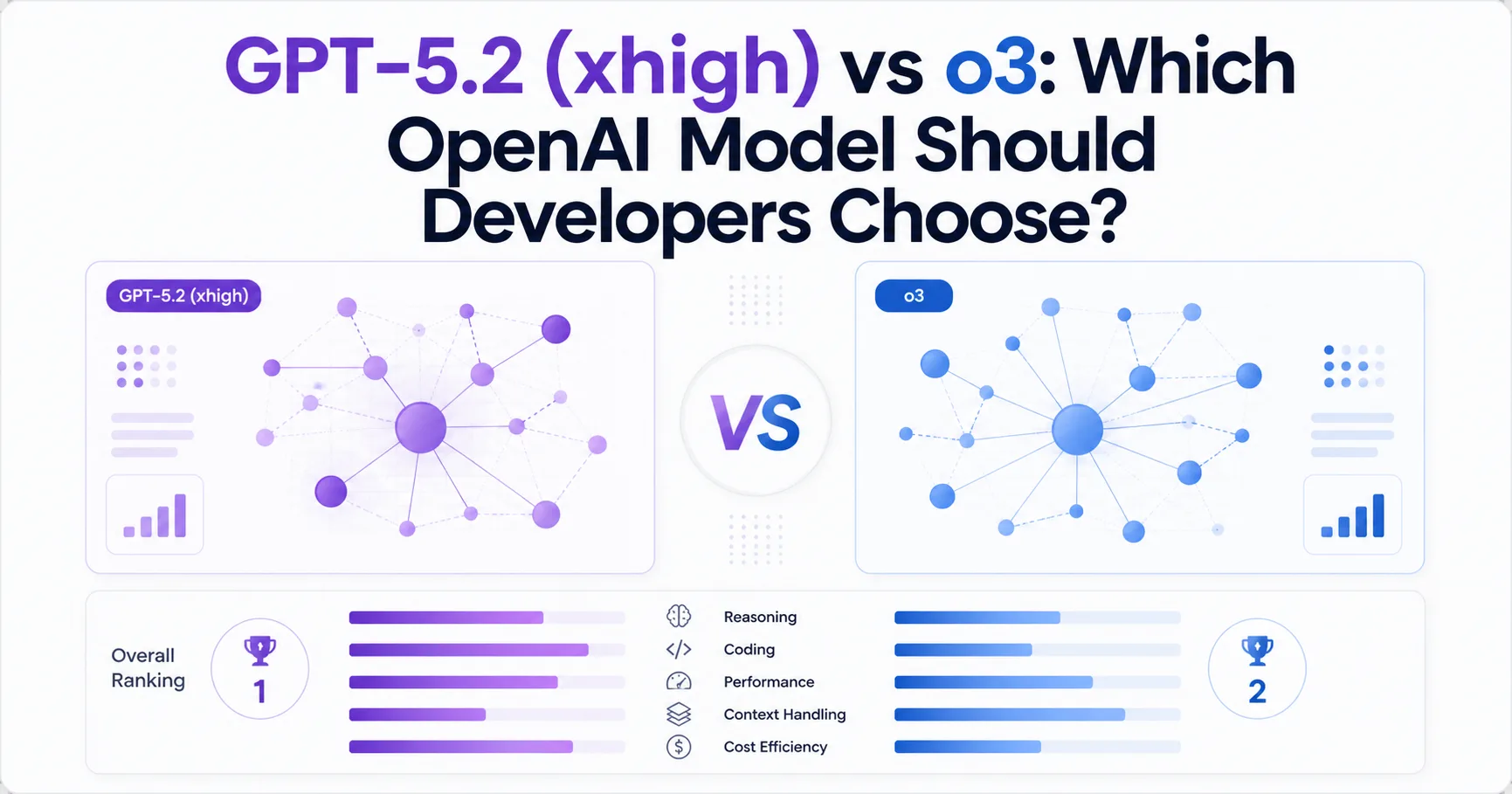
- **Winner overall:** GPT-5.2 (xhigh), with an Artificial Analysis Intelligence Index of 42.2 vs 30.4 and a Math Index of 99 vs 88.3 - **Cheaper:** o3 at $3.5 vs $4.8125 per 1M blended tokens - **Faster:** o3 at 128.056 median output tokens per second, while GPT-5.2 (xhigh) has no reported value - **Pick GPT-5.2 (xhigh) when:** higher measured reasoning quality matters more than output cost and current access is already verified - **Watch out:** official pages do not confirm current API availability, stable aliases, or version-specific limits for either model Data provided by https://artificialanalysis.ai/
GPT-5.2 (xhigh) vs o3
GPT-5.2 (xhigh) is the stronger measured model, while o3 is the safer choice only when lower blended cost and verified output speed outweigh capability differences. Artificial Analysis reports GPT-5.2 (xhigh) at 42.2 on its Intelligence Index and 99 on its Math Index, compared with 30.4 and 88.3 for o3. The same dataset reports o3 at 128.056 median output tokens per second, while GPT-5.2 (xhigh) has no reported output-speed value. Both models show 0.3 seconds of reported latency.\n\nThe larger selection risk is operational rather than purely technical. The current OpenAI Models page does not list GPT-5.2, gpt-5-2, xhigh, or o3. The current OpenAI Pricing page also does not list either model. Developers should therefore treat this comparison as a measured capability and economics comparison, not proof of current production availability.
Executive summary for developers
GPT-5.2 (xhigh) offers the stronger measured capability profile, but o3 presents a lower-cost and better-documented speed signal in the supplied data. GPT-5.2 (xhigh) leads o3 by 11.800000000000004 points on the Artificial Analysis Intelligence Index and by 10.700000000000003 points on the Artificial Analysis Math Index. Those gaps suggest a meaningful advantage for demanding reasoning and mathematics workloads, although the brief does not provide task-level examples or a verified benchmark methodology beyond the named indexes.\n\n| Decision factor | GPT-5.2 (xhigh) | o3 | Practical reading |\n|—|—:|—:|—|\n| Intelligence Index | 42.2 | 30.4 | GPT-5.2 (xhigh) has the stronger measured general capability signal |\n| Math Index | 99 | 88.3 | GPT-5.2 (xhigh) has the stronger measured mathematics signal |\n| Blended price per 1M tokens | $4.8125 | $3.5 | o3 costs less under the supplied blended mix |\n| Input price per 1M tokens | $1.75 | $2 | GPT-5.2 (xhigh) costs less for input-heavy traffic |\n| Output price per 1M tokens | $14 | $8 | o3 costs less for output-heavy traffic |\n| Reported latency | 0.3 seconds | 0.3 seconds | The supplied latency figures are tied |\n\nThe official evidence is incomplete for both choices. OpenAI Models does not provide version-specific context windows, output limits, API parameters, or benchmark results for either model in the supplied material. It also does not confirm whether either model remains directly callable. That omission matters because a model with a better score is not a usable production dependency until its endpoint, alias, limits, and lifecycle are verified.
Performance: what the score gap means
GPT-5.2 (xhigh) has the stronger measured capability signal, but o3 has the only reported streaming-speed measurement in the supplied comparison. The Intelligence Index gap is 11.800000000000004 points, and the Math Index gap is 10.700000000000003 points. For developers, that pattern favors GPT-5.2 (xhigh) for tasks where answer quality, mathematical reliability, or difficult multi-step reasoning affects downstream rework. It does not prove that GPT-5.2 (xhigh) wins every coding task. The brief contains no verified coding benchmark, failure-case report, or reproducible community test for either model.\n\no3’s 128.056 median output tokens per second is useful evidence for interactive generation, but it cannot establish that o3 will feel faster in every application. User-perceived responsiveness also depends on prompt size, time to first token, tool calls, retries, output length, and application rendering. The supplied data reports 0.3 seconds of latency for each model, so the available latency signal does not separate them. GPT-5.2 (xhigh) has no reported median output-speed value, which makes any speed ranking between the two models incomplete.\n\nThe official documentation creates a second performance boundary. OpenAI Models gives no version-specific context window, output cap, API parameter set, or official benchmark for GPT-5.2 (xhigh) or o3 in the supplied material. Developers should benchmark their own prompts before assigning either model to code generation, agent loops, or latency-sensitive interfaces.
Cost: the cheaper model is not always cheaper
o3 is the cheaper default for blended and output-heavy workloads, while GPT-5.2 (xhigh) can be cheaper when input tokens dominate the bill. The supplied blended price is $3.5 per 1M tokens for o3 versus $4.8125 for GPT-5.2 (xhigh). Output pricing widens the difference further, at $8 for o3 versus $14 for GPT-5.2 (xhigh). That makes o3 the more natural fit for applications that generate long answers, produce many code patches, or run repeated model-led workflows.\n\nGPT-5.2 (xhigh) costs $1.75 per 1M input tokens, compared with $2 for o3. The lower input price can matter for retrieval-heavy systems that send large context and request compact responses. The capability gap can also change effective cost. If GPT-5.2 (xhigh) resolves a task in fewer attempts, needs fewer repair calls, or prevents an expensive downstream review, its higher token rate may still produce a lower cost per completed outcome. The supplied brief does not include retries, token consumption by task, success rates, or production workload distributions, so that effective-cost conclusion cannot be quantified.\n\nPricing availability remains unresolved. OpenAI Pricing does not list GPT-5.2 (xhigh) or o3 in the supplied material, and it does not confirm current Standard, Batch, Flex, or Fast mode prices for either model. Treat the Artificial Analysis figures as comparison data, then verify an active account-level price before committing architecture or budget.
Recommendation by workload
GPT-5.2 (xhigh) is the better first choice for high-stakes reasoning, while o3 is the better first choice for cost-sensitive generation with verified access. The measured scores favor GPT-5.2 (xhigh) on both supplied evaluations, including a Math Index of 99. That makes it the stronger candidate for mathematical analysis, complex planning, and workflows where a wrong answer creates substantial review or correction cost. The evidence does not establish a coding-specific winner, because the brief contains no reliable coding tests or community reports for either model.\n\nChoose o3 when the application produces substantial output, requires a reported speed signal, or has a strict blended-token budget. Its $3.5 blended price and $8 output price are lower than GPT-5.2 (xhigh)'s $4.8125 and $14. Its 128.056 median output tokens per second is also the only supplied output-speed measurement. Those advantages are conditional because the official OpenAI Models page does not confirm that o3 remains directly callable.\n\nFor a new production integration, verify availability before model testing. The current directory reportedly centers on GPT-5.6 series models, and the supplied official material does not describe a formal replacement path for either GPT-5.2 (xhigh) or o3. If access is confirmed, run the same representative prompt set against both models, measure completed-task cost, and keep a fallback model because lifecycle status is not established by the supplied sources.
Evidence gaps that should change your rollout plan
o3 has no verified current lifecycle status, just as GPT-5.2 (xhigh) has no verified current lifecycle status in the supplied official documentation. The OpenAI Models page does not list either model, and the brief does not identify a stable alias, active endpoint, successor relationship, context window, output limit, or version-specific parameter set for either choice. The absence of a listing is not proof that an account cannot access a model, but it is enough to make availability an explicit rollout gate.\n\nThe community evidence is also insufficient. No reliable Reddit, Hacker News, or X source was found with a confirmed original post, test method, and clear discussion of coding behavior, speed perception, or model quirks. Developers should not convert the supplied benchmark spread into claims about refactoring quality, tool use, instruction following, or failure modes. The comparison can support a shortlist, but it cannot replace a task-specific evaluation or an API availability check.
Frequently asked questions
Which model should I choose for difficult reasoning tasks?
Choose GPT-5.2 (xhigh) when difficult reasoning quality is the primary criterion, because the supplied Artificial Analysis results place it at 42.2 on the Intelligence Index versus 30.4 for o3. The brief does not prove superiority on every coding or agent task.
Which model is cheaper for production use?
o3 is cheaper under the supplied blended pricing, at $3.5 per 1M tokens versus $4.8125 for GPT-5.2 (xhigh). GPT-5.2 (xhigh) has the lower input price, so input-heavy workloads can produce a different cost outcome.
Is o3 faster than GPT-5.2 (xhigh)?
o3 has the only supplied output-speed measurement, at 128.056 median output tokens per second, while GPT-5.2 (xhigh) has no reported value. The latency figures are tied at 0.3 seconds, so a complete speed ranking is not supported.
Can I safely start a new API integration with either model?
Do not assume current availability for either model until you verify it in your account and endpoint configuration. The supplied OpenAI Models page does not list GPT-5.2 (xhigh) or o3, and no stable alias is confirmed.
Does the comparison prove GPT-5.2 (xhigh) is better at coding?
No, the comparison does not prove a coding-specific advantage. GPT-5.2 (xhigh) leads the supplied general Intelligence Index and Math Index, but the brief contains no reliable coding benchmark, reproducible community test, or confirmed coding failure analysis.
Sources
- OpenAI ModelsVerifying current model-directory visibility, official capability descriptions, API availability evidence, version-specific documentation gaps, and lifecycle uncertainty for GPT-5.2 (xhigh) and o3.
- OpenAI PricingVerifying current pricing-page visibility and the absence of supplied official Standard, Batch, Flex, or Fast mode prices for GPT-5.2 (xhigh) and o3.
Published: