
AI model analysis
GPT-5.4 (xhigh) vs GPT-5 mini (high): Which Model Should Developers Choose?
A developer-focused comparison of GPT-5.4 (xhigh) and GPT-5 mini (high), covering capability, coding performance, cost, availability, and model-selection risks.
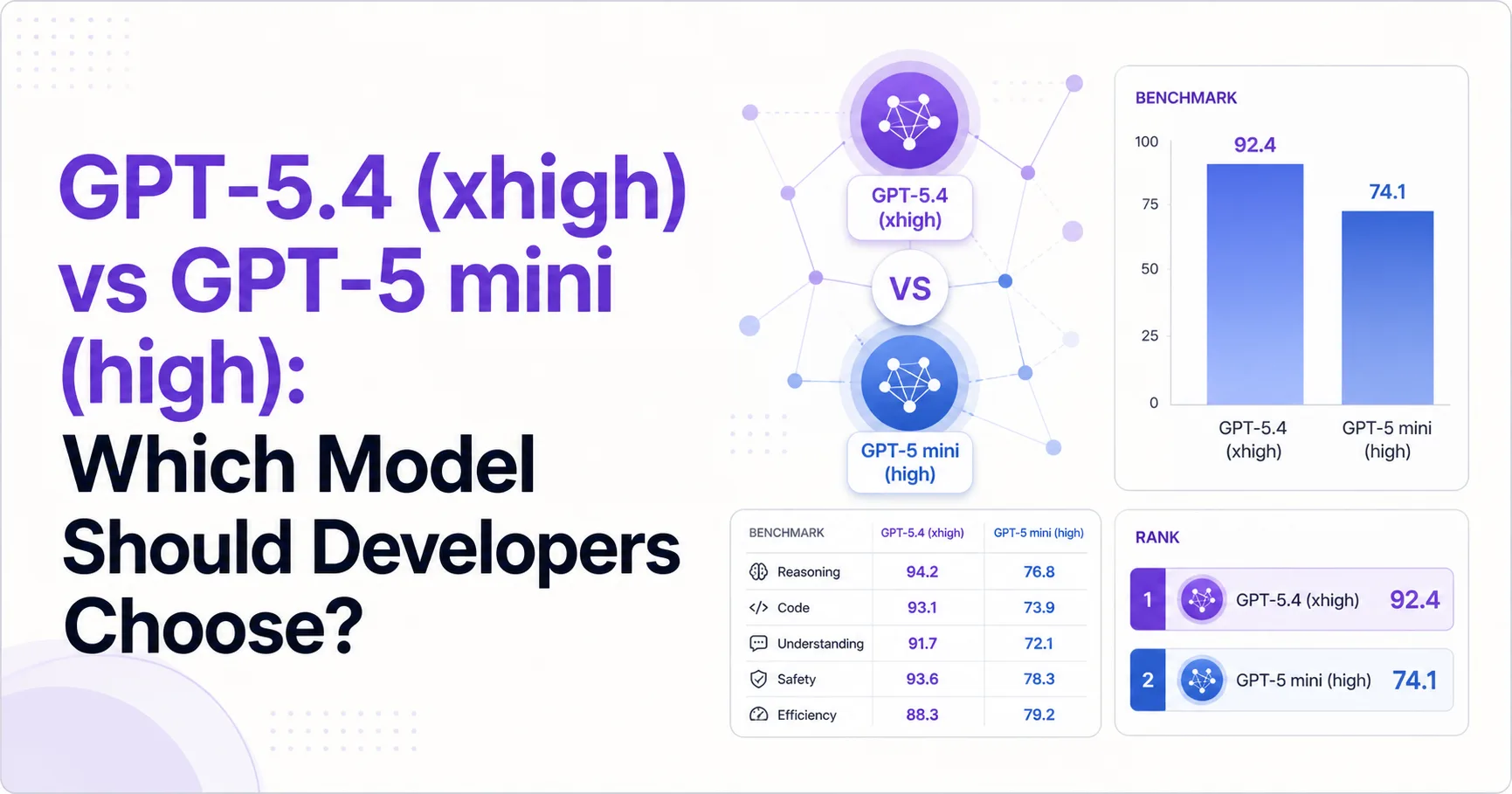
- **Winner overall:** GPT-5.4 (xhigh), with an Artificial Analysis Intelligence Index of 51.4 and Coding Index of 71.1 - **Cheaper:** GPT-5 mini (high) at $0.6875 vs $5.625 per 1M blended tokens - **Faster:** GPT-5.4 (xhigh) and GPT-5 mini (high) tie at 0.3 seconds latency - **Pick GPT-5 mini (high) when:** low cost matters most and your workload is math-heavy, where it records a 90.7 Math Index - **Watch out:** GPT-5 mini (high) is not currently listed on OpenAI’s model or pricing pages, so availability and official specifications remain unverified
GPT-5.4 (xhigh) vs GPT-5 mini (high)
GPT-5.4 (xhigh) is the safer default for developers who value broad capability, coding quality, and documented tool support over minimum cost.
The comparison is unusually asymmetric. The available data gives GPT-5.4 (xhigh) a much higher Artificial Analysis Intelligence Index of 51.4 and Coding Index of 71.1. GPT-5 mini (high) scores 25.3 and 15.6 on those same indexes, while also recording a Math Index of 90.7. The data therefore points to a clear general-purpose advantage for GPT-5.4, but it does not prove that GPT-5 mini is inferior for every narrow task.
The larger issue is product certainty. OpenAI documents GPT-5.4 directly, including its reasoning settings, tools, context window, output limit, and API aliases in the GPT-5.4 model documentation. The current OpenAI model directory does not list GPT-5 mini, so its exact API identity and availability cannot be confirmed from the current model catalog.
Developers should treat GPT-5.4 as the production baseline and GPT-5 mini as a cost-sensitive candidate that requires an availability check before adoption.
Executive summary
GPT-5.4 (xhigh) wins the broad developer comparison, while GPT-5 mini (high) wins the cost and narrow mathematics tradeoff.
| Decision area | Better choice | Evidence and implication |
|---|---|---|
| General capability | GPT-5.4 (xhigh) | Intelligence Index: 51.4 vs 25.3 |
| Coding | GPT-5.4 (xhigh) | Coding Index: 71.1 vs 15.6 |
| Mathematics | GPT-5 mini (high) in the available data | Math Index: 90.7 for GPT-5 mini; no GPT-5.4 value is provided |
| Blended cost | GPT-5 mini (high) | $0.6875 vs $5.625 per 1M blended tokens |
| Latency | Tie | Both models record 0.3 seconds |
| Official product certainty | GPT-5.4 (xhigh) | GPT-5.4 has a dedicated current model page; GPT-5 mini does not appear in the current catalog |
GPT-5.4 is documented as a model for complex professional work, coding, tool use, and computer operation in OpenAI’s launch announcement. Its API supports reasoning effort values including none, low, medium, high, and xhigh, with xhigh representing a setting rather than a separate model alias according to the model page.
GPT-5 mini looks attractive for high-volume workloads because its blended price is much lower. However, the current OpenAI catalog and pricing page do not verify its listing, stable alias, or current price in the model directory or in the pricing documentation. That gap makes the cheaper choice less operationally certain than the data table suggests.
The practical conclusion is simple: choose GPT-5.4 for complex application behavior, and evaluate GPT-5 mini only after confirming that the exact model identifier can be called in your target account.
Performance: what the score gap means for real applications
GPT-5.4 (xhigh) is the stronger general-purpose engineering model in the available evaluation data.
The coding gap is large enough to affect architecture decisions. GPT-5.4 records a Coding Index of 71.1, compared with 15.6 for GPT-5 mini. That does not mean every code completion will be better, nor does it identify the exact tasks behind the index. It does indicate that developers should expect a meaningful difference on workloads involving repository understanding, multi-step changes, debugging, and tool-mediated implementation, provided the evaluation is relevant to their application.
GPT-5.4 also leads on the general Intelligence Index, with 51.4 versus 25.3. This matters most when the model must combine requirements, inspect evidence, make tradeoffs, and produce a usable result in one workflow. A higher general score can reduce the need for manual decomposition, but it cannot replace application-level validation.
The mathematics result changes the shape of the decision. GPT-5 mini records a Math Index of 90.7, while no GPT-5.4 mathematics value is supplied. Developers should not convert that single result into a universal claim that GPT-5 mini reasons better. The evidence supports a narrower statement: GPT-5 mini may deserve a focused trial for math-heavy workloads, while the provided data does not establish a direct GPT-5.4 comparison on that index.
Latency does not separate the models. Both record 0.3 seconds, so the choice should not be justified by an assumed speed advantage. Output speed is unavailable for both models in the data brief. Community reports also disagree about GPT-5.4 latency and stability, and the available discussions do not provide reproducible prompts, request sizes, or scoring methods in the Hacker News discussion and one latency-related comment.
GPT-5.4’s documented tool surface is another practical advantage. Its Responses API can use web search, file search, code interpreter, hosted shell, computer use, MCP, and related tools in the official model documentation. No equivalent official capability list is available for GPT-5 mini.
Cost: the cheaper model can become the riskier choice
GPT-5 mini (high) is the clear price winner, but its lower unit cost does not settle the production economics.
The available data places GPT-5 mini at $0.6875 per 1M blended tokens, compared with $5.625 for GPT-5.4. Its listed input price is $0.25 versus $2.5, and its output price is $2 versus $15. Those differences make GPT-5 mini compelling for bulk classification, inexpensive drafting, routing, and other workloads where a lower-quality result can be detected or repaired cheaply.
The decision can reverse when errors require human review, additional model calls, retries, or complex orchestration. A cheap model that misses repository context or produces unreliable code may create more engineering work than a higher-priced model that completes the task in fewer attempts. The data brief does not provide retry rates, human-review costs, or task-level success rates, so no exact break-even point can be established.
GPT-5.4 also has a specific long-context cost risk. OpenAI states that input beyond 272K tokens causes the full session to use higher input and output billing multipliers on the GPT-5.4 model page. A system that repeatedly carries large histories may therefore cost substantially more than a short-context estimate suggests. Developers should measure retained context, tool traces, and output length rather than relying only on average request volume.
Batch and Flex pricing can change the economics for asynchronous jobs, while Fast mode and eligible data-residency endpoints introduce separate pricing rules in OpenAI’s pricing documentation. The correct comparison depends on traffic shape, latency requirements, caching, context length, and the cost of incorrect outputs.
Community evidence reinforces the need for budget controls. One user reported spending about $300–400 per month while running one or two agents, but the report is personal and lacks a reproducible workload definition in the Hacker News comment. Treat that report as a warning about usage patterns, not as a forecast.
Recommendation by workload
GPT-5.4 (xhigh) should anchor production systems that turn complex instructions into code, analysis, or tool actions.
Choose GPT-5.4 when the application needs several of the following characteristics: reliable repository-level coding, structured outputs, function calls, long documents, visual inputs, tool use, or computer interaction. OpenAI documents text and image input, text output, streaming, function calling, structured outputs, and support for Responses, Chat Completions, and Batch APIs in the GPT-5.4 model documentation. The model is also available through the stable gpt-5.4 alias, with a lockable snapshot named gpt-5.4-2026-03-05 on the same official page.
Choose GPT-5 mini only for a controlled cost-sensitive experiment until its official availability is confirmed. It is a reasonable candidate for workloads with strict budgets, high request volume, simple fallback paths, or a specialized mathematics component. Its Math Index of 90.7 is the strongest narrow signal in the comparison, but the missing GPT-5.4 value prevents a complete head-to-head mathematics conclusion.
Do not select GPT-5 mini solely because its benchmark record looks attractive or because its unit price is lower. The current OpenAI catalog does not list gpt-5-mini, and the current pricing page does not provide a dedicated entry for it in the model directory and pricing page. The research brief also found no reliable community testing that verifies its coding behavior, speed, or stability.
A sensible rollout uses GPT-5.4 for difficult requests and sends only well-understood, low-risk traffic to the mini candidate. Log task type, repair attempts, reviewer intervention, token mix, and final acceptance. The supplied sources do not provide those operational measurements, so developers must collect them before making a permanent routing rule.
The final recommendation is therefore conditional. GPT-5.4 is the better default for developers buying capability and operational clarity. GPT-5 mini is worth testing where cost dominates and the application can detect failure, but its undocumented product status is itself a selection risk.
Questions to resolve before implementation
GPT-5 mini (high) is the model that requires the most verification before a production commitment.
The central unanswered question is whether the name in the data brief maps to a currently callable OpenAI API model. The current official directory does not show a dedicated entry, and the pricing page does not show a dedicated price. That means developers should verify the exact model identifier, account access, supported parameters, rate limits, and billing behavior in their own environment.
The second unanswered question concerns workload fit. The available scores show a strong GPT-5.4 advantage in general intelligence and coding, but they do not explain which task families produce those results. They also show GPT-5 mini at 90.7 on the Math Index without a corresponding GPT-5.4 value. A local evaluation should therefore separate coding, mathematics, retrieval, structured extraction, tool use, and long-context behavior.
Finally, GPT-5.4’s official capabilities do not guarantee application success. Context organization, prompts, tool schemas, retries, and validation remain important. Community users describe both stable complex-task performance and configuration-sensitive outcomes in the broader Hacker News thread, so production teams should test their own workflows.
Frequently asked questions
Is GPT-5.4 (xhigh) better than GPT-5 mini (high) for coding?
GPT-5.4 (xhigh) is the stronger coding choice in the supplied data, with a Coding Index of 71.1 compared with 15.6 for GPT-5 mini. That evidence supports a general preference, not a guarantee for every repository, language, or prompt.
Should developers choose GPT-5 mini because it is much cheaper?
GPT-5 mini deserves a cost-focused trial, but developers should not choose it for production solely because its blended price is $0.6875 compared with $5.625. Verify availability and measure repair, review, and retry costs first.
Which model is faster?
Neither model has a measured latency advantage in the supplied comparison because GPT-5.4 (xhigh) and GPT-5 mini (high) both record 0.3 seconds. Output-speed data is unavailable for both models.
Is GPT-5 mini officially available through the OpenAI API?
The supplied research cannot confirm current official availability for GPT-5 mini. The current OpenAI model directory does not list it, and the pricing page provides no dedicated entry, so developers must verify access directly.
When is GPT-5 mini worth testing?
GPT-5 mini is worth testing for low-risk, high-volume workloads with strong validation and fallback paths, especially mathematics-oriented tasks where the supplied data reports a Math Index of 90.7.
Sources
- GPT-5.4 ModelOfficial GPT-5.4 capabilities, reasoning settings, context limits, API support, tools, pricing multipliers, aliases, snapshot, and limitations
- Models | OpenAI APICurrent OpenAI model catalog and the absence of a dedicated GPT-5 mini listing
- Pricing | OpenAI APIOpenAI standard, Batch, Flex, Fast mode, and model pricing availability
- Introducing GPT-5.4Official GPT-5.4 positioning for professional work, coding, tool use, and computer operation
- GPT 5.4 in practice – Stinks?Community disagreement about GPT-5.4 stability, configuration sensitivity, and practical experience
- Hacker News comment 47704353Personal GPT-5.4 usage cost and multi-agent experience
- Hacker News comment 47704323Community feedback about GPT-5.4 latency and usage experience
Published: