
AI model analysis
GPT-5.5 (high) vs GPT-5 mini (high): Which Model Should Developers Choose?
A developer-focused comparison of GPT-5.5 (high) and GPT-5 mini (high), covering capability, coding performance, cost, availability evidence, and model-selection tradeoffs.
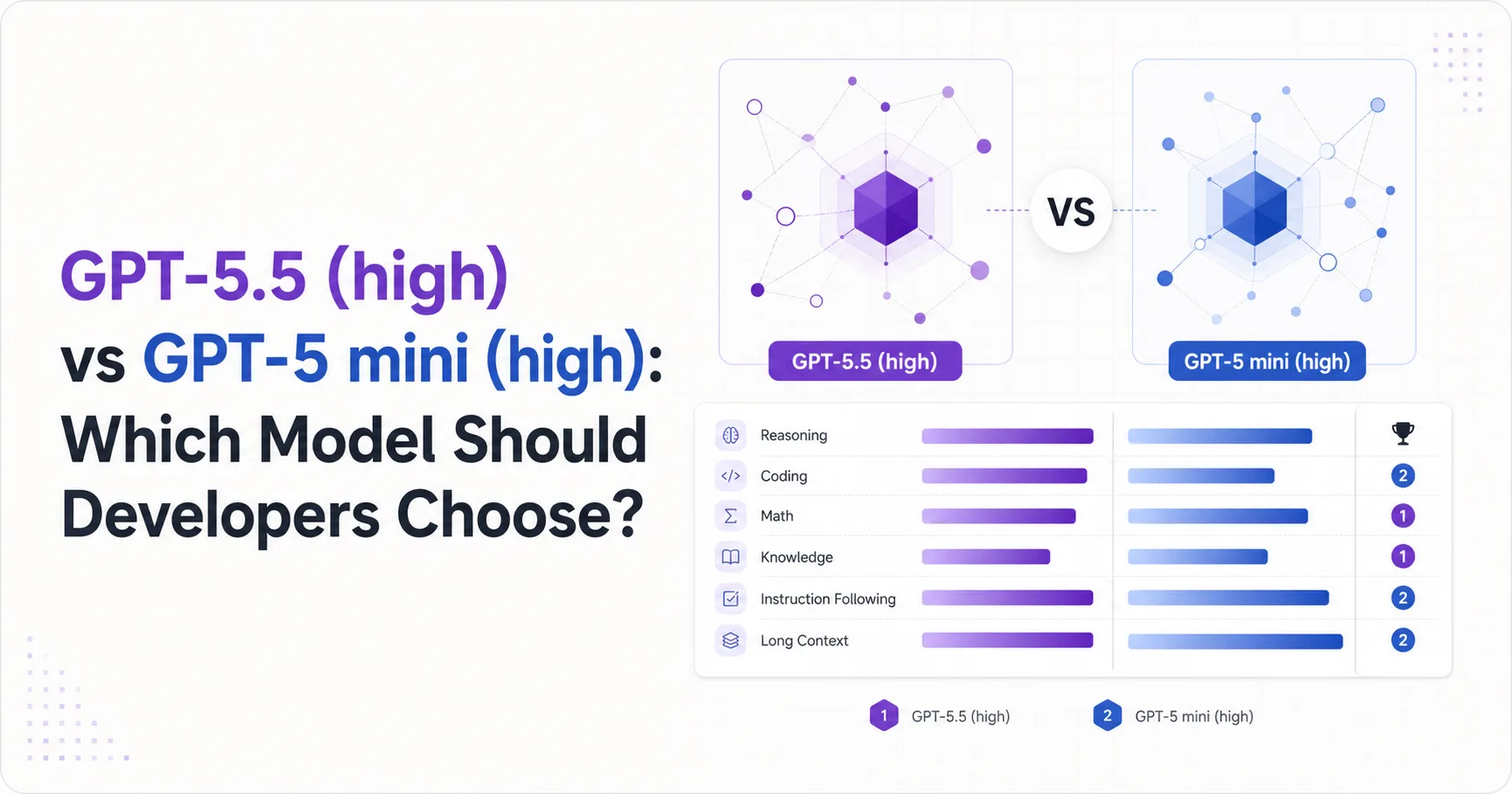
- **Winner overall:** GPT-5.5 (high), with a 71.6 coding index versus 15.6 for GPT-5 mini (high) - **Cheaper:** GPT-5 mini (high) at $0.6875 vs $11.25 per 1M blended tokens - **Faster:** GPT-5.5 (high) and GPT-5 mini (high) tie at 0.3 seconds latency - **Pick GPT-5 mini (high) when:** mathematical evaluation matters most, because it records a 90.7 math index and the comparison has no GPT-5.5 math score - **Watch out:** GPT-5 mini (high) has a reported $0.6875 blended price, but current official pages do not verify its API listing or availability
GPT-5.5 (high) vs GPT-5 mini (high)
GPT-5.5 (high) is the stronger default for serious software work, while GPT-5 mini (high) is the lower-cost specialist choice when its availability is confirmed. Artificial Analysis reports a coding index of 71.6 for GPT-5.5 (high) and 15.6 for GPT-5 mini (high), a large separation for development tasks (Artificial Analysis). The same snapshot reports blended prices of $11.25 and $0.6875 per 1M tokens, so the smaller model costs substantially less (Artificial Analysis).
The practical decision is therefore not simply quality versus price. GPT-5.5 (high) has a documented API model, a documented reasoning configuration, and official positioning for coding, tool-based agents, long-context retrieval, computer operation, knowledge work, and scientific research (GPT-5.5 model page, GPT-5.5 usage guide). GPT-5 mini (high) lacks a current official model entry, a verified pricing entry, and a confirmed relationship between the display name and an API model ID (OpenAI Models, OpenAI Pricing).
For a production team, that availability gap changes the recommendation. GPT-5.5 (high) is easier to validate, pin, monitor, and support. GPT-5 mini (high) may be attractive for high-volume or math-heavy workloads, but the supplied evidence does not establish that developers can currently call it reliably through a public API.
Executive summary
GPT-5.5 (high) wins the broad developer comparison because its documented product surface aligns with its stronger coding and intelligence scores. The supplied data reports an Artificial Analysis coding index of 71.6 for GPT-5.5 (high), compared with 15.6 for GPT-5 mini (high), and an intelligence index of 53.1 versus 25.3 (Artificial Analysis).
| Decision factor | GPT-5.5 (high) | GPT-5 mini (high) | What it means |
|---|---|---|---|
| Coding index | 71.6 | 15.6 | GPT-5.5 (high) is the safer engineering default |
| Intelligence index | 53.1 | 25.3 | GPT-5.5 (high) has the broader measured advantage |
| Math index | Not provided | 90.7 | GPT-5 mini (high) has the only reported math result |
| Blended price per 1M tokens | $11.25 | $0.6875 | GPT-5 mini (high) is the economical candidate |
| Latency | 0.3 seconds | 0.3 seconds | The snapshot shows no latency advantage |
The official evidence is asymmetric. GPT-5.5 (high) maps to the API model gpt-5.5 with reasoning.effort set to high; the official model page documents supported effort levels, a fixed snapshot, modalities, endpoints, and tools (GPT-5.5 model page). The current model directory does not list gpt-5-mini, and the pricing page does not list its standard, Batch, Flex, or Fast mode prices (OpenAI Models, OpenAI Pricing).
That means the data snapshot and current official documentation answer different questions. Artificial Analysis supplies a comparative measurement and price record. OpenAI’s current pages supply evidence about documented availability. The materials do not prove that GPT-5 mini (high) is unusable, deprecated, or permanently unavailable. They only show that its current public API status cannot be verified from the supplied official pages.
Performance: what the score gap means for developers
GPT-5.5 (high) is the better fit for multi-step engineering work because its measured coding advantage is large enough to affect review burden, recovery work, and task scope. Artificial Analysis reports coding indices of 71.6 for GPT-5.5 (high) and 15.6 for GPT-5 mini (high) (Artificial Analysis). The comparison does not provide task-level pass rates, error categories, or an independent reproduction, so the score gap should guide testing rather than replace it.
A higher coding score matters most when the model must understand an existing repository, change several related areas, preserve interfaces, and verify the result. GPT-5.5 (high) is officially positioned for coding and tool-based agents, and OpenAI documents support for function calling, file search, web search, code execution, computer use, MCP, and related tools (GPT-5.5 usage guide, GPT-5.5 model page). Those capabilities make the model a stronger candidate for repository changes and operational workflows, provided the application defines success criteria, stopping conditions, tool rules, and verification steps (GPT-5.5 usage guide).
GPT-5 mini (high) remains interesting for narrower tasks. The snapshot reports a math index of 90.7 for GPT-5 mini (high), while no GPT-5.5 math value is supplied (Artificial Analysis). That result is not enough to establish overall superiority in mathematical reasoning because the comparison lacks a corresponding GPT-5.5 score and does not describe the benchmark methodology.
Speed does not resolve the choice. The supplied snapshot gives both models a latency value of 0.3 seconds and no median output-tokens-per-second value (Artificial Analysis). No reliable independent speed test for GPT-5.5 (high) was found, and no verified community test establishes GPT-5 mini (high) speed. Teams should measure end-to-end time under their own prompts, tools, retries, and output limits.
Cost: when the cheaper model can become expensive
GPT-5 mini (high) is dramatically cheaper on the supplied price record, but GPT-5.5 (high) can be cheaper at the workflow level if it prevents repeated attempts and manual repair. Artificial Analysis reports blended prices of $0.6875 per 1M tokens for GPT-5 mini (high) and $11.25 for GPT-5.5 (high) (Artificial Analysis). The same snapshot reports input prices of $0.25 and $5, and output prices of $2 and $30 respectively (Artificial Analysis).
The raw price advantage favors GPT-5 mini (high) for predictable, short, high-volume work. Examples include simple transformations, classification, extraction, routine drafting, and calculations where the application can validate outputs cheaply. The supplied evidence does not verify the model’s current API access, so procurement and deployment risk must be resolved before treating that price as actionable (OpenAI Models, OpenAI Pricing).
GPT-5.5 (high) becomes more defensible when a failure triggers an expensive human review, a second model call, a rollback, or a broken deployment. Community reports describe large files, duplicate implementations, database design problems, regressions, instruction drift, unrelated file changes, and premature completion in some GPT-5.5 workflows, but those reports are personal experiences without a uniform test method (Reddit report, OpenAI Developer Community report). These reports argue for supervision and validation, not for a definitive quality ranking.
Long-context usage can also change GPT-5.5’s economics. OpenAI states that inputs above 272K tokens apply higher pricing to the entire session, while the usage guide warns that high-detail image processing can increase input tokens and latency (GPT-5.5 model page, GPT-5.5 usage guide). A team comparing models should price the complete workflow, including context repetition, tool calls, retries, validation, and human intervention.
Recommendation by workload
GPT-5.5 (high) should be the default choice for production engineering agents, while GPT-5 mini (high) should be considered only after API availability and task fit are verified. The recommendation follows the measured coding gap, the documented GPT-5.5 tool surface, and the absence of current official evidence for the mini model (Artificial Analysis, GPT-5.5 model page, OpenAI Models).
Choose GPT-5.5 (high) for repository-wide coding, debugging across multiple files, tool-driven agents, computer-operation workflows, complex technical research, and tasks where the output must be checked against explicit acceptance criteria. OpenAI recommends the Responses API for reasoning, tool calls, and multi-turn state, and documents controls for reasoning effort and response verbosity (GPT-5.5 usage guide).
Choose GPT-5 mini (high) for cost-sensitive workloads only when a working endpoint is confirmed and the application has strong validation. The reported $0.6875 blended price makes it compelling for large request volumes, while the reported 90.7 math index makes mathematical workloads worth testing (Artificial Analysis). The evidence does not show whether that math result transfers to production coding, structured extraction, agent loops, or long-context retrieval.
A sensible rollout uses task routing instead of one universal model. Send high-risk software changes to GPT-5.5 (high). Send cheap, bounded tasks to GPT-5 mini (high) after a canary confirms availability and output quality. Keep a human review path for architecture changes, database migrations, deployment actions, and tasks with broad tool permissions. OpenAI specifically warns that higher reasoning effort does not guarantee better results and that unclear stopping conditions can cause excessive searching or quality loss (GPT-5.5 usage guide).
The strongest unresolved question is not benchmark performance. It is whether GPT-5 mini (high) represents a currently callable public API configuration. The supplied materials do not answer that question. Teams should obtain a successful API request, model identifier, terms, and current billing record before committing production architecture to it.
Availability and evidence limits
GPT-5.5 (high) has verifiable current documentation, while GPT-5 mini (high) has a material documentation gap that limits confident procurement decisions. OpenAI’s model directory lists current models but does not contain a separate gpt-5-mini entry in the supplied research (OpenAI Models). The pricing page also omits gpt-5-mini from the supplied current listings (OpenAI Pricing).
The data snapshot still assigns GPT-5 mini (high) a release date of 2025-08-07 and reports performance and pricing values (Artificial Analysis). Those facts can support a comparative hypothesis, but they do not resolve the model’s current public API status. The materials do not provide an API model ID, a current model page, a reproducible request, or an official price table for GPT-5 mini (high).
The evidence for GPT-5.5 is stronger but not complete. OpenAI announces the model and publishes vendor benchmarks, while the supplied research explicitly says those benchmark results are not independent reproductions (Introducing GPT-5.5). Community feedback is mixed and methodologically weak. One Reddit report describes architecture and maintainability problems, while an OpenAI Developer Community post describes regressions, workflow noncompliance, and premature completion, with the author acknowledging a lack of firm empirical evidence (Reddit report, OpenAI Developer Community report).
The right conclusion is bounded confidence. GPT-5.5 (high) is the defensible production default from the available evidence. GPT-5 mini (high) is a promising low-cost candidate, not a fully verified production dependency.
FAQ
GPT-5.5 (high) is the safer default for most developers because its API identity, tools, guidance, and production positioning are documented. The mini model needs availability validation before adoption.
Frequently asked questions
Which model should developers choose for coding?
GPT-5.5 (high) is the stronger coding choice because the supplied comparison reports a 71.6 coding index versus 15.6 for GPT-5 mini (high), while official documentation also positions GPT-5.5 for coding and tool-based agents (Artificial Analysis, GPT-5.5 usage guide).
Is GPT-5 mini (high) actually cheaper in production?
GPT-5 mini (high) is cheaper on the supplied data record, at $0.6875 blended per 1M tokens versus $11.25 for GPT-5.5 (high), but current official pricing does not verify that mini price or availability (Artificial Analysis, OpenAI Pricing).
Does GPT-5 mini (high) have an advantage for mathematics?
GPT-5 mini (high) has the only supplied mathematics result, with a 90.7 math index, but the evidence cannot establish a win because no corresponding GPT-5.5 math score or benchmark methodology is provided (Artificial Analysis).
Which model is faster?
Neither model has a demonstrated speed advantage in the supplied snapshot because both report 0.3 seconds latency and neither has a median output-tokens-per-second value (Artificial Analysis). Independent, reproducible speed evidence is insufficient.
Can teams safely build around GPT-5.5 (high) without supervision?
Teams should not remove supervision from GPT-5.5 (high), because OpenAI warns that unclear success criteria, stopping conditions, and tool rules can produce excessive searching, continued execution, or lower-quality results (GPT-5.5 usage guide).
What is the main unresolved risk in this comparison?
The main unresolved risk is GPT-5 mini (high) availability, because the supplied current OpenAI model and pricing pages do not verify its API identifier, callable status, or current commercial terms (OpenAI Models, OpenAI Pricing).
Sources
- Artificial AnalysisComparative coding, intelligence, mathematics, latency, and pricing data supplied in the data brief.
- GPT-5.5 model pageGPT-5.5 API identity, snapshot, context, output limits, modalities, tools, availability, and long-context pricing behavior.
- OpenAI ModelsCurrent model-directory status and the absence of a supplied current gpt-5-mini listing.
- GPT-5.5 usage guideReasoning controls, Responses API guidance, tool-task safeguards, image-detail behavior, and known failure conditions.
- OpenAI API PricingCurrent pricing-directory evidence and the absence of a supplied gpt-5-mini price entry.
- Introducing GPT-5.5Official GPT-5.5 positioning, release announcement, and vendor benchmark context.
- OpenAI API ChangelogGPT-5.5 API release timing and extended prompt-caching limitation.
- GPT 5.5 isn't getting nerfed...Anecdotal GPT-5.5 coding, architecture, maintainability, and long-task feedback.
- GPT-5.5 seems to be degradedAnecdotal feedback about workflow compliance, regressions, instruction drift, and premature completion.
Published: