
AI model analysis
GPT-5.5 (low) vs GPT-5 nano (high): Which Model Should Developers Choose?
A developer-focused comparison of GPT-5.5 (low) and GPT-5 nano (high), covering intelligence, coding evidence, latency, pricing, availability uncertainty, and practical selection criteria.
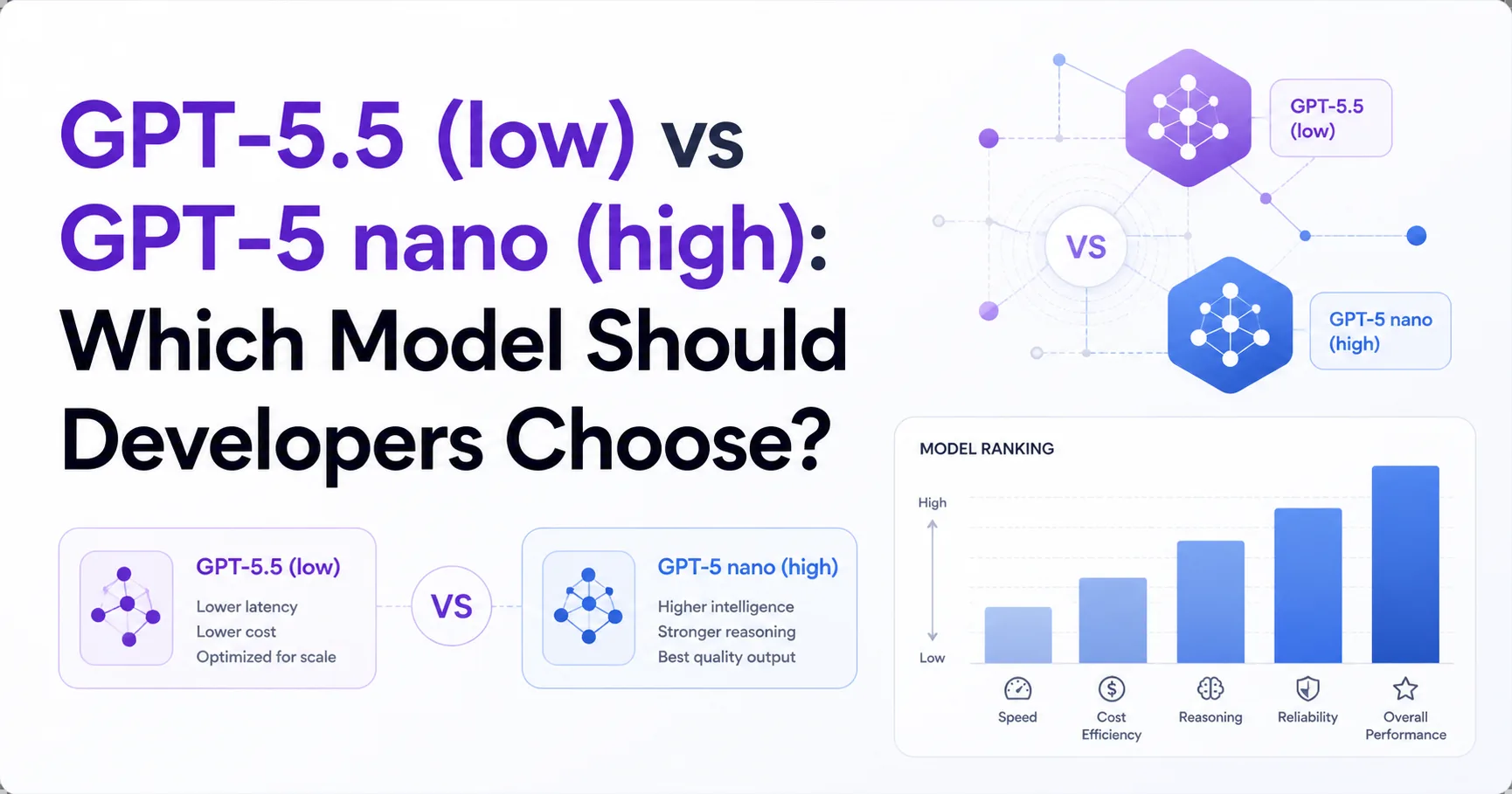
- **Winner overall:** GPT-5.5 (low), with an Artificial Analysis Intelligence Index of 43.5 vs 19.9 - **Cheaper:** GPT-5 nano (high) at $0.1375 vs $11.25 per 1M blended tokens - **Faster:** Tie, with both models at 0.3 seconds latency - **Pick GPT-5 nano (high) when:** low-cost math-oriented workloads can tolerate unclear availability and missing coding evidence - **Watch out:** GPT-5.5 (low) has a 60.9 coding index, but GPT-5 nano (high) has no comparable coding score
GPT-5.5 (low) vs GPT-5 nano (high)
GPT-5.5 (low) is the safer quality choice, while GPT-5 nano (high) is the clear cost choice for narrowly bounded workloads. The comparison data gives GPT-5.5 (low) an Artificial Analysis Intelligence Index of 43.5, compared with 19.9 for GPT-5 nano (high). GPT-5 nano (high) costs $0.1375 per 1M blended tokens, compared with $11.25 for GPT-5.5 (low). Both models have a reported latency of 0.3 seconds.
The practical decision is less settled than the score gap suggests. GPT-5.5 (low) has a reported coding index of 60.9, but GPT-5 nano (high) has no comparable coding score. GPT-5 nano (high) has a math index of 83.7, but GPT-5.5 (low) has no comparable math score. These missing comparisons prevent a complete capability ranking.
Official documentation creates a separate availability risk. OpenAI’s model documentation does not list either exact model name as a clearly documented standalone entry in the supplied research. OpenAI’s pricing documentation lists GPT-5.5 pricing, but does not establish a separate GPT-5.5 (low) alias or price. The same pricing page lists GPT-5.4-nano, not GPT-5 nano. Data provided by https://artificialanalysis.ai/.
Executive summary for developers
GPT-5.5 (low) offers stronger measured general intelligence, while GPT-5 nano (high) offers dramatically lower token cost and a strong measured math result. The intelligence score gap is 23.6 points in favor of GPT-5.5 (low). That result supports GPT-5.5 (low) for mixed tasks involving interpretation, planning, coding, and broader reasoning.
GPT-5 nano (high) is attractive when request volume dominates unit economics. Its blended price is $0.1375 per 1M tokens, and its input and output prices are $0.05 and $0.4 per 1M tokens. GPT-5.5 (low) is priced at $11.25 per 1M blended tokens, with input at $5 and output at $30 per 1M tokens. The price difference is large enough to change architecture decisions, especially for classification, extraction, routing, and other high-volume operations.
The evidence does not prove that GPT-5 nano (high) is faster. Both models have a reported latency of 0.3 seconds, while median output tokens per second are unavailable for each model. The evidence also does not prove that GPT-5 nano (high) is better for coding, because its coding index is missing. Developers should treat the comparison as a measured trade-off between broader intelligence evidence and lower cost, not as a complete benchmark leaderboard.
The official status remains uncertain. OpenAI’s model page describes general model capabilities and API access, but the supplied research does not confirm either exact model as a current standalone catalog entry. OpenAI’s pricing page confirms listed GPT-5.5 prices but does not verify the exact low reasoning alias.
Performance: what the scores mean in real development work
GPT-5.5 (low) is the stronger default for heterogeneous developer tasks because its measured intelligence score is higher and its coding evidence is available. The Artificial Analysis Intelligence Index is 43.5 for GPT-5.5 (low) and 19.9 for GPT-5 nano (high). That gap suggests a meaningful advantage for tasks that combine requirements interpretation, multi-step decisions, code changes, and response quality.
The coding evidence is asymmetric rather than directly comparative. GPT-5.5 (low) records an Artificial Analysis Coding Index of 60.9. GPT-5 nano (high) has no coding index in the supplied data. Therefore, the available evidence supports using GPT-5.5 (low) for coding, but it does not establish the size of its coding advantage.
GPT-5 nano (high) has a measured Artificial Analysis Math Index of 83.7. GPT-5.5 (low) has no math index in the supplied data. This makes GPT-5 nano (high) a credible candidate for math-focused workloads, but the result does not establish broader reasoning quality. A math score cannot substitute for evidence about repository navigation, tool use, code repair, or long-form planning.
Latency does not separate the models in this snapshot. Each reports 0.3 seconds latency. Median output tokens per second are unavailable for each model, so the data cannot answer which model streams longer answers faster. The research also found no reliable community posts that verify coding feel, speed perception, or recurring model quirks. Developers should benchmark their own prompts before treating the measured scores as production behavior.
Cost: when the cheaper model can become the expensive choice
GPT-5 nano (high) is the economic winner by a wide margin, but GPT-5.5 (low) can be cheaper at the system level when quality failures trigger retries or human review. GPT-5 nano (high) costs $0.1375 per 1M blended tokens, compared with $11.25 for GPT-5.5 (low). Its input price is $0.05 per 1M tokens, and its output price is $0.4 per 1M tokens. GPT-5.5 (low) costs $5 for input and $30 for output per 1M tokens.
The price advantage makes GPT-5 nano (high) compelling for workloads with predictable prompts, short answers, and narrow acceptance criteria. Examples include high-volume classification, basic extraction, lightweight scoring, and math-heavy requests where an independent validator can catch errors. The supplied data does not provide context windows, maximum output limits, or exact API parameters, so cost estimates cannot safely assume a particular prompt size or response ceiling.
GPT-5.5 (low) becomes easier to justify when each failure has a high downstream cost. A weak classification can misroute a customer case. An incorrect extraction can corrupt a workflow. A coding error can consume engineering time through debugging and review. The data does not quantify failure rates for either model, so no break-even quality threshold can be calculated from the supplied evidence.
Official pricing adds an operational caveat. OpenAI’s pricing page lists GPT-5.5 prices, but the research says those prices correspond to GPT-5.5 and are not separately confirmed for GPT-5.5 (low). The same page lists GPT-5.4-nano rather than GPT-5 nano. Confirm the exact callable identifier and billing behavior before committing to either model.
Recommendation by workload
GPT-5.5 (low) is the recommended starting point for coding assistants, mixed reasoning agents, and workflows where correctness matters more than token price. Its Intelligence Index is 43.5, and its Coding Index is 60.9. Those are the strongest available signals for broad developer work, even though the research does not provide a direct coding comparison against GPT-5 nano (high).
GPT-5 nano (high) is the recommended starting point for high-volume, cost-sensitive tasks with narrow outputs and independent validation. Its blended price is $0.1375 per 1M tokens, and its Math Index is 83.7. It is especially worth testing for mathematical evaluation, structured checks, routing, and simple transformations. The recommendation depends on confirming that the exact model remains callable, because the supplied OpenAI model documentation does not clearly document GPT-5 nano as a standalone current entry.
Use GPT-5.5 (low) when a single request must interpret ambiguous requirements, choose among tools, modify code, and explain the result. Use GPT-5 nano (high) when the task can be expressed as a constrained contract with clear validation. A staged design can also route simple requests to GPT-5 nano (high) and escalate uncertain cases to GPT-5.5 (low), but the supplied data does not reveal routing accuracy or escalation rates.
Do not select either model solely from the model names or release dates. GPT-5.5 (low) has a data release date of 2026-04-23, while GPT-5 nano (high) has a data release date of 2025-08-07. The official pages do not resolve whether either exact identifier is a stable current API alias. Treat availability, limits, and billing as validation gates before launch.
FAQ before you choose
GPT-5.5 (low) is the better default when the application spans coding, general reasoning, and ambiguous instructions. Its available intelligence and coding evidence is stronger, but the official alias status remains unresolved. OpenAI’s model documentation provides general capability and API information without confirming the exact standalone entry in the supplied research.
Frequently asked questions
Which model is better for coding?
GPT-5.5 (low) is the better-supported coding choice because it has an Artificial Analysis Coding Index of 60.9, while GPT-5 nano (high) has no comparable coding score in the supplied data. The evidence supports GPT-5.5 (low), but it does not quantify the coding gap.
Which model is cheaper for production workloads?
GPT-5 nano (high) is much cheaper at $0.1375 per 1M blended tokens, compared with $11.25 for GPT-5.5 (low). GPT-5.5 (low) may still reduce total system cost when cheaper outputs create more retries, validation work, or human review.
Is GPT-5 nano (high) faster than GPT-5.5 (low)?
Neither model is shown to be faster in this comparison because each has a reported latency of 0.3 seconds. Median output tokens per second are unavailable for both models, so streaming performance remains unverified.
Which model should I use for math?
GPT-5 nano (high) is the stronger math candidate because its Artificial Analysis Math Index is 83.7, while GPT-5.5 (low) has no math score in the supplied data. That result does not establish broader reasoning or coding superiority.
Can I safely assume these exact model names are stable API identifiers?
No. The supplied research does not confirm either exact model as a clearly documented standalone current entry. OpenAI’s model documentation and pricing documentation should be checked before implementation, and exact availability remains evidence-limited.
Sources
- OpenAI ModelsVerifying official model catalog coverage, general capabilities, API access, and the absence of clear standalone documentation for the exact model identifiers.
- OpenAI PricingVerifying listed GPT-5.5 pricing, current nano-model pricing references, billing modes, and the absence of a separately documented GPT-5 nano price.
- Artificial AnalysisAttribution for the comparison snapshot, evaluation scores, latency values, release dates, and pricing data supplied for this article.
Published: