
AI model analysis
GPT-5.5 (low) vs o3: Which OpenAI Model Should Developers Choose?
A developer-focused comparison of GPT-5.5 (low) and o3 across capability signals, speed, cost, availability, and production risk.
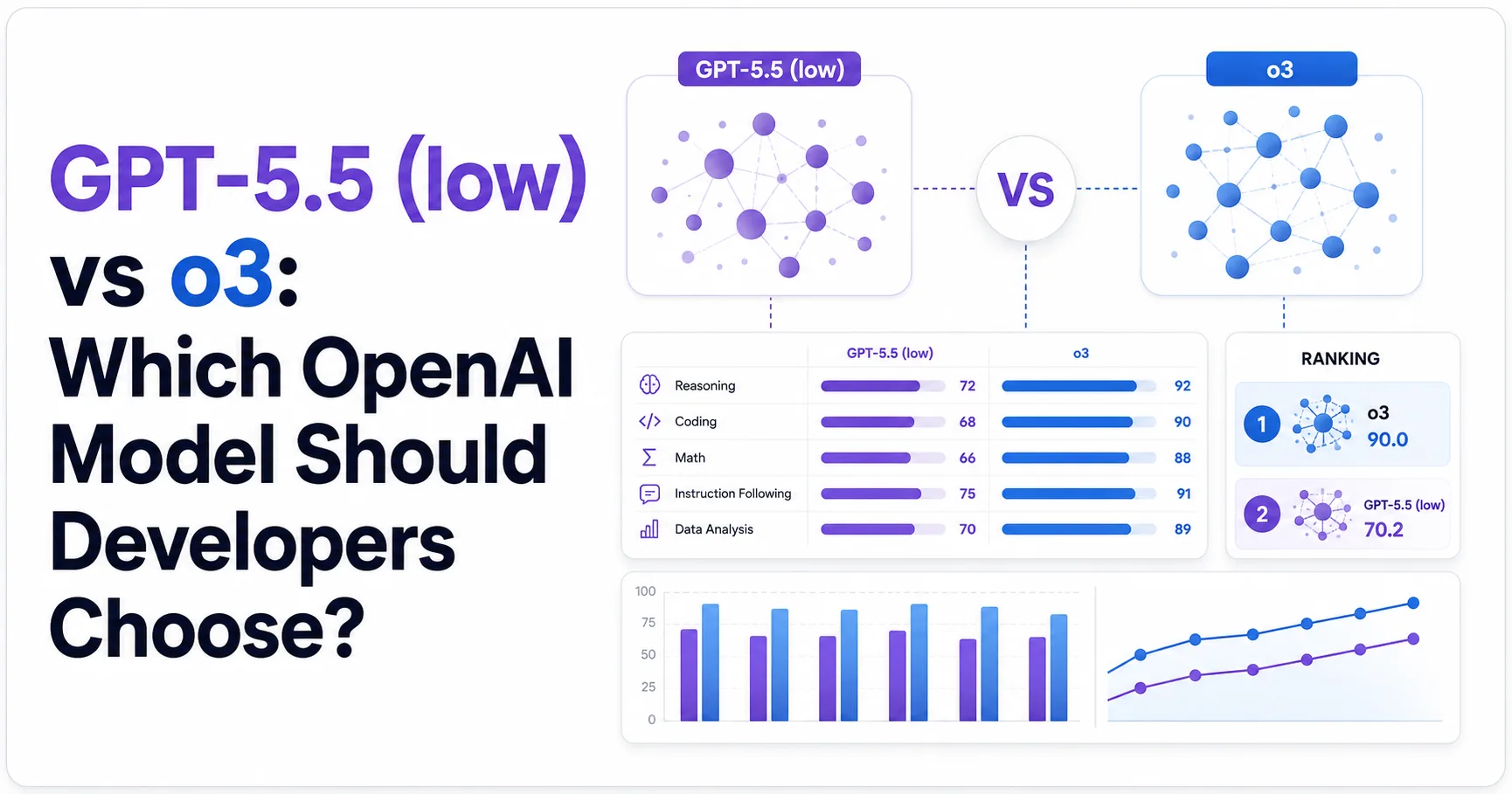
- **Winner overall:** GPT-5.5 (low), with a 43.5 Artificial Analysis Intelligence Index versus o3 at 30.4 - **Cheaper:** o3 at $3.5 vs $11.25 per 1M blended tokens - **Faster:** o3 at 128.056 median output tokens per second, while GPT-5.5 (low) has no reported value - **Pick o3 when:** predictable output speed, lower token cost, or math-heavy workloads matter most - **Watch out:** official documentation does not clearly confirm either model's current standalone API availability or stable alias
GPT-5.5 (low) vs o3
GPT-5.5 (low) is the stronger default for general developer work, but o3 remains the more economical and better-documented performance choice in selected workloads.
The supplied data gives GPT-5.5 (low) a 43.5 Artificial Analysis Intelligence Index and a 60.9 Artificial Analysis Coding Index. o3 records 30.4 on the Intelligence Index and 88.3 on the Artificial Analysis Math Index. These signals do not form a complete head-to-head benchmark because the models are not scored on the same full set of evaluations. The data is provided by Artificial Analysis.
The practical decision is therefore conditional. GPT-5.5 (low) has the broader available capability signal for general reasoning and coding, while o3 has a strong math signal, a reported output speed of 128.056 median output tokens per second, and a lower blended price of $3.5 per 1M tokens. GPT-5.5 (low) is listed at $11.25 per 1M blended tokens.
Availability creates a separate risk. OpenAI’s model documentation does not list GPT-5.5 (low) or o3 as standalone current entries in the supplied research. OpenAI’s pricing documentation lists GPT-5.5 pricing, but not a dedicated GPT-5.5 (low) billing entry or an o3 price. Developers should verify the exact model identifier before committing to either integration.
Executive summary
GPT-5.5 (low) offers the better general-purpose profile, while o3 offers the clearer cost and math advantage.
GPT-5.5 (low) leads the available general intelligence signal, scoring 43.5 versus o3 at 30.4 in the supplied Artificial Analysis data. It also has the only reported coding index in this comparison, at 60.9. That result should not be treated as a direct coding win because the supplied data does not provide an o3 coding score. The comparison is incomplete by design, not because a missing value can be inferred. Data provided by Artificial Analysis.
o3 has the only reported math score, 88.3, so math-oriented developers have a meaningful positive signal for o3 but no matched GPT-5.5 (low) result. o3 also has a reported median output speed of 128.056 tokens per second. GPT-5.5 (low) has no reported output-speed value, so the data cannot prove that o3 is faster overall. Both models show latency of 0.3 seconds in the supplied snapshot.
Cost is the clearest separation. o3 costs $3.5 per 1M blended tokens, compared with $11.25 for GPT-5.5 (low). Its listed input and output prices are $2 and $8, versus $5 and $30 for GPT-5.5 (low). That difference can dominate total operating cost in high-volume applications, especially when outputs are long.
The official documentation adds uncertainty rather than resolving it. OpenAI’s model page currently emphasizes newer model entries and does not clearly establish either candidate’s standalone status in the supplied material.
Performance and developer workflow
GPT-5.5 (low) is the better first candidate for mixed reasoning and coding workflows, but o3 has the stronger visible signal for mathematics and response throughput.
A general developer assistant rarely performs one task repeatedly. It may inspect a repository, explain an unfamiliar function, propose a change, write code, and reason through edge cases in the same session. GPT-5.5 (low) has an Artificial Analysis Intelligence Index of 43.5 and a coding index of 60.9. Those values suggest a useful broad-workflow candidate, although the missing o3 coding score prevents a direct coding comparison. The data is provided by Artificial Analysis.
o3 is more attractive when the workload has a strong mathematical or structured-reasoning component. Its math index is 88.3, but GPT-5.5 (low) has no corresponding math value in the supplied data. That asymmetry matters: o3 may be the better specialist for mathematical tasks, yet the evidence does not establish that it is better at debugging, repository navigation, or code generation.
Streaming applications also need careful interpretation. o3 has a reported median output speed of 128.056 tokens per second, while GPT-5.5 (low) has no reported value. This supports choosing o3 when observed token throughput is a hard requirement. It does not prove lower end-to-end latency, because both models have a reported latency of 0.3 seconds and real response time also depends on prompt size, output length, queueing, and tool calls.
The missing context-window, output-limit, parameter, and failure-mode details for both models are evidence gaps. Developers should treat task-specific evaluation as necessary before selecting a default.
Cost and total ownership
o3 is the clear price leader, but GPT-5.5 (low) can still be cheaper overall if its broader capability reduces retries, routing, or human correction.
The supplied blended price is $3.5 per 1M tokens for o3 and $11.25 for GPT-5.5 (low). Input pricing is $2 for o3 and $5 for GPT-5.5 (low). Output pricing is $8 for o3 and $30 for GPT-5.5 (low). These figures make o3 the natural choice for large-volume generation, classification, extraction, and other workloads where quality requirements are already satisfied. Data provided by Artificial Analysis.
Token price is not the same as application cost. A cheaper model becomes more expensive when it needs repeated retries, produces unusable patches, calls tools incorrectly, or requires substantial post-processing. The supplied data does not measure any of those outcomes. It also does not provide matched coding scores, matched math scores, context limits, or failure rates. No defensible break-even point can therefore be calculated from the brief alone.
Output-heavy workloads deserve extra scrutiny. The output price is $8 per 1M tokens for o3 and $30 for GPT-5.5 (low), so verbose agent traces, generated code, and long explanations can amplify the difference. Prompt-heavy workloads still favor o3 on listed input pricing, but caching, context length, and request patterns may change the result.
OpenAI’s pricing page lists GPT-5.5 pricing modes, including standard, Batch, Flex, and Fast mode, but the supplied research does not confirm that those entries apply to the standalone GPT-5.5 (low) identifier. It also does not list o3 pricing. The Artificial Analysis snapshot and official billing page therefore describe different availability surfaces, which should be verified before forecasting spend.
Recommendation by workload
GPT-5.5 (low) is the best provisional default for broad developer assistance, while o3 is the better targeted choice for cost-sensitive or math-heavy systems.
Choose GPT-5.5 (low) when one model must cover coding, general reasoning, repository questions, and mixed technical conversations. The available data gives it a 43.5 Intelligence Index and a 60.9 Coding Index. Those are useful directional signals, not a complete proof of superiority, because o3 lacks a corresponding coding value in the supplied snapshot. Data provided by Artificial Analysis.
Choose o3 when the application rewards mathematical reasoning, high reported output throughput, or low token cost. Its math index is 88.3, its reported median output speed is 128.056 tokens per second, and its blended price is $3.5 per 1M tokens. Those advantages are compelling for batch analysis, mathematical assistance, and high-volume workflows, provided task quality meets the product requirement.
Use a routing strategy only if evaluation justifies the added complexity. A simple first test can compare representative prompts across coding, mathematics, tool use, long-context behavior, and correction rate. The supplied brief lacks matched evidence for several of these categories, so routing rules should come from measured application outcomes rather than model reputation.
Availability must be part of the decision. OpenAI’s model documentation does not clearly confirm a stable standalone entry for GPT-5.5 (low) or o3 in the supplied material. OpenAI’s pricing documentation also does not provide a dedicated current o3 price. A model that cannot be reliably addressed, billed, or supported is not a production choice, regardless of benchmark appeal.
Questions to answer before adoption
o3 is the safer low-cost experiment, while GPT-5.5 (low) is the broader capability hypothesis that needs direct availability verification.
The evidence supports a staged decision. Start by confirming the exact API identifier, then test representative developer tasks, then compare quality-adjusted cost. The supplied materials do not establish stable aliases, context windows, output limits, or dedicated failure patterns for either model. OpenAI’s model page and OpenAI’s pricing page should be checked again before implementation. The numerical comparison comes from Artificial Analysis.
Frequently asked questions
Is GPT-5.5 (low) better than o3 for coding?
GPT-5.5 (low) is the stronger provisional coding candidate because the supplied data reports a 60.9 Coding Index, but o3 has no matching coding score, so a direct coding winner cannot be established.
Is o3 cheaper than GPT-5.5 (low)?
o3 is cheaper on every listed token price in the supplied snapshot, costing $3.5 per 1M blended tokens versus $11.25 for GPT-5.5 (low), with lower input and output rates as well.
Is o3 faster than GPT-5.5 (low)?
o3 has the only reported output-speed value, 128.056 median output tokens per second, while both models show latency of 0.3 seconds, so overall speed superiority remains unproven.
Which model should a developer choose for mathematics?
o3 is the better-supported mathematics choice because it has an 88.3 Artificial Analysis Math Index, while GPT-5.5 (low) has no corresponding math value in the supplied data.
Can developers safely deploy either model today?
Neither model can be declared deployment-safe from the supplied documentation alone, because stable aliases, current standalone availability, context limits, and dedicated failure modes are not clearly confirmed for both candidates.
Sources
- Artificial AnalysisAll benchmark, speed, latency, release-date, and pricing values supplied in the data brief.
- OpenAI ModelsOfficial model visibility, general capability documentation, current product positioning, and availability evidence.
- OpenAI PricingOfficial pricing entries, billing modes, and evidence about model-specific pricing availability.
Published: