
AI model analysis
GPT-5.5 (xhigh) vs GPT-5 mini (high): Which Model Should Developers Choose?
A developer-focused comparison of GPT-5.5 (xhigh) and GPT-5 mini (high), covering coding quality, latency, pricing, model availability, and selection risks.
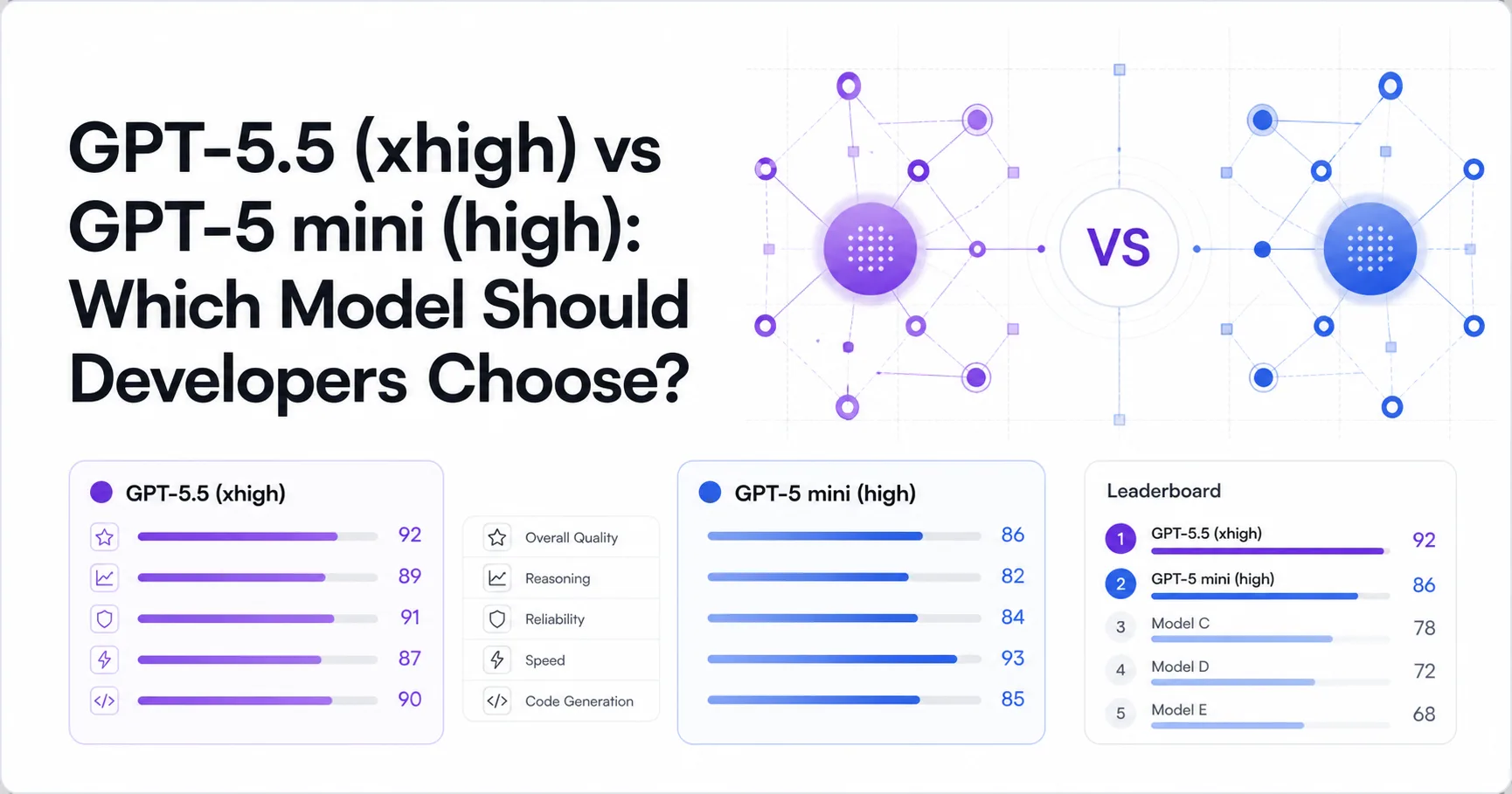
- **Winner overall:** GPT-5.5 (xhigh), with an Artificial Analysis Coding Index of 74.9 versus 15.6 - **Cheaper:** GPT-5 mini (high) at $0.6875 vs $11.25 per 1M blended tokens - **Faster:** Tie, with both models at 0.3 seconds median latency - **Pick GPT-5 mini (high) when:** low cost matters more than documented coding capability, and you can validate the model yourself - **Watch out:** GPT-5 mini (high) lacks current official documentation for its model ID, pricing, limits, and supported tools Data provided by https://artificialanalysis.ai/
GPT-5.5 is the safer default for serious development work
GPT-5.5 (xhigh) is the stronger and better-documented choice for developers who need reliable coding, planning, and tool-oriented execution.
The comparison data gives GPT-5.5 (xhigh) an Artificial Analysis Coding Index of 74.9, compared with 15.6 for GPT-5 mini (high), while the Artificial Analysis Intelligence Index is 54.8 versus 25.3. Artificial Analysis provides the underlying comparison data.
GPT-5.5 is also the model with a current dedicated API page, a stable model ID, a documented snapshot, supported APIs, tool support, context limits, and pricing. The GPT-5.5 model documentation identifies gpt-5.5 as the model ID and describes its current API surface.
GPT-5 mini (high) is far cheaper, and its comparison data includes a Math Index of 90.7. However, OpenAI’s current model directory does not list gpt-5-mini as an independent current model entry. That makes the low-cost option attractive for experiments, but risky as an assumed production dependency.
The decision is a trade between documented capability and extreme cost efficiency
GPT-5.5 (xhigh) offers the stronger documented engineering profile, while GPT-5 mini (high) offers a dramatically lower token price with insufficient current product evidence.
| Decision factor | GPT-5.5 (xhigh) | GPT-5 mini (high) |
|---|---|---|
| Coding comparison | Artificial Analysis Coding Index: 74.9 | Artificial Analysis Coding Index: 15.6 |
| General intelligence comparison | Artificial Analysis Intelligence Index: 54.8 | Artificial Analysis Intelligence Index: 25.3 |
| Math comparison | No value in the data brief | Artificial Analysis Math Index: 90.7 |
| Blended price per 1M tokens | $11.25 | $0.6875 |
| Median latency | 0.3 seconds | 0.3 seconds |
| Current official model listing | Dedicated model documentation exists | No independent current directory entry found |
OpenAI’s GPT-5.5 documentation describes support for text and image input, structured output, function calling, file search, web search, prompt caching, and several execution tools. OpenAI’s model guide positions GPT-5.5 for complex professional work, coding agents, long-context retrieval, and product specifications that must become implementation plans.
The mini model cannot be compared on the same documented dimensions. OpenAI’s model directory does not provide a dedicated entry for GPT-5 mini (high), and the current pricing page does not list its prices. The data brief supplies price and evaluation values, but it does not establish whether the model remains directly callable, which API identifier should be used, or which tools it supports.
That gap changes the procurement question. GPT-5.5 can be evaluated as a documented platform choice. GPT-5 mini (high) must first be treated as an availability hypothesis.
GPT-5.5's coding advantage matters most when errors create downstream work
GPT-5.5 (xhigh) is the better performance choice for repository-scale coding, architectural reasoning, and tool-heavy workflows where a weak first attempt creates expensive repair work.
The comparison chart shows a large coding separation, but the practical meaning is more important than the score itself. A higher coding result can matter when the model must understand an existing repository, preserve interfaces, choose an implementation path, and validate changes across several related files. OpenAI’s GPT-5.5 announcement reports strong results across coding, software engineering, computer use, browsing, and tool-oriented evaluations, although some reported evaluations are internal.
The qualitative evidence points in the same direction, but it is not a controlled user benchmark. Developers in one r/AIcodingProfessionals discussion describe GPT-5.5 as useful for architecture, debugging direction, code review, planning, and long project sessions. A separate r/codex discussion reports successful large refactors for some users, while other users describe answers as too brief, overly abstract, or vulnerable to fragile implementation choices.
The evidence is insufficient to claim that GPT-5.5 is universally faster or more accurate in production. The data brief reports identical median latency of 0.3 seconds for the two models, but it does not provide output throughput values for either model. It also does not provide an independent, reproducible coding test for GPT-5 mini (high). Developers should therefore interpret GPT-5.5’s advantage as a stronger capability signal, not a guarantee of lower end-to-end task time.
GPT-5 mini is cheaper enough to change the architecture, not just the bill
GPT-5 mini (high) is the cost winner by a wide margin, but its apparent savings can disappear if undocumented availability forces fallback logic or additional validation.
The blended comparison price is $0.6875 for GPT-5 mini (high) and $11.25 for GPT-5.5 (xhigh). Input pricing is $0.25 versus $5, and output pricing is $2 versus $30 per 1M tokens. Artificial Analysis supplies these comparison values. The gap is large enough to support different routing strategies, such as using the cheaper model for routine transformations and reserving GPT-5.5 for tasks where failure has a higher operational cost.
The cheaper model is not automatically cheaper for a complete workflow. A low-priced model can require more retries, stricter validation, human review, or a second model pass when it produces weak code or misses domain constraints. The available materials do not quantify retry rates, review time, token usage per completed task, or production failure costs. Any claim about total cost of ownership therefore remains unproven.
GPT-5.5 also has pricing conditions that matter for long-context systems. The official pricing documentation states that sessions exceeding 272K tokens receive higher input and output multipliers under the listed modes. The GPT-5.5 model page documents the same long-context pricing condition. Developers building repository analysis or large-document workflows should model those thresholds before assuming the blended price represents every request.
Batch and Flex pricing may improve GPT-5.5 economics for workloads that tolerate delayed processing, but the supplied evidence does not establish an equivalent current pricing path for GPT-5 mini (high).
Choose GPT-5.5 for production engineering and GPT-5 mini only after direct validation
GPT-5.5 (xhigh) should be the production default for high-impact engineering workflows, while GPT-5 mini (high) should be considered only after its identity and availability are verified.
Choose GPT-5.5 when the model must plan changes across a repository, use tools, interpret a product specification, review implementation quality, or operate under explicit acceptance criteria. OpenAI’s model guide recommends specifying reuse requirements, delegated subtasks, testing expectations, acceptance standards, and stopping conditions for coding agents. That guidance implies an important operational boundary: GPT-5.5 is capable, but it still needs deliberate orchestration.
Choose GPT-5 mini (high) for low-risk workloads only when the price advantage is the main requirement and the task can tolerate local testing. Suitable candidates may include simple classification, lightweight transformations, or disposable prototypes, but the supplied materials do not provide verified evidence for its supported tools, context window, output limit, or production stability. OpenAI’s current pricing page and model directory do not list it as a current dedicated entry.
A sensible rollout is to test both models against the same repository tasks, acceptance checks, retry policy, and output budget. The comparison data already shows that GPT-5 mini (high) has a Math Index of 90.7, so developers should avoid assuming that its weaker coding comparison means weak performance for every technical task. The evidence is insufficient to identify where that mathematical strength transfers to a real application.
The final recommendation is conditional. GPT-5.5 is the safer choice when failure costs time or trust. GPT-5 mini (high) is the more interesting choice when cost dominates and the team can prove that the referenced model is callable and adequate.
Questions to resolve before standardizing either model
GPT-5.5 (xhigh) has clearer production evidence, but developers still need task-specific validation before making a platform-wide decision.
The largest unresolved issue concerns GPT-5 mini (high), not its price or comparison scores. The supplied materials do not establish a current stable API identifier, official availability, supported tools, context limit, output limit, or reproducible community benchmark. OpenAI’s model directory and OpenAI’s pricing page are the relevant official references for resolving that uncertainty.
The second unresolved issue is workflow economics. The materials provide token prices and latency, but not completed-task cost, retry frequency, review burden, or failure severity. Those missing measurements can reverse the apparent cost decision for complex coding work.
The FAQ below focuses on those selection questions rather than repeating the comparison chart.
Frequently asked questions
Is GPT-5.5 (xhigh) the better model for coding?
Yes, GPT-5.5 (xhigh) is the stronger documented coding choice because its Artificial Analysis Coding Index is 74.9 versus 15.6 for GPT-5 mini (high), and official materials describe coding-agent and tool-oriented use cases.
Should developers use GPT-5 mini (high) because it is much cheaper?
Developers should use GPT-5 mini (high) only after verifying its current API availability and testing task quality, because its $0.6875 blended price does not prove lower total workflow cost.
Which model is faster?
Neither model is faster in the supplied comparison: GPT-5.5 (xhigh) and GPT-5 mini (high) both show 0.3 seconds median latency, while output throughput data is unavailable for both models.
Does GPT-5 mini (high) have a useful technical advantage?
GPT-5 mini (high) has an Artificial Analysis Math Index of 90.7, but the available materials do not establish how that result transfers to software engineering, domain reasoning, or production application tasks.
Is GPT-5.5 (xhigh) safe to use without strict orchestration?
No, GPT-5.5 (xhigh) still benefits from explicit reuse rules, testing expectations, acceptance criteria, and stopping conditions because official guidance warns that open-ended tool access can cause unnecessary search, delay, cost, or quality regression.
Sources
- Artificial AnalysisComparison data for pricing, latency, and evaluation indexes.
- GPT-5.5 Model DocumentationGPT-5.5 model ID, snapshot, context and output limits, modalities, APIs, tools, and long-context pricing conditions.
- Using GPT-5.5GPT-5.5 positioning, reasoning effort guidance, coding-agent orchestration, style behavior, and known limitations.
- OpenAI ModelsCurrent model directory and the absence of an independent current GPT-5 mini entry.
- OpenAI API PricingCurrent listed model pricing and GPT-5.5 Standard, Batch, Flex, Fast mode, and long-context pricing conditions.
- Introducing GPT-5.5GPT-5.5 release timing and official benchmark results.
- Codex GPT-5.5 + cheap coding models is honestly the best workflow I've used so farUncontrolled community reports about architecture, debugging, code review, planning, and long coding sessions.
- What types of users are getting good results from GPT 5.5?Conflicting community reports about refactoring, response style, domain modeling, code quality, and orchestration needs.
Published: